







'Preventable lapse' by service provider caused 9.5-hour public healthcare IT outage on Oct 13: Tan Kiat How
The senior minister of state for health apologised for the Oct 13 disruption, saying it "should not have happened". The outage forced about 4,000 outpatient appointments to be rescheduled.
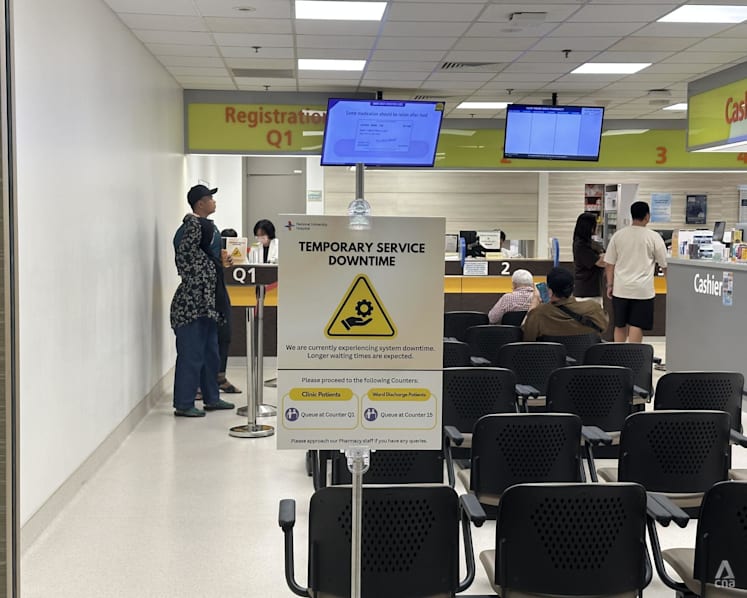
NUH is among public hospitals and healthcare institutions across Singapore hit by system disruptions on Oct 13, 2026. (Photo: CNA/Nikki Yeo)

This audio is generated by an AI tool.


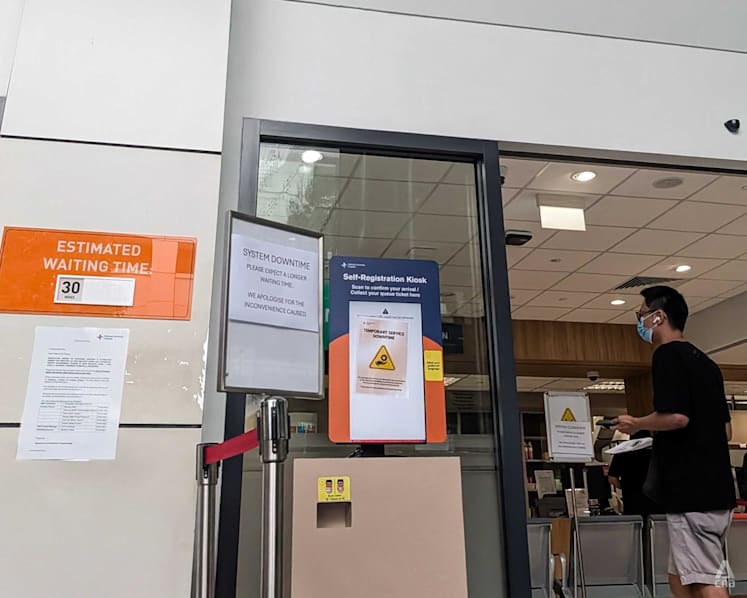
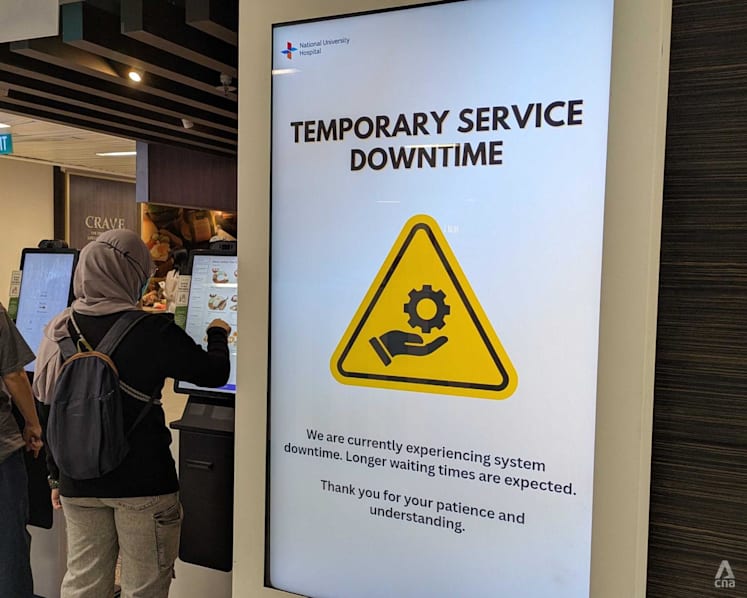
SINGAPORE: A "preventable" lapse by a contracted service provider to complete a required security update led to the nine-and-a-half hour disruption to services across Singapore's public healthcare clusters on Oct 13, Senior Minister of State for Health Tan Kiat How told parliament on Tuesday (Nov 3).
About 4,000 outpatient appointments were rescheduled, and some patients experienced delays of up to two hours, Mr Tan said. "No adverse patient safety incidents were attributed to the disruption in this case."
The disruption impacted services across all three public healthcare clusters - NHG Health, the National University Health System (NUHS) and SingHealth.
Services affected included appointment bookings, visitor registration, medication dispensing and billing.





Healthcare institutions activated downtime procedures, with additional staff supporting operations and clinicians using selected read-only patient records and manual workflows to continue essential care, Mr Tan said.
National health technology agency Synapxe had contracted a service provider to manage the necessary update, but it was not carried out, Mr Tan said.
"Synapxe is reviewing the provider's contractual obligations and will take appropriate action for any established lapses. Regardless of the outsourcing arrangement, Synapxe remains accountable for the resilience of its critical systems."
Mr Tan said the public healthcare systems have backup infrastructure, including two data centres, but both depended on the same underlying Domain Name System (DNS) service and security configuration.
"Switching between them would therefore not have resolved this particular disruption," he added. "Synapxe will review such shared dependencies and strengthen alternative recovery arrangements."
The required security update to a shared DNS was not completed before a scheduled global change, Mr Tan said, likening the DNS to an internet address book that helps systems locate and connect to applications. "This was a known change and a preventable lapse."
The disruption on Oct 13 caused inconvenience and concern to patients and their families, and created additional work for healthcare workers, he noted. "We apologise. It should not have happened."
The investigation found that this was not a cyberattack, and there was no unauthorised access to, compromise or loss of patient data, Mr Tan added.
Noting the duration of the disruption, he said monitoring detected abnormal activity, but it took time to identify the underlying problem and restore services safely. Synapxe is strengthening monitoring and fault diagnosis to enable faster recovery.
EXPERT PANEL
Mr Tan said the government is strengthening resilience in three areas.
These include prevention, by improving the tracking and verification of critical technical changes, and containment, by addressing shared dependencies and improving recovery arrangements. The third area involves continuity of care, by improving downtime systems, staff readiness and regular exercises, including for partial outages.
"MOH will oversee the corrective actions and verify that they are effective," said Mr Tan.
Synapxe has appointed an expert panel comprising representatives from other organisations that have similar engineering profiles to review the investigation findings and proposed remediation measures and identify further improvements.
"Digitalisation brings important benefits to healthcare. But as our systems become more interconnected, resilience must improve too," said Mr Tan.
"We must make our technology more reliable, while ensuring healthcare workers can continue caring for patients safely even when technology fails."
DECENTRALISING IT SYSTEM?
Several MPs had filed questions about the disruption, asking how many patients were affected, whether backup systems were in place and why critical healthcare infrastructure lacked real-time redundancy to prevent operational disruption.
In a supplementary question, MP Yip Hon Weng (PAP-Yio Chu Kang SMC) asked what the incident had taught about the common points of failure across Singapore's healthcare system, and whether the Ministry of Health still assesses that there is no material concentration risk.
He noted that the ministry had said weeks before the outage that Synapxe, as the public healthcare system's corporate IT function, "should not be regarded as presenting concentration risks".
Mr Tan responded that MOH is mindful of any concentration risk and dependencies but stressed that all three public healthcare clusters use the same global DNS service, which would thus result in the same dependencies.
"In actual fact, for this disruption, decentralising the healthcare IT systems would therefore not necessarily have prevented the disruption. It could have made the diagnosis and recovery much more difficult," said Mr Tan.
MP Poh Li San (PAP-Sembawang West SMC) asked if staff at healthcare institutions are trained to promptly switch to manual systems during such disruptions, and if there are plans to decentralise healthcare IT services to individual public healthcare clusters.
To this, Mr Tan noted that healthcare professionals used manual procedures and established workarounds even though they were unable to have timely access to the IT systems.
"These backup plans, downtime procedures were activated and worked as planned, and this is a result of the clusters and healthcare providers doing the exercises on a regular basis," he said.
He added that the ministry will continue to look at building up redundancy and resilience efforts, and having an approach where there are common platforms provided by Synapxe to support the healthcare clusters as well as systems for healthcare professionals to use.




