

How air pollution affects workplace behaviour
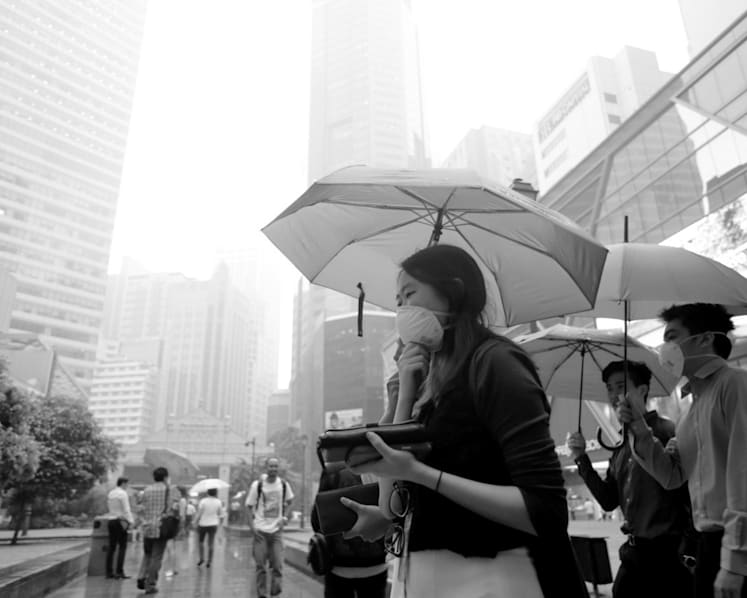
The study found that the negative effects of air pollution were mitigated when organisational support was high, for instance, when an employee’s supervisor was concerned about his staff’s health. Photo: Reuters
Much has been said about the transboundary haze, which has brought with it complaints of sore throats, itchy eyes and government warnings to stay indoors.
Worse, recent data from the World Health Organization suggests that air pollution accounts for 3.7 million premature deaths annually around the world. The health effects of air pollution are apparent, but what is less known is the psychological effect it has on our behaviour, and consequently our job performance.
Such psychological effects, too, exact a cost, one that is rarely factored in when assessing pollution’s true economic impact.
In a study conducted over October and November last year, a team of researchers and I from various universities examined the effect of air pollution on workplace behaviour in the city of Wuhan in central China — a country infamous for having some of the most dangerously polluted urban environments in the world.





In China, the sources of pollution are of course rather different. Nonetheless, as the haze is made up of similar particles and the methods for measuring pollutants too are similar, we can reasonably assume that here in Singapore, it has comparable effects.
EGO DEPLETION
In our study, we focused on a behavioural theory known as ego depletion — the idea that an individual’s self-control draws upon a limited pool of mental resources which can be used up and needs opportunities to restore.
Such mental resources, or the ability to hold oneself together, can be affected when air pollution changes physical levels of oxygen and glucose in the blood, or when it causes psychological conditions such as insomnia, anxiety or even depression.
In particular, our research examined how pollution affected “organisational citizenship behaviour”, and “counterproductive workplace behaviour” through a daily diary-based study of employees.
The first behaviour — organisational citizenship — relates to how an employee might contribute towards the functioning of the firm, beyond the call of duty. This could include the willingness to help others, to engage with one’s team beyond his job scope, or to initiate action that protects or improves the firm’s image.
“Counterproductive behaviour” is the flipside of this and includes a range of deviances such as dealing with personal matters during work hours, as well as rudeness, hostility or even outright bullying of colleagues.
To test our hypotheses, we followed 161 full-time employees across different industries over two weeks.
In their daily diary entries, our participants rated their perceptions of pollution levels, their levels of mental resources, as well as organisational citizenship and counterproductive workplace behaviours.
And we found a clear link between high levels of air pollution and decreased levels of organisational citizenship behaviour. Likewise, the worse the pollution, the more we saw counterproductive workplace behaviour.
In other words, by reducing mental resources and thus self control, air pollution resulted in more deviance at work and made staff less giving or engaged.
Interestingly, using a formula that rated all the participants’ responses, we found that they reported a reduction of 10 per cent, on average, in such resources.
Of course, how such negative effects manifest themselves can vary considerably between individuals.
A worker may experience little or no health problems while another in the same office may suffer badly from pollution. Likewise, one’s perception of what constitutes “severe” pollution may be very different from another.
ORGANISATIONAL SUPPORT CAN HELP MITIGATE EFFECTS
However, a key factor in determining how employees react when their resources are drained is the support they receive — or feel they receive — from those around them.
We found that the negative effects of air pollution were mitigated when organisational support was high, for instance, when an employee’s supervisor was concerned about his staff’s health on hazy days.
During our study, we also came across firms taking active steps to tackle the immediate effects of pollution, such as installing more effective air filters in their offices.
Such demonstrations of support can go some way to increase or replenish an employee’s mental resources.
Supportive firms could provide additional work breaks or the option to work from home when the air is bad, or they may provide easier and better access to healthcare.
Of course, while this favours an argument that firms must do all that they can to support employees exposed to severe air pollution, all of this comes at a cost.
The worse the pollution gets, the more the costs multiply for business — so at a broader level, the best option would obviously be if there were no pollution at all.
But understanding the impact of air pollution on employee behaviour is an important part of measuring its detrimental effects and financial costs — at the company and national level. Our study adds weight to the financial argument for stronger and more effective policies to tackle pollution at source.
ABOUT THE AUTHOR:
Sam Yam is Assistant Professor of Management & Organisation at the National University of Singapore Business School.




