How mid-sized powers can band together to solve big problems
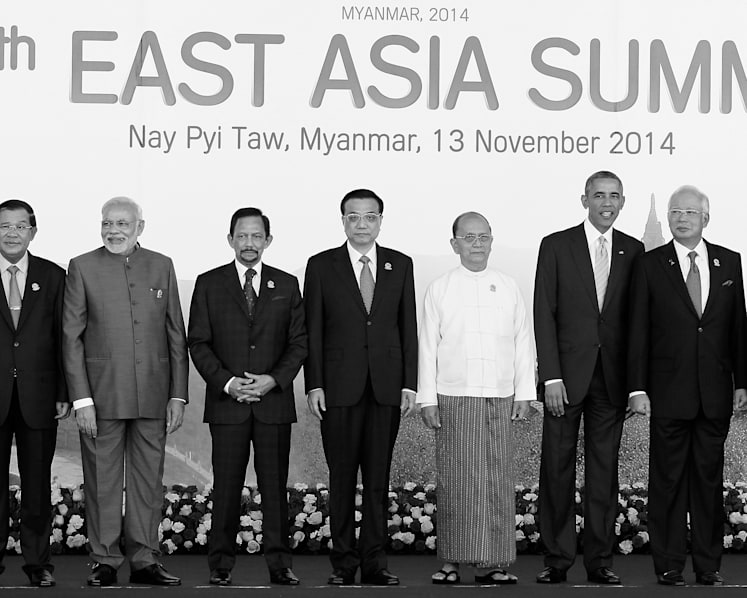
Leaders posing for a photo at the East Asia Summit in Myanmar last year. The summit has the potential to be the most significant grouping, because it involves all key regional players and can address both geopolitical and economic issues. Photo: Reuters
Leadership is one of those things about which it is sometimes wise to be careful what you wish for.
In the context of Asia-Pacific security, there has been far too much preoccupation with who is — and will be in the future — the top dog on the block; and far too little with building the kind of cooperative and collaborative arrangements that will make the region safe and comfortable for all its inhabitants — no matter who has, and for how long, the biggest gross domestic product, the strongest military, the most allies and partners or the most evidently effective soft power.
The unwillingness of American leaders and presidential aspirants to speak publicly in terms other than the need to maintain “dominance”, “leadership”, “primacy” or “pre-eminence” both globally and in the region, has its own self-fulfilling momentum and inevitably generates the kind of chest-beating pushback we are seeing from Beijing in the South China Sea.
Neither side is remotely attracted to settling the issue of who is No 1 by armed conflict, but one does not have to accept the inevitability of what some United States scholars are breathlessly calling the Thucydides Trap to acknowledge that events can all too easily career out of control when nationalist emotion starts overriding rational calculation.





These considerations have long motivated regional policymakers who have wanted to shift the focus away from bilateral competition to cooperative security through multilateral institution building.
All those efforts have so far been disappointing or incomplete, but the arguments for pursuing them remain compelling.
And the most useful kind of leadership we can hope for in the years ahead will be from those states — perhaps more likely to be the region’s middle powers than its great ones — that have the vision, energy and stamina to realise the dream of common security: Finding our security with others rather than against them.
MULTI-PARTY MEETINGS
From the late 1980s, we have seen the evolution of a number of regional mechanisms of varying degrees of formality and effectiveness. The Asia-Pacific Economic Cooperation (APEC), initiated in 1989 with annual leaders’ meetings institutionalised from 1993, remains a largely economic dialogue and policy organisation.
However, security issues have regularly been discussed in its margins, nowhere more importantly than at the New Zealand meeting in 1999, which mobilised a response to the explosive situation in East Timor.
The Association of Southeast Asian Nations (ASEAN) Regional Forum (ARF) — a meeting since 1994 at the foreign-minister level and now with 27 members — was intended to evolve through three phases over time, starting with confidence-building measures, moving to more explicit conflict-prevention roles and ultimately conflict management and resolution.
It has done some useful work on initiating discussion on a code of conduct for the South China Sea and developing cooperative disaster-relief capability. There has also been some useful regular dialogue on issues such as counterterrorism and transnational crime, maritime security and non-proliferation and disarmament.
Nonetheless, it would be fair to say that ARF is still largely stuck in the first groove — dialogue about confidence building — rather than living up to the hopes that by now, it would be doing something more substantial.
The East Asia Summit (EAS) was initiated in 2005, involving meetings at the leaders’ level. It grew out of the ASEAN+3 grouping, adding another three (India, Australia and New Zealand) and, since last year, embracing the US and Russia as well.
Although nothing very substantive has yet emerged from the EAS, it has the potential to be the most significant grouping, because it not only has all the key regional players around the table, but also (unlike ARF) meets at the highest level and (unlike APEC) can address both geopolitical and economic issues.
The impulse for all these institutions and processes has been recognition to some extent that multilateral approaches are necessary in addressing security and related issues. There are certainly a number of good reasons for that approach.
MULTILATERALISM OVER UNILATERALISM
Many contemporary problems in Asia and elsewhere are simply beyond the capacity of single countries, however powerful, to resolve unilaterally. These include terrorism, maritime security, arms control, drug and people trafficking, climate change, health pandemics, refugee management and some major trade and financial imbalances — and all need cooperative and collective action.
Global responses may be optimal, but problems that are primarily regional in scope and character are likely to be better dealt with at that level, given limitations of time, attention, commitment and resources at the global level.
Collective action beats unilateral action almost every time. Unilaterally volunteered actions can make an important contribution to problem solving; but unilaterally imposed solutions, even if possible, generate resentment and stress, are inherently more fragile than those cooperatively agreed on, and are very susceptible to changes in underlying power balances.
And multilateral action beats bilateral action most of the time. Some problems may appear to be capable of bilateral resolution, but are much better resolved in more multilateral frameworks — for example, free-trade pacts as well as arms-control and disarmament agreements.
Finally, regular meetings among regional leaders, in group and bilateral settings, help build close and confident personal relationships, which make shocks less likely, peaceful accommodation to new power realities more manageable and stability more sustainable.
Of course, in all of this, there is a need to be less preoccupied in the future with issues of form (who sits around which table when) and much more focused on issues of substance: What exactly leaders and their ministers will talk about and what practical outcomes can emerge from their discussions that are capable of real-world delivery.
We need real dialogue and real policy cooperation, not just another expensive series of photo opportunities with set-piece speeches endorsing pre-cooked lowest-common-denominator communiques.
Improved regional architecture is not an end in itself — all the effort will be worthwhile only if it actually enhances stability, prosperity, state security and human security.
It remains my firm belief, based on my experience as Australia’s Foreign Minister from 1988 to 1996, working closely with Indonesia in the development of the United Nations peace plan for Cambodia — as complex a conflict-resolution issue as the region is ever likely to face — and with ASEAN and other colleagues in building the initial APEC and ARF architecture, that the more energetic and creative of the region’s middle powers may be the most productive players in generating the new generation of cooperative mechanisms required.
The characteristic method of middle-power diplomacy is coalition building with like-minded countries, and its characteristic motivation is what I have long described as “good international citizenship”.
This is a belief in the utility and necessity of acting cooperatively with others in solving international problems, particularly those that by their nature cannot be solved by any country acting alone, however big and powerful. Recognising that being — and being seen to be — a good international citizen is at least as central a component of any country’s national interests as the traditional duo of geostrategic security and economic prosperity.
There is plenty of scope for middle-power diplomacy in the Asia-Pacific to advance regional security objectives. The biggest dogs on the block will not always be receptive to the smaller ones nipping at their heels.
But, remembering the way the Permanent Five were roped in to engagement on Cambodia by the Australia–Indonesia initiative and how the initially reluctant US, Russia and China were persuaded to endorse and join APEC, ARF and EAS initiatives, there is good reason to hope that the region’s security leadership will be shared and its destiny not forever hostage only to great power rivalry.
This commentary was first published here.
ABOUT THE AUTHOR:
Gareth Evans is chancellor of the Australian National University, co-chair of the Global Centre for the Responsibility to Protect, was president of the International Crisis Group from 2000 to 2009 and served as Australia’s Foreign Minister from 1988 to 1996. This article first appeared in the most recent edition of the East Asia Forum Quarterly, Leadership in the Region.