India needs a real opposition with real solutions
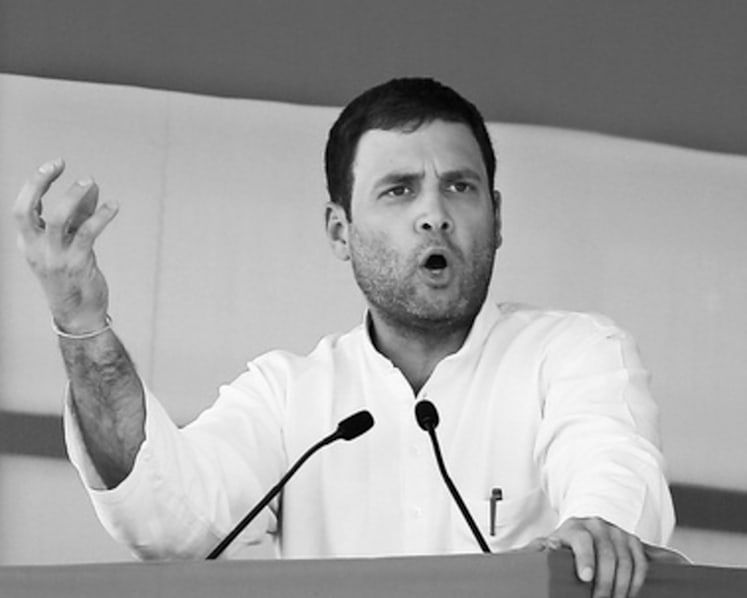
India’s Congress party vice-president Rahul Gandhi addressing a farmers’ rally at Ramlila ground in New Delhi on Sunday. He pilloried Prime Minister Narendra Modi’s government over its attempt to amend a controversial land-acquisition law. Photo: Reuters
Since its drubbing in national elections nearly one year ago, India’s opposition Congress Party has seemed almost lifeless. That finally appeared to change over the weekend, when presumptive Congress leader Rahul Gandhi swooped back into New Delhi after a mysterious 56-day-long sabbatical abroad. At a rally on Sunday and a speech in Parliament on Monday, the heir to the Nehru-Gandhi dynasty, which has ruled India for much of its modern history, pilloried Prime Minister Narendra Modi’s government over its attempt to amend a controversial land-acquisition law.
Like all democracies, India is best served by an agile opposition that can keep the government honest and present voters with a credible alternative. But the diffident Mr Gandhi, who until now has shown very little appetite for the rough-and-tumble of Indian politics, is unlikely to convince anyone other than party sycophants that he can compete with Mr Modi for fiery charisma. More than a macho leader, what Congress needs is a coherent policy agenda — not the one voters rejected last year, but a vibrant alternative that seeks to transform India’s oldest political organisation into a true, 21st-century centre-left party.
Mr Gandhi’s two speeches gave no hint of such a programme. While he may have finally shown the urge for a scrap — deriding Mr Modi’s right-wing government as a Suited-Booted administration catering for rich industrialists— he did not have anything new to offer India’s farmers, who make up about half of the population.
If all that rural Indians wanted was to preserve the Land Acquisition Act passed by a Congress-led government in 2013, they would not have voted for Mr Modi in such large numbers. Even the charge that Mr Modi favours industry is hardly new; Mr Gandhi deployed it repeatedly while campaigning last year, to little discernible effect.





BEING A TRUE OPPOSITION LEADER
Congress clearly has not absorbed the cardinal lesson from the party’s defeat last year: Even the poorest Indians no longer believe that an economic programme based primarily on handouts will lead to greater prosperity. Mr Modi won because he persuaded voters that he had a better plan. Mr Gandhi needs one of his own.
He has to start by resisting the urge to defend some idealised rural India against the encroachment of industry and urbanisation. Agriculture simply cannot support half of India’s workforce while contributing only 15 per cent of gross domestic product; many farmers would gladly give up their back-breaking work for good jobs and better services in towns and cities, if they were available. They understand that the future of their children does not lie in the land.
As centre-left parties in Europe have done, Congress also needs to acknowledge the fact that market economies are the best means of generating prosperity, despite their flaws. That does not mean parroting Mr Modi’s slogans about growth. Mr Gandhi could come out strongly against monopolies and oligopolies, while supporting a rules-based, competitive capitalist system. This may be a tough sell, given his party’s record of cronyism. But never having been in government himself, he can at least promise to begin with a clean slate.
Mr Gandhi can also legitimately champion a larger role for the state than Mr Modi — who himself is not looking to launch a Thatcherite revolution — might do. Whereas Mr Modi’s Bharatiya Janata Party has focused on leveraging state capacity to upgrade roads, ports and railways, Congress could offer an attractive agenda for upgrading India’s social infrastructure, too.
The party might, for instance, develop a plan for universal health insurance, where both state and citizens contribute to premiums. (The government could pay a larger share for the poorest Indians.) Nothing prevents Congress from promoting creative ways to improve education and worker skills. It is clear government schools have not delivered ideal learning outcomes. So why not commit the state to financing education, but letting the private sector deliver it, using vouchers at the school level and student loans for university?
Instead of clinging to a bad law, Mr Gandhi could improve the lives of farmers more by canvassing for massive public investment in irrigation; Indian peasants are still far too dependent on rains. Congress could also promise public investment in storage and cold chains, as well as universal crop insurance.
If he is to revive his party, Mr Gandhi needs to do more than agitate as if he were one of India’s many social activists. He needs to build a programme of constructive economic policy alternatives that Mr Modi has chosen not to pursue, for whatever reason. That is what a true opposition leader would do. BLOOMBERG
ABOUT THE AUTHOR:
Dhiraj Nayyar is a journalist in New Delhi and editor of Surviving The Storm: India And The Global Financial Crisis.