

A post-BN, post-PR future for Malaysia?
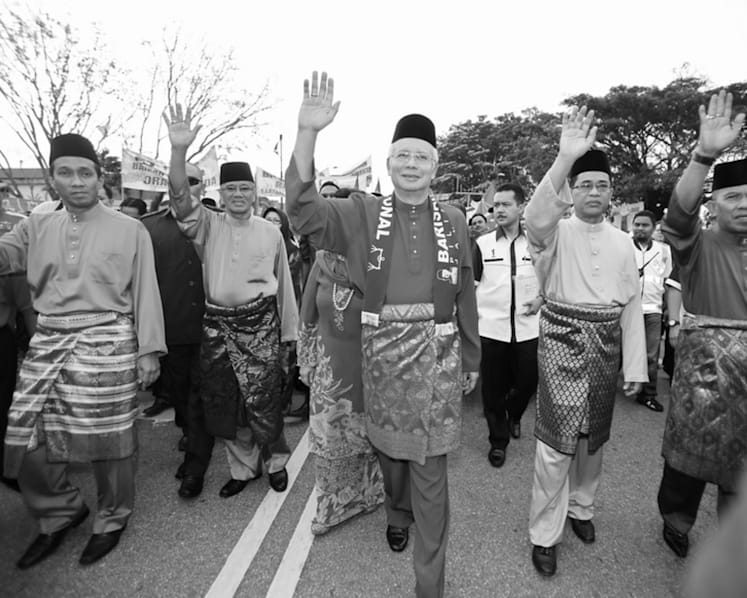
Malaysian Prime Minister Najib Razak (centre) going to submit his nomination papers to contest in the 2013 general elections. With the next general election due only in 2017, there is time to reconfigure the Malaysian political landscape by introducing a more progressive form of coalition politics. Photo: Reuters
Many Malaysians are understandably dismayed by the recent break-up of the opposition Pakatan Rakyat (PR), the seven-year-old coalition made up of the Democratic Action Party (DAP), Parti Keadilan Rakyat (PKR) and Parti Islam Se-Malaysia (PAS).
At its peak, the PR’s control of five of 13 states had raised hope it would congeal into a permanent alternative to the long-ruling Barisan Nasional (BN) coalition. But in truth, the fundamental differences within the coalition had always put its sustainability in doubt.
With the next general election due only in 2017, there is time to reconfigure the Malaysian political landscape by introducing a more progressive form of coalition politics — one that recognises the vastly divergent regional and cultural interests of Malaysia and does not seek to bind them together in a uniform, permanent and centripetal manner, BN-style.
The old rigid model, in place since Merdeka in 1957, has run its course.





In the case of the BN, it is held together only by the practicalities of power and the fact that it is dominated by the United Malays National Organisation (UMNO), a party that holds two-thirds of the coalition’s parliamentary seats. Smaller parties have steadily lost relevance and today, their loyalty in the coalition is assured only by the promise of positions and largesse.
Now even UMNO itself is split, after Prime Minister Najib Razak’s sacking last month of his deputy Muhyiddin Yassin and others critical of his handling of the 1Malaysia Development Berhad financial scandal.
The PR coalition did not share the dynamic of a single dominant partner, and the friction between the leadership core in the west coast of Peninsular Malaysia and the periphery regions proved to be its undoing.
Outside the west coast of Peninsular Malaysia, the PR concept itself was a nebulous one. For example, while Penang, Selangor, Perak and, to a lesser extent, Kedah, could rightly be described as PR states, the same label was always dubious in reference to Kelantan. How was Kelantan a PR government when DAP does not contest in the state and PKR only has one single representative? For all intents and purposes, it was and still is, simply a PAS government.
The hudud issue — the straw that broke the camel’s back — was a manifestation of this conundrum. The Kelantan state government felt it was merely exercising its democratic rights in pursuing its legislative aspirations — the constitutionality of it notwithstanding.
However, because hudud was not part of the PR Common Policy Framework that all three parties signed off on, PAS Kelantan’s attempt to implement it constitutes a clear breach of agreement. Therein lies a bigger question — should the PAS state government have been bound by the PR contract, when it was in actuality not really a PR government? The problem, therefore, was a structural one.
CENTRAL VS REGIONAL
That some interests and aspirations of the various regions of our country differ and, at times, even seem at odds with one another, should not come as a surprise. After all, every region is different, culturally, socio-economically and demographically.
Hence, instead of trying to impose the unwieldy structure of a permanent coalition for all, a better option is to encourage decentralised coalition-building through non-permanent, contractual coalitions. This means that different regions or states could have their own local coalitions, which may be very different from their own party’s coalition at the federal level.
Such a concept is widely practised elsewhere. In Germany, for example, Chancellor Angela Merkel’s Christian Democratic Union (CDU) forms a coalition government with the Social Democratic Party (SPD) at the federal level, while the opposition bloc is made up of the Green Party and Die Linke.
However, the configuration is vastly different at the state level. In the state of Brandenburg, the SPD governs in partnership with Die Linke, while in North Rhine-Westphalia, the SPD shares government with the Green Party.
These flexible configurations make a lot of sense, as they reflect the needs and aspirations of the different regions and levels of politics. Each coalition is bound by contractual agreements for a set duration — a single electoral cycle — and these agreements are made public so the people know exactly what to expect.
This also allows minor parties to play an important role without permanently binding themselves to any particular coalition. The smaller Free Democratic Party, for example, by playing the role of junior coalition partner in both CDU and SPD governments at separate times, has been in power longer than any other party in Germany.
Decentralised coalitions are also less polarising. Two-party or two-coalition dichotomies often manifest itself in very antagonistic terms, such as is the case in Malaysia, leaving very little room for compromise and cooperation. However, when parties are aware that their opponent today may become their partner tomorrow, there would be an instant, moderating effect.
This would also mean that coalition-building in Malaysia could be flexible and pragmatic. For example, DAP could form government with PKR in Penang in a coalition that excludes the Penang chapter of PAS, while a different arrangement could take place in Selangor — on the condition that a clear coalition contract is agreed to by all parties involved.
In the same vein, PAS could choose to be coalition partners with UMNO in Kelantan if it so wished, while choosing to oppose UMNO at the federal level. Meanwhile, various possible configurations could be conjured in Sabah and Sarawak.
If arrangements could be non-permanent and contractual, we would also be likely to see the emergence of smaller local parties and even “third force” parties at the national level.
A natural question is whether the Malaysian electorate is mature and sophisticated enough to grasp this idea, given that they are so used to the existing framework.
I am also often advised that I should not compare Malaysia with Germany, as the latter is an advanced, democratic country. But lest we forget, the whole of Germany has been democratic for only the past 25 years following the collapse of the Iron Curtain and German reunification in 1990. Even the former West Germany had been democratic only since 1949. Before that, Germany was the most infamous fascist dictatorship in the modern world.
Furthermore, it is not only advanced countries such as Germany that practise decentralised coalitions, but also our neighbours such as Indonesia and the Philippines. Therefore, there is nothing to suggest why Malaysians would not be able to comprehend the concept.
Given the demographically diverse make-up of our federation and the clear differences among the various geographical regions, decentralised coalitions may actually be the most practical and efficient political configuration for our country. Not only would it encourage the formation of regional coalitions that better reflect local aspirations and needs, it would also set the tone for a more progressive and inclusive political landscape.
Hence, in the midst of the ongoing political crisis in our country, with the PR dissolved and the BN heading towards implosion, there is much hope and opportunity that a brighter and more democratic future for Malaysia can be forged.
ABOUT THE AUTHOR:
Zairil Khir Johari is the Democratic Action Party’s Member of Parliament for Bukit Bendera in Penang and the party’s assistant national publicity secretary.




