

Remembering three key principles of Singapore’s fiscal system
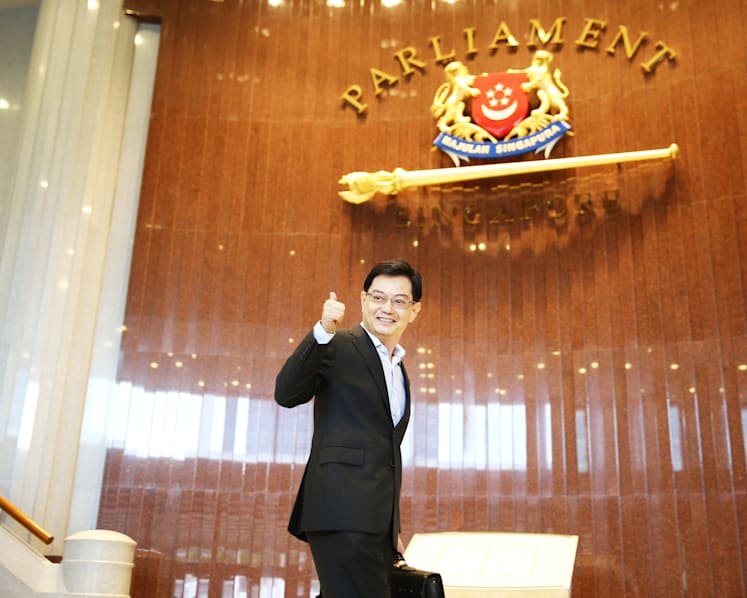
Finance Minister Heng Swee Keat arriving at Parliament House for last year's Budget. Singapore’s fiscal system has been undergirded by three fundamental principles - fiscal prudence, fiscal discipline and fiscal equity – which have served the nation well, say the authors. TODAY file photo
The 2018 Budget Statement will be delivered by the Minister for Finance, Mr Heng Swee Keat, on February 19.
What is unusual in this year’s run-up to the budget is the strong signalling from the government that tax rises are impending.
The central case for justifying a tax increase is the projected increase in public expenditure, particularly healthcare, as the population ages. The discourse on tax increases has taken three main threads.
The first revolves around the need for citizens to bear a fair share of the costs of providing public services to meet increasing demands. The second relates to whether more of the accumulated reserves should be taken into the annual budget for spending, to offset the need to raise taxes. Third, the equity in the distribution of the tax burden. How much more should the better off shoulder than the lower-income?





The discourse should shift from policy decisions to policy principles.
Singapore’s fiscal system has been undergirded by fundamental principles, which have been consistently applied since Independence, to deliver results which are admired worldwide – a stable macro-economic environment that has generated broad-based growth benefitting all segments of society.
These principles - namely, fiscal prudence, fiscal discipline and fiscal equity – have served us well, and should remain pertinent in future years.
Fiscal prudence is largely a consideration for expenditure restraint.
The discourse on tax rises has treated expenditure increases as inevitable.
However, a serious look at expenditure restraint and reprioritisation should be undertaken before determining revenue measures. There is certainly legitimacy in anticipating increases in healthcare and other ageing related imperatives.
However, more emphasis could be placed on discussing if the increased expenditures could be funded by cuts in other areas.
In this regard, Minister Heng had made a move in the right direction by announcing, in last year’s Budget, a 2 per cent downward adjustment in budget caps for all Ministries and Organs of State.
However, this only reduces the budget growth trajectories for the agencies under the budgeting framework, but does not amount to a budget cut.
A bottom-up review of the cost of government could be undertaken to achieve greater economies in spending. This will be a painful exercise as it entails trade-offs and making judgments regarding which areas of spending are discretionary and thus could be reduced or done away with.
But it should be a necessary precursor to any consideration of raising additional revenues.
Fiscal discipline is concerned with living within one’s means.
Without the Net Investment Returns Contribution (NIRC), the budget would be in a structural deficit.
In Financial Year 2017, the NIRC was budgeted at S$14.11 billion, which, after plugging the basic budget deficit of S$8.19 billion and topping up various Endowment and Trust Funds to the tune of S$4.01 billion for funding of longer term needs - such as productivity and research - yielded a final overall budget surplus of S$1.91 billion.
The NIRC, introduced in 2009, is a significant modification from the preceding Net Investment Income (NII) framework, which was limited to tapping on actual investment income.
The NIRC, in contrast, permits the Government to spend on the basis of expected long-term returns.
The Government can only tap on up to 50 per cent of the NIRC on relevant assets net of liabilities.
Initially, relevant assets comprised assets managed by GIC and the Monetary Authority of Singapore (MAS), but Temasek’s assets were subsequently included.
The inherent danger of a readily available and large headroom capacity in the NIRC is that it can induce complacency in adherence to the principle of fiscal prudence.
Hence, fiscal discipline and fiscal prudence should be viewed as mutually reinforcing principles undergirding sound fiscal management.
It is important that the prescription for such management does not lie only in frameworks and rules, but also in policy culture. Fiscal planners need to maintain a perspective which focuses on limiting themselves to a tight criteria of what constitutes essential expenditure, and not leverage on the convenience of the NIRC.
The upshot of failing to do so is that, as the NIRC was a modification from the NII, a future government may be tempted to make additional modifications till it reaches the point where it crosses the line from tapping earnings to drawing on capital.
Fiscal discipline is key to the maintenance of investor confidence in Singapore’s small open economy, and we must not go down the slippery path of living beyond our means by drawing on our savings, which will eventually run out.
Fiscal equity has been the third and often least visible principle of Singapore’s fiscal management.
This is concerned about the distribution of both the tax burden and benefits.
Singapore’s model has been progressive across the board, in the sense that the tax curve has been weighted on the middle and upper-income earners: 60 per cent of Singaporean workers do not even pay income tax.
The Goods and Services Tax, or GST, is regressive when considered in isolation.
However, when taken together as a system of tax and benefits, the Singapore model must be recognised as equitable and even generous. However, income inequality continues to widen, and wealth distribution, as opposed to purely income, has increasing determinative effects on social mobility. This raises questions about how best to use a tax mix to narrow the income and wealth gaps and better even out the playing field. There should be more discussion on whether Singapore should impose capital gains taxes, and even estate duties, which were abolished over a decade ago.
These policy questions should be brought back into focus to ensure that fiscal equity continues to inform the Singapore model.
Singapore is in an envious position of being able to tackle these challenges within a reasonably comfortable time frame.
However, that comfort should not become a reason for complacency. And serious policy questions should not be avoided due to precedence or past decisions.
The future should be dealt with on its own terms based on evergreen principles that have served us well.
ABOUT THE AUTHORS:
Devadas Krishnadas and Lee Kok Fatt are respectively chief executive and director of Future-Moves Group, an international strategic consultancy and executive education provider based in Singapore. Mr Lee is also the author of “Singapore’s Fiscal Strategies for Growth - A Journey of Self Reliance”.




