Why low-tech living is back
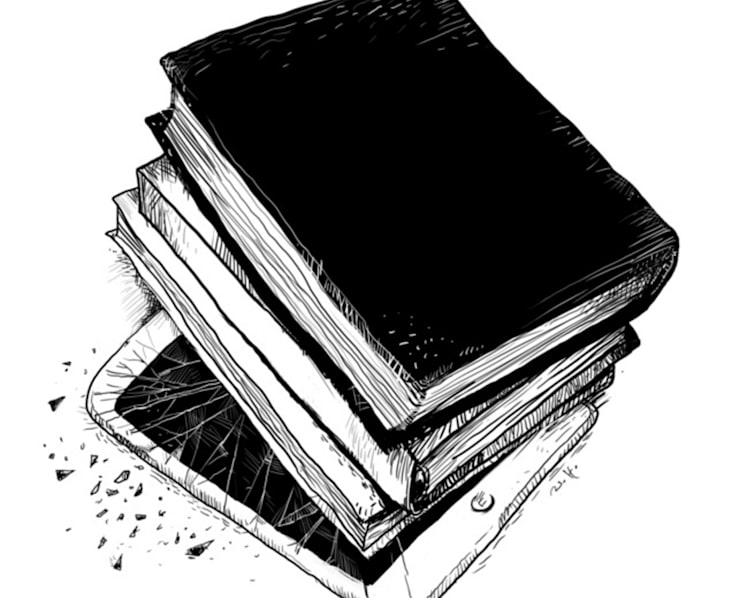
Books are back and hotter than vinyl records. Today Illustration
Books. Remember them? The big lumps of wood pulp that used to clog up your shelves? Well, they are back and hotter than vinyl records.
The British Library recently announced that the rise of the digital age had, paradoxically, helped boost numbers visiting the library by 10 per cent.
Mr James Daunt, CEO of Waterstones, Britain’s leading bookselling chain, revealed that sales of traditional books were rising strongly again, while demand for e-book readers had, “to all intents and purposes disappeared”.
Waterstones’ rival, Foyles, said its sales were up by 8.1 per cent on last Christmas, despite fewer promotions, and with traditional books accounting for most of the advance. “The physical book is having a resurgence,” said Foyles boss Sam Husain. “People still like to shop online, but there’s nothing like being in the bookshop.”





It was not meant to be this way. When e-books took off in the mid-noughties, many foresaw the death of the printed variety, which had dominated the market for 600 years, and great was the wailing and gnashing of teeth among traditionalists. A slim,170g Kindle could store hundreds of books, and the device was packed with nifty features for tech-addicted customers. The book was clearly headed the same way as the quill. Or the typewriter. Or, for that matter, the vinyl record.
Happily, the e-book pioneers forgot something important. There are some things that technology cannot replace, and readers began to realise that a proper book possessed something akin to a soul. Not only older readers, either. My 16-year-old son begged for a Kindle a few years ago. When I asked him last week if he still used it, he looked up from the hand-bound, Folio edition of The Count of Monte Cristo he had received for Christmas and blinked. “Oh, that, not really.”
RE-EMBRACING OLD TECHNOLOGIES
Behind the world’s unstoppable technological advance, it seems, is the awkward human refusal to be rushed. Or conned into believing that things that will actually make their lives more complicated will make them easier. Or sold expensive solutions to problems that do not exist. And from these stirrings of resistance is arising the phenomenon of low-tech.
Millions are re-embracing technologies that had seemed doomed to a cobwebby obsolescence. Clam-shell and flip phones are the new height of chic, with the likes of United States Vogue editor Anna Wintour, singer Rihanna and actress Scarlett Johansson all flaunting the venerable devices. Good-quality examples of these old phones can fetch more than £800 (S$1,640) — far more than the latest Apple iPhone 6 — and so big is the demand that Korean manufacturer Samsung is bringing out a new version.
The appeal is only partly faddishness. The old phones actually do what phones used to do, which is make and receive phone calls, without depositing your whole life in cyberspace, where it can be stolen and used to embarrass you before the entire world. And as rocker Iggy Pop said: “You can drop it and it doesn’t break.”
The same sound reasoning may explain the extraordinary comeback of the Polaroid instant photo camera. Last year’s Hollywood nude photo scandal, in which hackers accessed Apple’s iCloud storage system and put naked pictures of more than 100 actresses, including Jennifer Lawrence and Kirsten Dunst, on the Internet, had a chilling effect in celebrity circles.
It was excellent news for Polaroid, though. Near bankrupt in the early 2000s, the US corporation stopped selling its famous self-developing film in 2007. The rights were bought by a small Dutch-based company, The Impossible Project, which is now struggling to meet demand.
“Last year, our film sales were up 60 per cent,” said Mr Creed O’Hanlon, the firm’s CEO. “We probably sold 1.4 million packs of film, and we sold 3,000 cameras on Black Friday alone.”
Mr Hanlon admitted that while celebrities had helped create a buzz, the big buyers were teenagers. “Today, the thing teenagers love is taking a picture, hearing a click and a whirr, then seeing an image slowly appear in the palm of their hand,” he said. “People love the tangibility. You can write on it, you can give it to somebody. It feels one-off and more special than just transferring you a file.”
Vinyl-record sales are booming too. Last year, they hit an estimated 1.2 million — the highest in 20 years, and a five-fold increase since 2008. Threatened by seemingly superior technologies, the old discs seemed headed for extinction, but, as with books, it is the “soul” of vinyl that has been its salvation.
Even typewriters are bouncing back. Spooked by the WikiLeaks and Edward Snowden affairs, intelligence agencies and political groups are reportedly returning to Cold War technology to keep their secrets safe. The glamour is back too. Movie star Tom Hanks recently published a “love letter” to the typewriter, declaring: “The tactile pleasure of typing is incomparable ... there is a sheer physical pleasure to typing.”
Dr Mike Evans, a theoretical physicist at York University, believes the appeal of high-technology is being undone by its constant quest for what he calls “sterile perfection”. People are naturally curious, he argued, and they like to have some sense of how things work. With, say, a record player it is obvious; with a shiny plastic stick, it is not.
“Modern gadgets are designed not to betray the imperfect physical nature of their workings,” said Dr Evans. “That is a shame, because imperfections are important in helping us understand the world.”
Someone should write a book about it. THE DAILY TELEGRAPH
ABOUT THE AUTHOR:
William Langley is a The Daily Telegraph columnist. This is an excerpt of a longer piece.