Covid-19 is turning our lives upside down. How are you adjusting to change?
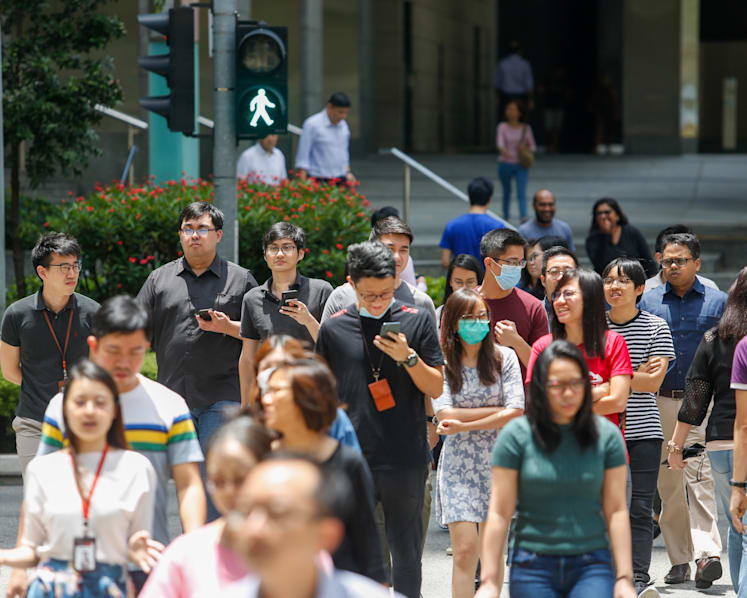
It is perhaps useful for us to step back and recognise where we are in terms of the story we are living and writing, says the author.
Showing no signs of abating, the coronavirus pandemic is increasingly being described as the world’s gravest crisis since World War II.
Half the world’s population is on lockdown, and in Singapore, we have had to make constant and necessary adjustments to day-to-day living, like working from home, practising safe distancing and being more vigilant about personal hygiene.
In doing so, it is perhaps useful for us to step back and recognise where we are in terms of the story we are living and writing - about the changes that we are going through.
As I reflect on this, I flipped back to my class notes from a course with Harvard leadership and organisation professor Marshall Ganz titled Public Narrative: Loss, Difference, Power, and Change.





There are a few different ways we could be telling this story of change.
I) Reject change or reject the past
When change comes upon us, it may be tempting, at least at first, to deny the change. We may brush it off as a temporary blip, and continue to make plans assuming things will soon go back to the way they were.
This can be seen in how early on, some countries adopted relatively relaxed postures on the outbreak, with the assumption that they could largely go on living life as normal.
It now seems clear that the option of rejecting change has been thrown out the window. Instead, changes that were previously unthinkable are now being implemented overnight. We now run the risk of swinging to the other extreme.
Yuval Noah Harari, author of 21 lessons for the 21st Century, rings a warning bell in a recent Financial Times column for us to take account of the longer-term consequences even as we need to make swift changes today.
For example, he highlights his fear that the current pandemic may normalise the sacrifice of privacy for health, with the deployment of mass surveillance tools in countries that have so far rejected them. He questions if we need to completely turn away from one in order to obtain the other.
Neither of the extreme responses to change is particularly helpful, as they are both ultimately driven by fear and unrealistic.
II) Accommodate change or adapt to change
Beyond the extremes, we still face another question: Are we writing a whole new story, or are we fundamentally continuing with an old story with some adjustments?
This is the difference between accommodation and adaptation. In accommodation, the old story largely continues with a nod to the change. The overall tenor is still to largely preserve as much of the old story as possible.
In adaptation, a new story is constructed. We embrace the change as something that is, on balance, positive. We carry with us what we want to retain from the old story, as we begin building the new story.
THE CONTINUUM OF CHANGE
Businesses will be grappling with these questions as they respond to change.
As a youth and corporate trainer, I remember how back in January, before the potential scale and impact of Covid-19 had truly hit us, I was operating with “business as usual” assumptions.
In fact, I was still making plans to host a group of students from China on an innovation change journey here in Singapore, until travel restrictions rendered this an impossibility. This was me denying change.
In the weeks that followed, as training and facilitation jobs got cancelled and the nation went into Dorscon Orange, with increasingly tighter restrictions as the days went by, I went into accommodation mode.
I deferred the training to August and later in the year and took the downtime to revamp our website and offerings.
I thought I was responding to the change as best as I could. But the story of the business I thought I would be running was pretty much still the old one – one based on groups of people who would still, at some point, come together and gather in person for training and events.
But as of now, my frame of mind has (finally) officially shifted into adaptation.
This means moving the company’s events and engagements online, hosting life hack classes on iglive and even e-picnics. We are also embarking on a new initiative where we recruit youths as experience designers to help small business owners adapt to change by bringing their products and experiences online.
If I had thought that the accommodation response was enough, and that I could soon go back to comfortably cruising on the old storyline, I was wrong.
The opportunity that lies ahead of us is in adaptation, and the potential to write a new and different story of who we can be and what we can offer.
REACT IN FEAR OR RESPOND WITH HOPE?
Why is it important to update and calibrate our response according to the times? It makes for the difference between fear and hope.
When I was in accommodation mode, every new restriction announced by the Government triggered a new wave of fear in me. “How much worse would things be?” I found myself asking.
Every job cancelled led me to worry: “How much longer is this going to drag on?”
As I shift to the new response of adaptation, I also find my hope renewed. I know now that my focus needs to be on a new story, and the new opportunities that could lie within.
This is of course not just a story for Covid-19.
We are constantly grappling with changes of varying magnitude. Whenever you or any organisation go through a change effort, you may find yourselves and your team anywhere along this spectrum, from rejecting change, accommodating to adapting and rejecting the past.
Where there is tension, it may be worthwhile looking into the story each party may be holding about change, and where they may diverge.
We human beings are meaning-makers. In times of chaos, we turn to story to help us make sense of where we are and where we are headed. In these times, what is the story you are writing about change?
ABOUT THE AUTHOR:
Yong Yoek Ling is founder of corporate consultancy Good Company and youth training academy Bold At Work. She previously worked in the civil service and was awarded the Public Service Commission Scholarship and the Lee Kuan Yew Scholarship.