

Get tough on speeding food delivery riders
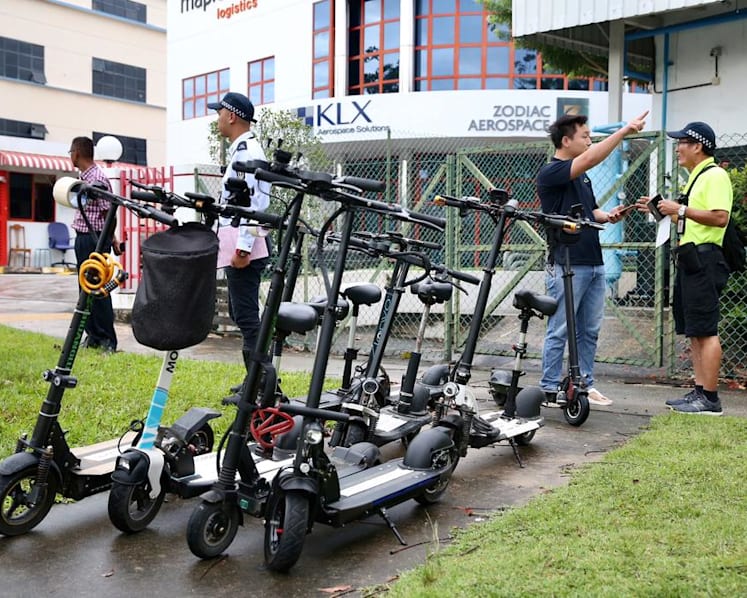
The authorities should develop safe-riding rules for delivery crew and hold companies accountable if their riders fail to comply, says a reader.
Earlier this month, Senior Minister of State for Transport Lam Pin Min told Parliament that town councils can ban personal mobility devices (PMDs) in the void decks of public housing blocks.
He noted that it is up to the town councils to decide, since the configuration of void decks differs in various areas.
The Active Mobility Act — the law that spells out where equipment such as PMDs can be used and how fast they can go — does not cover areas such as void decks.
Are we to believe that the town council by-laws are more effective than the Act?





The safety of pedestrians cannot be compromised.
Take food delivery riders who speed down corridors of Housing and Development Board (HDB) blocks and risk crashing into children and elderly persons.
I have seen riders take their devices into lifts and up to the different floors.
The Land Transport Authority (LTA) must step up enforcement against reckless food delivery riders quickly.
On Sunday (May 12), I was almost knocked down by a speeding GrabFood delivery rider on an electric scooter along a walkway beside the Telepark building in Tampines Central.
He challenged me to a fight after I advised him to slow down.
With many Singaporeans ordering food online during weekends, the speed with which these riders complete orders exposes huge safety risks.
This raises questions of why riders get around recklessly and if restaurants or food delivery firms pressure them to speed.
Riders should not race against time to fulfil orders and avoid penalties, if any, by their companies for late delivery. Speeding to meet delivery deadlines is a recipe for accidents, particularly at night where visibility is reduced.
Customers should also be more accommodating if they receive their meals late. As technology makes ordering easy, we see more riders zipping along footpaths, walkways, and the corridors and void decks of HDB blocks.
The LTA must not only penalise riders who are caught speeding, but also impose a fine on the delivery firms.
It should also develop safe-riding rules for delivery crew and make riders pass a written test before allowing them to ply the trade.
Delivery companies should be held responsible if they fail to ensure that their riders abide by the rules.
This will protect pedestrians and riders themselves.
The LTA must also enforce the rule that users dismount and push their PMDs in areas with high pedestrian traffic, such as walkways.
Delivery companies, too, must take a serious view of reckless riding and make it clear to riders that they do not condone aggressive behaviour.




