

A glass-half-full look at regional relations and geopolitical developments
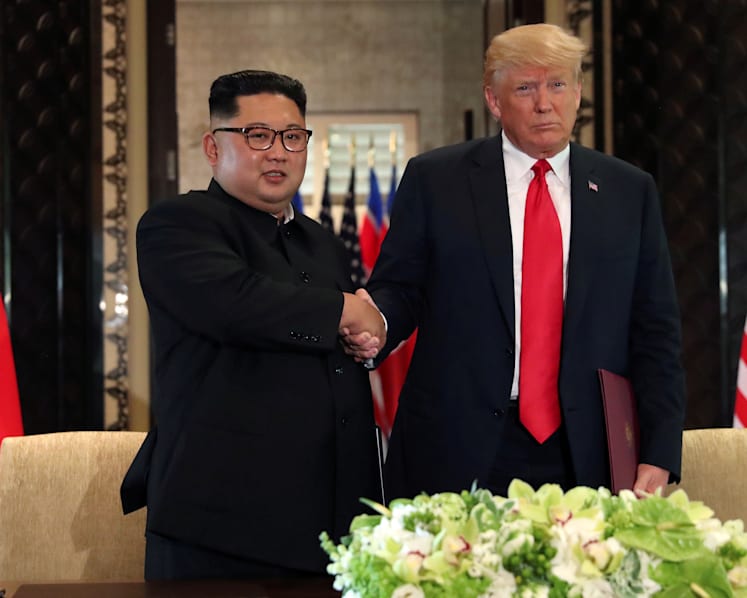
The author says that at times, it helps to adopt a half-glass-full perspective on peace-making efforts. One instance is the situation in the Korean Peninsula. While Complete Verifiable Irreversible Denuclearization is still a long way off, United States-Pyongyang relations have de-escalated considerably in the initial stages of rapprochement.


It may be a little unconventional and even counter intuitive talking about peace-making in a period that appears to be characterised by increasing tensions around East Asia.
But, if one focuses only on the tensions in the region, one may also lose sight of the rapprochement and confidence building measures (CBMs) taking place. Perhaps, at times, it helps to adopt a glass-half-full perspective on peace-making efforts at a time of heightened geopolitical tensions.
Take for instance the situation in the Korean Peninsula.
While Complete Verifiable Irreversible Denuclearization (CVID) is still a long way off, United States-Pyongyang relations have de-escalated considerably in the initial stages of rapprochement.





North Korea has stopped testing missiles and nuclear devices and refrained from displaying Inter Continental Ballistic Missile in large military parades.
This is an important development after Pyongyang repeatedly tested nuclear devices (including a suspected hydrogen or hydrogen-like) bomb and fired missiles over the Japanese airspace above the island of Hokkaido in 2017.
On the part of US and South Korea, they have suspended or scaled down major military exercises to de-escalate tensions, with South Korean President Moon Jae-in a key advocate of dialogue with his North Korean counterpart.
Japan also deserves plaudits for patiently working with Seoul and Washington D.C. on the issues of Japanese abductees kidnapped by North Korea at the height of the Cold War.
Tokyo has consistently and faithfully implemented United Nations sanctions while supporting the US alliance network to reach out to Pyongyang.
Even in the face of provocation by Pyongyang last year, Tokyo calmly drilled its people, tracked the North Korean projectiles and exercised tremendous self-restraint when long-range missiles were fired over its airspace.
The other stakeholder in the region, China, has also contributed to CBMs in other areas.
In the face of global trade tensions, Beijing is making up with Tokyo and Seoul.
It repaired relations with Seoul over the Terminal High Altitude Air Defence (Thaad) system deployment which Beijing had opposed on grounds that its powerful radar could undermine China’s national security.
The boycotts over K-pop, Korean supermarkets and Korean products in China have stopped while the Moon administration has suspended the deployment of a second Thaad missile system.
With regards to Japan, China leaders met with Prime Minister Shinzo Abe to set up maritime hotlines, de-escalating tensions in the East China Sea.
Mr Abe is keen to reset Sino-Japanese relations on an even keel on a prolonged basis instead of the current situation of cyclical on-off bilateral relations.
Beijing has talked about the possibility of potentially joining the Comprehensive and Progressive Agreement for the Trans Pacific Partnership, a pact originally perceived by Beijing as excluding China.
Tokyo is giving strong support to the Beijing-initiated Regional Comprehensive Economic Partnership and has, on occasions, considered possible cautious co-operation with Beijing-initiated Asian Infrastructure Investment Bank or Beijing’s all-important Belt and Road Initiative.
The Association of South-east Asian Nations (Asean) has also done its part for peace in the region.
In the South China Sea disputes, all parties have agreed to a single document for the framework of the Code of Conduct.
There is still a long way off in the road to peace but the first few difficult steps have been taken.
One notable effort is the stepping up of military exercises between Asean and Beijing.
Started off as table top exercises, the next phase involved the navies of Asean members and China taking part in drills off the sea of Guangdong.
Then came the exercises in the Straits of Malacca involving China, Malaysia and Thailand.
The People’s Liberation Army (PLA) sent hundreds of troops, including a missile destroyer, a frigate, four transport planes, three helicopters and a hospital ship.
Malaysia contributed almost 600 armed personnel and warships while Thailand sent a contingent of 54 participating soldiers who were unarmed.
This was the largest ever military exercise between PLA and an Asean country and the level of ease and confidence that Malaysia and China had was well noted.
As the drills focussed on joint planning and coordination and was targeted at improving the security of the narrow and congested Straits of Malacca, they were seen as for the common good of the region.
It also allows the field commanders to get to know each other personally and foster a level of comfort in joint operations which is helpful for regional security.
If these rapprochement efforts and confidence building measures can be sustained and expanded, the capacity for resolving crises, misperceptions of each other’s intentions and misunderstanding can be further enhanced.
Peace is the fundamental building block for economic development in the region and no major stakeholder in the region will want it to come under threat.
Therefore, it is important for CBMs and rapprochement to be inclusive and involve major, middle and small power.
ABOUT THE AUTHOR:
Dr Lim Tai Wei is Senior Lecturer at Singapore University of Social Sciences and an adjunct Senior Research Fellow at the National University of Singapore's East Asian Institute.




