

How to make a bad situation in N Korea worse
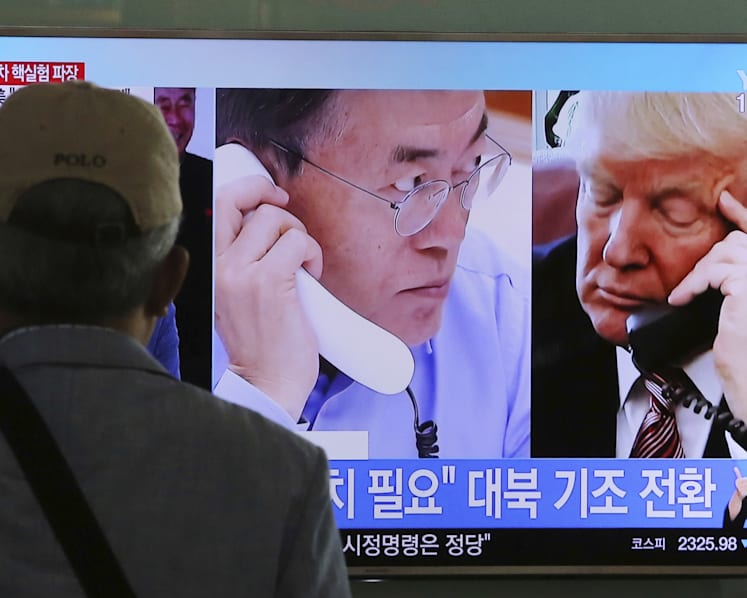
A news telecast in South Korea featuring South Korean President Moon Jae-in and US President Donald Trump. By alienating a key ally, Mr Trump would erode the US deterrent against North Korea and further embolden dictator Kim Jong-un. Photo: AP
There are, as is often noted, no good options for dealing with North Korea. All the more reason for the United States not to make the few it does have even worse.
That is what US President Donald Trump is doing by linking the security threat posed by North Korea with his trade agenda.
Irked by China’s failure to help the US rein in North Korea’s nuclear programme, and having been stymied in his attempts to retaliate against Chinese steel dumping and intellectual-property infringements, he is vowing an implausible trade war with the US’ largest trading partner.
Even less rationally, the administration has dropped hints it is about to scrap a free trade agreement with ally South Korea. As a negotiating strategy, Mr Trump’s approach is utterly unsuited to the North Korean crisis. For one, it is almost certain to fail.





True, China itself has had some success using its trade clout to bully smaller nations for their support of the Dalai Lama or political dissidents. But neither China nor any other nation is going to compromise what it sees as its security needs because of trade threats or concessions.
South Korea is losing billions to an unofficial Chinese boycott targeting its deployment of a US-made missile defence system — and after the North’s latest nuclear test, President Moon Jae-in agreed to expand the system. The US also stands to lose far more than North Korea if Mr Trump continues down this path.
Despite Mr Trump’s claims, the free trade agreement with South Korea has caused minimal, if any, damage to the US economy.
By contrast, alienating a key ally, host to nearly 30,000 US troops, would erode the US deterrent against North Korea, further embolden dictator Kim Jong-un, distract from China’s lax enforcement of sanctions on the North — and hurt US exporters, farmers and consumers.
It is eminently possible to simultaneously compete on trade and cooperate on security issues.
Longstanding trade disputes have not prevented the US and China from achieving real gains on cyber security and climate change, for example. Nor have those deals stopped the US from pursuing its other interests both commercially and geopolitically.
It is important to remember that having no good options does not mean the US has no options short of war. The most viable path forward has not changed: The US and its allies South Korea and Japan need to strengthen their deterrent capability.
This will require not just additional military resources but deeper intelligence-sharing, expanded missile defences and a unified diplomatic position. And if the Treasury Department wants to cut off Chinese companies doing business with the North, it would be wise to target a high-profile firm clearly violating sanctions that China itself has approved. Efforts to spread information within North Korea and to highlight the regime’s crimes against humanity should be redoubled.
At the same time, and despite China and Russia baulking at stronger United Nations sanctions, the US should be quietly discussing a coordinated diplomatic approach with China, rather than issuing threats and accusations on social media. Whatever their disagreements on trade, cooperation still holds out the best chance of achieving what both sides want: A peaceful end to the current stand-off. BLOOMBERG




