Should food delivery apps share the spoils with restaurants? Here's what China's Meituan did
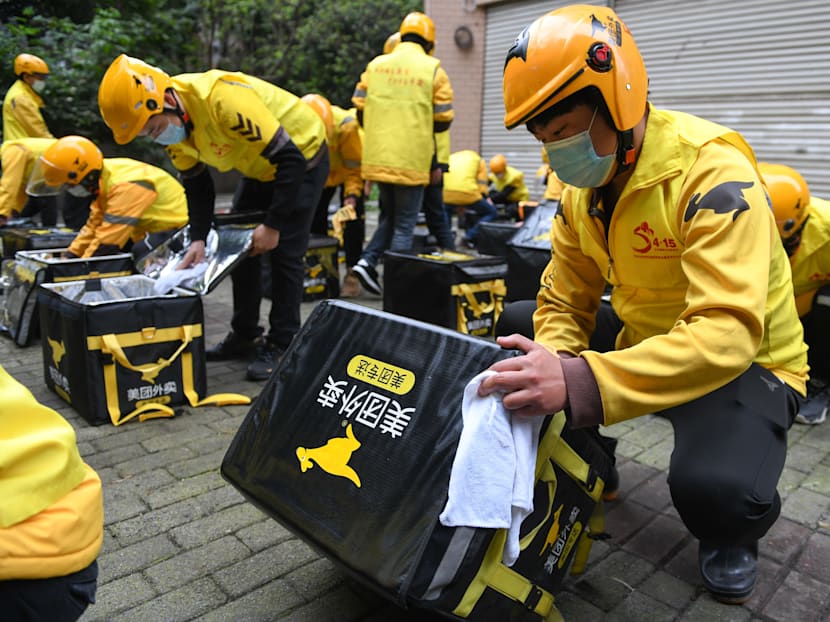
Meituan deliverymen at a site in Chongqing, China, on April 13, 2020. While the Covid-19 epidemic has made heroes of such delivery workers, it has also devastated restaurants and their equilibrium with Meituan.
In the animal world of business, tech start-ups and traditional companies have a symbiotic relationship. Their coexistence can lead to mutual benefits, or it can turn parasitic.
When it comes to China’s dominant takeaway app Meituan and the country’s food delivery business, the parties are seeking a new arrangement.
Before Covid-19, the profits of both China’s restaurant industry and Meituan were growing in a delicate balance.
The 10-year-old “super-app” has become China’s third most valuable listed tech company, and is one of the world’s few tech stars to actually turn a profit. It did this mostly through rapid growth in transaction volumes — but it has also increased the amount it keeps from commission, marketing and other revenues.





While the epidemic has made heroes of China’s yellow-and-blue-jacketed delivery workers, it has also devastated restaurants and their equilibrium with Meituan.
One survey of more than 60,000 chain restaurants said that by February losses had on average outstripped their entire profit from 2019.
In the same month, Meituan and its smaller rival, Alibaba’s Ele.me, were sent open letters by the regional restaurant associations of Shandong, Hebei, Yunnan and Chongqing, which cover a vast geographical stretch of Chinese cuisine.
The associations sounded a nationwide alarm over the fate of the industry, urging Meituan to lower its commission.
As Yunnan’s restaurateurs put it: “With the skin gone, what can the hair attach itself to?”
In the end, it was an intervention by the country’s largest restaurant association, in Guangdong province, that brought a public response from Meituan. What followed was a rare example of a public and partially successful negotiation between an industry and a tech platform.
In its open letter to Meituan, Guangdong’s restaurants asked it to split its revenues more evenly with them, by lowering the amount that restaurants pay per transaction. In Guangdong, that can range from 3 to 25 per cent. Meituan says its average nationwide commission is between 10 and 20 per cent.
The restaurants wanted something else too: The ability to sell via Meituan’s competitors, voiding the exclusivity agreement common to Chinese e-commerce platforms.
Just over a week later, a deal was done. Meituan said the restaurants could take their pick of platforms. High-quality merchants would also get an extra 3 to 6 per cent of their commission back as a rebate to be used on Meituan’s platform, to buy ads for example.
Meituan may have sensed the wider mood in the country. As one magazine put it: “Why isn’t the increasingly profitable Meituan willing to help its merchants get through this difficult period together?”
The tech company’s response is that it, too, is increasingly unprofitable. People have turned to online delivery rather than dining out — but not in high enough numbers.
In February, the group’s food delivery volumes halved from normal periods. As big as it has become, Meituan recognises it needs its merchants to survive. The company does not make meals; it arranges for their marketing, sale and delivery.
But the merchants also need Meituan. In the first few weeks of the epidemic, some Beijing restaurants set up street-side tables for fire sales of vegetables. “We’re still delivering,” they said while announcing venue closures.
A similar scene has played out in San Francisco, where the mayor issued an emergency order capping delivery-app commission at 15 per cent. The local restaurant association is in support.
As a result, Uber has stopped delivering to the Treasure Island neighbourhood saying it was no longer able to finance these services.
Pundits are split on whether this was a necessary cost-saving measure or a political pressure tactic.
It is not unusual for tech firms and their more traditional partners to fight over the spoils. But now they are so meagre, splitting them has become a tense affair.
Back in China, Meituan has secured a 20 billion yuan (S$4 billion) low-interest lending facility for struggling merchants — which its hotel and leisure industry clients surely are.
Yet this cannot be enough to heal a deeply wounded industry. Nor has the government managed to lend sufficient help.
Meituan says it has been conducting a “listening campaign” with restaurants around the country, starting in Guangzhou, the capital city of Guangdong province.
“We are hoping that by meeting and discussion we’ll come to a solution,” the company says. I hope the venues to host such meetings will still be there by the end of the year. FINANCIAL TIMES
ABOUT THE AUTHOR:
Yuan Yang is the Financial Times’ Beijing tech correspondent.