Using Islam to score political points
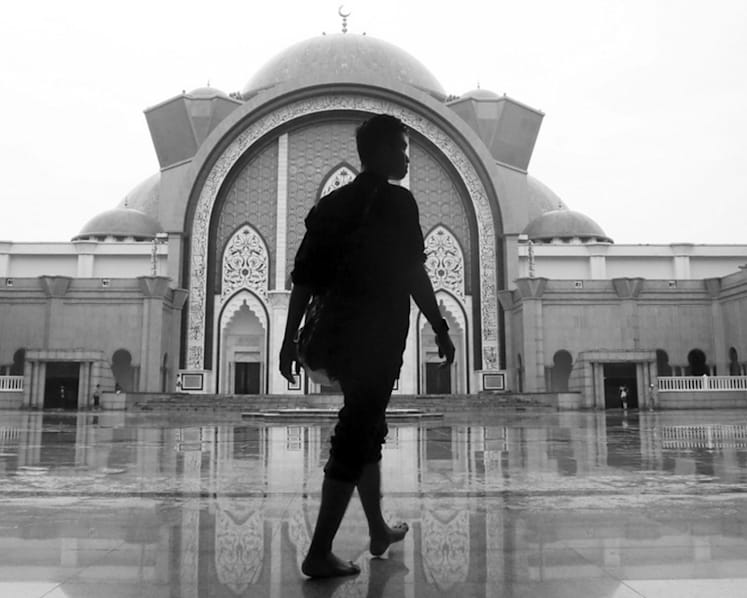
The Kedah Islamic Religious Department announced that, beginning this month, Muslims who fail to perform Friday prayers three times in a row can be fined or jailed. Photo: Reuters
Recent religious controversies in Malaysia point towards an increasing influence of Islam that affects the rights of minorities and non-Muslims, a trend that appears to be in line with the government’s agenda as it seeks to retain the popular vote.
During the recent SEA Games in Singapore, Malaysian gymnast Farah Ann Abdul Hadi was berated online for wearing a leotard, despite winning gold medals for the country. On Monday, two women were denied entry into the Selangor state secretariat building for wearing skirts that were deemed inappropriate. It comes less than a month after the Road Transport Department told another woman to wear a sarong to cover up her legs if she wanted to be served and another report yesterday of a similar incident at a hospital in Petaling Jaya last week.
These incidents over dressing — or lack of it — have created an uproar among Malaysians, with some defending the gymnast and the women. There are also many other instances that suggest the authorities are stepping up efforts to enforce the practices of Sunni Islam as part of the government’s long-running Islamisation policy.
For instance, the Kedah Islamic Religious Department announced that, beginning this month, Muslims who fail to perform Friday prayers three times in a row can be fined not exceeding RM1,000 (S$360) or jailed for up to six months, or both.





This comes after a report in Bernama last month that the Home Ministry has banned four books authored by novelist Faisal Tehrani, as they were found to have contained Shia elements and contravened the teachings of Sunni Islam.
The larger aim of the ruling Barisan Nasional (BN) coalition in institutionalising Sunni Islam in the country is to counter the opposition Parti Islam Se-Malaysia (PAS) in winning the hearts and minds of the Malay Muslims.
The policy has led not only to the expansion of the Islamic bureaucracy, but has also undermined the Constitution’s secular foundation. What are the origins of such a policy and what does it mean for Malaysians at large?
Islamisation policy unofficially started when Malaya (Malaysia) became independent in 1957. The Malaysian government expanded its Islamisation efforts in the early ’70s by instituting a number of Cabinet-level offices and national Islamisation policies. The worldwide Islam revivalism in the ’70s also contributed to the general Islamisation process in Malaysia.
Since the ’80s, the government has aggressively championed Islamisation policies under three Prime Ministers, namely “Penerapan Nilai-Nilai Islam” (Inculcation of Islamic Values) under Dr Mahathir Mohamad; “Islam Hadhari” (Civilisation Islam) under Mr Abdullah Badawi; and Islam “Wasatiyyah” (moderation in Islam) under Mr Najib Razak.
These policies helped spread Islamic education in local universities to produce talent with the required knowledge and skills in Islam. At the same time, graduates of these programmes have been systemically recruited into the public bureaucracy to protect, strengthen and spread Islam. This has pushed the rapid expansion of Islamic bureaucracy and institutionalised Islamic law to an extent that was unimaginable in the pre-colonial era.
Since the ’90s, the Islamic bureaucracy, supported by the BN government led by the United Malays National Organisation (UMNO), has been enforcing Islam on Muslims through moral policing based on an adherence to the Sunni doctrine of Islam.
UMNO’s push for Islamisation is politically motivated, based on its belief that the party must act as a bastion of the Islamic faith to boost political support among Malay Muslims, who make up the majority of the population.
The latest initiative coming out of the close collaboration between UMNO and the Islamic bureaucracy is the proposed implementation of the Syariah (compliance) Index. Launched in February by Mr Najib, the index complements Islamic governance through a more comprehensive Syariah yardstick in eight major areas, namely legal, politics, economy, education, culture, infrastructure, environment and social. This will further strengthen UMNO as the defender of Islam in Malaysia.
UMNO has also showed tacit support for PAS’ move to introduce hudud law (Islamic criminal law) in the state of Kelantan. Again, the move is politically motivated, aimed at putting pressure on fault lines within the opposition Pakatan Rakyat (PR) coalition. UMNO’s strategy appears to have paid off, with PR now in tatters over disagreement on the hudud issue.
This will definitely give an advantage to the ruling BN at the next general election. And if the move to implement hudud law is passed by Parliament, Malaysia will enter a new phase of Islamisation policy and political Islam.
The Islamisation policy in Malaysia has several aims.
The first is to make Islam a special religion, unlike in secular countries, with a special state-sponsored Islamisation policy. This allows for the federal and state governments to establish departments, agencies, education institutions and courts to manage the policy’s affairs and fund its activities.
This expansion of Islamic bureaucracy goes hand in hand with the agenda to turn Malaysia into an Islamic state.
Second, it enforces the Sunni Islamic teaching to all Muslims in Malaysia through the Syariah Index and the fight against any other type of Islamic teaching such as Shiism and Liberal Islam. This adversely affects the practice of pluralism and intra-religious freedom in Malaysia.
Third, it provides more power to the Islamic bureaucracy in monopolising the interpretation of Islam through the Administration of the Islamic Law Act. Thus, Islamisation has also had significant ramifications on non-Muslims in practising their religion, as demonstrated by the “Allah” issue, where the Catholic Church has lost a legal battle to use the word.
Finally, it essentially gives legitimacy to the BN government, which works closely with the Islamic bureaucracy, for championing the issue of Islam against other Islamisation agendas by opposing political parties, particularly PAS, and civil society movements. UMNO believes that as long as the party is championing Islam, it will always have Malay-Muslim support.
Clearly, Islam will continue to play an important role in determining the future of politics and ethnic relations in Malaysia. Unfortunately, the religion will be exploited to benefit those in pursuit of power and dominance, with adverse consequences for the secular foundation of the Malaysian Constitution, leading to the marginalisation of the non-Muslim communities.
ABOUT THE AUTHOR:
Dr Mohd Azizuddin Mohd Sani is an associate professor at the School of International Studies at Universiti Utara Malaysia. This commentary is adapted from an earlier piece in The Trends in Southeast Asia, published by the Institute of Southeast Asian studies.