

5 suggestions to help Singapore move towards a new normal
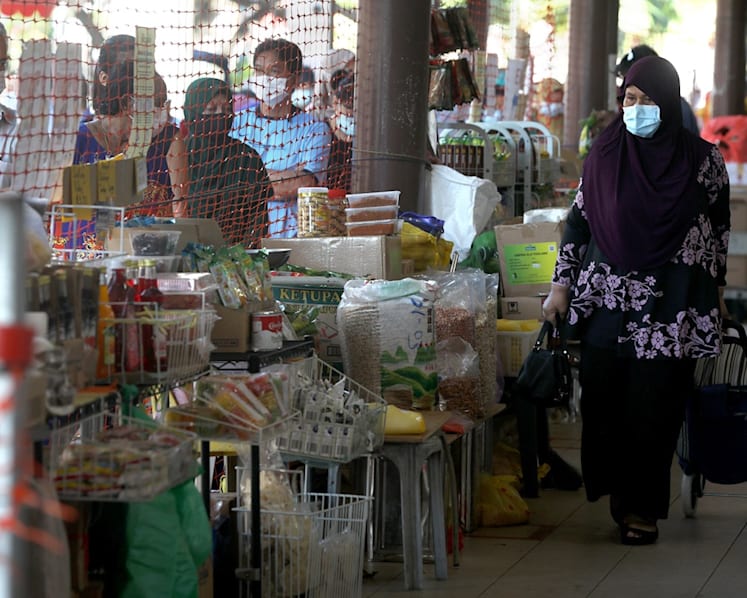
A queue at Geylang Serai Market on May 21. One suggestion by the author is for Singapore to institute single-way lanes at markets and supermarkets.


The Government announced on May 19 that Singapore would exit the circuit breaker in three phases after June 1. This came after six weeks of closing down non-essential businesses and getting Singaporeans to work from home.
Covid-19 infections in the community dropped sharply and cases are now mostly confined to the migrant worker dormitories.
As Singapore gears up to resume activities cautiously from June 2, I would like to offer five suggestions on how we as a nation can accelerate our graduation to the new normal.
EASING TRAVEL





The Baltic countries of Estonia, Latvia, and Lithuania have opened their borders to one another. Australia and New Zealand are contemplating a similar free travel zone. These are small but important steps towards normalising society and economy.
The Government is exploring the reopening of borders with other countries which present similar or lower risk of Covid-19 transmission as Singapore. However, the optics of Singapore’s current Covid-19 situation may hinder such efforts.
If citizens of other countries are not receptive to visitors from Singapore given the relatively high headline numbers, it would be hard for their governments to allow travel for visitors from Singapore without restrictions such as quarantine.
One way is to report our Covid-19 statistics for two categories — Singapore-R (resident population, comprising citizens and permanent residents only) and Singapore-NR (non-resident).
This would allow Singapore to emphasise in our negotiations that we seek free movement for Singapore-R.
SAFEENTRY SYSTEM
The new SafeEntry system requires users to register their name, National Registration Identity Card (NRIC) number and mobile number before entering premises.
According to the SafeEntry website, the data would be shared with the authorities and would be deleted “when it is no longer needed for contact tracing”.
As a nation, we have worked hard to protect individual privacy. It took a huge effort to get from the days when lucky draw organisers published results with the NRIC numbers of winners to the present where businesses are not allowed to register the numbers for customer loyalty programmes.
The 2018 SingHealth cyber breach where the personal particulars of 1.5 million patients were stolen sharply reminded us of the hazards of large centralised databases of individual information.
Does the SafeEntry system really need NRIC numbers?
Logging the mobile phone numbers should be good enough since they are registered to individuals with proof of identity at the point of sale. If needed for contact tracing, the telecommunication companies would have the records.
And, in any case, would not the authorities contact people through the mobile phone? So, the mobile phone is the key link, not an NRIC number.
As for seniors and kids who do not have smartphones, the Government has said that it is working on technological solutions to include them in contact tracing.
CROWD CONTROL AT MARKETS
Despite home delivery of groceries, many Singaporeans still prefer to shop in person. Congestion at several popular wet markets had led the government to limit entry by NRIC numbers.
Some supermarkets have had to regulate entry to prevent overcrowding within their premises.
A long-term but costly solution is to increase the spacing of aisles. A more immediate solution (implemented by supermarkets in California) is to channel customers in one direction along each aisle.
The one-way system can help to avoid customers inadvertently facing each other and reduce cross-infection.
Another California practice that our supermarkets could follow is to provide customers with alcohol wipes to wipe basket and trolley handles.
TELEMEDICINE AND INSURANCE
Since the circuit breaker started on April 7, the Ministry of Health (MOH) has directed all medical practitioners to defer non-essential medical care. Services that are suitable for teleconsultation should be delivered remotely, said MOH.
Telemedicine reduces the risk of cross-infection, cuts travelling and waiting, and overall, raises productivity.
The continuation of remote consultation could be a lasting benefit of the Covid-19 outbreak.
Yet for several weeks after the circuit breaker started, some insurers do not cover remote outpatient consultations unless patients had policies with specific telemedicine coverage.
It was only on May 5 that the Life Insurance Association Singapore and the General Insurance Association announced that insurers would cover all outpatient telemedicine claims with immediate effect.
The move came two weeks after the Government announced on April 21 that the circuit breaker would be extended by four weeks to June 1.
The associations said the move was part of insurers’ efforts “to provide additional support for policyholders amid the Covid-19 pandemic and especially in light of Singapore’s extension of the circuit breaker period to June 1”.
While the gesture was certainly welcome, there was no explicit indication of how long it would last.
In a statement on May 22, MOH made clear that given that even after Singapore ends the circuit breaker on June 1, physical medical consultations “should be minimised whenever possible, with teleconsultation and medication delivery being the preferred mode of review”.
Given that remote consultations will prevail as Singapore settles into a new normal, insurers should continue to cover telemedicine claims in the months to come.
This will greatly ease concerns of policyholders and show that insurers support efforts to prevent community spread of Covid-19.
TRANSPORT DESIGN
A greater challenge will be public transport. Maintaining distances of at least 1m seems impractical, especially during peak hours.
Part of the solution is requiring all passengers to wear masks. Another is design: Train carriages and buses should be retrofitted with windows that can be opened.
Circulation of fresh air would reduce the risk of cross-infection. And it’s not such an old-fashioned idea. In Hong Kong, train carriages are equipped with openable windows.
Singaporeans are keen to resume life as soon as possible in a safe way.
Besides each of us personally doing our part, tweaks in government policies and businesses practices would help.
ABOUT THE AUTHOR:
Ivan Png is Distinguished Professor in NUS Business School and the Department of Economics and principal investigator of SPIRE (Service Productivity and Innovation Research Programme) at the National University of Singapore.




