The Big Read in Short: What the US-China trade and tech war heralds
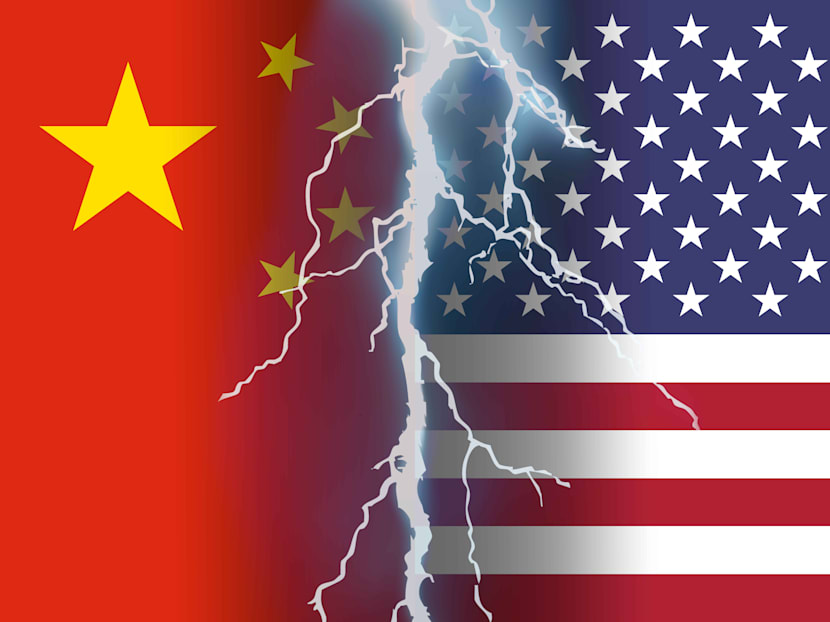
China’s Huawei was placed on a US export blacklist last week, amid concerns in Washington that the telecommunications giant could use its devices to spy on Americans for China.


Each week, TODAY’s long-running Big Read series delves into the trends and issues that matter. This week, we examine the impact and implications of the US-China conflict on the rest of the world, including the man in the street. This is a shortened version of the feature, which can be found here.
SINGAPORE — When the Berlin Wall fell in 1989, worldwide audiences held their breath, hoping that the end of the Cold War would usher in a more united, open world.
The years that followed did not disappoint: Cooperation between nations created an interconnected world, technology was shared across boundaries and in space, and global value chains that made possible the technology seen today now dominate international trade.
But Cold War-era rhetoric has once again seeped into the lexicon as the United States and China wage a trade and tech war against each other, threatening to undermine this globalised and free trade environment.





China’s Huawei was placed on a US export blacklist last week, amid concerns in Washington that the telecommunications giant could use its devices to spy on Americans for China.
The move, said Singaporean and international analysts, threatens to kick-start a technological cold war — or a “digital iron curtain” — that will have far-reaching effects on the rest of the world.
Sure enough, in a retaliatory move, China’s Commerce Ministry said on Friday (May 31) that it will draft a list of foreign companies, organisations and individuals that it deems “unreliable” for harming Chinese companies, state-run China National Radio reported.
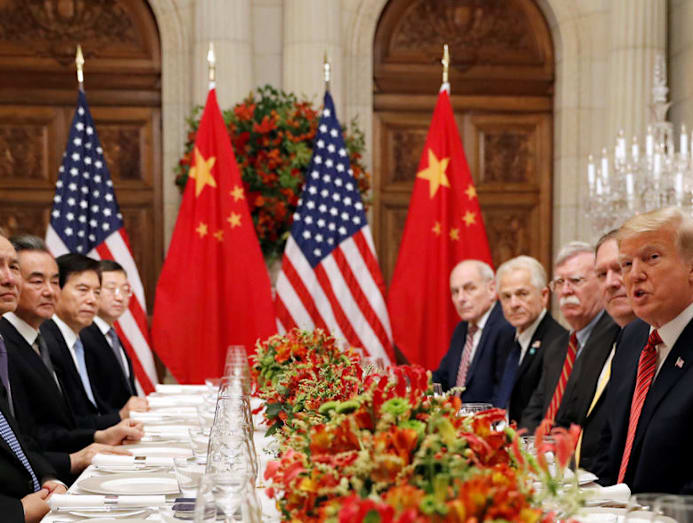
US President Donald Trump and Chinese President Xi Jinping, along with senior officials from both countries, attend a working dinner after the G20 leaders' summit in December last year. Photo: Reuters
PARALLELS AND DIFFERENCES WITH THE COLD WAR
The Cold War fought between the capitalist US and the communist Soviet Union from the ‘50s until the ‘90s was a battle of ideology, but was also marked by a technological conflict — culminating in the space race — as well as espionage and a build-up of military forces by both sides.
Professor Christopher Balding from Fulbright University Vietnam said the current conflict can be framed like the Cold War if one accepts that the US and China are fundamentally in opposition, and the trade dispute is a mere pretext for the conflict between the two major powers. The use of tariffs and punitive measures by the Trump administration are part of the confrontation, he added.
However, Assistant Professor Selina Ho from the Lee Kuan Yew School of Public Policy said that the ideological component is missing in the current conflict. America had presumed China would play a part in the international liberal order, rather than be excluded from it. But this has changed as US thinks China has become a strategic competitor in the economic, technological and military spheres, said Asst Prof Ho.
The tensions started before the election of incumbent US President Donald Trump, experts pointed out. In 2015, US policymakers called for a grand strategy to balance China’s ascendancy. China had also launched “Made in China 2025”, with the aim of becoming a high-tech manufacturing and electronics powerhouse.
As both US and China have not budged from their initial positions on the conflict, there is a strong risk that the technology war will continue in the long term, the experts said.
READ ALSO
Trade war has limited impact on China financial markets - regulator
Fox host, Chinese state TV anchor face off over trade war
China consumers sour as fruit prices soar on weather, trade war
IMPACT ON GLOBAL VALUE CHAINS
The ending of the US-Soviet Cold War gave rise to a new economic order, in which products are manufactured, assembled and traded along a global value chain that plays to the individual strengths and advantages of each nation.
This is why a mobile phone today is made up of parts from all over the globe, otherwise the cost to produce it will be much higher. Two in three products exported today come from the global value chain, according to the World Trade Organisation (WTO) and the World Bank.
But the tech cold war could unravel these chains, experts told TODAY.
Counterpoint Technology Market Research associate director Tarun Pathak said that while these global chains exist today, the balance of power of technology had, over time, become concentrated in the US and China. US’ strength was its research and talent, while China had an advantage in manufacturing products to the rest of the world.
This led to an inevitable situation today where both sides want more control in a zero-sum situation, thinking that one could gain simply by penalising the other party, said Mr Pathak. This will have a knock-on effect on the global value chains for the rest of the world.
UOB economist Barnabas Gan said the tech war will “invariably” affect the Republic deeply. He noted that Singapore’s electronics exports are at a level which is among the lowest recorded.
While Singapore and regional countries could benefit if the supply chain re-orientates to South-East Asia, this will take a long time, plenty of investment, and the world will still suffer a net loss, said Mr Pathak.
At the global level, the significant far-reaching effects would damage innovation and collaboration, as well as widen the digital divide between rich and poor nations, said Professor Fu Xiaolan, the founding director of the Technology and Management Centre for Development at Oxford University.
THROWBACK TO US-JAPAN SPAT
Prof Fu noted that the current conflict bears a similarity to the industrial rivalry in the ‘80s and ‘90s between US and Japan — respectively the world’s biggest and second largest economies at the time.
Then, the US was saddled with a massive trade deficit and had made it a goal to protect its domestic economy from countries like Japan, which was enjoying a trade surplus advantage due to its weak yen.
In 1985, US, Japan as well as three other major economies — Britain, France and West Germany — signed the Plaza Accord. This drastically appreciated the yen against the US dollar. American exports grew, but trade tensions still remained.
In 1987, the US imposed tariffs on Japanese exports, accusing it of setting up a semiconductor cartel.
These actions led to a collapse of the Japanese economy, giving rise to the infamous “lost decade”.
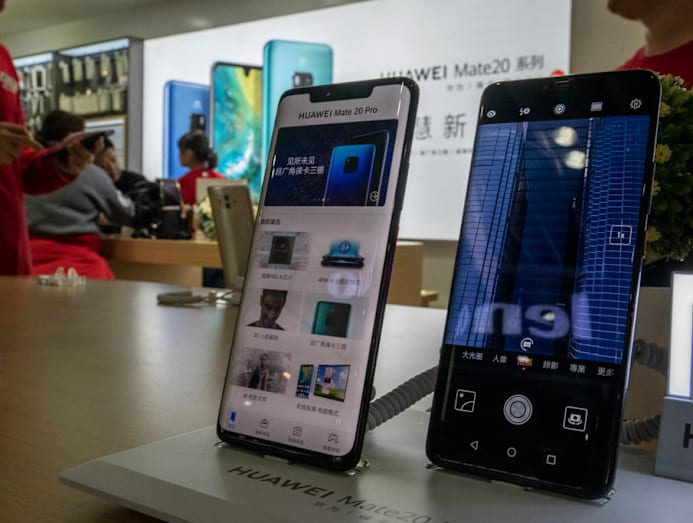
The US has pressured its allies to boycott Huawei-manufactured 5G equipment due to national security concerns. Photo: The New York Times
WIDER IMPACT
As trade tensions persist, regional countries could be politically pressured to choose between the two powers, said experts. This is already seen in the battle for supremacy in the global rollout of fifth-generation (5G) telecommunications networks.
In Europe and Latin America, the US has pressured its allies to boycott Huawei-manufactured 5G equipment due to national security concerns.
Prof Fu said that the rollout of 5G could be pushed back as a result of the tech conflict.
Ms Stephanie Syptak-Ramnath, interim charge d’affaires at the US Embassy in Singapore, said 5G will have a lasting and profound impact on this world and encouraged every country to look “very carefully at every aspect of their choices in 5G networks”.
Responding to TODAY’s queries, the Info-communications Media Development Authority said that Singapore encourages vendor diversity in its telecommunication systems to mitigate risks from dependency on any one vendor. IMDA has launched a public consultation of the 5G rollout in Singapore.
WHAT IT MEANS FOR CONSUMERS
Last year, Huawei had a 13 per cent share of the Singapore smartphone market. Apple was first, at 37 per cent, followed closely by Samsung at 34 per cent, according to data from market intelligence firm IDC.
With US firms such as Google and Qualcomm yanking the licences for Huawei to manufacture products with their software and hardware, the future of Huawei is uncertain.
But beyond Huawei phones, if the tech cold war continues to escalate, there could be more severe effects on technological advancement, analysts said.
A global boycott of Chinese technology could lead to a fragmentation of how 5G technology develops — much like how there were two standards for VHS and Betamax, said Ms Lim May-Ann, managing director of research consulting firm TRPC.
Mr Alfred Siew, co-founder of technology website Techgoondu, said that interoperability of technology could also be affected if technological development is forced to happen based on boundaries and geopolitical lines. Noting that Russia passed a law last month to disconnect from the World Wide Web, he said: “Will we see a world of three Internets: one for US, China and Russia? Nobody knows.”