

Of apple ears and menstruation machines
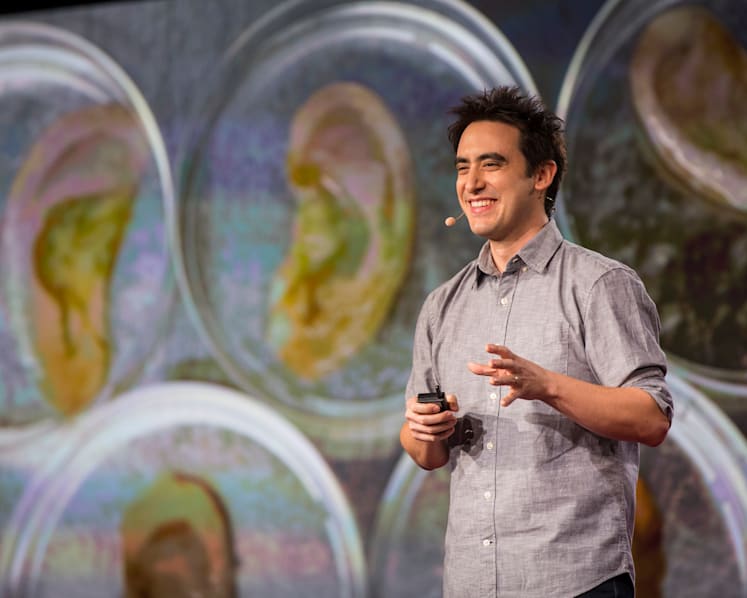
Hear from scientist and biohacker Andrew Pelling at the Marriott Hotels TED Fellows Salon here in Singapore. Photo: Ryan Lash


Brought to you by

By injecting human cells into apples carved into the shape of an ear, scientist Andrew Pelling created a cheap artificial ear that could one day replace expensive prosthetic ears.
In order to let men experience the pain of menstruation, artist Hiromi Ozaki leveraged technology to create a machine, worn around the waist, which simulates bleeding and muscle cramps.
Dr Pelling and Ms Ozaki are TED Fellows, a prestigious group of people worldwide who have been recognised by TED as innovators on the rise in their respective fields.
Both will be in Singapore for the Marriott Hotels TED Fellows Salon, part of a global partnership between TED and Marriott Hotels, where TED Fellows are invited to speak to and inspire audiences around the world.





This year’s theme is based on imagination, where the speakers will focus on how they find inspiration and think out of the box. The event will be held at the Singapore Marriott Tang Plaza Hotel on Oct 29.
REAL-LIFE IMPLICATIONS
Dr Pelling is a professor and entrepreneur whose imagination has wandered far beyond others.
As a biohacker – someone who manipulates biology using certain techniques – the thought struck him one day: Is there any way that people can cheaply make their own body parts in their kitchen sink? What about from fruits? These have cell “scaffolds” that could be implanted with human cells.
Dr Pelling got his wife, who makes instruments, to carve out the shape of an ear from an apple. That slice was washed with soap and water to remove the apple cellular material. Human cells were then injected into it. Amazingly, the human cells grew and multiplied within the empty scaffolds of the apple cells.
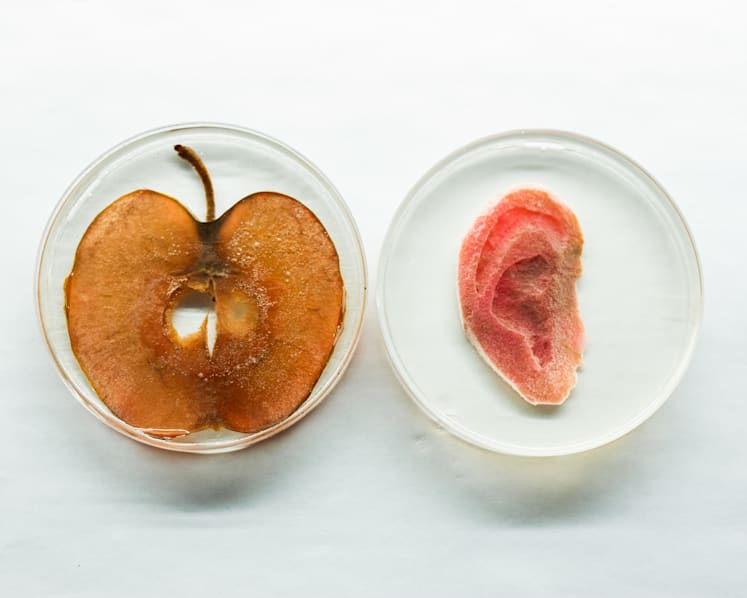
Apple ears: Paving the way for affordable prosthetics? Photo: Bonnie Findley
The invention is making waves as a quirky “wow” project and is not being used in reality yet. But it has the potential to benefit humankind as a scientific application for affordable prosthetics.
Dr Pelling is now studying the possibility of using the humble asparagus to form new connections between the ends of damaged and severed nerves, or even for the spinal cord.
In order to gain different ideas, perspectives and insights, the professor and research chair at the University of Ottawa likes to bring artists, scientists, social scientists and engineers together in his projects.
“It’s really important to bring people together from other disciplines and backgrounds,” he said. “That diversity of experiences and perspectives often leads to really interesting questions, ones that you would never predict,” he mused.
EXPLORING CONTEMPORARY ISSUES
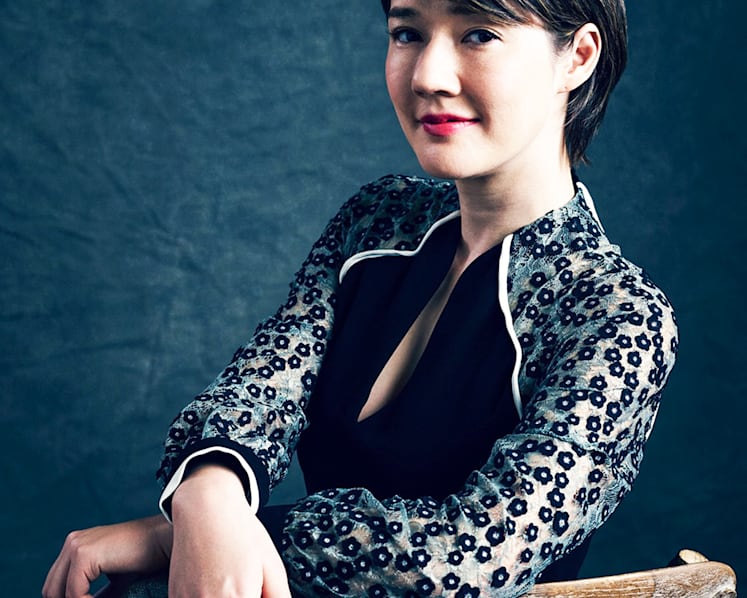
British artist and designer Hiromi Ozaki is unapologetically unconventional. Photo: TED Conferences LLC
Like Dr Pelling, Ms Ozaki, a project associate professor at the University of Tokyo, likes to adopt a multi-disciplinary approach. Her work, which seeks to confront issues faced in contemporary society, cuts across music, art, design, social media and technology.
“I’m an artist and I work with scientists and engineers to imagine different kinds of futures, and make videos talking about these possible futures based on technology I work with,” said Ms Ozaki, who’s popularly known by her artist moniker Sputniko!
One of her more notorious works is the menstruation machine, a device fitted with a blood-dispensing mechanism and lower-abdomen-stimulating electrode to simulate the pain and bleeding of menstruation.
To propel the machine into mainstream consciousness, she created and wrote the music for a music video about a boy who built the machine to feel like a girl. It has garnered over 600,000 views on YouTube.
One of Ms Ozaki’s latest projects is telling the story of a fictional school – the Tokyo Medical University for Rejected Women – where women rejected from medical schools operate on men using robots, turning them into perfect male doctors who “graduate” from the school. It’s a dig at the scandal that erupted last year when medical schools in Japan were found to have lowered exam scores of female candidates to preserve the medical industry’s male-dominated environment.
[ooyala id='VudGhqaTE6yWEcJdoZaHnekXpMBIt-ZP'][/ooyala]
TED Fellows are invited to Marriott Hotels around the world to spark creative ideas and meaningful conversations. Video: Marriott Hotels
WIN TICKETS TO TED FELLOWS SALON
Meet Dr Pelling and Ms Ozaki face to face at the TED Fellows Salon, a collaboration between TED and Marriott Hotels that started in September 2016. TED Fellows are invited to Marriott Hotels around the world – including Bangkok (2017), Bangalore (2018) and Singapore this year – to spark creative ideas and meaningful conversations.
Marriott Hotels is offering 30 pairs of tickets for the TED Fellows Salon, held at Singapore Marriott Tang Plaza Hotel on Oct 29. Enter the sweepstakes here. The contest ends on Oct 21.




