After nearly 3 decades on the job, this zoo veteran says 'animals are so much smarter than people'
At 20, fresh out of polytechnic, Ms Chan Poh Shan walked into the Singapore Zoo's corporate office asking for a job. She hasn't looked back since.
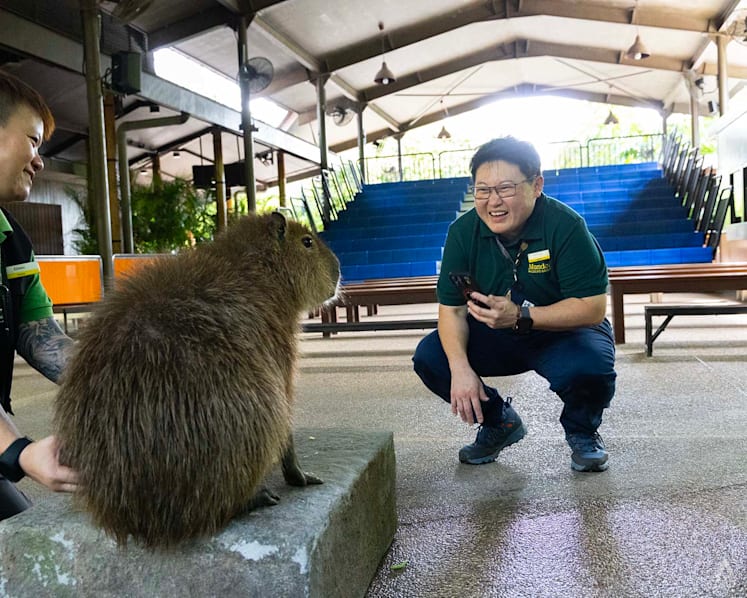
Long-serving zoo worker Chan Poh Shan (right) facing a capybara. (Photo: CNA/Raj Nadarajan)

This audio is generated by an AI tool.


For most people, the excitement of going to work would likely wear thin after more than two decades on the job.
But since 1998, Ms Chan Poh Shan has happily made the long trek from her Tampines home before sunrise to reach her Mandai office by 7.30am, before her 8am official start time.
"The air is fresher in the morning," the 48-year-old told me with a conspiratorial smile as if letting me in on a trade secret.
When we met one morning in late December – at 9am, much later than her usual start time – Ms Chan took me on a tour around the River Wonders and the Singapore Zoo in a buggy.
Our ride was full of starts and stops as the deputy vice-president of animal behaviour and programmes at Mandai Wildlife Group slowed down to say hello to animals and staff members alike by name.
At 20, fresh out of polytechnic, Ms Chan walked into the Singapore Zoo’s corporate office one day.
"I came to the zoo and thankfully, I met with this HR (human resources) lady who was so nice. She told me that they were advertising for a keeper position in one week's time, asking me to look out for the advertisement in the newspaper," she recalled.
Despite having a diploma in chemical process technology, she decided to pursue her interest in working with animals instead after being "totally bored" during a laboratory internship.
The rest, as she put it, was history – a kaleidoscopic career working with more than 100 species of animals across Bird Paradise, River Wonders, Night Safari and Singapore Zoo's Animal Behaviour and Programmes departments, including sea lions, snakes, puma, wolves, hyenas and binturongs.
"You name it, I've handled it before," said Ms Chan, who now oversees the animal behaviour and programmes department with 70 to 80 workers under her watch, along with around 800 animals from more than 100 species in her care.





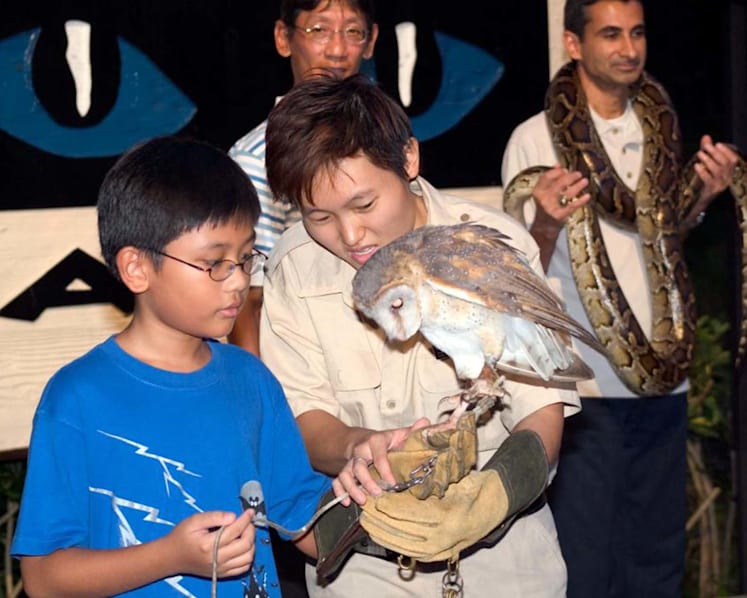
After a 2023 promotion, her more desk-bound, business-minded role is now filled with emails and meetings.
But the best parts of her day are the in-between periods when she gets to make her rounds of the parks, checking on the animals and chatting with staff members.
"Obviously, previously, I was a lot happier, when I could engage with animals more than people," said Ms Chan with a chuckle.
"Being around animals, training and getting to know them, is the best part of the job."
EARLY ENCOUNTERS WITH THE WILD
Maybe it was the novelty of being on a buggy for the first time, or the chirpy way Ms Chan greeted fauna and humans alike as we made our rounds, but her enjoyment of her workplace was somewhat infectious.
"I love to drive. I love to drift. If only buggies could drift," she said half-jokingly, while navigating around familiar bends.
Most of Ms Chan's adult life has been spent in the parks of Mandai Wildlife Group, which is the steward of Mandai Wildlife Reserve, home to five attractions: Rainforest Wild Asia, Singapore Zoo, River Wonders, Bird Paradise and the Night Safari.
She did not hesitate to refer to her workplace as her second home, and her colleagues and the animals as her second family.
After all, they have seen her through many life milestones, including pranking her on her 21st birthday and throwing her into the pool on the stage of the Singapore Zoo Shaw Foundation Amphitheatre.
We do everything from cleaning the animal's enclosure to refurbishing their dens, carrying logs, sourcing big trunks and leaves to decorate their dens and make (the habitats) interesting for them.
After landing her first job as a keeper, Ms Chan's days began the same way for years: checking on the health and well-being of the animals in her care and handling husbandry.
"We do everything from cleaning the animal's enclosure to refurbishing their dens, carrying logs, sourcing big trunks and leaves to decorate their dens and make (the habitats) interesting for them," she said.
Back then, Ms Chan did not know if working with animals would be her calling.
"The first week was the most terrible week, because the shoes were horrible, the gum boots. My feet were just aching so badly," she recalled. "But you kind of overcame it, because the animals were just fun to be with."
Ms Chan continued working part-time as a show presenter at the Night Safari even during a career break while getting her degree in biology, before returning as a full-time employee after graduation, eventually climbing the ranks in a series of managerial roles.
She started with sea lions, reptiles, then dogs, cats and other domestic animals in the Singapore Zoo's KidzWorld, before looking after other species, including puma, wolves, hyenas, binturongs, otters, sugar gliders, rats and capybaras.
She now conceptualises enhancements to existing programmes for visitors, such as Breakfast in the Wild, where guests may eat breakfast while meeting animals that include African penguins and animal presentations such as River Wonders' Once Upon A River.
While she no longer gets as much hands-on time with the animals, Ms Chan said she is proud of the role she plays in designing a curriculum and better career pathways for her staff members, especially given Singapore's lack of zoology courses in tertiary institutions.
"Previously, you observe, you find a senior to teach you. If they teach you the wrong thing, that's it.
"Now, it's a lot more structured, everything is written down, so coaches just need to follow through the manual and add in their experiences to teach new staff," said Ms Chan, who is now pursuing a part-time Master of Business Administration course to "sharpen (her) skills" and better handle the growing responsibilities of her role.
It was clear to me that although she no longer works with animals as closely, the skills and relationships she had built over the years were second nature to her.
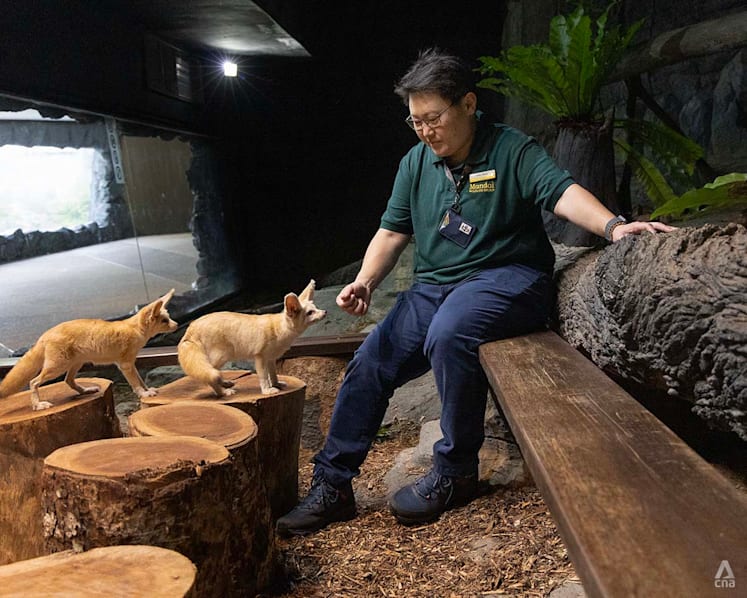
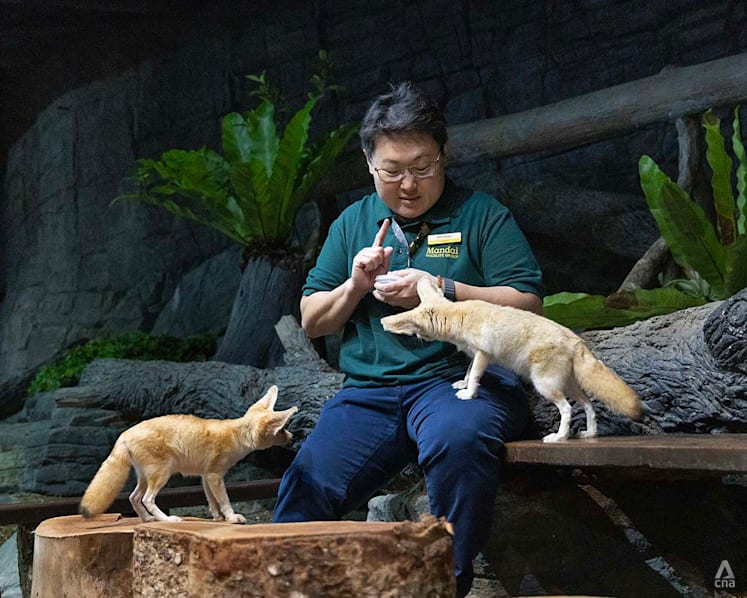
During our chat, she introduced me to Nailah and Zuri, a mother-daughter pair of fennec foxes housed at the Animal Behaviour and Enrichment Centre within the Singapore Zoo.
She had cared for Zuri, the mother fox, after it was rescued as a confiscated pet from the illegal wildlife trade. Nailah was born in 2016, much to Ms Chan's delight.
Inside the enclosure, the two foxes were wrapped up in play, but Ms Chan said she was able to tell them apart just by the shape of their faces.
It was their most active period of the day, just after waking, and they darted about, circling one another before stopping briefly when Ms Chan called their names.
"Don't worry, the bites are not painful at all," she said with a smile, offering treats unhurriedly as the little foxes circled our feet.
TOO MANY FAVOURITES
Ask Ms Chan if she has a favourite animal in her decades of working with them and she would refuse to choose one.
"There are too many favourites," she said, shaking her head.
Even though she is the only one in her family working with animals, Ms Chan traced her love for animals to her childhood, when she grew up in a "mini zoo", where her parents' provision shop in Siglap was home to cats, dogs, birds, terrapins and fish.
These days, Ms Chan lives with her parents and her cat Chummy, which was rescued from a warehouse.
Animals and this job, it seems, have long taken up most of her life and Ms Chan admitted that she could not quite imagine herself doing anything else now.
"The only other thing I can imagine myself doing is sleeping, binging on Netflix," she said.
She admitted, however, that she does not enjoy watching animal documentaries.
"I don't mind, but I don't like to see the sad part of documentaries, an animal being hunted and killed. I don't want to think about it."
The most difficult part of the job for her is when an animal is sick and nearing the end of its life.
"No matter how tough the boss is, or how tough the day can be, it can never be as tough as losing a family member," she said.
While she is soft-hearted for the animals in her care, Ms Chan's job role is something that clearly takes a strong backbone.
During our interview at River Wonders, she and her trainers coaxed capybaras gently as they nosed at leaves, never rushing them even as they backtracked, wandered around and took about a half hour to walk the short distance back to their homes.
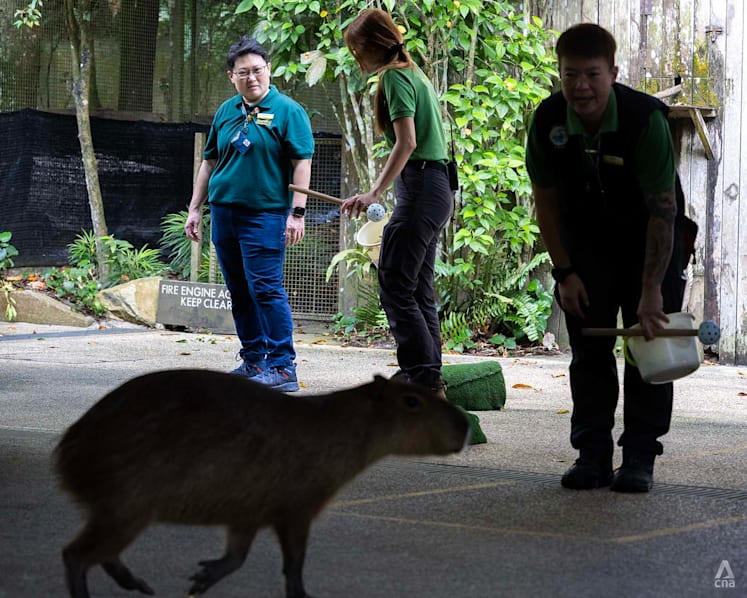
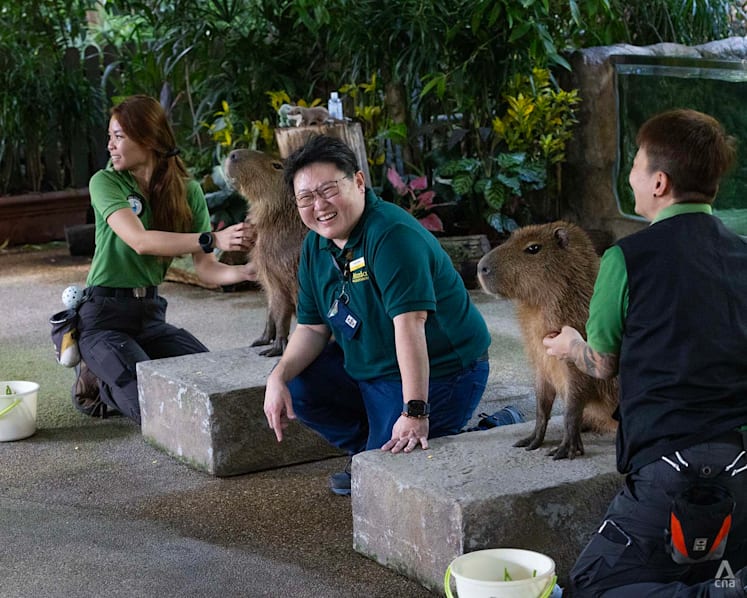
The task of handling both animals and visitors simultaneously is one that requires sensitivity, patience, situational awareness and common sense, said Ms Chan.
"Some people want to see immediate results, but you don't get to see that, so patience is really important.
"With co-workers, I always tell them that with animals, no matter how aggressive they are, we shouldn't retaliate with aggression or dominance, because that will never work."
These hard-won lessons were forged over more than two decades on the job. And she has the scars to show for it.
She pointed out one behind her head, where she once needed 13 stitches after a binturong caught its claws on her while playing. This was an encounter from her early years, before she knew how to "read" the animal's behaviour.
However, Ms Chan insisted that all these injuries were solely the result of "human error".
She is not intimidated by big cats or carnivores, especially given that she raised many of them since they were young.
When we took her (a hyena) in, she was one vicious devil. She kept on charging and biting, and I still have the scar from her.
She recalled working with a young hyena. Its ears had been bitten by its mother, which had killed its sibling.
"When we took her in, she was one vicious devil. She kept on charging and biting, and I still have the scar from her.
"But with patience and training and routine, we were trying to create that positive reinforcement. And in the end, she became like an angel, she was playing ball with all of us."
In this case, they engaged the hyena through positive reinforcement training, a method of using rewards to encourage desired behaviours when training an animal.
Ironically, the only creature that Ms Chan is afraid of is the household lizard.
"Everyone always says, 'You're not scared of puma, you're not scared of hyenas, you're not scared of snakes, you're scared of lizards?" said Ms Chan, shuddering at the thought of the latter. "Yeah, why not?"
One of the earliest challenges at work was learning how to handle snakes, not least because some were around 3m long, but also because they needed to be regularly fed lizards to add variety to their diet.
Whether dealing with reptiles or the changing demands of her role, Ms Chan said that she has tried to keep an open mind and expose herself to different parts of the job, to appreciate the work more.
"It doesn't occur to me that I would leave here. All I'm thinking about is what do I need to do tomorrow?"
ANIMALS 'SO MUCH SMARTER' THAN PEOPLE
Being a part of corporate life was never her goal, but Ms Chan said she recognised it as a natural part of career progression and sees herself as a “voice for the animals and the people”.
She is far from the only long-serving staff member at Mandai Wildlife Group, having colleagues who were at the zoo before she was born. What keeps people around, she believes, is a combination of the environment, the people and, above all, the animals.
"Thinking about leaving here, leaving the animals and people behind, is sad. I see my team now and I love them so much. They're like a crazy bunch of people, but it's so nice to see them grow over the years as well," said Ms Chan.
Over the years, she has watched Mandai Wildlife Reserve also evolve alongside changing expectations.
She gestured to the former Frozen Tundra building, once home to Inuka the polar bear. It has been repurposed into the zoo's animal behaviour and enrichment centre to give visitors a closer look at how animals are cared for and encouraged to thrive.
"It's not only an animal park, but it has lots of standards in terms of animal care, how we manage the animals. Maybe a lot of people will think Western zoos are the best, but if you come to Singapore Zoo, you come to Mandai, you will get equal experiences or even better."
When I asked about broader ethical concerns surrounding animal welfare in zoos, Ms Chan said the company is "never stagnant", striving to improve with the times and give its animals the best.
All tickets to Mandai Wildlife Reserve, for instance, also have a portion of the revenue committed to supporting more than 50 conservation projects across Singapore and Southeast Asia.
Educating visitors, including gently correcting misconceptions on the job, is also important, she said.
"Parents are misleading (the children) sometimes. Every time (a parent says things like), 'Dirty, no, it'll bite', we will call them over and explain," she said.
Be it through conversations with visitors or in the programmes she helps design, Ms Chan hopes to encourage people to be nicer to animals and not take the natural world for granted.
"Animals are not stupid. They're all so much smarter than people.
"It's just a lot of perceptions that people have about animals that are so wrong. We are not the superior ones ... They created this ecosystem. We are just living in it," she said.