About time Parliament’s processes get updated
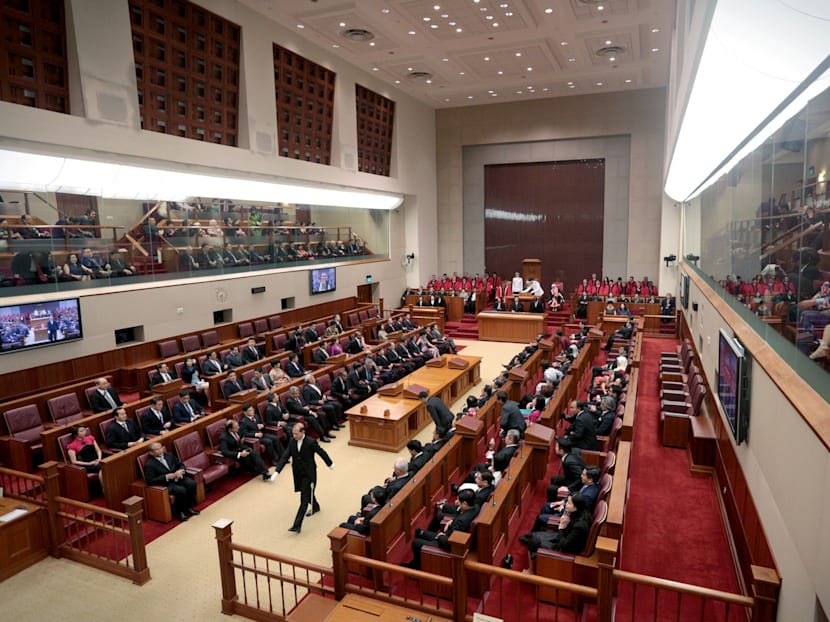
Parliament’s role in the nation’s governance cannot be underestimated. It is not simply about making correct decisions, but also about how robustly decisions are made. Photo: Jason Quah


In Singapore’s system of constitutional government, Parliament’s standing as the focal point of political life and governance is vital. As the primary law-making institution, Parliament plays a critical role in endowing the nation’s laws and national policies with authority and legitimacy.
This is achieved through Parliament’s scrutiny function vis-a-vis the Executive, primarily through the examination of the Government’s policies and decisions. For example, Government ministers are regularly questioned in Parliament on their ministries’ policies and decisions.
Today, Members of Parliament (MPs) will debate a motion on the amendments to Parliament’s Standing Orders (SO), the written rules of procedure that regulate Parliament’s proceedings. Article 52 of the Singapore Constitution empowers Parliament to “make, amend and revoke Standing Orders for the regulation and orderly conduct of its own proceedings and the despatch of business”. The last time the SO were amended was in 2010.
One of the key changes to be debated today is the proposal by the Standing Orders Committee to raise the minimum interval between the introduction of a proposed legislation and the ensuing debate in the Second Reading from seven to 10 “clear days”.





Since 2006, an average of about 30-odd Bills (proposed new laws or amendments to existing laws) are introduced each year. What this figure belies is the significance of some of these laws, including the Pioneer Generation Fund Bill, the Public Order Bill and major constitutional changes.
Given the gravity of the proposed changes, many MPs joined in the various debates in Parliament. As such, the proposal to increase the minimum interval between a Bill’s introduction and its Second Reading debate is to be welcomed. This will give MPs more time to study a Bill and to prepare their speeches and raise pertinent questions.
Occasionally, our courts also consider the Government’s responses to MPs’ speeches and queries during such debates to help interpret the laws. One recent example concerned the Protection from Harassment Act and whether it applied to protect entities or organisations from harassment.
The larger point is that any proposed law must be carefully scrutinised, particularly those that provide the Government with significant powers such as the Public Order (Additional Temporary Measures) Bill in the wake of the 2013 Little India riots, and the Criminal Law (Temporary Provisions) Act which has to be renewed every five years.
Another set of proposed amendments by the Standing Orders Committee to improve parliamentary procedures arises from last year’s constitutional changes relating to the Elected Presidency. Under the Constitution, Parliament can overrule a presidential veto that is contrary to the recommendation of the Council of Presidential Advisers.
The proposed amendments call for both the President’s grounds and the council’s recommendation to be made available to Parliament at least two days before the motion to overrule the President. This is after the Speaker of Parliament has determined and is satisfied that the President’s decision in the exercise of his custodial powers was in fact contrary to the council’s recommendation.
Before overruling a presidential veto, the issue must be carefully studied and debated robustly by Parliament. Such an overruling must be done on a principled basis and should have the support of Singaporeans.
Otherwise, Parliament’s overruling of a presidential veto can divide the country.
In this regard, the proposed requirement of a minimum of two days to study the documentation is too parsimonious to fully consider a contentious and weighty issue where public opinion may be split.
The Standing Orders Committee also considered whether to increase the length of time for parliamentary questions, which is currently fixed at 90 minutes per sitting day.
But the 10-member committee — which includes Parliament Speaker Halimah Yacob, Leader of the House Grace Fu, Government Whip Chan Chun Sing and Workers’ Party MP for Hougang Png Eng Huat — decided that there was no need to increase the duration of Question Time. The basis was that the Government had, from time to time, extended it to three hours.
This is a missed opportunity by the committee.
Question Time is a valuable platform for Parliament to hold the Government to account, and for the Government to explain and justify its policies and decisions, and the use of public funds. MPs file in advance, questions for oral or written answers by the various ministers on the various subject matters they are responsible for.
Questions for oral answers are different from those for written answers as the former enables the MPs to ask supplementary questions in the House.
A case can be made for Question Time to be increased to two hours in every sitting. In 90 minutes, Parliament seldom goes beyond 20-25 questions, leaving about two-thirds of all questions filed for oral answers in a sitting either to be deferred to the next sitting (with no guarantee again that it would be answered during Question Time) or a written answer provided.
As governance becomes more complex, a timely airing of Singaporeans’ concerns can highlight issues and elicit effective and efficient responses. After all, governance requires not just a whole-of-government perspective but a whole-of-society approach.
Question Time is also a platform for the Government to explain its policies and position on alternative views.
It is this iterative process of questions and answers, the articulation of diverse views, that forms an integral part of Parliament’s role as a check and balance.
How supplementary questions are responded to is often revealing as well. Are answers pro forma? Do they get to the core of the issue and address the MP’s concerns? The form and substance of the Government’s response is often indicative of the mastery of the minister with regard to the topic under scrutiny as well as the coherence of the policy and its implementation.
Government and governance are fundamentally about the ability to exercise power, including the processes for making and implementing decisions. It is not simply about making correct decisions, but also about how robustly decisions are made. Are they in tandem with Singaporeans’ growing aspirations for inclusive and purposeful representation and democratic ownership of governmental processes?
Parliament’s role in the nation’s governance cannot be underestimated. As such, its processes and procedures must continuously strive to attain higher levels of relevance, effectiveness, efficiency and legitimacy.
ABOUT THE AUTHOR: Eugene K B Tan is associate professor of law at the Singapore Management University