

An election 50 years ago may hold lessons for Thailand in 2019
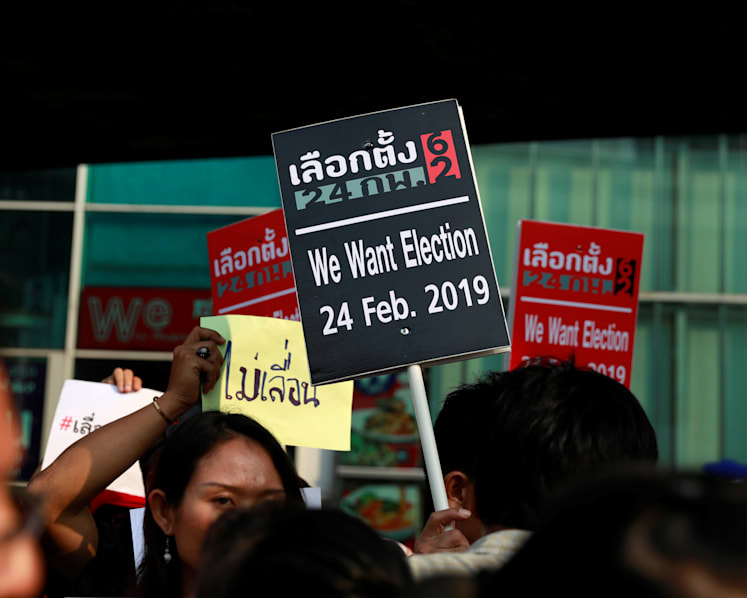
Activists and university students gather in Bangkok on Sunday (Jan 6) to demand the first election in Thailand since the military seized power in a 2014 coup to be held on February 24.


The first months of 2019 will see a major change in Thailand’s political landscape after half a decade of forced stagnation.
Whether as scheduled on Feb 24 or — as rumours in Bangkok now suggest — sometime in March, voters will soon go to the polls in elections due to end the military dictatorship of the National Council for Peace and Order (NCPO) junta in power since May 2014.
Provisions in the junta’s 2017 constitution favouring military domination of politics and government, along with continuing intimidation of the populace and the suppression of political activity, lead many observers to doubt that the elections will be free or fair. But such criticism underestimates the importance of the planned polls.
A single reality determines the nature of electoral and democratic politics in Thailand. This reality is that the overwhelming majority of Thai voters cast their votes in the provinces. Electoral and parliamentary politics in the country are therefore in fact provincial politics.





Bangkokians may consider their home town a trendy and fashionable world city. But the preferences and worldviews of provincial Thailand define any elected national parliament that meets in the capital.
During the last six months of 2018, with elections in view, NCPO head and Prime Minister Prayut Chan-o-cha tacitly acknowledged this reality.
He held increasingly frequent “mobile cabinet meetings” in such settings as Ubon Ratchathani in the north-east, Chiang Rai in the north and Chumphon in the upper south. This electioneering by stealth served to help lay the groundwork for General Prayut’s anticipated return to the premiership after the coming polls.
Those polls will occur 50 years after another general election held under very similar circumstances.
That earlier election and its aftermath suggest that it would be a mistake to dismiss the upcoming polls as insignificant, despite constraints both on the elections and on the parliament that will be elected.
On Feb 10, 1969, under a constitution introduced the year before and designed to ensure military domination of Thai politics, the dictatorship of Field Marshal Thanom Kittikachorn allowed parliamentary elections.
Just as civilian backers of Gen Prayut last year organised the Phalang Pracharat Party as a vehicle to support his retention of the premiership after the 2019 elections, so had a pro-military party been formed to contest the 1969 elections and allow Thanom to retain the premiership afterwards.
This tactic worked, as analysts believe that Gen Prayut’s plan to remain in power with the support of Phalang Pracharat and an appointed Senate will also work this time around.
But by the end of 1971 Thanom could no longer manage even the Members of Parliament — many elected from the provinces and focused on priorities of their own — belonging to his own pro-regime party. He infamously staged a coup against his own government and abrogated the 1968 constitution.
Less than two years later, in October 1973, impatience with restored military dictatorship and economic pressures in the form of skyrocketing rice prices combined with military factionalism to produce violence and tragedy on the streets of Bangkok and the collapse of military rule.
These developments of half a century ago merit recollection today. They highlight a range of issues for observers of Thailand to bear in mind as the country enters 2019.
Will, for example, a post-election government under Gen Prayut’s likely leadership prove capable of making the transition from enjoying unfettered dictatorial powers to managing the inherent messiness of debate in a parliament overwhelmingly composed of members elected by provincial voters?
Likely to make that task more difficult will be the presence in parliament of members belonging to the Pheu Thai Party, with its strong support in northern and north-eastern Thailand.
The use to which former Prime Minister Thaksin Shinawatra will, working from exile, put that party’s parliamentary delegation numbers is among developments to watch in the year ahead.
Of similar interest will be the role of military factionalism.
While Thanom staged a coup against his own government before other factions in the Thai military turned on him, military factionalism did in the end bring him down.
How long Gen Prayut’s fellow generals will remain willing for him to stay in charge is another important question.
Nor does that question apply only to the military. Observers of Thailand must also watch for signs that the big business concerns whose interests the NCPO has served so well decide that Gen Prayut has outlived his usefulness.
Economic difficulties, to which tensions over trade and over the theft of intellectual property between the United States and China expose South-east Asian economies like Thailand’s, may well contribute to this sentiment.
In addition to parliamentary elections, a second major event will mark the opening months of 2019 for Thailand. The palace has just announced that the formal coronation of King Vajiralongkorn will take place during the first week of May.
In an act that restored the monarchy to a position of influence in Thai politics, King Bhumibol intervened to resolve his country’s October 1973 political crisis.
The late king had by then been on the throne for nearly three decades. He had spent a decade and a half renewing the legitimacy of the Thai monarchy through visits to the countryside and support for economic development.
Should the upcoming elections set in motion events leading to a political crisis, and perhaps even to violence, whether and how King Vajiralongkorn chooses to intervene to resolve that crisis will be crucial questions.
His father’s intervention in 1973 drew on the counsels and talents of a group of close advisors. Observers will therefore do well to pay close attention both to the figures who emerge as the most influential courtiers in the newly crowned King Vajiralongkorn’s reign and to their sensitivity to priorities of the provincial Thai voters who will elect the new parliament.
Thailand, above all provincial Thailand, has changed beyond all recognition since the country’s voters went to the polls in February 1969.
The Thai military and its understanding of its role may have changed rather less.
As for the monarchy, while a new reign has now begun, the last years of King Bhumibol’s reign found royalists in denial of its need to change along with the country and its provinces. The coronation of King Vajiralongkorn in May 2019 may bring the chance to move beyond that denial.
Events will, one way or another, soon make clear how significant the troubling parallels between 1969 and 2019 will prove for Thailand.
ABOUT THE AUTHOR:
Michael J Montesano is Coordinator of the Thailand Studies Programme at the ISEAS-Yusof Ishak Institute.




