

Govt's asset-building approach emphasises individual work ethic, personal responsibility
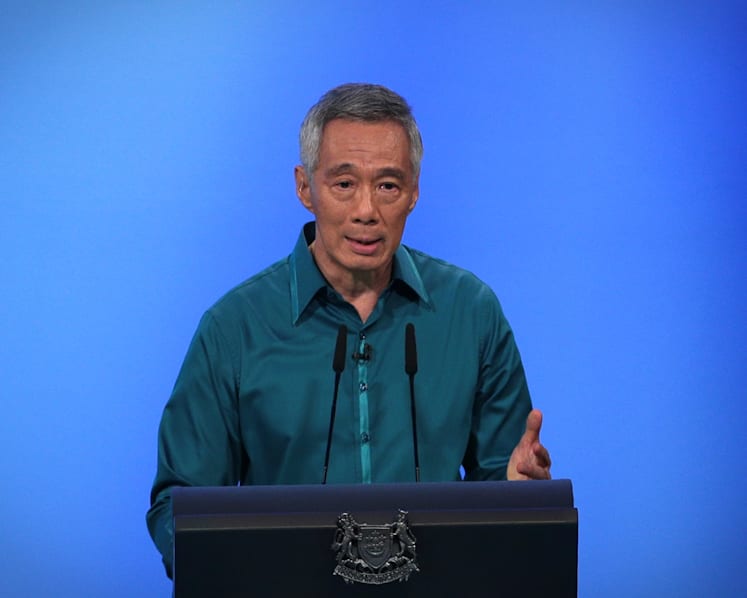
Prime Minister Lee Hsien Loong speaking at the National Day Rally 2018.

I was delighted to be invited by Dr Vasoo and Professor Bilveer Singh to come and launch this book, which they have co-edited entitled “Critical Issues in Asset Building in Singapore’s Development”. I have known Vasoo for more than 30 years. We entered politics together in the 1984 general elections. We were fielded in two adjacent new constituencies in Ang Mo Kio town – he in Bowen, I in Teck Ghee.
Politics was a natural extension of Vasoo’s passion for social work. He brought into politics the same empathy and concern for the disadvantaged that led him into social work in the first place. And after he retired as an MP, Vasoo continued to be active in community work, helping to look after the residents in Teck Ghee.
Doing good is in his blood. I’m very happy to see he is continuing to pursue his calling – both in academia and also practising social work on the ground. And inspiring and nurturing younger Singaporeans through his teaching and writing. And his latest contribution is this collection of essays on Singapore’s asset-building policies, co-edited with Bilveer.
Bilveer is a specialist in international relations, particularly on Indonesia and Southeast Asia. He teaches and writes on politics and governance. I am glad he is bringing his own perspective to the social issues which have been discussed in this book. The co-editors have chosen to define the term “assets” broadly. To include traditional tangible assets like housing and the CPF. But also intangible assets such as political institutions, fundamental national values like multiculturalism, and consensus on vital policies like defence and water resources.





In my National Day Rally last Sunday, I spoke about public housing. I hope you watched the speech, or if not, I hope you read a little bit about it, especially the political science students. Singaporeans from all walks of life live in public housing, and take pride in our HDB estates. More than 80% of Singaporeans own their own good quality HDB flats, with a full range of amenities, set in a garden city.
The Government has long pursued home ownership as a key national policy, for many good reasons. It gives every Singaporean a stake in the country – something to fight for when the chips are down. It enables every Singaporean to share our economic growth, because as the economy grows, so will the value of your home. And nearly every household has a substantial asset to their name, even low-income households. As a result, we have improved lives significantly for all and avoided the extremes of privation and poverty often seen even in affluent societies.
The Government could have adopted other policies to house the population. We could have left housing largely to the private market, like in Hong Kong. We could have controlled rents, like in San Francisco, or we could have provided rental flats at subsidised rates to tenants, as quite a number of governments do. But none of these alternatives would have achieved the same economic and social results as home ownership. Because the experience of other cities shows that the private market will not provide adequately for the poor or even the middle-income families.
As for rental housing, the mindset it creates is very different from owning the home you live in. It’s not yours. A tenant lives from month to month, rent to rent; he cannot sell the property or leave it to his children; he has no interest in the long-term value of the property. Whereas a home owner takes responsibility for his property, thinks long term, and does his best to protect its value directly through good maintenance and upkeep but also indirectly by upholding the society and system on which the value of his home depends.
That is why HDB sells flats to Singaporeans at highly subsidised rates, and even for low income households, HDB prefers to sell a very heavily subsidised flat to them, rather than offer them a subsidised rental unit at cheap rents. HDB flats are sold on 99-year leases, for reasons both of principle and practicality, which I explained fully at my Rally.
But suffice to say, there are fundamental reasons why we do it, because of equity, and there are practical reasons because after 99 years, it’s time to take back and rebuild.
Some commentators say that since it’s 99 years and not forever, the lease is merely an extended rental and not a sale. I find this argument, frankly, amazing. Because many private properties are held on 99 year leases, and yet nobody argues that they are merely being rented.
HDB lessees have all the rights over their flats that owners of such leasehold private properties have. You can live in it, you can transact it, and you can bequeath it to your children. It is yours. In fact HDB owners enjoy extra privileges, because HDB flats get upgraded from time to time, with generous government funding, which private property does not – sometimes a sore point with private property owners.
So, housing is one important way in which we help Singaporeans to build up their assets, but it’s not the only way. We also have the Central Provident Fund (CPF), which is another major asset that Singaporeans have, and build up over their working years.
The CPF is a compulsory saving scheme. Its original purpose was savings for retirement needs. We could have addressed this need through a state pension scheme, funded through taxes, like many countries do. But instead, we have built a unique system to help people save up for themselves, and build up a nest egg for retirement.
Over time the CPF has expanded into savings for housing, medical and education needs as well. The Government helps you to grow your CPF savings by paying fair and even generous interest rates. And once in a while the Government tops up CPF balances as a hong bao for citizens. Not so very often, but when the Ministry of Finance is feeling rich. This way, Singaporeans have a disciplined way to save for the future, and take care of the major financial commitments for life.
Our approach of asset enhancement has worked well, although we are not dogmatic about it.
We do provide grants and subsidies where necessary, for example Silver Support to supplement the CPF for those who have earned too little to build up enough for their retirement, Workfare to top up incomes at the lower end, and U-Save to help low and middle income households with their utility bills.
In summary, our asset-building approach emphasises individual work ethic and personal responsibility, supported by government policies and resources. And Singaporeans support this approach. This support from Singaporeans for sound government policies is one of our intangible assets. There are other intangible shared values and social norms too, which together underpin Singapore’s society and unity. The book discusses these too, it’s an important part of the book.
Like our commitment to multiculturalism; our tradition of tripartite cooperation; our intolerance for corruption; our acceptance of National Service as a common and necessary sacrifice; our appreciation of the vital importance of water resources; and our trust in one another.
These intangibles hold us together as one people. They enable our society to solve problems and make progress in ways which are very difficult for others to emulate, and therefore, provide us lasting competitive advantage. That is why when the occasion arises, we go out of our way to make a point of these fundamental tenets, to underline their importance and remind people what our social cohesion depends upon. For example, when we deal with corruption cases publicly and transparently, or stand firm on national service obligations, even in cases where people make a strong argument to the contrary.
I am therefore glad that Vasoo and Bilveer have co-edited this volume. It is important for academics in our universities and think-tanks to study and debate issues that are of importance to Singapore and write about them and publish about them and get them published. There will be a diversity of views, that’s the value of the discussion. And any academic worth his salt, will have ideas how things can be done better, or at least differently.
We should encourage such debate, and conduct it in a constructive spirit. It will help us to understand issues better, come up with better solutions, see things in a fresh perspective, and move our debate, our policy and the outcomes forward.
Once again, my congratulations to the co-editors Vasoo, Bilveer and all the contributors for your hard work. It is now my pleasure to launch this book. Thank you very much.




