Have trust in S’pore’s vaccination system, then Covid-19 herd immunity will be attained

The Pfizer-BioNTech vaccine arrived on the evening of Dec 21, 2020, at Changi Airport aboard a scheduled SIA Boeing 747-400 freighter service from Brussels.
Following Prime Minister Lee Hsien Loong’s announcement on Dec 14 that free Covid-19 vaccinations will be offered to all Singaporeans and long-term residents, foreign critics have cast doubt on the safety and benefit of Covid-19 vaccines in messages circulating on social media.
Friends and colleagues have shared such misleading messages and videos with me, and I have come across much harmful misinformation on Covid-19 vaccines in cyberspace, including false claims of a healthcare worker dying shortly after being vaccinated.
OUTSTANDING TRACK RECORD
My confidence that the Covid-19 vaccines approved and used in Singapore will be safe and effective is based on the outstanding track record of Singapore’s National Childhood Immunisation Programme (NCIP).
Since Singapore became independent in 1965, every child from infant to adolescent has had access to vaccination to protect them against serious childhood diseases.
Following periodic evaluation and revision over the years, the NCIP has evolved into a comprehensive programme covering 12 diseases including diphtheria, tuberculosis, poliomyelitis, tetanus and measles.
Only diphtheria and measles vaccinations are compulsory under the Infectious Diseases Act.
The NCIP is based on the recommendations of an Expert Committee on Immunisation which comprises specialists from both the public and private sectors.
Members of the Expert Committee review the safety and efficacy data of vaccines, and provide their expert advice to the Ministry of Health (MOH) on vaccination policies.
Every child is precious to his or her parents.
Parents have faith in our health system and support the NCIP despite most vaccinations being non-mandatory.
This has resulted in high immunisation coverage for every childhood cohort, resulting in herd immunity in our childhood population and the eradication of many debilitating childhood diseases.
This is demonstrated in the table below where the combination of an effective immunisation programme and strong public support has resulted in good public health outcomes:
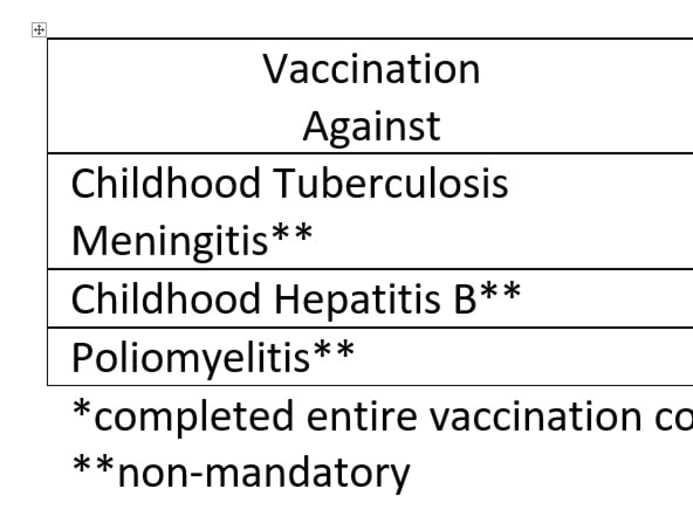
The people of Singapore have demonstrated strong trust in our health system as can be seen from the yearly take-up rate of over 95 per cent for childhood immunisation, according to MOH’s data.
We should have the same confidence that a robust system is in place for Singapore’s Covid-19 vaccine roll-out.
For all medicinal products, including vaccines, approval before use must be given by the Health Sciences Authority (HSA) after a stringent evaluation process.
Similar to the NCIP, MOH has appointed an Expert Committee on Covid-19 Vaccination to assess the safety and efficacy data of various Covid-19 vaccine candidates, make recommendations to the Government on Singapore’s Covid-19 vaccination strategy, and ensure the safe and effective use of Covid-19 vaccines in our population.
PUBLIC ENGAGEMENT
A survey conducted in early December by market research firm Milieu Insight of 1,000 people aged 16 and above found that 48 per cent will get a Covid-19 vaccination when it is available.
Another 34 per cent will wait six to 12 months, 9 per cent will consider having one eventually while the remaining 9 per cent will not get one at all.
Although this poll, commissioned by The Straits Times, shows that Singaporeans are more open to Covid-19 vaccination than the people of many other countries, public engagement must still be carried out to counter the misinformation on social media and halt the growing wave of vaccine hesitancy.
If more and more people get influenced by misinformation and decide to either adopt a wait-and-see attitude or reject vaccination outright, Singapore will have difficulty achieving a high immunisation rate and attaining population herd immunity.
Beside using the media to inform the public, the Government should mobilise grassroots leaders to offer in-person counselling to constituents.
The Government has kept the public well informed on the number of Covid-19 cases through timely updates. In the same way, daily updates on the number of people vaccinated will boost public confidence as the tally grows by the day without any major safety issues.
PUBLIC SUPPORT
MOH’s chief health scientist, Professor Tan Chorh Chuan, has said that at least 80 per cent of Singapore’s population would have to be vaccinated to achieve herd immunity against Covid-19.
Although the Covid-19 vaccination will not be mandatory, Singaporeans should step forward to be vaccinated once it becomes available, except for children under 16, pregnant women, immunocompromised persons and those with health conditions which could make inoculation risky.
With the knowledge that side effects can occur with any vaccine, even with vaccines that have been in use for a long time, we should not let isolated cases of allergic reaction to Covid-19 vaccine deter us from being vaccinated.
Experts say the risk of becoming severely affected by Covid-19 is much higher than by a vaccine. Not being vaccinated puts ourselves, our loved ones and the community at greater risk than getting a jab.
Singapore has no natural resources or hinterland, so herd immunity will allow us to reopen our economy and borders, and bring much-needed economic and emotional relief to all.
All of us are looking forward to a post-Covid Singapore, but we must all play our part in attaining herd immunity.
ABOUT THE AUTHOR:
Associate Professor Lam Pin Woon is a director and advisor of several regional companies. He was previously the chief executive officer (CEO) of the Health Promotion Board and the president and CEO of public listed firm Healthway Medical Corporation.