

Rise of Muslim population poses challenge to India
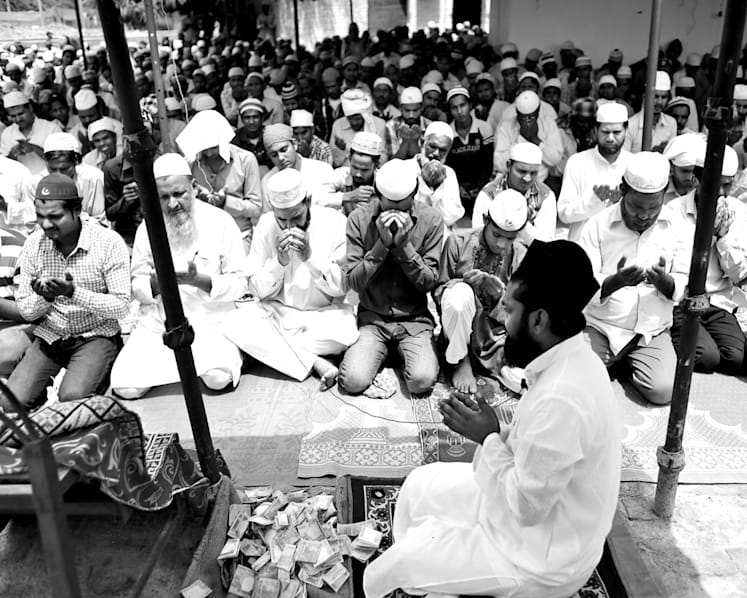
With a population of 310 million Muslims in 2050, India will become the country with the most Muslims in the world. Photo: AP
In the next three-and-a-half decades, the demography of world religions will change considerably, with significant global consequences — political, social and economic.
The proportions of the various religions in the world population will remain largely the same or decline, except for Islam. In South Asia, especially India, where tensions between majority Hindu and minority Muslims are on the rise, such demographic change risks bringing upheavals.
Worldwide, Muslims have the highest fertility rate and the youngest average age, and their number is projected to increase from 1.6 billion in 2010 to 2.76 billion in 2050. For the first time in history, Muslims will nearly equal Christians, until now the world’s largest religious group in size. The number of Christians in the United States, Europe and Australia will decline significantly because of a larger increase in the number of those who identify as “unaffiliated”, perhaps denoting agnostic or atheist.
These changes will also have repercussions for relationships between Muslims and non-Muslims globally, especially in South Asia — exacerbating existing tensions or giving rise to new challenges for promoting harmonious interreligious group relations.





The Muslim populations of all South Asian countries will record varying degrees of change. Afghanistan and Nepal’s Muslim populations will more than double. Bangladesh will register the smallest increase, around 36 per cent. The number of Muslims in the Islamic Republic of Pakistan and Sri Lanka will increase by 63 and 48 per cent, respectively.
The largest and most consequential change, however, will be in India, poised to become the most populous nation. Its Hindu population will increase by 35 per cent from 1.03 billion in 2010 to 1.38 billion in 2050, but Indian Muslims will increase by 76 per cent from 176 million to 310 million in the same period. This means that the largest increase in the Muslim population of South Asia will occur in India.
India will acquire a new global status in terms of its population’s religious composition. With a population of 310 million Muslims in 2050, India will become the country with the most Muslims in the world. While Hindus will remain a majority population at 77 per cent, the proportion of Muslims will increase from 14 per cent in 2011 to 18 per cent in 2050.
The population increase will present additional and more complex challenges for the nation’s democratic political system, which is grounded in its secular Constitution that envisions justice, liberty, equality and fraternity for all Indian citizens. But this system is increasingly contested.
POOR ECONOMIC AND EDUCATIONAL CONDITIONS
While there have been general improvements in living conditions in India, these benefits have not been evenly distributed.
Indian Muslims have not been equal beneficiaries of the nation’s economic growth. Their status is not very different from that of the Dalits, or untouchables, in the mid-20th century, which led to the constitutionally mandated affirmative action. Using 1947 as a baseline, Muslims have experienced downward mobility.
It was this realisation that led India to establish a Prime Ministerial High Level Committee in 2004. Popularly known as the Sachar Committee, it was set up to investigate if Indian Muslims faced greater relative deprivation in different spheres and what corrective steps could be taken to correct inequities.
The Sachar Report issued in 2006 marked a decisive shift from the politics of identity to the politics of development, because it showed that the problems of the Muslims needed to go beyond identity politics and the customary allegiances to secularism and pluralism. It showed that the conditions of Muslims are only slightly better than Hindu scheduled castes and scheduled tribes, protected groups, and worse off than the category of Hindus termed “other backward castes.”
The Sachar Committee carried out extensive consultations throughout the country to document Muslim perceptions of the problems they faced, by focusing on identity, security and equity.
Its investigation highlighted the fact that, unlike other religious minorities, Indian Muslims carry an additional burden of being labelled as “anti-nationalist” and being “appeased” simultaneously. Their poor economic and educational conditions show that the so-called appeasement has not worked, and such identity markers often lead to suspicion and discrimination by people and institutions.
Discrimination is pervasive in employment, housing and schooling. Muslim women face continuing discrimination because of their identity markers. At the same time, a majority of their fellow non-Muslim citizens regard the sociocultural characteristics of the Muslim community as the cause of its backwardness.
CHALLENGE TO INDIAN DEMOCRACY
The Indian government released Census 2011 data on religious communities in August, and some media outlets seized the opportunity to sensationalise the report by seeking to portray that the Hindu population in India is decreasing while the Muslim population is going up.
A close look at the data reveals that the populations of both the Hindu and the Muslim communities have increased.
The Indian government delayed the release of Census 2011 religious composition of the population data for four years. One plausible reason is that the previous government, run by the Indian Congress-led United Progressive Alliance, was seen as “pro-minorities or Muslims” and did not want the now-ruling Bharatiya Janata Party (BJP) to exploit the religious composition data, which shows a decline in the proportion of Hindus in the population and an increase in the proportion of Muslims.
The release of the Census 2011 religious composition data by the BJP-led government would appear to be politically expedient to consolidate political support among its core constituency.
It also feeds into the movements, such as “Ghar Wapsi” spearheaded by BJP-affiliated groups such as Vishva Hindu Parishad and Rashtriya Swayamsevak Sangh and their offshoots. The Ghar Wapsi movement is portrayed not as a conversion programme but as a “purification” ceremony for bringing home Christian and Muslim minorities seen as polluting the majority Hindu population. It is also an overt strategy of communal polarisation using religion as a tool for boosting majoritarianism, the political philosophy that suggests a majority group has a primary role in society’s decisions.
Movements like Ghar Wapsi are demeaning and humiliating strategies seeking to devalue and deny Muslims and Christians the authenticity of their religious identities. Daily degradations, discrimination, repression, a sense of collective grievances, the violation of culturally grounded codes of identity, economic and social dislocations, ghettoisation, anxiety and helplessness, are powerful ways to inflict humiliation.
This leads to feelings of lowered self-respect, which in turn inspires a willingness to obey humiliating authority, or engage in overt rebellion or simmering resentment.
The relative deprivation of Indian Muslims, the largest Muslim population in the world by 2050, will create a disjunction between the promise of equality of citizenship in India’s secular democracy for everyone, including minorities, and the existential reality. The result is social and political conditions that may undermine India’s political stability and make Indian Muslims a security threat. If such developments materialise, they will pose a serious challenge to Indian democracy, with national and global ramifications.
The Indian state and its political infrastructure have been relatively successful in countering challenges presented by the diversity of its population. India thus has the capacity and the ability to deal with these new challenges, given its political and collective will. YALE GLOBAL
ABOUT THE AUTHOR:
Riaz Hassan is director of the International Centre for Muslim and non-Muslim Understanding at the University of South Australia and visiting research professor at the Institute of South Asian Studies at the National University of Singapore.




