

S’pore schools strive to teach in fun-filled, creative ways
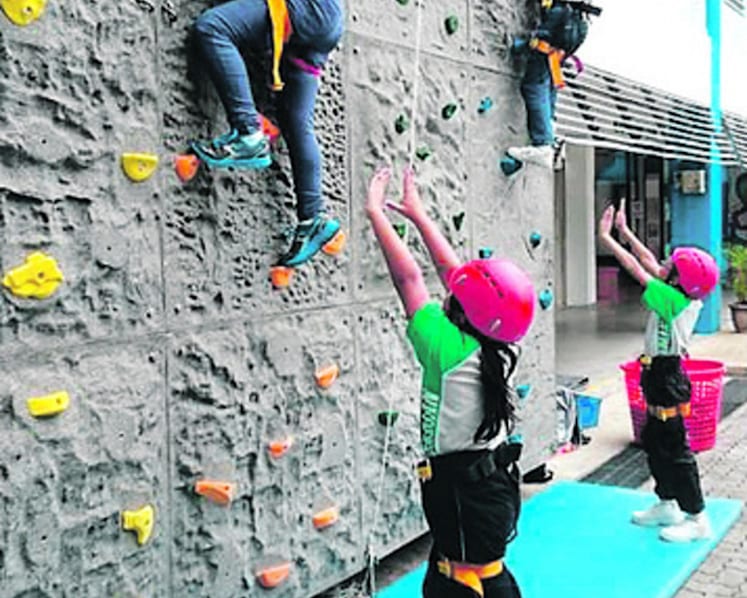
At Concord Primary School, every student has a chance to participate in overnight camps and scale the 7m-high rock wall installed at the school’s parade square. Photo: Concord Primary School
We thank Ms Natalie Ong Yuqin for her letter “Let children fall in love with learning through play” (July 6).
We agree with Ms Ong that learning through play is important, especially for children in the younger age groups. Learning through play, both in the MOE kindergartens and the lower-primary levels in our schools, is part of our wider commitment to provide a holistic education for our students. Play is more than just fun and is an especially good way for children to learn. Students grow up with a sense of wonder and curiosity about the things around them, and this encourages them to find out more on their own.
Our schools also have programmes that are experiential in nature and incorporate learning in creative, fun and enjoyable ways. These include activities that facilitate development in the five learning domains (cognitive, moral, social, aesthetics and physical) and help students to develop social emotional competencies.
Teachers use innovative approaches to learning that emphasise not only concepts and skills, but also practical applications, real-world contexts and connections across disciplines. Students are also encouraged by inquiry-based activities to experience, “learn by doing” and solve real problems. There is increased focus on applied learning across all subjects, be it in the arts or sciences, and also through our Applied Learning Programmes. All these will help our students appreciate the relevance and value of what they are learning, keep their curiosity alive and motivate them to keep learning throughout their lives.





Values and character development are also at the core of the holistic education that our schools provide. Positive attitudes, confident self-expression and empathic people skills are “caught” via active participation in our character and citizenship education curriculum, values-in-action projects, co-curriculum activities and Learning for Life programmes.
Different students have different interests and strengths, and learn best in different ways. Our education system has, in recent years, opened up many new pathways for our students to pursue their different interests and strengths, so that we bring out the best in every child, empowering them to acquire the skills they need to realise their aspirations.
With regard to the difficult maths question mentioned by Ms Ong, we would like to clarify that the question was used in a mathematics competition for secondary-level students who excel in mathematics — it is not a primary-level question.
We hope that parents and the community will continue to partner us in our children’s holistic education journey.




