

Taking Sino-Singapore ties to a new level
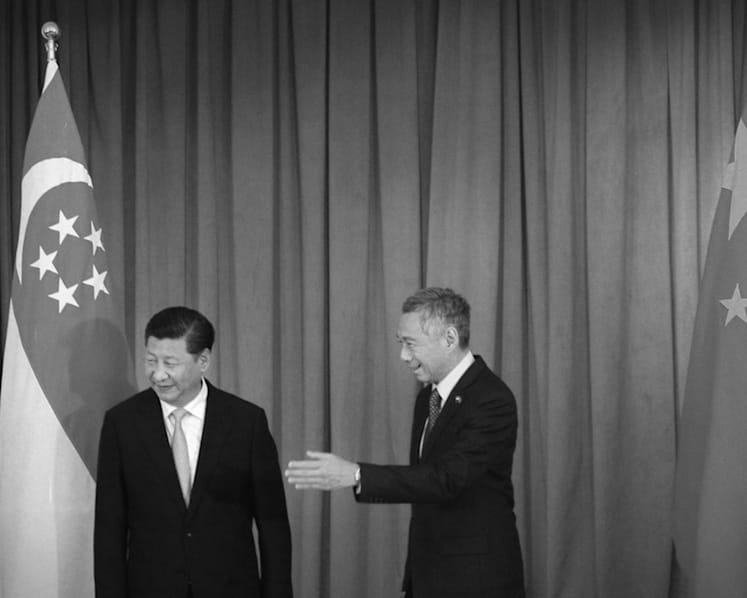
Chinese President Xi Jinping (left) and Prime Minister Lee Hsien Loong at the Istana on Saturday. Bilateral ties have been given a significant boost with the mutual exchange of state visits in this silver jubilee year of the establishment of diplomatic relations. Photo: Jason Quah
With China’s President Xi Jinping’s first State visit to Singapore last weekend, there is no doubt that the establishment of an “all round partnership” is catalytic in taking Sino-Singapore bilateral ties to a new level.
Yet, how Singapore navigates the treacherous waters of international relations as China continues to assert itself in territorial claims in the East and South China seas will have an impact upon the island state’s relevance to China.
The differences between Singapore and China are stark. China is a regional power, a superpower-in-waiting, while Singapore’s existential survival and prosperity hinges on her being relevant to the global community economically and geopolitically.
Sino-Singapore ties have benefited from the wisdom, patient and shrewd cultivation of the late Mr Lee Kuan Yew, who was respected and trusted by generations of mainland Chinese leaders since the 1970s. Mr Lee’s successors have recognised the need and importance of engaging China bilaterally and multilaterally, particularly at a time when Mr Xi has called for a “new form of great-power relationship”.





However, ever scrupulous since independence in not being perceived as a “third China” (after mainland China and Taiwan), Singapore has meticulously nurtured relations with China even before the establishment of formal diplomatic ties in 1990. It underlines what has, in substance, been a strategic relationship even if both countries have refrained from describing the relationship as such.
Bilateral ties have been given a significant boost with the mutual exchange of state visits in this silver jubilee year of the establishment of diplomatic relations. Among other agreements that reflect a broad canvas of mutual interests, both countries agreed to upgrade the China-Singapore Free Trade Area Agreement and to cooperate on the third government-to-government project in Chongqing. The latter is very much in sync with Singapore’s pathfinder efforts in Western China, in tandem with the Chinese government’s call to Go West.
As China rapidly becomes more developed, Singapore’s development experience and technical cooperation may become less relevant to China. As such, constant innovation is needed to keep, in Vice-Premier Zhang Gaoli’s words in 2013, the “special and important” relationship mutually relevant.
This raises the question of why Singapore must remain relevant to China. Relevance should be mutual. If the thinking is that only Singapore must be relevant to China, this will result only in an unequal relationship. Should either country see relevance as being one-sided, then the opportunities for more substantive and sustainable ties will be severely curtailed.
Besides broadening and deepening Sino-Singapore cooperation, Singapore’s involvement in western China is likely to have an important signalling effect. Investors from other countries will take a closer look at western China, following Singapore’s footsteps. This potential knock-on effect can have impactful multiplier effects on China’s development plans, especially Mr Xi’s One Belt, One Road initiative.
TREADING CAREFULLY
With government-to-government relations developing in multifaceted ways, both countries can consider significantly enlarging the sphere of bilateral cooperation by opening up new platforms of engagement, especially those of people-to-people (P2P).
Closer P2P ties can enable the man in the street to appreciate why the relationship between China and Singapore is a special one, and one that is not just confined to the political and economic elites. There is room for a broader and deeper spectrum of engagement between two countries.
This is an important investment for the future, considering that young Singaporeans have in the past demonstrated an ambivalent, if not some amount of condescension, towards China. This was first highlighted by then Prime Minister Goh Chok Tong in his 2001 National Day Rally speech.
The imperative is for Singapore to grasp opportunities to cooperate, and to make our modest contribution towards China’s succeeding economically. This can provide impetus and support for global prosperity premised on the “prosper thy neighbour” principle, manifested by mutual growth and prosperity.
Since Mr Xi assumed office in 2013, China’s diplomatic charm offensive has seen its leaders actively engaging developing countries, whether in Asia, Africa, or Latin America. In East Asia, however, the diplomatic outreach has been negated by its unequivocal and perhaps unrelenting show of hard power in the quest for dominance in the South and East China seas. Regardless of Mr Xi’s assurance of China’s peaceful development in his Singapore Lecture, all eyes will be on China’s actual conduct in the years ahead.
In this regard, Singapore’s insights as a cipher in providing alternative perspectives to China’s engagement in South-east Asia and the Asia-Pacific region can be helpful to China. Although Singapore is careful not to over-state its importance in this regard, this niche role is crucial to helping stakeholders in East Asia, such as China and the United States, have the benefit of considered analysis and frank counsel.
Singapore is not a geo-political threat to China. Its ability to help China make sense of regional developments can be potentially enriching. Singapore’s role as an interlocutor received a boost, notwithstanding that Mr Xi’s visit to Singapore had to concede, if not share, the limelight with the historic meeting of Mr Xi and Taiwanese President Ma Ying-jeou here last Saturday.
As Singapore and China strengthen relations, what China does and its approach to issues — the South and East China seas and Taiwan — that intimately affect other Asian countries will affect bilateral ties. Singapore also has important diplomatic and economic ties with our South-east Asian neighbours and with the US.
Looking ahead, as Sino-Singapore ties deepen, Singapore has to continue to tread carefully and act in a principled manner in the disputes China is involved in. Given our abiding belief in the balance of powers in maintaining regional peace and security, Singapore has been rather frank with China on the issue of freedom of navigation in the South China Sea in recent years.
A rising and assertive China will generate inevitable tensions as the global political, security and economic architecture seeks a new equilibrium. It is imperative that Singapore maintains a robust, firm and balanced relationship with China. As China’s friend, and through bilateral ties and cooperation, Singapore can promote a better understanding of China.
Even as Singapore is rightfully circumspect about its role given that it is a small state, the challenges of being neutral and even-handed in the great power play requires that Singapore keeps its eye on the prize: Not just the national interest but regional and global interests at this geopolitical crossroads of China’s rise.
ABOUT THE AUTHOR:
Eugene KB Tan is an associate professor of law at the Singapore Management University School of Law.




