

Thailand should not leave its citizens stranded abroad in limbo
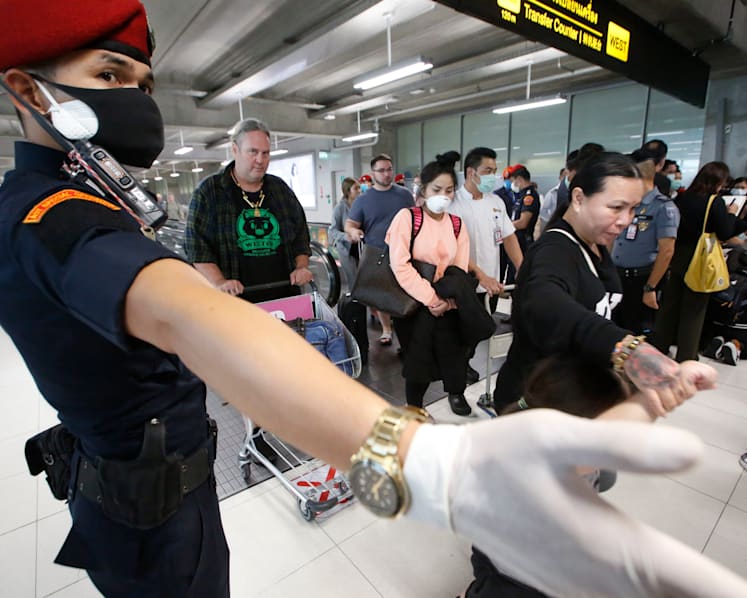
A security official directs arriving travellers at Suvarnabhumi Airport on March 12, 2020. Thailand has said that it can allow only 200 of its citizens abroad to return each day.
On my last day of self-quarantine, a nurse from a public health centre in my neighbourhood called me, checking if I had any symptoms or signs of Covid-19.
She was nice, trying to collect all the necessary information to make sure I am free of the virus. Afterwards, the centre will issue me a certificate saying that I've completed the 14-day home quarantine and can resume my normal life.
I was surprised the nurse had not contacted me earlier. She conceded that the process had been delayed. The centre was supposed to reach me the day I started self-isolation, since the officials had to do a follow-up and offer help in case I had any symptoms.
But I cannot complain — at least I could re-enter the country. A large number of Thais are stranded abroad, and it's because the government keeps changing its policy.





According to a news report, a travel blogger from Yala has been stuck in Montenegro for roughly a month because the Thai government abruptly sealed off the sky on the night of April 3.
Because of the flight ban, 23 Thais found themselves in a situation reminiscent of the Tom Hanks' film The Terminal, being forced to spend four days at Haneda Airport in Tokyo. They were eventually sent home last Wednesday on an ANA airplane.
According to the Thai Foreign Affairs Ministry, over 5,400 Thais are stranded at airports worldwide, waiting for Thailand's skies to be reopened. Another 10,000 on the Malaysian-Thai border are keeping their fingers crossed they'll be able to head home soon.
The Centre for Covid-19 Situation Administration (CCSA) is asking those living outside the country to stay where they are if they are not in real trouble. The CCSA said on April 7 that the country can accommodate 200 returnees a day.
Having watched the daily CCSA press conferences, I cannot help but feel the government has discriminated against Thais wishing to return home, as if they are super spreaders.
Isn't it the government's duty to provide state-quarantine sites to prevent infection and protect others if any returnees test positive?
I was stunned by an online survey by news outlet Matichon asking its readers if they think the government should allow Thai expats to return home. Some respondents agreed with the government that those Thais should stay in a holding pattern.
Imagine if it were members of your family who couldn't leave coronavirus hotspots, or had encountered The Terminal experience at an airport while trying to make a connecting flight.
Some netizens have tried to paint a bad image of the stranded returnees, insinuating they are from rich families.
They have apparently missed the pictures of poor migrants working at tom yum kung food shops in Malaysia, who have nowhere to go and have been forced to sleep on the pavement after their shops were shut down in the wake of the Malaysian government's lockdown orders.
They are penniless, spending all they had on bus fare, only to find the borders had been sealed "to protect 65 million Thais" from the virus, as CCSA spokesman Taweesilp Visanuyothin has stressed.
Nobody would expect their own government to shut the door in their face. Now, they have no choice but to wait until state quarantine facilities are ready.
I talked to a mother of two whose children are now college students in the United States, a Covid-19 hotspot, waiting for their turn to re-register as returnees when the government lifts the flight ban, planned for April 18. They were all set to go home the day the ban was enacted.
The mother is frustrated with the ongoing process. The family's anxiety is understandable.
They often compared their children's situation with that of Chinese students, who had exact instructions from their government on what to do in case they wished to go home.
But the Thai government has been mercurial in its approach. In its failures to think about granting a grace period, many have been left stranded at airports and in the streets.
The government used to praise those studying abroad as the future of the country. Then one day, these students found themselves "unwanted".
How can they help build up the country, as the government hopes, when they face absurd discrimination as a "risk group"? I try to imagine what type of Thai citizens these young people will grow up to be.
Prime Minister Prayuth Chan-ocha keeps saying "no one will be left behind" when addressing the public on TV. He's probably right. No one is left behind. They are simply left outside the kingdom. BANGKOK POST
ABOUT THE AUTHOR:
Sirinya Wattanasukchai is a columnist for the Bangkok Post, where she was formerly assistant news editor.




