

Voices from the Front Lines: Anxious at first, but desire to see patients improve keeps me going
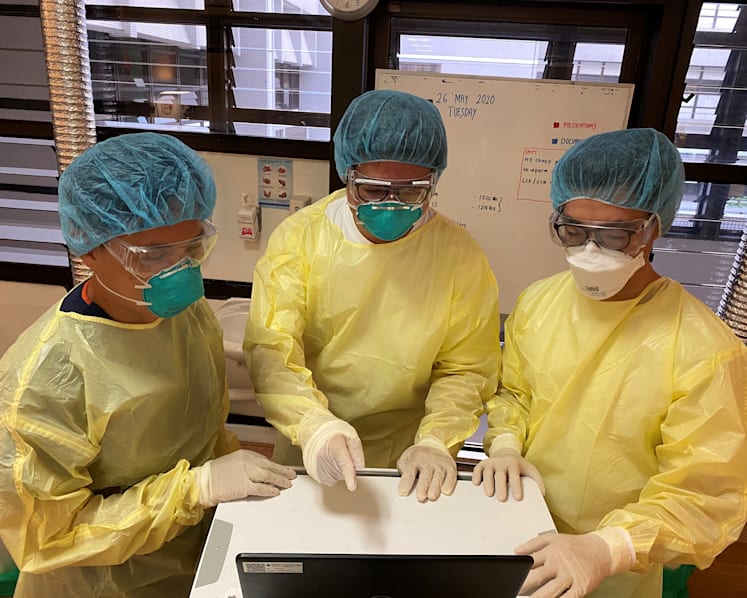
Dr Benjamin Tan (centre) with his colleagues at the National University Hospital on May 26, 2020.
As the fight against Covid-19 will be a long-drawn one, TODAY’s Voices section hopes to shine a light on the triumphs and struggles of Singapore’s front-line workers by publishing their first-hand accounts.
In this first instalment of Voices from the Front Lines, Dr Benjamin Tan of the National University Hospital writes of an initial anxiety about the disease that gave way to hope and a desire to see his patients improve.
It is 7 in the morning. Mask, shoe cover, gown, gloves, hair cap and goggles on.
It is another day in the Covid-19 pandemic ward, where the medical team is getting ready for our daily ward round.





Initially, many of us were anxious about this invisible enemy, but the fear and anxiety have since transformed into a stronger commitment and desire to see our patients improve.
Healthcare workers around the world have reported psychological distress and anxiety.
In Singapore, we are fortunate to have been trained in infection control and have access to personal protective equipment when caring for Covid-19 patients. These measures have been effective in limiting transmission among healthcare workers and allowed us to focus on our patients with a better state of mind.
Caring for Covid-19 patients on the front lines has been a true privilege.
The majority of coronavirus patients are migrant workers. Through our interactions on daily ward rounds, we learnt that they needed a means to stay connected to the outside world and more information about Covid-19.
We also noticed an increasing level of anxiety among some of these migrant friends. Many spoke little or no English, and there was a significant language barrier that impaired communication.
We had to innovate quickly, and with the help of translators, visual aids and hospital befriender initiatives that used their native language, we could better communicate with them.
I have been touched by many heartfelt experiences along the way.
While most patients are medically stable, a small number can show more severe symptoms, and may need closer and more prolonged monitoring.
I took care of one such patient, Mr A, a migrant worker.
I saw how his face fell as other patients in the ward were discharged, wondering when his turn would come.
In addition to the symptoms he experienced, he must have been concerned and anxious about his condition. Imagine being far from home with a potentially life-threatening disease, with understanding limited by a significant language barrier.
We tried our best to support him emotionally. He was resilient. Finally, after a few weeks, with medical therapy and supportive treatment, he got much better, and we were relieved.
On the day of his discharge, he approached the team to thank us, and asked if he could take a photograph with us and if we could sign our names on a book as a keepsake. We were lost for words. Patient encounters such as these remind us why we are on the front lines.
The pandemic has been a true test of resilience and commitment to our calling.
But we take heart that everyone is united in this battle. Every member of the healthcare team plays a critical role. We are confident that we will emerge from this outbreak stronger than before.
There is light at the end of every tunnel.
ABOUT THE WRITER:
Dr Benjamin Tan, 31, is a senior resident with the division of neurology at the National University Hospital, where he now works in the pandemic ward caring for Covid-19 patients.
If you are on the front lines of the Covid-19 outbreak or know someone who wishes to contribute to this series, write to voices [at] mediacorp.com.sg with your full name, address and phone number.




