

What are the policy implications of the Cabinet reshuffle?
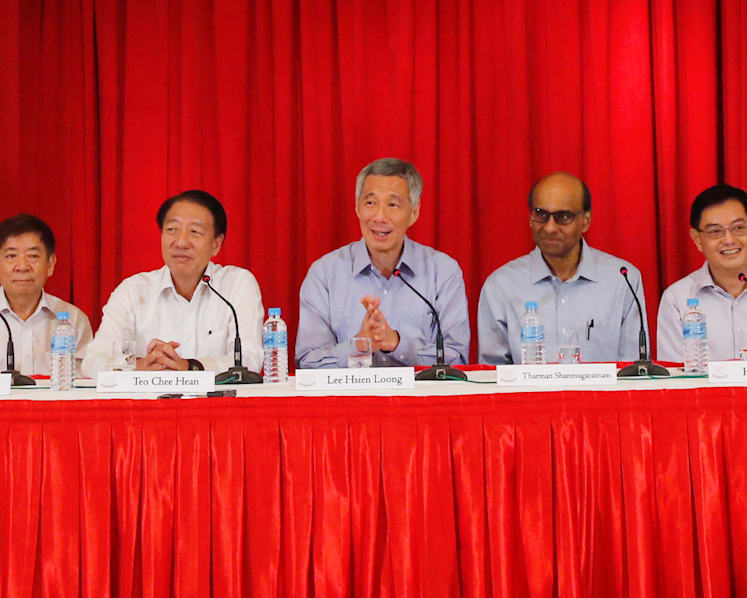
The ability of the 4G leaders to transform Singapore’s economy and adapt the workforce to new industry needs will signify their readiness to take over the reins of governing Singapore from the current leaders, seen here in this 2015 photo.

Much has been said about the political implications of Singapore’s recent cabinet reshuffle, with much of this attention focused on the identity of Singapore’s future Prime Minister as well as the shape of the 4G leadership.
While such discourse is no doubt important for ascertaining Singapore’s future leadership, there are more important policy implications of the cabinet reshuffle that need to be discussed.
At the heart of the recent cabinet reshuffle is a strong emphasis on Singapore’s ongoing economic transformation and in particular, tackling the implications of technological disruption.
This is evident in the roles that have been taken on by the three Prime Ministerial frontrunners, namely Mr Chan Chun Sing, Mr Heng Swee Keat, and Mr Ong Ye Kung.





Mr Chan’s appointment to the Ministry of Trade and Industry (MTI) places him at the forefront of Singapore’s economic policies. Coupled with his experience in encouraging reskilling in the labour movement, particularly through the formation of NTUC’s training council, Mr Chan’s move from the labour movement speaks volumes of his upcoming role in managing economic and labour transformation.
Furthermore, Mr Chan has taken on leadership of the public service innovation drive which, together with his new leadership of the public service division, provides the platform for him to introduce innovative transformations to public service organisations and policy processes.
Despite not seeing any changes in portfolio, Mr Heng’s current role as Minister of Finance places him at a key strategic position in managing transformations to Singapore’s financial services sector – whether in terms of FinTech, cryptocurrency, or blockchain.
His continued chairmanship of the Future Economy Council and leadership of the industry transformation roadmaps sees him play a crucial role in pre-empting and ameliorating future disruptions to Singapore’s economy and industries.
Mr Heng’s stewardship of the National Research Council – a new responsibility he is taking over from Deputy Prime Minister Teo Chee Hean - also serves to further align research and innovation with overall economic development.
As Education Minister, Mr Ong will play a similarly important role in managing Singapore’s ongoing economic transformation by ensuring that the country’s future workforce is adequately skilled and ready for future industries.
One simple example is the introduction of coding skills to primary school students – an idea that was initiated in the Smart Nation initiative but which will require the education ministry’s leadership in implementation.
Perhaps more importantly, Mr Ong’s role in leading the SkillsFuture initiative will be extremely important for Singapore’s ability to reskill its current labour force and prepare it for the digital economy.
Aside from the three prime ministerial frontrunners, other members of the 4G leadership have also taken on key positions tied to Singapore’s economic transformation.
For instance, Mr Ng Chee Meng’s move to the NTUC highlights the key linkages between the labour movement and education, with worker education and reskilling increasingly crucial for ensuring employability in an evolving economy.
Similarly, the appointment of Mr Chee Hong Tat and the retention of Dr Koh Poh Koon at MTI highlight the growing importance of the ministry, with it now led by three members of the 4G leadership.
Mr Chee’s second appointment at the Ministry of Education is also testament to the increasingly close linkages between economic development and education. Indeed, this economy – education – labour triumvirate may prove crucial for managing disruption and driving productivity.
Clearly, the cabinet reshuffle has placed key members of the 4G leadership in positions that will require them to lead Singapore’s ongoing economic and labour transformation. Given the impact of disruptive technologies on employment and productivity, linkages between economic development, labour relations and education have become increasingly important.
SECURITY AND FOREIGN AFFAIRS
While the realm of economic development has received an injection of new blood with the cabinet reshuffle, Prime Minister Lee Hsien Loong has chosen to emphasise stability in the realm of security and foreign policy, with no changes in key portfolios of defence, home affairs and foreign affairs.
The continuity in the foreign affairs post is not a surprise considering that Singapore is in the middle of its year-long Asean chairmanship, with the Asean Summit in fact starting a day after the cabinet reshuffle.
It would appear that the 4G leadership is gradually being exposed to the various functions of government, beginning with the important roles of economic and labour development, with their exposure to security and foreign policy left to future cabinet reshuffles. Similarly, the appointment of Mr Iswaran to the newly-created position of Minister-in-charge of Trade Relations suggests a similar move to allow the 4G leadership to cut their teeth in economic diplomacy.
However, this is not to say that the 4G leadership has not been exposed to diplomacy or defence issues. For instance, Mr Chan is also heavily involved in the China-Singapore Chongqing Connectivity Initiative and was previously Senior Minister of State for Defence. Mr Ong helped negotiate the Singapore-United States Free Trade Agreement when he was a civil servant, and as Second Minister for Defence until May 1, had attended many international security meetings.
More than simply a matter of leadership transition, the cabinet reshuffle will have significant implications for policymaking in the coming years. It is useful to think of the reshuffle as a reorientation of the government’s policy expertise and capabilities.
With disruptions to Singapore’s economy and labour force increasingly frequent and severe, the new team will have a short runway to address these rapidly emerging issues. Indeed, their ability to transform Singapore’s economy and adapt the workforce to new industry needs will signify their readiness to take over the reins of governing Singapore.
ABOUT THE AUTHOR:
Woo Jun Jie is an assistant professor at the Public Policy & Global Affairs Programme of Nanyang Technological University, where he teaches Singapore Politics and Singapore Foreign Policy.




