

Xi’s Chinese dream encounters reality check in HK
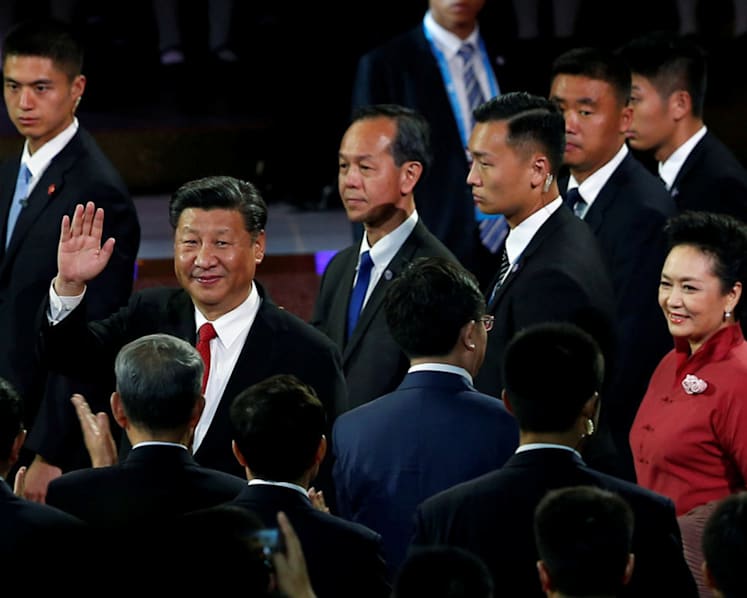
President Xi at the 20th anniversary celebration of the handover of Hong Kong, on June 30. His visit was seen in the territory as more about sending a message to mainland China. Photo: Reuters


A multi-billion-dollar bridge to bind Hong Kong to China and showcase Chinese engineering excellence, adoring crowds and banners everywhere welcoming him to celebrate the 20th anniversary of the handover of the former British colony.
The Hong Kong that Chinese President Xi Jinping saw on a three-day inspection visit last week was a charming, loyal and thriving place. No wonder he held up Hong Kong as a key part of his “dream” for the “great rejuvenation of the Chinese nation”.
The problem is that Mr Xi was inspecting a Potemkin village rather than the real Hong Kong. That city is a far more troubled place, where the bridge project has been hamstrung by budget overruns and a corruption scandal, widening social inequality is fuelling opposition to Chinese rule and local leaders have few ideas for closing the vast expectation gap between Beijing and Hong Kongers.
But the purpose of Mr Xi’s tour was less to understand real conditions in Hong Kong, a semi-autonomous city of 7.4 million people, than to send a message to the 1.4 billion people in mainland China that he is as loved and in command as ever.





“China’s leaders aren’t necessarily overly self-aware or self-reflective,” said Mr Kevin Carrico, a lecturer in Chinese studies at Australia’s Macquarie University. “So how we saw the visit may be very different from how they see it.”
On the few occasions that Mr Xi ventured beyond his heavily fortified base at Hong Kong’s main convention centre — for example, to lead a military parade while dressed in a Mao suit — he was surrounded by a mobile ring of steel. Protesters who came within just a few hundred metres calling for democracy in Hong Kong were arrested, either for Mr Xi’s security or, the police said, for their own.
In private, officials must have briefed Mr Xi on some of Hong Kong’s many problems, for he did acknowledge several “issues”, including housing and a lack of patriotism among young people.
But his response — calling for a new campaign of national education and threatening Hong Kongers not to cross a “red line” by challenging sovereignty or Communist Party rule — is unlikely to win any hearts and minds in Hong Kong.
As Mr Lau Mingwai, a billionaire property tycoon and head of the Hong Kong government’s youth commission, has noted, Hong Kongers “receive information at a frequency and channel much closer to the Western than the Chinese style”.
So when Mr Xi and other Communist leaders speak, they sound to many young Hong Kongers as if they are “from another planet”.
On that particular planet, Hong Kong’s problems, from unaffordable housing to growing public discontent, are little to do with Beijing’s failure to respect Hong Kong’s autonomy, or the crowding-out effect of the territory’s powerful pro-Beijing tycoons.
Rather, they are the result of hostile foreign forces and troublesome locals who are, in Mr Xi’s words, “making everything political or deliberately creating differences and provoking confrontation”.
By tying the smooth running of Hong Kong to his much-vaunted slogan about the “Chinese dream”, Mr Xi is sending a signal to Hong Kong officials that they must step up the fight against Beijing’s enemies in the city, from independence activists to more moderate opponents who simply criticise Communist rule.
The flipside is that the President, who has centralised more power than any Chinese leader since Mao Zedong, will be closely associated with what transpires in Hong Kong, where Beijing has much less control than he might think from his stage-managed visit.
Yet Mr Xi already has a full in-tray, trying to manage a leadership transition ahead of the five-yearly party congress in the autumn, while cracking down on influential tycoons in the heavily indebted financial sector and being stuck between an erratic United States President and a rogue North Korean leader. More hardline policies and a tin ear in Hong Kong are likely to further alienate Hong Kongers, compounding Mr Xi’s growing list of problems and undermining, rather than promoting, his Chinese dream. FINANCIAL TIMES
ABOUT THE AUTHOR:
Ben Bland is South China correspondent of the Financial Times.




