Advertisement

big read Big Read

More than a disability, dementia takes a toll on the whole family – and more young patients are getting it

Caregivers of people living with dementia say the condition changes more than just memory – it alters lives, relationships and even personalities. As more are diagnosed in their prime, experts say individuals should be on guard for symptoms and risk factors.
More than a disability, dementia takes a toll on the whole family – and more young patients are getting it

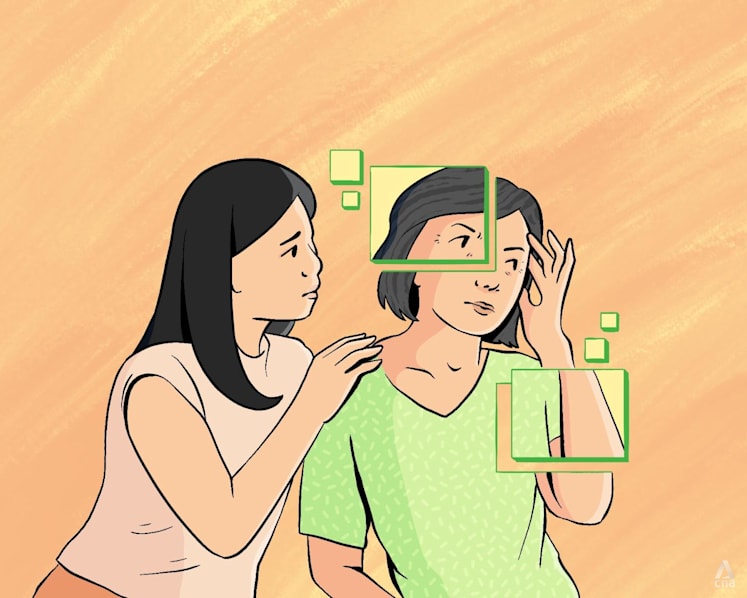
As Singapore’s population ages, more families may have to provide caregiving to loved ones with dementia, given that the number of people living with dementia is projected to rise. (Illustration: CNA/Nurjannah Suhaimi)

New: You can now listen to articles.

This audio is generated by an AI tool.

01 Aug 2025 09:30PM (Updated: 07 Aug 2025 05:49PM)

While many of his peers were focused on graduation trips or job prospects, Mr Eric Lim, then a final-year undergraduate in 2013, was preoccupied with caring for his late father. His father had suffered a series of strokes and was later diagnosed with vascular dementia.

"It was very stressful, because I felt it was like a role reversal: All the time it's always my parents taking care of me, but then suddenly I'm thrust into this role," said Mr Lim, now 36 and co-founder of Somnus Sleep Wellness, a company that helps people with sleep issues such as insomnia.

Those unfamiliar with the condition might associate dementia mainly with memory loss, but as Mr Lim and other caregivers who spoke to CNA TODAY shared, its impact extends far beyond that.

Many other medical conditions and disabilities require caregivers to help their loved ones perform daily tasks. But not many, unlike dementia, changes the personality of the patients, or the loved ones caring for them.


CNA Games
Show More
Show Less

For example, Mr Lim's father, who was diagnosed at 67, became easily agitated and would constantly pluck at his diaper in distress after losing control of his bowel movements. Such behaviour often left Mr Lim frustrated.

"Before he fell ill, my dad was always a very gentle person. So when his personality changed, we went: 'What's happening?'. It got us very stressed, and I experienced burnout,"  said the entrepreneur.

"I found myself more impatient, and it was a lot harder to respond with empathy for my dad, even though I'm usually not that kind of person."
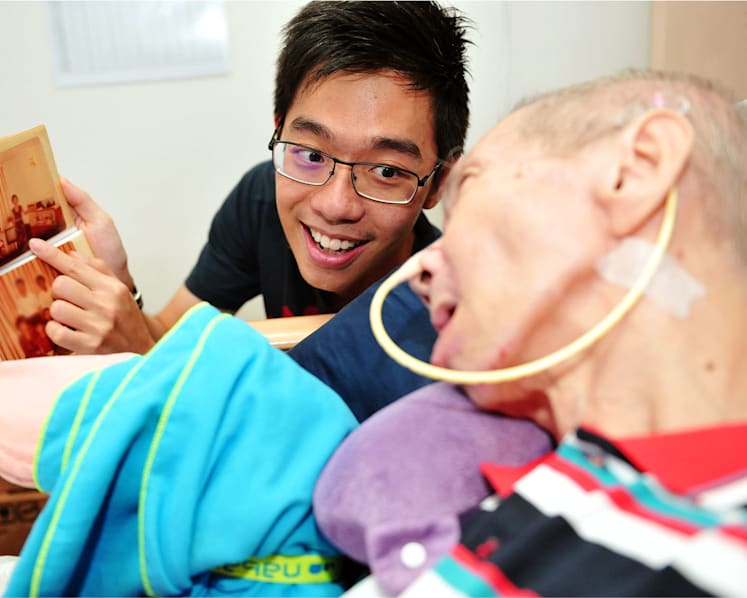
Mr Eric Lim, 36, became a caregiver to his father when he was a final-year undergraduate in 2013. His father was diagnosed with vascular dementia after a series of strokes. (Photo: Eric Lim)

As Singapore’s population ages, more families may go through what Mr Lim experienced, given that the number of people living with dementia is projected to rise.

The prevalence of dementia among older adults aged 60 and above decreased slightly over the past decade, to one in 11 in 2023 from one in 10 in 2013. But the overall number of such adults with the condition rose to 73,918 from 51,934 over the same period, according to a study by the Institute of Mental Health (IMH).

The total number is projected to increase to about 152,000 by 2030, according to the Ministry of Health.

Notably, some other figures also point to a growing number of young-onset dementia, which is when the condition strikes those under the age of 65.

In a study released in 2016, the National Neuroscience Institute (NNI) saw more than a threefold increase in the number of patients with young-onset dementia over the five preceding years, though it did not provide actual numbers.

More recently, the number of new cases it saw at Tan Tock Seng Hospital (TTSH) went up from 60 in 2013 to 90 in 2023. The number dropped slightly to 80 last year, the institute told CNA TODAY.

Global figures also point to a growing number of young-onset dementia, said Dr Kelvin Tan, head of the Minor in Applied Ageing Studies programme at the Singapore University of Social Sciences.

One study by a group of researchers from Sichuan University, China and published in February found the global incidence of dementia among people under 65 years of age rose slightly from 16.24 per 100,000 people in 1990 to 17.16 per 100,000 people in 2021, he added.


Experts such as Associate Professor Adeline Ng, the lead for the dementia clinical programme at NNI, identified two reasons as to why young-onset dementia appears to be more common now.

There is now greater public awareness about the condition, leading to more diagnoses, she noted. Another reason is the rise in risk factors for certain types of dementia such as vascular dementia, which arises from reduced supply of blood to the brain due to damaged or blocked blood vessels.

"These risk factors include high blood pressure and diabetes – if they are not controlled when the person is diagnosed in middle age, then it can significantly increase the risk of young-onset dementia," said Assoc Prof Ng, who is also a senior consultant in neurology at the institute.

WHAT YOUNG-ONSET DEMENTIA LOOKS LIKE

Sometime in 2016, Ms Betty Pay, then a 59-year-old cashier at a town council office, began making mistakes in her work that were uncharacteristic of her.

Her husband, Mr Lim Kay Kwong, recounted that there were days when she had to repay the town council about S$200 due to her errors in processing payment.

"At that period of time, she could still say, 'Every day, I'm counting wrongly,' and was very nervous about it," Mr Lim told CNA TODAY in Mandarin recently.

The family, including their two adult children, decided that it was better for Ms Pay to stop working rather than having to reimburse the losses caused by her mistakes constantly. 

After she resigned, Ms Pay's cognitive functions continued to worsen, especially after her father died that same year. Her condition deteriorated to the extent that she needed help to perform basic daily tasks such as showering and eating.

Mr Lim, 73, said he felt deep sorrow watching his once vivacious and sociable wife become a mere shadow of her former self. 

Mr Lim quit his job as a public bus captain and became a caregiver for his wife, who was later formally diagnosed with dementia.
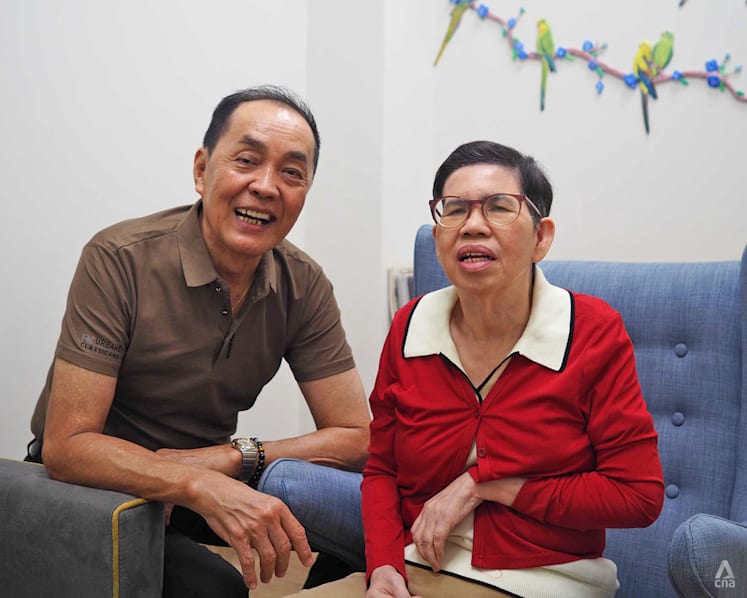
Mr Lim Kay Kwong, 73, quit his job as a public bus driver to be a caregiver for his wife, Ms Betty Pay, who was diagnosed with dementia. (Photo: CNA/Taufiq Zalizan)

Young-onset dementia cases, such as Ms Pay’s, can differ somewhat from those in much older adults in terms of causes and symptoms, said experts.

The neurodegenerative Alzheimer's disease and vascular dementia are the most common causes of later-onset dementia.

While these can also lead to young-onset dementia, genetics play a more significant role in younger individuals, said Dr Vanessa Lacuesta, senior manager for medical affairs at DKSH Healthcare Singapore.

"Beyond genetics, certain medical conditions are more commonly associated with young-onset dementia. These include conditions like traumatic brain injury, substance abuse  – particularly heavy alcohol use –  and even some autoimmune or infectious diseases," she added.

Mr Bernard Lim, director of advocacy and communications at Dementia Singapore, said: "While memory loss is one of the most common symptoms of dementia, particularly with Alzheimer's disease, people diagnosed with young-onset dementia are more likely to experience symptoms related to executive function, language or behavioural changes."

Dementia Singapore is a social service agency specialising in dementia care, support and advocacy.

Experts said that the cognitive decline may also happen more rapidly among younger cases.

Cases such as Ms Pay’s show how early-onset dementia presents an additional set of challenges to the patient and their family, compared with dementia developed later in life.

For instance, those with young-onset dementia are often still gainfully employed or even at the peak of their careers.

"This leads to substantial economic strain due to loss of employment and income, unlike many older patients who may already be retired," said Mr Lim from Dementia Singapore.
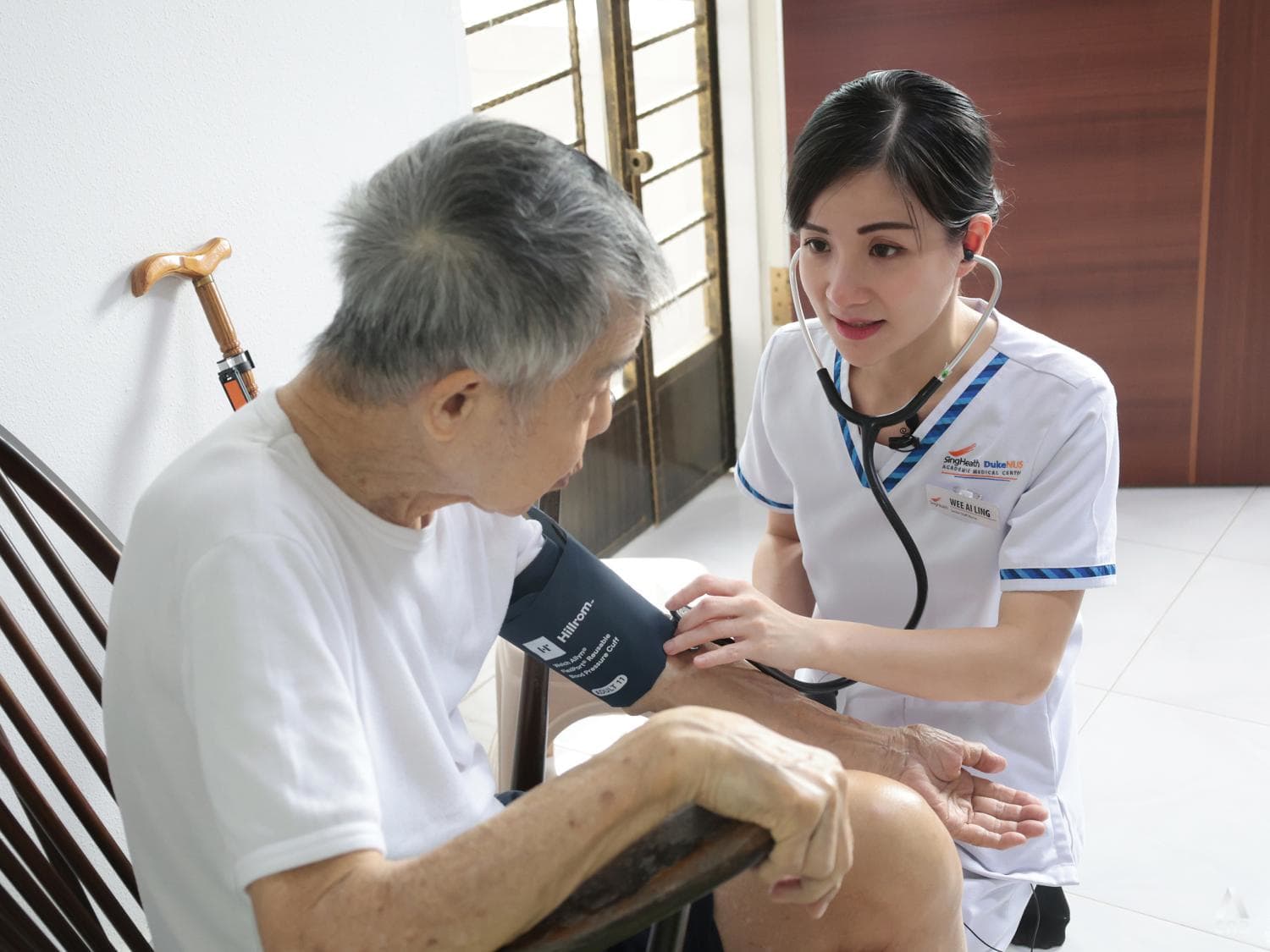
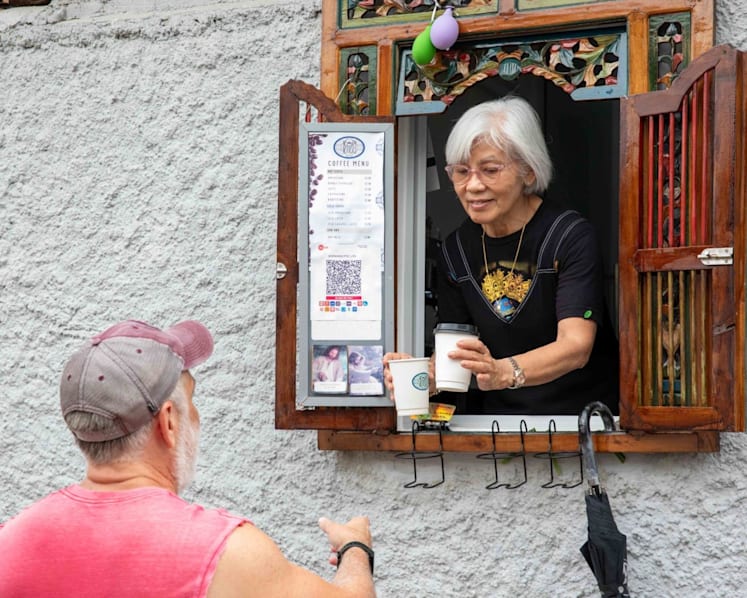
The 2016 NNI study found that the economic burden of young-onset dementia patients was almost twice that of older dementia patients.

The difference was mainly due to indirect costs arising from loss of income, with about 43.2 per cent of young patients with dementia reporting a loss of employment due to their condition, compared with 2.4 per cent of elderly patients.

The institute told CNA TODAY that it is embarking on a new follow-up study to look into the economic impact of young-onset dementia and dementia in general.

The World Health Organization said that dementia cost economies around the world US$1.3 trillion in 2019. About half of these costs are attributable to care provided by informal carers such as family members, who provide on average five hours of care and supervision daily.

In Singapore, a 2024 survey found that the average monthly cost of care for people living with dementia is close to S$2,500. It can go up to S$3,000 if the person is unable to perform three or more activities of daily living, according to the survey of about 1,000 Singapore residents by insurance provider Singlife.

Ms Helen Shen, group head of products at Singlife, said that young-onset dementia may also lead to premature depletion of savings or retirement funds, which the individual may not have had the time to build.

"Additionally, because dementia is often associated with older age, younger individuals may lack adequate insurance coverage or financial plans to address the condition," she said.

Dr Wayne Freeman Chong, a geropsychologist, or psychologist specialising in the mental health of older adults, said the caregiving distribution within a family also differs.

He noted that for elderly dementia patients, their caregivers tend to be their adult children. For younger people with dementia, however, the caregiving duty often falls upon their spouses instead, because the children may still be young.

"The person with young-onset dementia may gradually lose the ability to care for his or her own children. So then the caregiver is left to care for the spouse and their children on their own," said Dr Chong, who runs GeroPsych Consultants and is an adjunct lecturer at Nanyang Technological University (NTU).

On a personal level, the psychosocial impact on younger patients is also magnified, as they have to grapple with the diagnosis while their peers are healthy, said Mr Bernard Lim of Dementia Singapore.

Ms Usha Devi Ratnam, who leads the dementia programme at SASCO Senior Citizens' Home, added that because of this, and the fact that the condition is commonly associated with the elderly, some younger individuals “might be in the denial stage” in the initial phase of young-onset dementia, thus impeding early detection.

"So they might not be able to see that they have dementia. They are not going out to seek help," said Ms Usha.
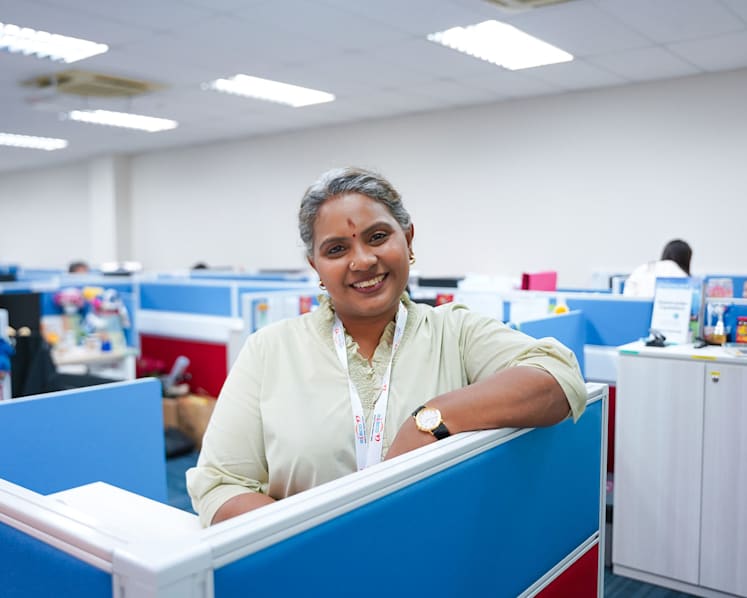
Ms Usha Devi Ratnam leads the dementia programme at SASCO Senior Citizens' Home. (Photo: Singapore National Co-operative Federation)

HOW TO BETTER SUPPORT WORKERS WITH DEMENTIA

Singapore has made big strides in providing support for people with dementia and their loved ones, noted the experts and caregivers, though they said there is always room for improvement.

While many older people with dementia now still have family members who can make caregiving decisions for them, this is quickly changing with more unmarried and childless people around, said Assistant Professor Shannon Ang from the Nanyang Technological University (NTU).

This gives rise to questions like what happens when there is no obvious candidate to care for such people with young-onset dementia, and whether the professional deputies and donees scheme, for instance, should be expanded, the sociologist added. 

For instance, Dr Wayne Freeman Chong, a psychologist specialising in the mental health of older adults, urged for certain cognitive stimulation programmes to be expanded to include more among those who are at risk of dementia, and not just focus on those who already have the condition.

More subsidies could also be provided to reduce the financial burden of caregiving and to make cognitive stimulation programmes more affordable. 

To better support those with young-onset dementia, experts said that personalisation and job matching can balance employers’ productivity goals with the need to provide work that can improve the cognitive state and overall well-being of the employee.

Ms Patricia Lee, who runs a company that offers therapy activities for people with dementia, gave examples of her programme participants who, despite their condition, are given the opportunity to perform meaningful jobs instead of menial tasks.

They include a former principal who is thriving as a private tutor and a former beauty salon business owner who has recently begun work as a beautician.

Her husband Arthur Wong, who himself is diagnosed with mild cognitive impairment, said: "It's important to (provide them a job with) dignity, show them they are useful members of society."

However, in a knowledge-based economy like Singapore, young-onset dementia is more difficult to accommodate in the workplace as compared to other ailments that afflict the body physically instead of the brain, said Asst Prof Ang.

"There is no impetus for businesses to redesign jobs to accommodate those with young-onset dementia unless it affects their bottom line," said the sociologist.

This raises the question whether the state would be willing to step in "when things no longer align with our values" or choose to leave it to market logic.

"What is needed for all of us is a society that values individuals beyond their economic productivity; where we all have an obligation to each other’s wellbeing, not just a single-minded belief in our own merit,” he said.

Collapse

CAREGIVERS ARE ALWAYS "ON THE EDGE"

Although dementia in the elderly is a condition that society may be familiar with, the immense toll it takes on both patients and their loved ones is often underestimated.

Singlife's 2024 survey found that 33 per cent of respondents did not see the link between dementia and disability.

But in fact, nearly 90 per cent of people with dementia need help with one activity of daily living and live with a disability, according to the survey.

The latest Well-being of the Singapore Elderly study by the Institute of Mental Health (IMH) found that caregivers of individuals with dementia had significantly higher care burden and level of psychological distress than caregivers of people without dementia.

Mr Eric Lim the entrepreneur recalled how being his father’s main caregiver was physically taxing and affected his work and social life.

Though he had hired a helper to care for his father during the day, Mr Lim himself would settle the old man's needs, such as bathing and feeding him, before he left for work. These were also the first things Mr Lim did when he returned home.

"I will be thinking, 'If I go out to meet my friends, what's going to happen to my dad at home?'" said Mr Lim, who added that he found his thoughts drifting to his father even at work sometimes.

Marketing professional Imran Johri, 51, and his family endured a different kind of emotional toll after his mother was diagnosed with dementia following the removal of a brain tumor in 1997.

His family had initially thought that the cognitive lapses they saw in their mother, now 74, were part and parcel of the recovery process post-surgery.

Coming to terms with the fact that their mother had a degenerative condition and would never return to her old self was tough on all of them.

"Knowing dementia is one thing. But to accept that one of your family members has it, is another thing altogether," Mr Imran said.
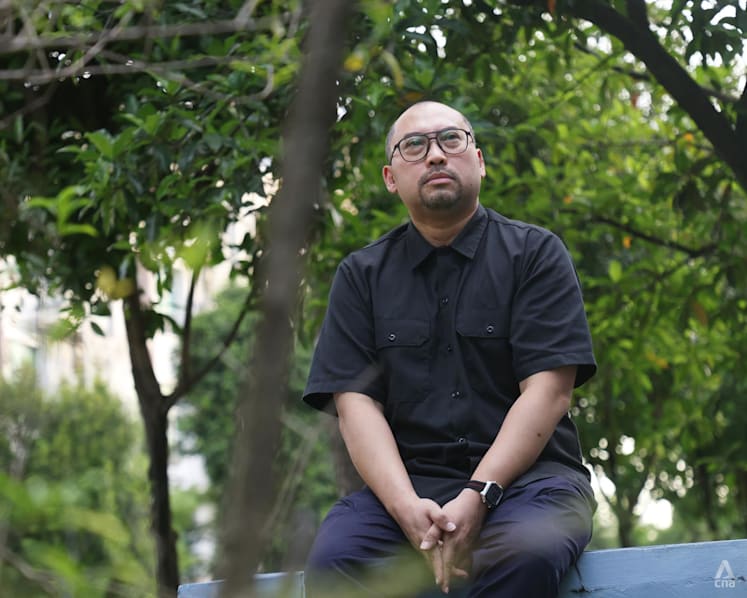
Marketing professional Imran Johri, 51, and his family found it hard to come to terms with the fact that their mother had dementia and would never return to her old self. (Photo: CNA/Ooi Boon Keong)

During the fasting month in March this year, his mother had a fall that exacerbated her cognitive decline – she could no longer recognise him, which further added to his sorrow.

Mr Imran also had to deal with the anxiety of being "always on standby", although he does not live in the same household as his mum.

"We're on the edge all the time. Whenever I get a call and I see my dad's number or the helper's number, especially late at night or early morning, both of us (me and my wife) will jump."

Tapping external help, such as a hired helper or daycare service, can ease the physical burden but does little to relieve caregivers of the emotional turmoil of caring for a loved one with dementia.

Ms Kate Cham, the co-founder of live-in helper and caregiver agency Anglo Caregivers, and her mother were her grandfather’s caregivers during the last two years of his life.

They mainly looked after the elderly man on weekends when their hired helper took her day off.

On those days, Ms Cham, 35, and her mother experienced first-hand the physical effort required to bathe a completely immobile bedridden person and tube-feed him. Her late grandfather, who died at the age of 91 in 2022, also had Parkinson's disease on top of dementia.

One challenge they faced was making difficult choices on his behalf in relation to his medical and caregiving needs.

Advertisement

In Pixels

Never too old to have new experiences, as seniors find stable companions outside of home
Never too old to have new experiences, as seniors find stable companions outside of home

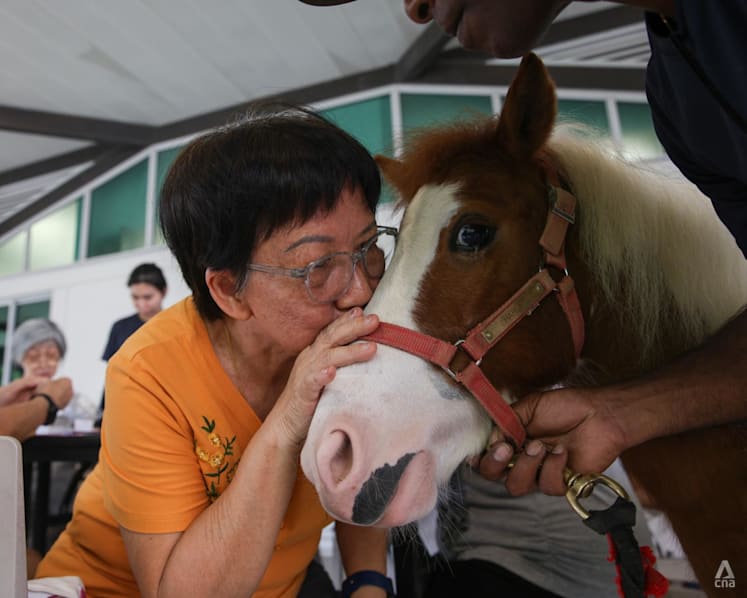
Madam Chow May Ho giving Harley, a miniature horse, a peck on its cheek. She said it was the first time she kissed an animal and that her heart was pounding. (Photo: CNA/Nuria Ling)

23 May 2025 09:30PM (Updated: 15 Oct 2025 11:58PM)

Placing one hand gently on the forehead of Matahari, a dark-chocolate brown mare, Mr Ang Tee Hiom read a short letter that he had prepared the week before. 

“Hi, Matahari. You look very healthy and strong. You look friendly. It’s a great day to meet up with you,” the retired police officer said.   

Matahari tilted its head towards Mr Ang as if sensing he was saying goodbye, for now. 

At 25 years old, the former polo horse would be equivalent in human age to Mr Ang who is 75. 

CNA Games
Show More
Show Less

Mr Ang was one of 10 seniors who took part in a 10-week-long equine-assisted programme for elders and it was the last session. 

In this week’s In Pixels, CNA TODAY takes a look at how the equine programme has benefited the retiree and the unexpected bonds that had formed along the way.
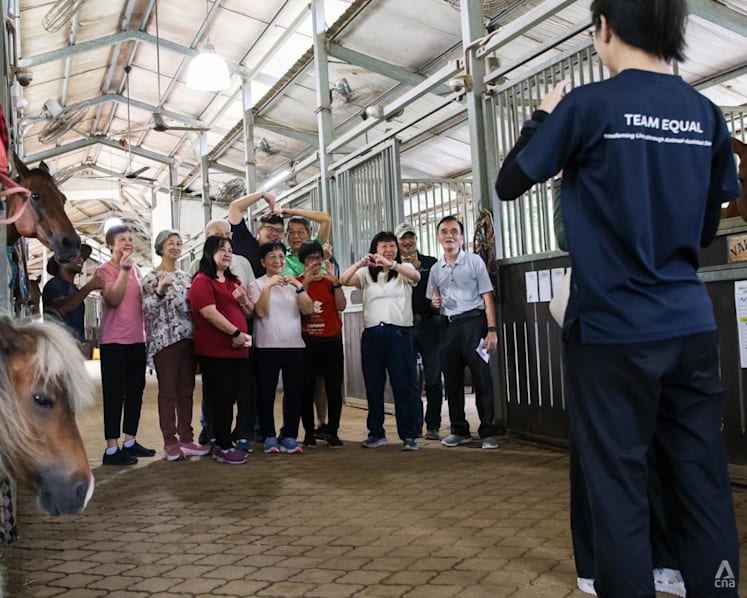
A group of seniors, the second cohort of participants in a pilot equine-assisted programme for elders, taking a group photo at a stable along Thomson Road where some of the sessions were held. (Photo: CNA/Nuria Ling)

The Temasek Foundation-EQUAL Haydays with Horses programme is a two-year pilot that connects seniors – including those who may be socially isolated – with horses.

Through activities such as feeding, grooming and interacting with horses, the equine-assisted programme seeks to enhance elders' physical and psychological well-being, cognitive functioning and social connectedness with the horses and other people.
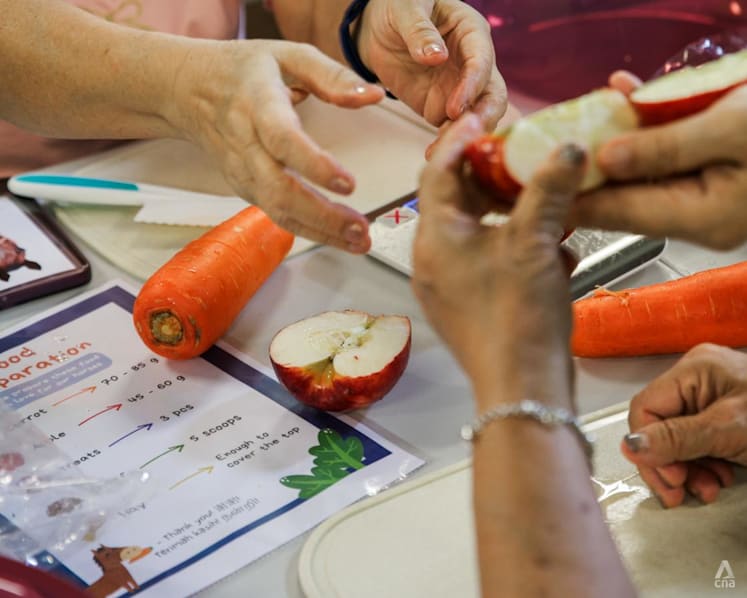
Participants preparing fruits, vegetables, biscuits and hay for horses as part of an equine therapy programme. (Photo: CNA/Nuria Ling)

The sessions are conducted at selected NTUC Health nursing homes and active ageing centres, or at the stables run by the charity group EQUAL. 

The seniors get to interact with nine retired horses that were previously racehorses, polo horses or riding school horses, as well as six miniature horses.

The programme, which was first introduced in October 2024, will be gradually rolled out to some 800 seniors in NTUC Health nursing homes and active ageing centres by 2026. 
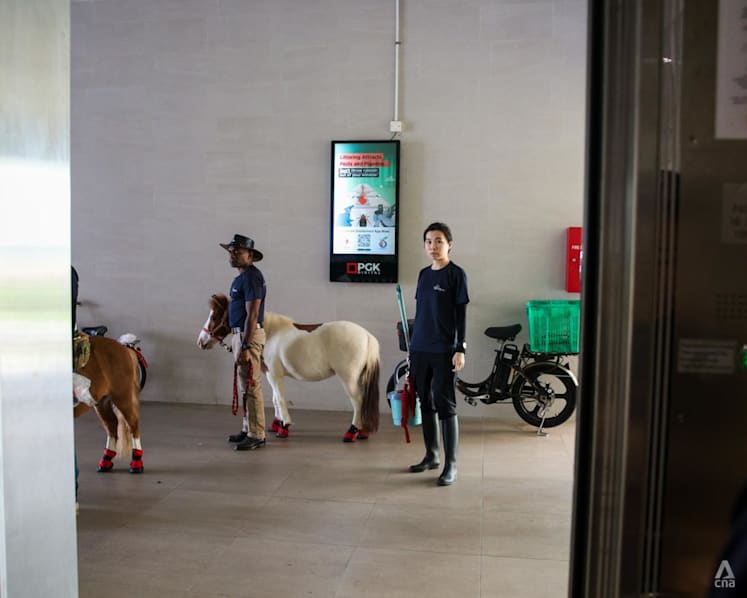
Equine trainers and programme instructors waiting to enter a lift with two miniature horses, Boogie and Harley, for a session held at an active ageing centre in Jurong West on Mar 17, 2025. (Photo: CNA/Nuria Ling)
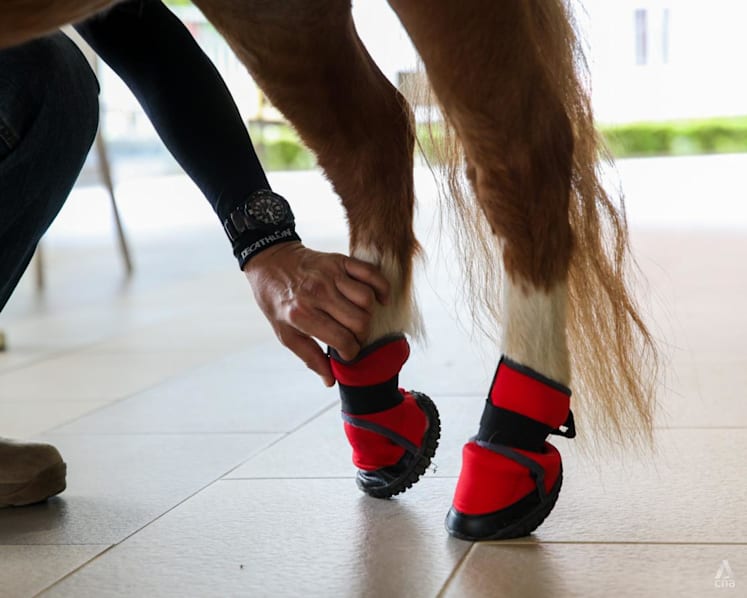
An equine trainer adjusting the shoes on Boogie, a miniature horse, after it tries to remove them. The horses wear special shoes on visits outside the stable for better traction and improved stability. (Photo: CNA/Nuria Ling)

Madam Chow May Ho, 77 is one of the seniors participating in the programme. 

Together with her husband, the couple signed up for the equine programme with much enthusiasm, but had cold feet the day before the first session began. 

“We were very excited,  but after signing up, I was a bit scared. That night, I couldn’t sleep. Are the horses aggressive? Will they kick us?," Mdm Chow recalled.  

Their fear was probably compounded by their friends' concerns, who had told them that the stable would be “smelly and infested with mosquitoes” and that they had to be under the sun for hours, even though these friends have not interacted with horses or taken part in the programme.

Mdm Chow's husband Tan Choon How said he wore a long-sleeved T-shirt and a wide-brimmed hat and doused himself with mosquito repellent on his first visit to the stable. 

Eventually, their fears dissipated and their confidence grew as they learnt how to interact with the horses. 

In the end, even their most sceptical friends signed up for the sessions.
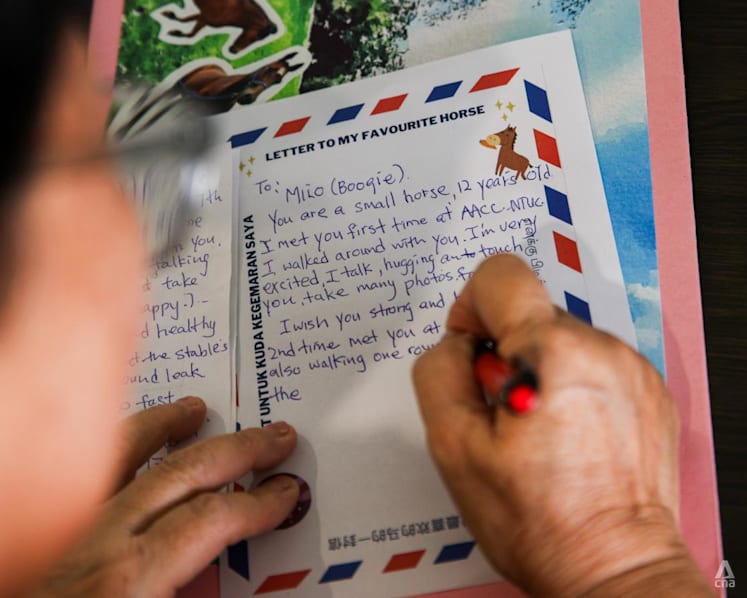
Madam Chow May Ho writing letters to her chosen horses as part of an activity for an equine therapy programme on Mar 17, 2025. The seniors read their letters to the horses the following week. (Photo: CNA/Nuria Ling)

A NERVOUS KISS FOR "SAYANG"  

At the active ageing centre in Jurong West where one of the sessions was being conducted, Mdm Chow was tasked to write a letter to one of the miniature horses named Boogie that was brought there that day.

Halfway through penning her thoughts, she was distracted by Harley, another miniature male horse that was there.  

Unable to resist petting him, she stopped her work and placed her hand near its nose for it to sniff, a technique she was taught as a way to introduce oneself to a horse.

The trainer then asked if she would like to give Harley a kiss. 

With much trepidation, she leaned forward and gave the horse a small peck and stroked its mane, while gently whispering “sayang” to it, a term of endearment in Malay. 

The retired preschool teacher said her heart was racing because it was her first time kissing an animal.
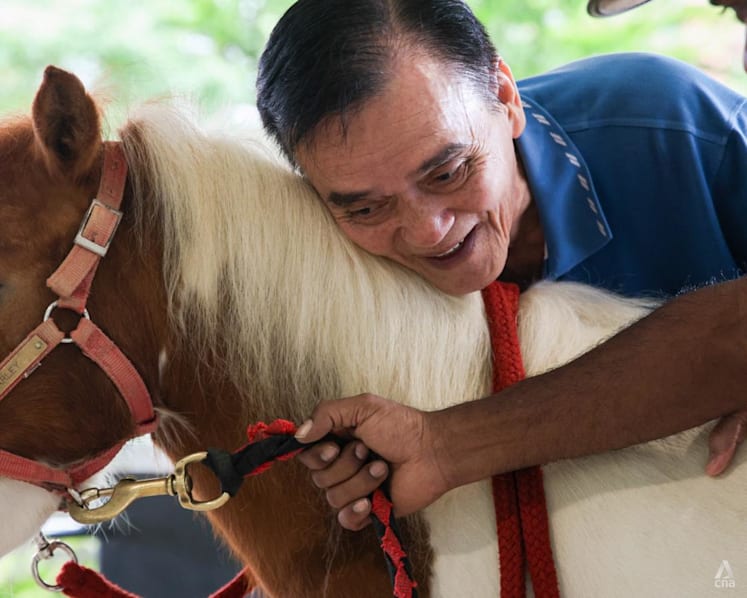
Mr Ang Tee Hiom giving Harley the miniature horse a hug during a session at an active ageing centre. (Photo: CNA/Nuria Ling)
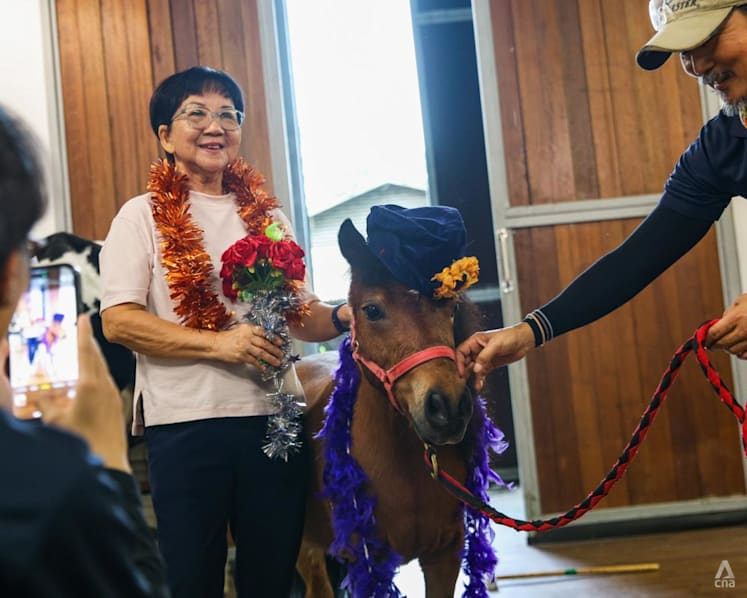
Miniature horse Friday, nicknamed “Kopi”, was all dressed up to take photographs with the participants of an equine therapy programme during the last session on Mar 24, 2025. (Photo: CNA/Nuria Ling)

As Mdm Chow’s confidence grew, so did her husband’s. 

Programme instructor Clarabelle Sih, 29, said she saw the “biggest change in attitude” in Mr Tan among the seniors. 

“At the beginning when you talked to him, he could not focus. His hands were shaking, even while leading the horse,” Ms Sih recalled. 

The former taxi driver said he had never been so close to such a large animal before, let alone touched one.

However, his fear gradually went away and before long, he was looking forward to the interactions. 

“Even though each session is two hours, it passes by very quickly, like there’s not enough time."

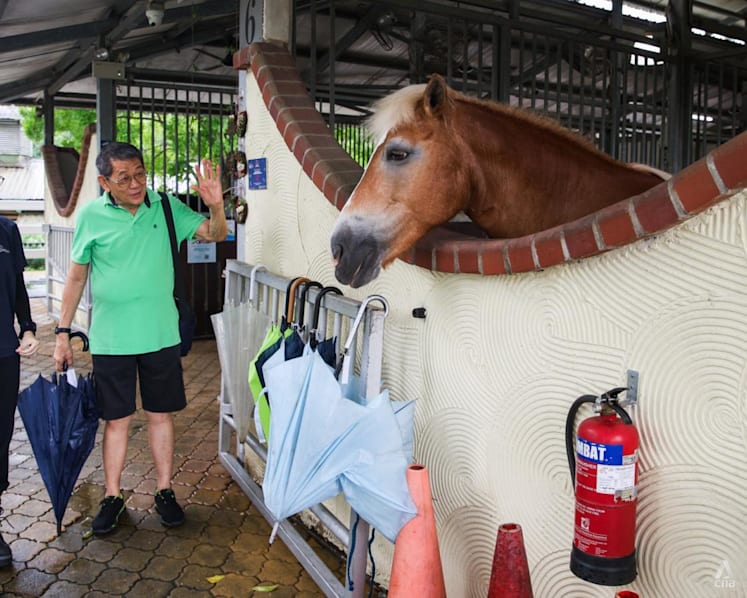
During the last session at the stable, Mr Tan waved goodbye to each of the horses in their stalls and patted them on their heads, bidding them a fond farewell. 
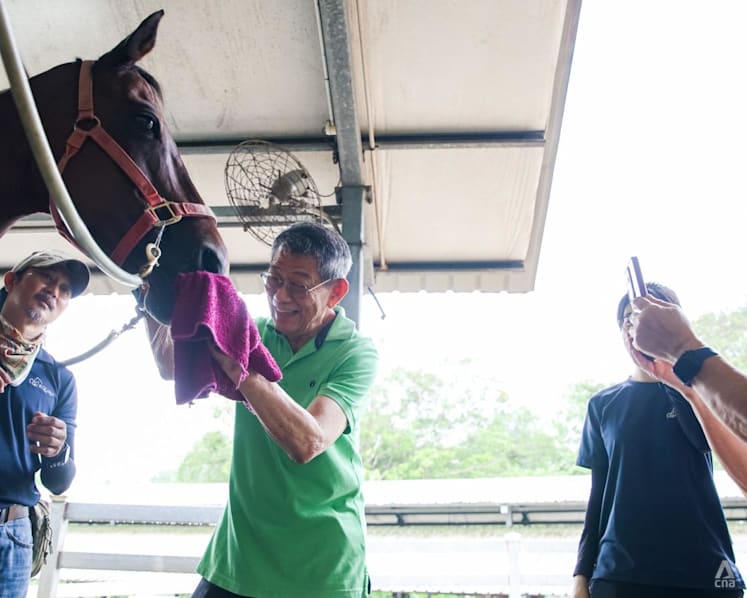
Mr Tan Choon How confidently cleaning Falco’s nostrils and eyes, a far cry from how he was during the first few sessions of an euqine therapy programme. The seniors took turns grooming the 22-year-old male retired riding school horse, one of the activities designed to boost their confidence. (Photo: CNA/Nuria Ling)
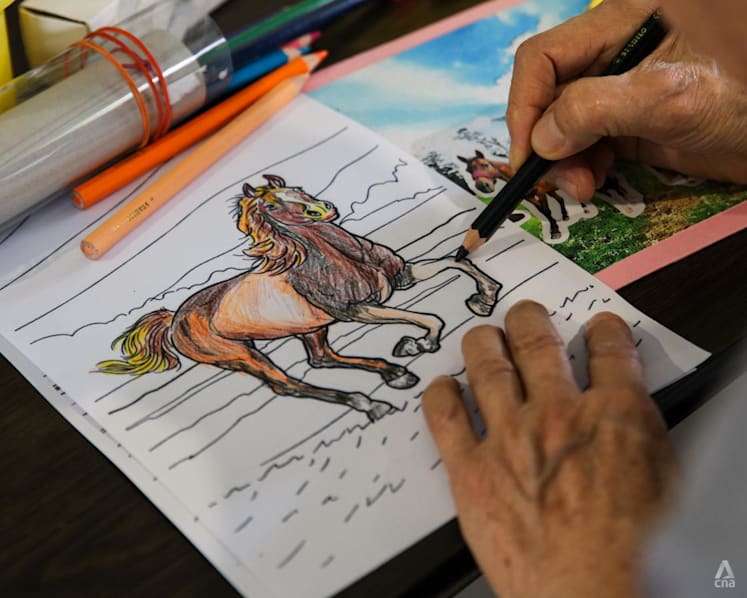
Mr Tan Choon How putting his artistic skills to use during a colouring activity at an active ageing centre on Mar 17, 2025. (Photo: CNA/Nuria Ling)
Mr Tan Choon How waving to Caterpillar, a 22-year-old female retired riding school horse, at the end of the last session of an equine therapy programme. (Photo: CNA/Nuria Ling)

Fear and anxiety were common feelings among the seniors at the start of the programme.

Mr Ang, for instance, said he was “a little scared” as well when he first approached a horse. 

The 75-year-old, who bears a stoic exterior, is not someone who is easily intimidated, having worked in the police force, the prison service and the Singapore Boys’ Home, a shelter for youth in rehabilitation.

Still, he said it was "different" when it came to animals. 

“For human beings, if we don’t like them, we can scold them, we can react to the way they treated us. But for animals, we have to understand their feelings, so it’s a different type of interaction,” he added.
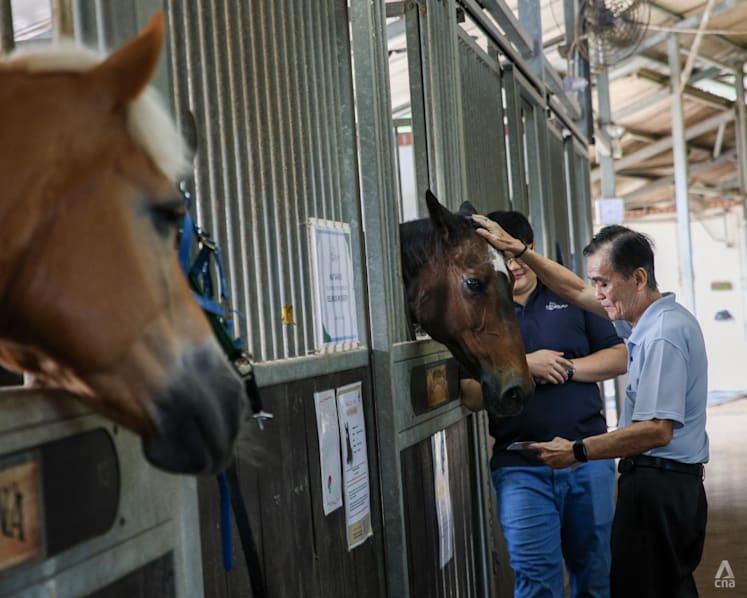
Mr Ang Tee Hiom sharing a moment with his favourite horse, Matahari, at a stable along Thomson Road run by charity group EQUAL, on Mar 24, 2025. (Photo: CNA/Nuria Ling)

Ms Sih noticed that Mr Ang had “come out of his shell” since the first few sessions of the programme when he preferred to sit by himself away from the rest of the group. 

Unlike most of the other participants who came with either their partners or friends, Mr Ang signed up for the programme alone, out of curiosity.

He lives with his wife, who is still working, and two adult children.

During the last session at the stable, he got emotional when he spoke about Matahari, having built a connection with it. 

“Feels sad that I won’t be able to see her again,” he said with a trembling voice. 

GRANDMA "KNOWS WHAT SHE IS DOING"

On the last day of the programme, the participants were allowed to invite a guest to the active ageing centre in Jurong West to interact with two miniature horses. 
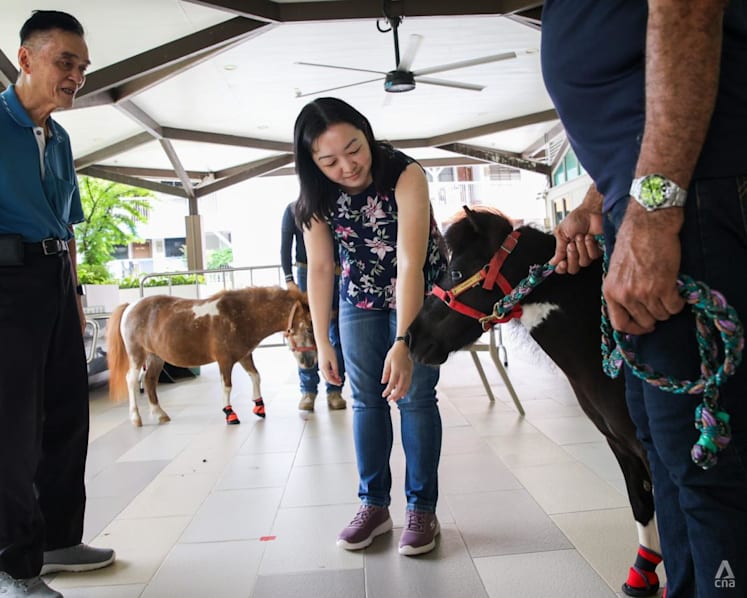
Mr Ang Tee Hiom (left) giving verbal instructions to his daughter Doreen Ang on how to introduce herself to a horse. (Photo: CNA/Nuria Ling)
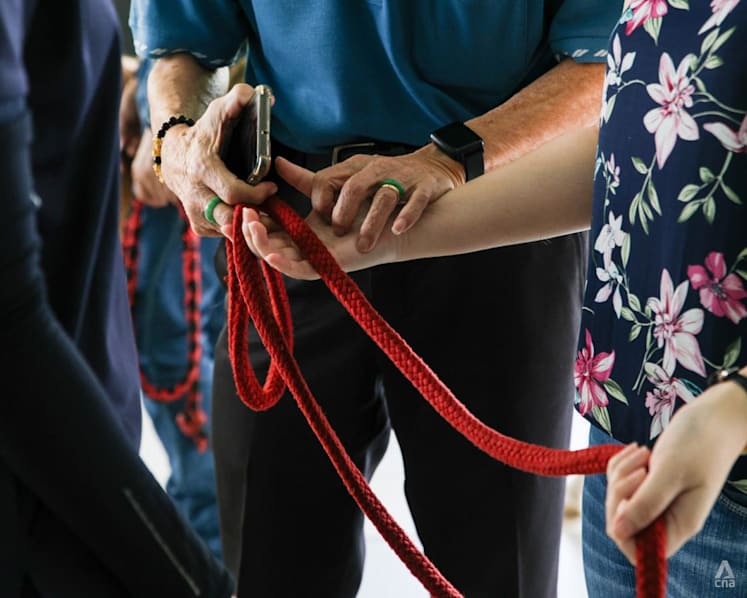
Mr Ang Tee Hiom showing his daughter (right) how to hold the lead rope on a horse. (Photo: CNA/Nuria Ling)

Mr Ang invited his daughter, Ms Doreen Ang, 38, a human resource executive who took leave from work to see firsthand what her father has been preoccupied with for the past 10 weeks. 

He showed her how to adopt a relaxed posture while holding the lead rope as well as where to stand when introducing herself to the horses.

Ms Ang said that her father looked forward to the sessions every week and would share photos of himself with the horses in the family chat group on the phone.
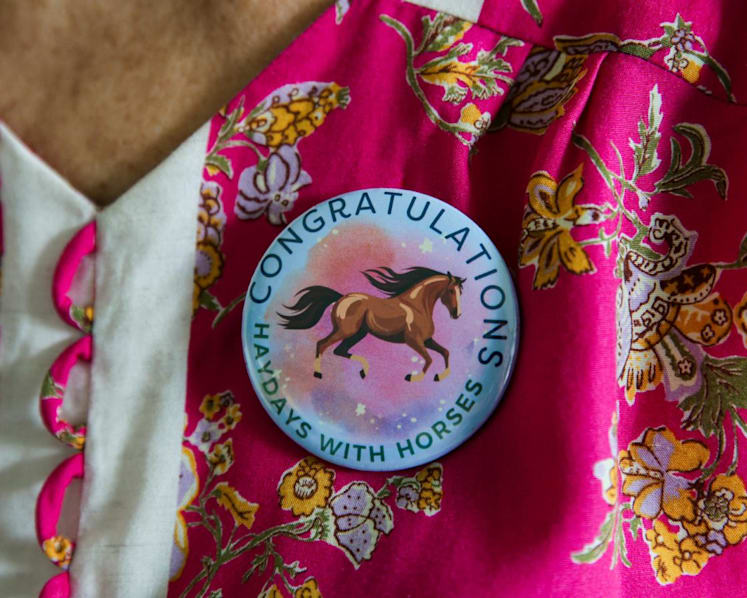
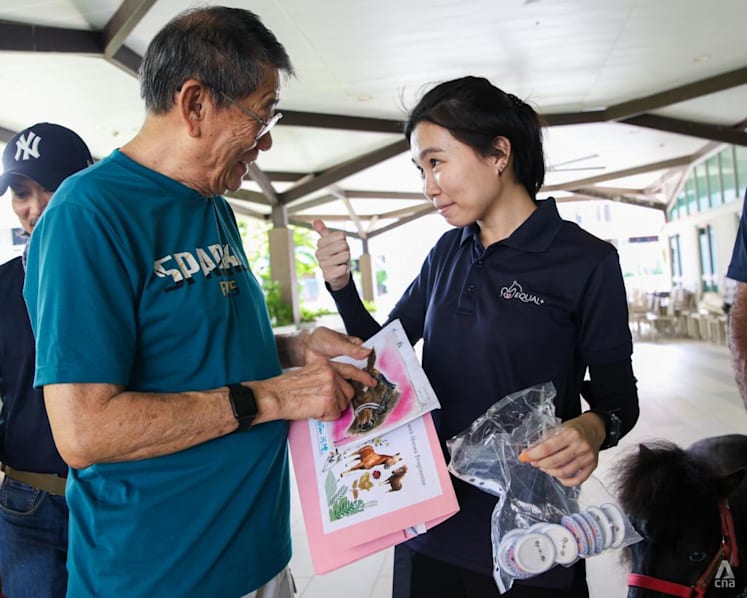
Participants were presented with a badge on the last session of the equine therapy programme. (Photo: CNA/Nuria Ling)
Mr Tan Choon How (left) gifting his drawings to euqine therapy programme instructor Clarabelle Sih. (Photo: CNA/Nuria Ling)
Ms Clarabelle Sih (right) bidding goodbye to Madam Chow May Ho (left) during the last session of the equine therapy programme. (Photo: CNA/Nuria Ling)

Mdm Chow took along her 16-year-old grandson Brandon Sim, who got to see his grandmother move with ease around the horses. 

She instructed him to say the horse’s name when approaching it and introduce himself.

“She knows what she’s doing,” he said proudly.

When it was time for a final group photo, the trainers positioned the horses in front of the seniors and their guests.

And as if right on cue, Ginger the miniature horse delivered its parting gift – a sizeable poop drop, just as the photo was being taken. 

Laughter broke out all around and someone in the group quipped that everyone received some “good luck” to end the day. 
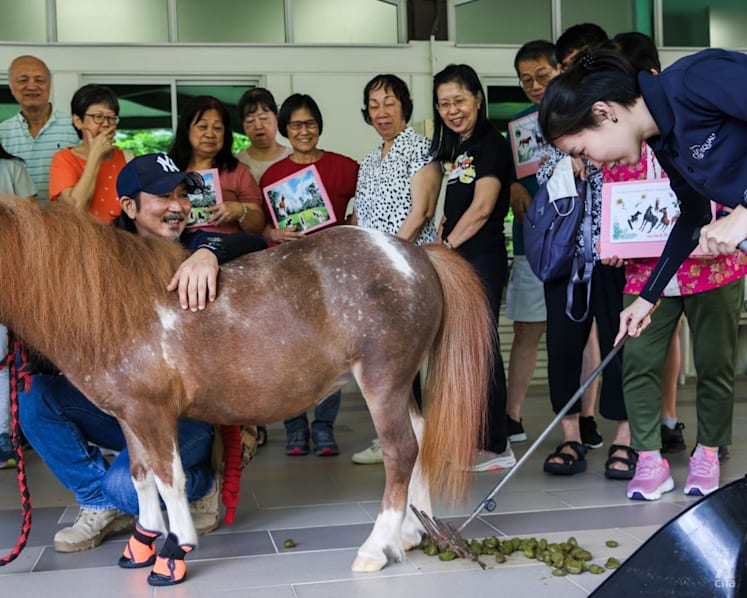
Miniature horse Ginger took a dump during a photoshoot, to the amusement of participants of an equine therapy programme. (Photo: CNA/Nuria Ling)
Advertisement

In Pixels

Inside a dragon kiln where temperatures go up to 1,300°C

Inside a dragon kiln where temperatures go up to 1,300°C

Wood-firing at a dragon kiln is a community effort that requires round-the-clock monitoring. (Photo: CNA/Ooi Boon Keong)

15 Nov 2024 09:30PM (Updated: 16 Oct 2025 12:09AM)

Nestled in an industrial estate in the western part of Singapore is an 84-year-old dragon kiln, the oldest and the only operational dragon kiln in the country. 

Built in 1940, the kiln at Thow Kwang Pottery Jungle was originally used for the mass production of household and industrial items such as cups and flower pots.

Over the decades, the place has evolved into a community space, now offering classes and events for potters to hone their craft. 

CNA TODAY joined the potter community for a wood-firing session that happens only two or three times a year.

CNA Games
Show More
Show Less

In Pixels takes you through the experience, as new and seasoned potters bond over fire and perspiration, creating unique works of art. 

PRAYERS TO THE "KILN GOD"  

At Thow Kwang Pottery Jungle, which is located a short distance from Nanyang Technological University, a group of around 30 people gathered on a Friday last month in front of the kiln.

This was at the request of the owners, Mr Tan Teck Yoke, 68, and his wife Yulianti Tan, 66. 

A prayer ceremony to the "kiln god" was about to begin. 

“We are praying to the ‘kiln god’ for a successful firing, for the pieces to achieve the desired effects,” Mr Tan explained to the enthusiastic participants. 

To this, the crowd responded by shouting, “Heng, ong, huat, ah,” a phrase in the Chinese dialect of Hokkien that collectively means wishing for good fortune.
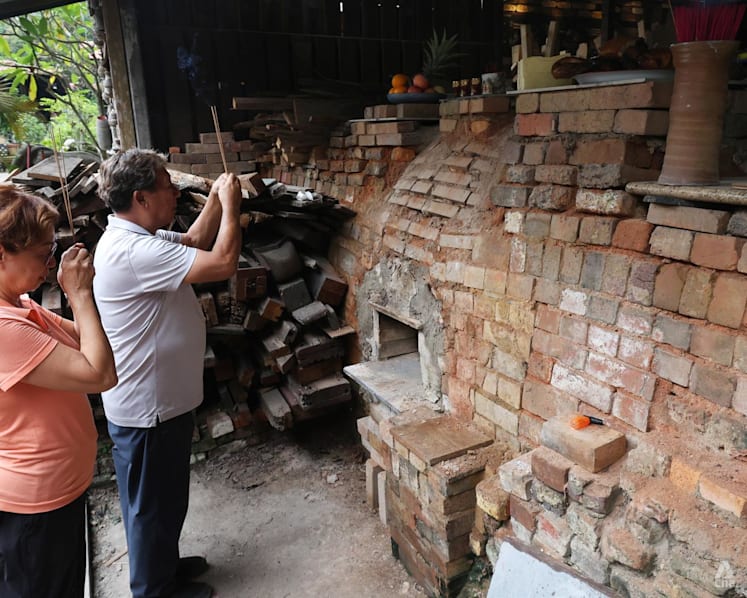
Mrs Yulianti Tan and Mr Tan Teck Yoke, owners of Thow Kwang Pottery Jungle, praying for a successful wood-firing session. (Photo: CNA/Ooi Boon Keong)

After the prayers were done, the fire box, which is a small opening at the front of the kiln, was lit. 

The participants each picked up a piece of wood to throw into the fire, hoping to add more "luck" to the process. 
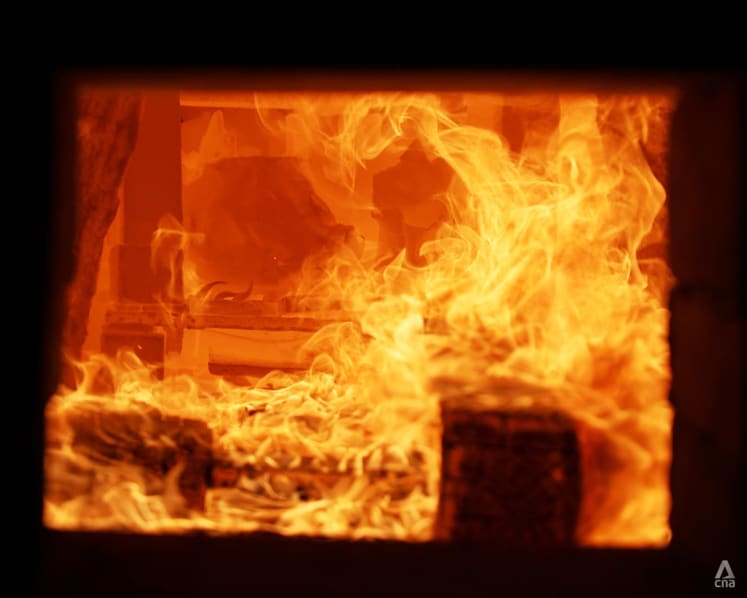
During wood-firing in a kiln, the fire and the ashes from the wood react with the glaze on the ceramic items to produce a unique and rustic look. (Photo: CNA/Ooi Boon Keong)

The dragon kiln was bought by Mr Tan’s father in 1965 and has been owned by the family since then.

It sits on a slope, is 27-metres long, 2-metres wide and curves around the side, resembling the body of a dragon in Chinese mythology. 

Its lengthy chambers are made out of bricks and there is a chimney at the end, located at the top of the slope.

The kiln can fit thousands of pieces of ceramic items, depending on the size of the pots. 

For this firing session, around 400 to 500 pieces were loaded in the kiln. 

NEW WAYS TO IMPROVE PROCESS

Temperatures in the dragon kiln can reach up to 1,300°C. 

They can fluctuate significantly due to the shape of the furnace and the use of wood as a fuel.

That is why one of the most crucial parts of the process is to monitor the temperature for all three days of the firing session.

Mr Chua Hee Lai, who is in his 50s and a hobbyist-turned-kiln master, helped to plan and lead each firing session. 
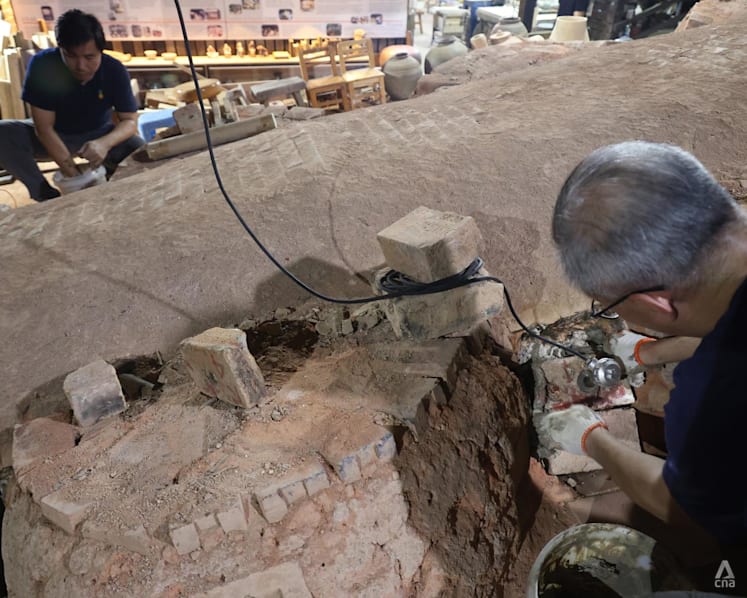
Mr Chua Hee Lai (right) installing thermocouples on the slopes of an 84-year-old kiln to monitor the temperatures. (Photo: CNA/Ooi Boon Keong)

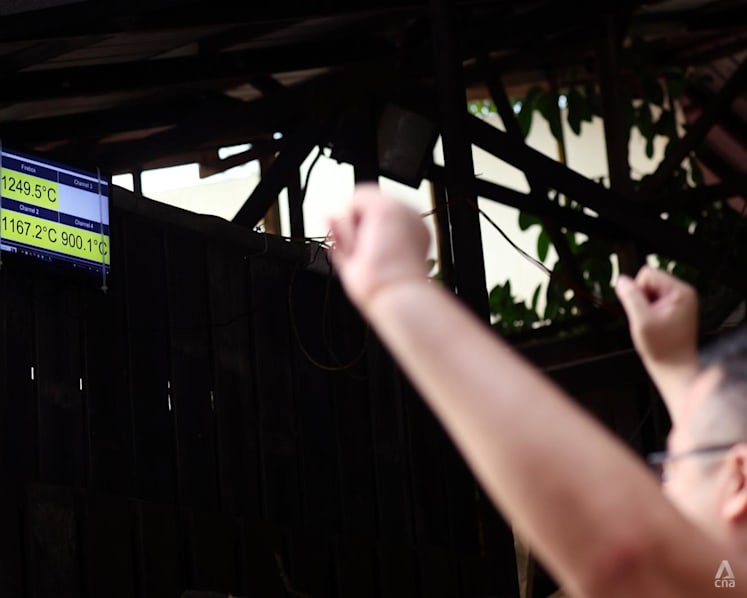
In 2019, Mr Chua, with the help of another potter, introduced a digital monitoring system that allowed them to track the temperatures remotely and give instructions to the potters doing shift work on site. 

Previously, they had to monitor the temperature by looking at the colour of the flame or record temperatures manually and then draw up prediction charts – a process that requires them to be on site for longer periods of time.
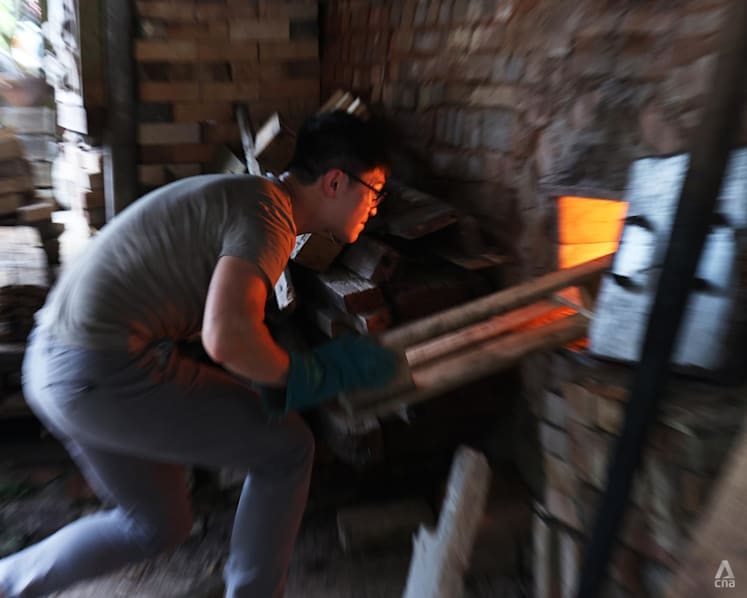
When the temperatures start to dip, potters will add more wood into the fire. (Photo: CNA/Ooi Boon Keong)
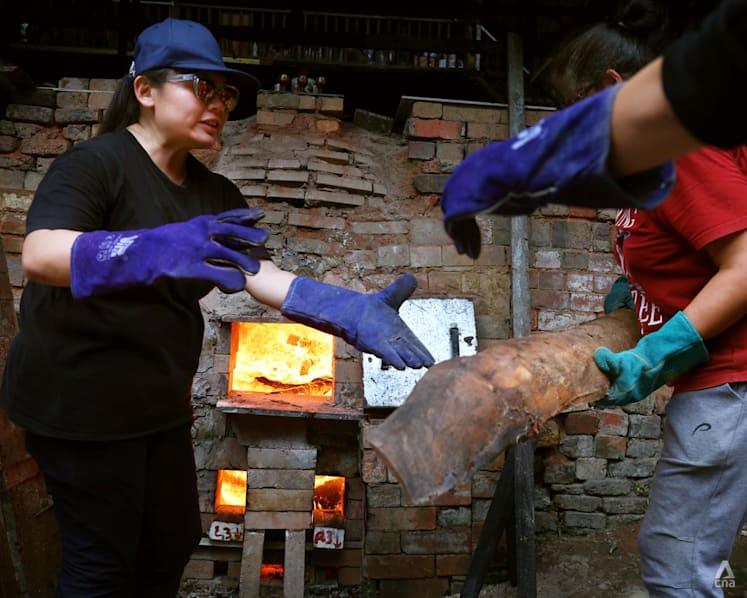
Potters handling large pieces of wood to be fed into a fire box. (Photo: CNA/Ooi Boon Keong)
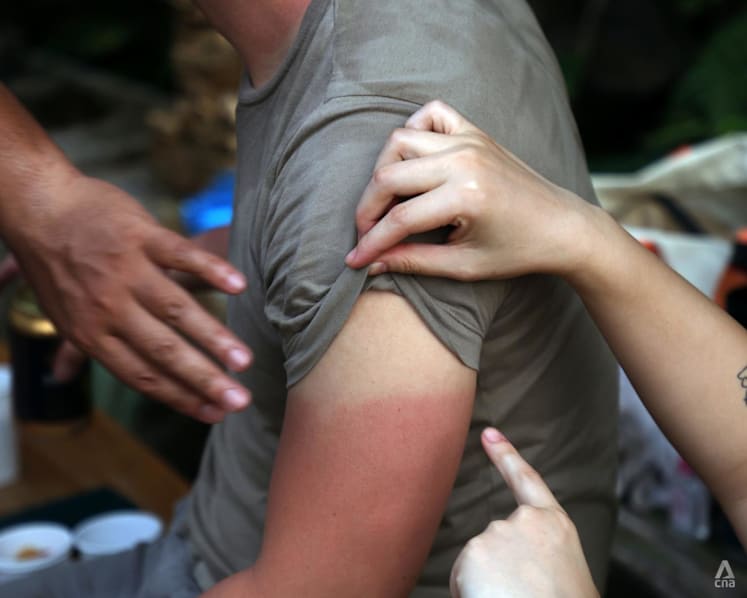
The effect of burning heat can be seen in the different skin colours of a potter’s arms, after he stood near the kiln's fire box for some time to keep the flame going. (Photo: CNA/Ooi Boon Keong)
Cheers breaking out as the target wood-firing temperature of 1,260°C was about to be reached. (Photo: CNA/Ooi Boon Keong)

THE "KAMPUNG SPIRIT"

Advertising executive Vanessa Low and product manager Goh Wei Ting, both 31, have been practising pottery at another pottery studio for around five years and this was their first time taking part in the wood-firing process.

Compared to a regular firing in an electric or gas kiln, wood-firing is "tiring and physically demanding", Mr Goh said.

However, they were buoyed by the “kampung spirit” or the sense of camaraderie that came about as participants laboured together. 

 “You just don’t feel tired, you just do (the work),” Mr Goh added. 

A group of young potters who are new to wood-firing taking photos near the kiln. (Photo: CNA/Ooi Boon Keong)
Experienced and new potters forming a human chain to carry pieces of wood to be used for the firing. (Photo: CNA/Ooi Boon Keong)
Participants having a lively potluck dinner, a brief respite from the day’s hard work. (Photo: CNA/Ooi Boon Keong)
After dinner, potters sitting around and chatting in front of the fire while monitoring the kiln. (Photo: CNA/Ooi Boon Keong)

OPENING OF THE KILN

Six days after the firing at the dragon kiln, the participants returned to open the kiln and check on their art pieces. 

“Shall we form a chain?” someone suggested to facilitate the removal of the brick walls. 

Without hesitation, a human chain quickly formed as the potters unsealed the kiln, one brick at a time. 

Potters in the process of dismantling the brick walls, in order to get into the kiln's chambers. (Photo: CNA/Ooi Boon Keong)
Breaking down the final wall to reach the last shelves holding pottery items. (Photo: CNA/Ooi Boon Keong)
The residual heat from the firing was keenly felt by the potters inside the kiln. (Photo: CNA/Ooi Boon Keong)
Each piece of pottery was removed carefully from the shelves and moved out in batches. (Photo: CNA/Ooi Boon Keong)
Finally, potters reached the chamber closest to the fire box. Only one person is able to reach the items in the narrow chamber. (Photo: CNA/Ooi Boon Keong)

A collective “wow” sounded as the final bricks were removed, revealing the final outcome of the nine-day process that comprised three days of firing and six days of cooling.

The potters carefully removed the art pieces from the shelves, while admiring the effects that the fire had on their work. 

Advertisement

In Pixels

Meet the 70-year-old lorry driver who is also a 'kite doctor'

Meet the 70-year-old lorry driver who is also a 'kite doctor'

Kite maker Tan Poh Wah flying his handmade dragon kite at the Marina Barrage. (Photo: CNA/Nuria Ling)

30 Nov 2024 09:30PM (Updated: 16 Oct 2025 12:08AM)

Rolling up to Marina Barrage with a trolley bag full of handmade kites and repair tools, Mr Tan Poh Wah had one clear mission for the day: To share his love of kite-flying with others. 

Known informally as the “kite doctor” among the regular visitors there, the 70-year-old spends most Sundays repairing kites or offering his handmade ones – mostly for free – to people at the open-air space that is the venue of Singapore's largest reservoir. 

“Watching people fly my kites makes me really happy,” Mr Tan said.  

This weekend, In Pixels speaks to four enthusiasts to find out what excites them about kite-flying. 

A FAMILIAR FIGURE

CNA Games
Show More
Show Less

Shortly after Mr Tan turned up at Marina Barrage in the Marina Bay area, a handful of people who wanted their kites repaired immediately made a beeline towards him. 

They offered him drinks and snacks to thank him for his service. 

Mr Tan Poh Wah fixing a kite for a member of the public at the Marina Barrage. (Photo: CNA/Mak Jia Kee)
A variety of sticks and other kite parts are some of the things in Mr Tan Poh Wah’s kit that he takes to the Marina Barrage. (Photo: CNA/Nuria Ling)

When he was done with the repairs, Mr Tan pulled a kite from his bag and launched it to the sky. 

He flew it with ease, strolling around the field, eager to find someone who will take the kite as a gift. 

His masterpieces are made mostly from recycled materials including plastic bags, discarded blinds, banners and umbrellas. 

Mr Tan Poh Wah holding up a kite he made using a supermarket plastic bag. (Photo: CNA/Mak Jia Kee)
Mr Tan Poh Wah with a handmade kite made out of recycled materials. (Photo: CNA/Nuria Ling)

Mr Tan is part of a group known as Singapore Original Kites, an informal gathering of adults in their 60s and 70s who share the same interest in making and flying kites.  

A semi-retired Chinese physician ​​Ong Cheng Her, 75, is the founder of the group.

He said that the only prerequisite to join the group is one’s ability to make a kite from scratch.  

He proudly showed CNA TODAY one of his creations, a red and white "umbrella kite". 

“Umbrellas are used for shade and rain protection, so why hasn’t anyone flown an umbrella kite? I decided to take on the challenge,” Mr Ong added.

Mr Ong Cheng Her, founder of the Singapore Original Kites group, holding an "umbrella kite" that he made in 2023. (Photo: CNA/Nuria Ling )
Mr Ong Cheng Her holding a kite he made, featuring flower and leaf patterns inspired by traditional Chinese paintings. (Photo: CNA/Mak Jia Kee)

HIS WORKSPACE AT HOME

As for Mr Tan, he is not retired, so flying and making kites is what he does only on Sundays.

He works six days a week as a lorry driver.

“I work to live, to fill my stomach so I can make kites.”

Stepping into his flat, Mr Tan led us to his "studio", which is a room filled with a bountiful supply of kites and raw materials. 

He described his workspace as a “chaotic but organised mess”. 

“My wife sometimes asks why I collect so many umbrellas, but she doesn’t interfere much because she knows I enjoy making these things.”

Mr Tan Poh Wah tying a ribbon to a bamboo stick to form part of a kite. (Photo: CNA/Nuria Ling)

Mr Tan has loved kite flying since he was a child, but it was not until he was in his 30s that he took to making kites himself.

A self-taught craftsman, he said that he learnt how to make kites by observing other kite-makers whenever an opportunity comes along. 

Mr Tan Poh Wah crafting a squid kite in his workshop that he set up in his flat. (Photo: CNA/Nuria Ling)
Mr Tan Poh Wah laying out pieces of a 70m-long "dragon kite" in his living room. (Photo: CNA/Nuria Ling)

Recently, Mr Tan finished repairing a 70m-long "dragon kite" that he first constructed in 2000. It broke at a kite festival in Taiwan in 2019 and required extensive repairs. 

After CNA TODAY approached him for an interview, Mr Tan said that he found new inspiration to repair the kite, which took him four Sundays to complete.

It was obvious that he is most proud of this kite among the many in his collection.

“Anyone who hasn't made a dragon or a phoenix kite isn't truly considered a kite maker,” he said, adding that these long kites are made up of many different sections and each needed to be crafted with great precision before they are finally stitched together. 

A 70m-long "dragon kite" made by Mr Tan Poh Wah flying at Marina Barrage. (Photo: CNA/Nuria Ling)

"GIANTS" IN THE SKY

Over at East Coast Park, another group of kite enthusiasts have gathered and their presence could be spotted from afar. 

The kites they have taken out, called "inflatable show kites", are gigantic balloon-like kites that are typically several metres in length when inflated.

Traditional kites rely on rigid frames for support, but inflatable show kites have no hard structures. They inflate as they catch on the wind and have to be anchored to the ground.

An inflatable show kite flying at East Coast Park. (Photo: CNA/Nuria Ling)
Mr Johnny Yap checking on a 10m-tall seahorse-shaped inflatable show kite. (Photo: CNA/Mak Jia Kee)

Project coordinator Johnny Yap and his wife Maggie Mok, a homemaker, both 51, are the founders of Show Kites Singapore, a group of people who are into these inflatable show kites.

The duo's interest in this started nearly 20 years ago when they took their children kite-flying. 

In the end, it was the couple themselves who got hooked on the activity. 

“We started flying bigger and bigger kites and before long, we realised that stick kites have a limit,” Mr Yap said.

This led them to explore inflatable ones in 2009 and they came across these kites online before buying their first. The sky is the limit when it comes to the sizes of such kites.

Ms Maggie Mok examining the flying cord of an inflatable show kite. (Photo: CNA/Mak Jia Kee)
Mr Johnny Yap fixing the attached strings on his show kite. (Photo: CNA/Nuria Ling)
Mr Johnny Yap holding open an inflation vent for air to fill up the kite. (Photo: CNA/Nuria Ling)

As their interests grew, Mr Yap and Ms Mok started travelling overseas to take part in international kite festivals. 

In September, they were at the International Kite Festival in Melaka, Malaysia, where they flew an inflatable show kite in the form of Singapore's tourism icon, the Merlion.

Advertisement

In Pixels

Inside a dragon kiln where temperatures go up to 1,300°C

Inside a dragon kiln where temperatures go up to 1,300°C

Wood-firing at a dragon kiln is a community effort that requires round-the-clock monitoring. (Photo: CNA/Ooi Boon Keong)

15 Nov 2024 09:30PM (Updated: 16 Oct 2025 12:09AM)

Nestled in an industrial estate in the western part of Singapore is an 84-year-old dragon kiln, the oldest and the only operational dragon kiln in the country. 

Built in 1940, the kiln at Thow Kwang Pottery Jungle was originally used for the mass production of household and industrial items such as cups and flower pots.

Over the decades, the place has evolved into a community space, now offering classes and events for potters to hone their craft. 

CNA TODAY joined the potter community for a wood-firing session that happens only two or three times a year.

CNA Games
Show More
Show Less

In Pixels takes you through the experience, as new and seasoned potters bond over fire and perspiration, creating unique works of art. 

PRAYERS TO THE "KILN GOD"  

At Thow Kwang Pottery Jungle, which is located a short distance from Nanyang Technological University, a group of around 30 people gathered on a Friday last month in front of the kiln.

This was at the request of the owners, Mr Tan Teck Yoke, 68, and his wife Yulianti Tan, 66. 

A prayer ceremony to the "kiln god" was about to begin. 

“We are praying to the ‘kiln god’ for a successful firing, for the pieces to achieve the desired effects,” Mr Tan explained to the enthusiastic participants. 

To this, the crowd responded by shouting, “Heng, ong, huat, ah,” a phrase in the Chinese dialect of Hokkien that collectively means wishing for good fortune.

Mrs Yulianti Tan and Mr Tan Teck Yoke, owners of Thow Kwang Pottery Jungle, praying for a successful wood-firing session. (Photo: CNA/Ooi Boon Keong)

After the prayers were done, the fire box, which is a small opening at the front of the kiln, was lit. 

The participants each picked up a piece of wood to throw into the fire, hoping to add more "luck" to the process. 

During wood-firing in a kiln, the fire and the ashes from the wood react with the glaze on the ceramic items to produce a unique and rustic look. (Photo: CNA/Ooi Boon Keong)

The dragon kiln was bought by Mr Tan’s father in 1965 and has been owned by the family since then.

It sits on a slope, is 27-metres long, 2-metres wide and curves around the side, resembling the body of a dragon in Chinese mythology. 

Its lengthy chambers are made out of bricks and there is a chimney at the end, located at the top of the slope.

The kiln can fit thousands of pieces of ceramic items, depending on the size of the pots. 

For this firing session, around 400 to 500 pieces were loaded in the kiln. 

NEW WAYS TO IMPROVE PROCESS

Temperatures in the dragon kiln can reach up to 1,300°C. 

They can fluctuate significantly due to the shape of the furnace and the use of wood as a fuel.

That is why one of the most crucial parts of the process is to monitor the temperature for all three days of the firing session.

Mr Chua Hee Lai, who is in his 50s and a hobbyist-turned-kiln master, helped to plan and lead each firing session. 

Mr Chua Hee Lai (right) installing thermocouples on the slopes of an 84-year-old kiln to monitor the temperatures. (Photo: CNA/Ooi Boon Keong)

In 2019, Mr Chua, with the help of another potter, introduced a digital monitoring system that allowed them to track the temperatures remotely and give instructions to the potters doing shift work on site. 

Previously, they had to monitor the temperature by looking at the colour of the flame or record temperatures manually and then draw up prediction charts – a process that requires them to be on site for longer periods of time.
When the temperatures start to dip, potters will add more wood into the fire. (Photo: CNA/Ooi Boon Keong)
Potters handling large pieces of wood to be fed into a fire box. (Photo: CNA/Ooi Boon Keong)
The effect of burning heat can be seen in the different skin colours of a potter’s arms, after he stood near the kiln's fire box for some time to keep the flame going. (Photo: CNA/Ooi Boon Keong)
Cheers breaking out as the target wood-firing temperature of 1,260°C was about to be reached. (Photo: CNA/Ooi Boon Keong)

THE "KAMPUNG SPIRIT"

Advertising executive Vanessa Low and product manager Goh Wei Ting, both 31, have been practising pottery at another pottery studio for around five years and this was their first time taking part in the wood-firing process.

Compared to a regular firing in an electric or gas kiln, wood-firing is "tiring and physically demanding", Mr Goh said.

However, they were buoyed by the “kampung spirit” or the sense of camaraderie that came about as participants laboured together. 

 “You just don’t feel tired, you just do (the work),” Mr Goh added. 

A group of young potters who are new to wood-firing taking photos near the kiln. (Photo: CNA/Ooi Boon Keong)
Experienced and new potters forming a human chain to carry pieces of wood to be used for the firing. (Photo: CNA/Ooi Boon Keong)
Participants having a lively potluck dinner, a brief respite from the day’s hard work. (Photo: CNA/Ooi Boon Keong)
After dinner, potters sitting around and chatting in front of the fire while monitoring the kiln. (Photo: CNA/Ooi Boon Keong)

OPENING OF THE KILN

Six days after the firing at the dragon kiln, the participants returned to open the kiln and check on their art pieces. 

“Shall we form a chain?” someone suggested to facilitate the removal of the brick walls. 

Without hesitation, a human chain quickly formed as the potters unsealed the kiln, one brick at a time. 

Potters in the process of dismantling the brick walls, in order to get into the kiln's chambers. (Photo: CNA/Ooi Boon Keong)
Breaking down the final wall to reach the last shelves holding pottery items. (Photo: CNA/Ooi Boon Keong)
The residual heat from the firing was keenly felt by the potters inside the kiln. (Photo: CNA/Ooi Boon Keong)
Each piece of pottery was removed carefully from the shelves and moved out in batches. (Photo: CNA/Ooi Boon Keong)
Finally, potters reached the chamber closest to the fire box. Only one person is able to reach the items in the narrow chamber. (Photo: CNA/Ooi Boon Keong)

A collective “wow” sounded as the final bricks were removed, revealing the final outcome of the nine-day process that comprised three days of firing and six days of cooling.

The potters carefully removed the art pieces from the shelves, while admiring the effects that the fire had on their work. 

Advertisement

In Pixels

Meet the 70-year-old lorry driver who is also a 'kite doctor'

Meet the 70-year-old lorry driver who is also a 'kite doctor'

Kite maker Tan Poh Wah flying his handmade dragon kite at the Marina Barrage. (Photo: CNA/Nuria Ling)

30 Nov 2024 09:30PM (Updated: 16 Oct 2025 12:08AM)

Rolling up to Marina Barrage with a trolley bag full of handmade kites and repair tools, Mr Tan Poh Wah had one clear mission for the day: To share his love of kite-flying with others. 

Known informally as the “kite doctor” among the regular visitors there, the 70-year-old spends most Sundays repairing kites or offering his handmade ones – mostly for free – to people at the open-air space that is the venue of Singapore's largest reservoir. 

“Watching people fly my kites makes me really happy,” Mr Tan said.  

This weekend, In Pixels speaks to four enthusiasts to find out what excites them about kite-flying. 

A FAMILIAR FIGURE

CNA Games
Show More
Show Less

Shortly after Mr Tan turned up at Marina Barrage in the Marina Bay area, a handful of people who wanted their kites repaired immediately made a beeline towards him. 

They offered him drinks and snacks to thank him for his service. 

Mr Tan Poh Wah fixing a kite for a member of the public at the Marina Barrage. (Photo: CNA/Mak Jia Kee)
A variety of sticks and other kite parts are some of the things in Mr Tan Poh Wah’s kit that he takes to the Marina Barrage. (Photo: CNA/Nuria Ling)

When he was done with the repairs, Mr Tan pulled a kite from his bag and launched it to the sky. 

He flew it with ease, strolling around the field, eager to find someone who will take the kite as a gift. 

His masterpieces are made mostly from recycled materials including plastic bags, discarded blinds, banners and umbrellas. 

Mr Tan Poh Wah holding up a kite he made using a supermarket plastic bag. (Photo: CNA/Mak Jia Kee)
Mr Tan Poh Wah with a handmade kite made out of recycled materials. (Photo: CNA/Nuria Ling)

Mr Tan is part of a group known as Singapore Original Kites, an informal gathering of adults in their 60s and 70s who share the same interest in making and flying kites.  

A semi-retired Chinese physician ​​Ong Cheng Her, 75, is the founder of the group.

He said that the only prerequisite to join the group is one’s ability to make a kite from scratch.  

He proudly showed CNA TODAY one of his creations, a red and white "umbrella kite". 

“Umbrellas are used for shade and rain protection, so why hasn’t anyone flown an umbrella kite? I decided to take on the challenge,” Mr Ong added.

Mr Ong Cheng Her, founder of the Singapore Original Kites group, holding an "umbrella kite" that he made in 2023. (Photo: CNA/Nuria Ling )
Mr Ong Cheng Her holding a kite he made, featuring flower and leaf patterns inspired by traditional Chinese paintings. (Photo: CNA/Mak Jia Kee)

HIS WORKSPACE AT HOME

As for Mr Tan, he is not retired, so flying and making kites is what he does only on Sundays.

He works six days a week as a lorry driver.

“I work to live, to fill my stomach so I can make kites.”

Stepping into his flat, Mr Tan led us to his "studio", which is a room filled with a bountiful supply of kites and raw materials. 

He described his workspace as a “chaotic but organised mess”. 

“My wife sometimes asks why I collect so many umbrellas, but she doesn’t interfere much because she knows I enjoy making these things.”

Mr Tan Poh Wah tying a ribbon to a bamboo stick to form part of a kite. (Photo: CNA/Nuria Ling)

Mr Tan has loved kite flying since he was a child, but it was not until he was in his 30s that he took to making kites himself.

A self-taught craftsman, he said that he learnt how to make kites by observing other kite-makers whenever an opportunity comes along. 

Mr Tan Poh Wah crafting a squid kite in his workshop that he set up in his flat. (Photo: CNA/Nuria Ling)
Mr Tan Poh Wah laying out pieces of a 70m-long "dragon kite" in his living room. (Photo: CNA/Nuria Ling)

Recently, Mr Tan finished repairing a 70m-long "dragon kite" that he first constructed in 2000. It broke at a kite festival in Taiwan in 2019 and required extensive repairs. 

After CNA TODAY approached him for an interview, Mr Tan said that he found new inspiration to repair the kite, which took him four Sundays to complete.

It was obvious that he is most proud of this kite among the many in his collection.

“Anyone who hasn't made a dragon or a phoenix kite isn't truly considered a kite maker,” he said, adding that these long kites are made up of many different sections and each needed to be crafted with great precision before they are finally stitched together. 

A 70m-long "dragon kite" made by Mr Tan Poh Wah flying at Marina Barrage. (Photo: CNA/Nuria Ling)

"GIANTS" IN THE SKY

Over at East Coast Park, another group of kite enthusiasts have gathered and their presence could be spotted from afar. 

The kites they have taken out, called "inflatable show kites", are gigantic balloon-like kites that are typically several metres in length when inflated.

Traditional kites rely on rigid frames for support, but inflatable show kites have no hard structures. They inflate as they catch on the wind and have to be anchored to the ground.

An inflatable show kite flying at East Coast Park. (Photo: CNA/Nuria Ling)
Mr Johnny Yap checking on a 10m-tall seahorse-shaped inflatable show kite. (Photo: CNA/Mak Jia Kee)

Project coordinator Johnny Yap and his wife Maggie Mok, a homemaker, both 51, are the founders of Show Kites Singapore, a group of people who are into these inflatable show kites.

The duo's interest in this started nearly 20 years ago when they took their children kite-flying. 

In the end, it was the couple themselves who got hooked on the activity. 

“We started flying bigger and bigger kites and before long, we realised that stick kites have a limit,” Mr Yap said.

This led them to explore inflatable ones in 2009 and they came across these kites online before buying their first. The sky is the limit when it comes to the sizes of such kites.

Ms Maggie Mok examining the flying cord of an inflatable show kite. (Photo: CNA/Mak Jia Kee)
Mr Johnny Yap fixing the attached strings on his show kite. (Photo: CNA/Nuria Ling)
Mr Johnny Yap holding open an inflation vent for air to fill up the kite. (Photo: CNA/Nuria Ling)

As their interests grew, Mr Yap and Ms Mok started travelling overseas to take part in international kite festivals. 

In September, they were at the International Kite Festival in Melaka, Malaysia, where they flew an inflatable show kite in the form of Singapore's tourism icon, the Merlion.

Advertisement

In Pixels

Inside a dragon kiln where temperatures go up to 1,300°C

Inside a dragon kiln where temperatures go up to 1,300°C

Wood-firing at a dragon kiln is a community effort that requires round-the-clock monitoring. (Photo: CNA/Ooi Boon Keong)

15 Nov 2024 09:30PM (Updated: 16 Oct 2025 12:09AM)

Nestled in an industrial estate in the western part of Singapore is an 84-year-old dragon kiln, the oldest and the only operational dragon kiln in the country. 

Built in 1940, the kiln at Thow Kwang Pottery Jungle was originally used for the mass production of household and industrial items such as cups and flower pots.

Over the decades, the place has evolved into a community space, now offering classes and events for potters to hone their craft. 

CNA TODAY joined the potter community for a wood-firing session that happens only two or three times a year.

CNA Games
Show More
Show Less

In Pixels takes you through the experience, as new and seasoned potters bond over fire and perspiration, creating unique works of art. 

PRAYERS TO THE "KILN GOD"  

At Thow Kwang Pottery Jungle, which is located a short distance from Nanyang Technological University, a group of around 30 people gathered on a Friday last month in front of the kiln.

This was at the request of the owners, Mr Tan Teck Yoke, 68, and his wife Yulianti Tan, 66. 

A prayer ceremony to the "kiln god" was about to begin. 

“We are praying to the ‘kiln god’ for a successful firing, for the pieces to achieve the desired effects,” Mr Tan explained to the enthusiastic participants. 

To this, the crowd responded by shouting, “Heng, ong, huat, ah,” a phrase in the Chinese dialect of Hokkien that collectively means wishing for good fortune.

Mrs Yulianti Tan and Mr Tan Teck Yoke, owners of Thow Kwang Pottery Jungle, praying for a successful wood-firing session. (Photo: CNA/Ooi Boon Keong)

After the prayers were done, the fire box, which is a small opening at the front of the kiln, was lit. 

The participants each picked up a piece of wood to throw into the fire, hoping to add more "luck" to the process. 

During wood-firing in a kiln, the fire and the ashes from the wood react with the glaze on the ceramic items to produce a unique and rustic look. (Photo: CNA/Ooi Boon Keong)

The dragon kiln was bought by Mr Tan’s father in 1965 and has been owned by the family since then.

It sits on a slope, is 27-metres long, 2-metres wide and curves around the side, resembling the body of a dragon in Chinese mythology. 

Its lengthy chambers are made out of bricks and there is a chimney at the end, located at the top of the slope.

The kiln can fit thousands of pieces of ceramic items, depending on the size of the pots. 

For this firing session, around 400 to 500 pieces were loaded in the kiln. 

NEW WAYS TO IMPROVE PROCESS

Temperatures in the dragon kiln can reach up to 1,300°C. 

They can fluctuate significantly due to the shape of the furnace and the use of wood as a fuel.

That is why one of the most crucial parts of the process is to monitor the temperature for all three days of the firing session.

Mr Chua Hee Lai, who is in his 50s and a hobbyist-turned-kiln master, helped to plan and lead each firing session. 

Mr Chua Hee Lai (right) installing thermocouples on the slopes of an 84-year-old kiln to monitor the temperatures. (Photo: CNA/Ooi Boon Keong)

In 2019, Mr Chua, with the help of another potter, introduced a digital monitoring system that allowed them to track the temperatures remotely and give instructions to the potters doing shift work on site. 

Previously, they had to monitor the temperature by looking at the colour of the flame or record temperatures manually and then draw up prediction charts – a process that requires them to be on site for longer periods of time.
When the temperatures start to dip, potters will add more wood into the fire. (Photo: CNA/Ooi Boon Keong)
Potters handling large pieces of wood to be fed into a fire box. (Photo: CNA/Ooi Boon Keong)
The effect of burning heat can be seen in the different skin colours of a potter’s arms, after he stood near the kiln's fire box for some time to keep the flame going. (Photo: CNA/Ooi Boon Keong)
Cheers breaking out as the target wood-firing temperature of 1,260°C was about to be reached. (Photo: CNA/Ooi Boon Keong)

THE "KAMPUNG SPIRIT"

Advertising executive Vanessa Low and product manager Goh Wei Ting, both 31, have been practising pottery at another pottery studio for around five years and this was their first time taking part in the wood-firing process.

Compared to a regular firing in an electric or gas kiln, wood-firing is "tiring and physically demanding", Mr Goh said.

However, they were buoyed by the “kampung spirit” or the sense of camaraderie that came about as participants laboured together. 

 “You just don’t feel tired, you just do (the work),” Mr Goh added. 

A group of young potters who are new to wood-firing taking photos near the kiln. (Photo: CNA/Ooi Boon Keong)
Experienced and new potters forming a human chain to carry pieces of wood to be used for the firing. (Photo: CNA/Ooi Boon Keong)
Participants having a lively potluck dinner, a brief respite from the day’s hard work. (Photo: CNA/Ooi Boon Keong)
After dinner, potters sitting around and chatting in front of the fire while monitoring the kiln. (Photo: CNA/Ooi Boon Keong)

OPENING OF THE KILN

Six days after the firing at the dragon kiln, the participants returned to open the kiln and check on their art pieces. 

“Shall we form a chain?” someone suggested to facilitate the removal of the brick walls. 

Without hesitation, a human chain quickly formed as the potters unsealed the kiln, one brick at a time. 

Potters in the process of dismantling the brick walls, in order to get into the kiln's chambers. (Photo: CNA/Ooi Boon Keong)
Breaking down the final wall to reach the last shelves holding pottery items. (Photo: CNA/Ooi Boon Keong)
The residual heat from the firing was keenly felt by the potters inside the kiln. (Photo: CNA/Ooi Boon Keong)
Each piece of pottery was removed carefully from the shelves and moved out in batches. (Photo: CNA/Ooi Boon Keong)
Finally, potters reached the chamber closest to the fire box. Only one person is able to reach the items in the narrow chamber. (Photo: CNA/Ooi Boon Keong)

A collective “wow” sounded as the final bricks were removed, revealing the final outcome of the nine-day process that comprised three days of firing and six days of cooling.

The potters carefully removed the art pieces from the shelves, while admiring the effects that the fire had on their work. 

Advertisement

In Pixels

Meet the 70-year-old lorry driver who is also a 'kite doctor'

Meet the 70-year-old lorry driver who is also a 'kite doctor'

Kite maker Tan Poh Wah flying his handmade dragon kite at the Marina Barrage. (Photo: CNA/Nuria Ling)

30 Nov 2024 09:30PM (Updated: 16 Oct 2025 12:08AM)

Rolling up to Marina Barrage with a trolley bag full of handmade kites and repair tools, Mr Tan Poh Wah had one clear mission for the day: To share his love of kite-flying with others. 

Known informally as the “kite doctor” among the regular visitors there, the 70-year-old spends most Sundays repairing kites or offering his handmade ones – mostly for free – to people at the open-air space that is the venue of Singapore's largest reservoir. 

“Watching people fly my kites makes me really happy,” Mr Tan said.  

This weekend, In Pixels speaks to four enthusiasts to find out what excites them about kite-flying. 

A FAMILIAR FIGURE

CNA Games
Show More
Show Less

Shortly after Mr Tan turned up at Marina Barrage in the Marina Bay area, a handful of people who wanted their kites repaired immediately made a beeline towards him. 

They offered him drinks and snacks to thank him for his service. 

Mr Tan Poh Wah fixing a kite for a member of the public at the Marina Barrage. (Photo: CNA/Mak Jia Kee)
A variety of sticks and other kite parts are some of the things in Mr Tan Poh Wah’s kit that he takes to the Marina Barrage. (Photo: CNA/Nuria Ling)

When he was done with the repairs, Mr Tan pulled a kite from his bag and launched it to the sky. 

He flew it with ease, strolling around the field, eager to find someone who will take the kite as a gift. 

His masterpieces are made mostly from recycled materials including plastic bags, discarded blinds, banners and umbrellas. 

Mr Tan Poh Wah holding up a kite he made using a supermarket plastic bag. (Photo: CNA/Mak Jia Kee)
Mr Tan Poh Wah with a handmade kite made out of recycled materials. (Photo: CNA/Nuria Ling)

Mr Tan is part of a group known as Singapore Original Kites, an informal gathering of adults in their 60s and 70s who share the same interest in making and flying kites.  

A semi-retired Chinese physician ​​Ong Cheng Her, 75, is the founder of the group.

He said that the only prerequisite to join the group is one’s ability to make a kite from scratch.  

He proudly showed CNA TODAY one of his creations, a red and white "umbrella kite". 

“Umbrellas are used for shade and rain protection, so why hasn’t anyone flown an umbrella kite? I decided to take on the challenge,” Mr Ong added.

Mr Ong Cheng Her, founder of the Singapore Original Kites group, holding an "umbrella kite" that he made in 2023. (Photo: CNA/Nuria Ling )
Mr Ong Cheng Her holding a kite he made, featuring flower and leaf patterns inspired by traditional Chinese paintings. (Photo: CNA/Mak Jia Kee)

HIS WORKSPACE AT HOME

As for Mr Tan, he is not retired, so flying and making kites is what he does only on Sundays.

He works six days a week as a lorry driver.

“I work to live, to fill my stomach so I can make kites.”

Stepping into his flat, Mr Tan led us to his "studio", which is a room filled with a bountiful supply of kites and raw materials. 

He described his workspace as a “chaotic but organised mess”. 

“My wife sometimes asks why I collect so many umbrellas, but she doesn’t interfere much because she knows I enjoy making these things.”

Mr Tan Poh Wah tying a ribbon to a bamboo stick to form part of a kite. (Photo: CNA/Nuria Ling)

Mr Tan has loved kite flying since he was a child, but it was not until he was in his 30s that he took to making kites himself.

A self-taught craftsman, he said that he learnt how to make kites by observing other kite-makers whenever an opportunity comes along. 

Mr Tan Poh Wah crafting a squid kite in his workshop that he set up in his flat. (Photo: CNA/Nuria Ling)
Mr Tan Poh Wah laying out pieces of a 70m-long "dragon kite" in his living room. (Photo: CNA/Nuria Ling)

Recently, Mr Tan finished repairing a 70m-long "dragon kite" that he first constructed in 2000. It broke at a kite festival in Taiwan in 2019 and required extensive repairs. 

After CNA TODAY approached him for an interview, Mr Tan said that he found new inspiration to repair the kite, which took him four Sundays to complete.

It was obvious that he is most proud of this kite among the many in his collection.

“Anyone who hasn't made a dragon or a phoenix kite isn't truly considered a kite maker,” he said, adding that these long kites are made up of many different sections and each needed to be crafted with great precision before they are finally stitched together. 

A 70m-long "dragon kite" made by Mr Tan Poh Wah flying at Marina Barrage. (Photo: CNA/Nuria Ling)

"GIANTS" IN THE SKY

Over at East Coast Park, another group of kite enthusiasts have gathered and their presence could be spotted from afar. 

The kites they have taken out, called "inflatable show kites", are gigantic balloon-like kites that are typically several metres in length when inflated.

Traditional kites rely on rigid frames for support, but inflatable show kites have no hard structures. They inflate as they catch on the wind and have to be anchored to the ground.

An inflatable show kite flying at East Coast Park. (Photo: CNA/Nuria Ling)
Mr Johnny Yap checking on a 10m-tall seahorse-shaped inflatable show kite. (Photo: CNA/Mak Jia Kee)

Project coordinator Johnny Yap and his wife Maggie Mok, a homemaker, both 51, are the founders of Show Kites Singapore, a group of people who are into these inflatable show kites.

The duo's interest in this started nearly 20 years ago when they took their children kite-flying. 

In the end, it was the couple themselves who got hooked on the activity. 

“We started flying bigger and bigger kites and before long, we realised that stick kites have a limit,” Mr Yap said.

This led them to explore inflatable ones in 2009 and they came across these kites online before buying their first. The sky is the limit when it comes to the sizes of such kites.

Ms Maggie Mok examining the flying cord of an inflatable show kite. (Photo: CNA/Mak Jia Kee)
Mr Johnny Yap fixing the attached strings on his show kite. (Photo: CNA/Nuria Ling)
Mr Johnny Yap holding open an inflation vent for air to fill up the kite. (Photo: CNA/Nuria Ling)

As their interests grew, Mr Yap and Ms Mok started travelling overseas to take part in international kite festivals. 

In September, they were at the International Kite Festival in Melaka, Malaysia, where they flew an inflatable show kite in the form of Singapore's tourism icon, the Merlion.

Advertisement

In Pixels

Inside a dragon kiln where temperatures go up to 1,300°C

Inside a dragon kiln where temperatures go up to 1,300°C

Wood-firing at a dragon kiln is a community effort that requires round-the-clock monitoring. (Photo: CNA/Ooi Boon Keong)

15 Nov 2024 09:30PM (Updated: 16 Oct 2025 12:09AM)

Nestled in an industrial estate in the western part of Singapore is an 84-year-old dragon kiln, the oldest and the only operational dragon kiln in the country. 

Built in 1940, the kiln at Thow Kwang Pottery Jungle was originally used for the mass production of household and industrial items such as cups and flower pots.

Over the decades, the place has evolved into a community space, now offering classes and events for potters to hone their craft. 

CNA TODAY joined the potter community for a wood-firing session that happens only two or three times a year.

CNA Games
Show More
Show Less

In Pixels takes you through the experience, as new and seasoned potters bond over fire and perspiration, creating unique works of art. 

PRAYERS TO THE "KILN GOD"  

At Thow Kwang Pottery Jungle, which is located a short distance from Nanyang Technological University, a group of around 30 people gathered on a Friday last month in front of the kiln.

This was at the request of the owners, Mr Tan Teck Yoke, 68, and his wife Yulianti Tan, 66. 

A prayer ceremony to the "kiln god" was about to begin. 

“We are praying to the ‘kiln god’ for a successful firing, for the pieces to achieve the desired effects,” Mr Tan explained to the enthusiastic participants. 

To this, the crowd responded by shouting, “Heng, ong, huat, ah,” a phrase in the Chinese dialect of Hokkien that collectively means wishing for good fortune.

Mrs Yulianti Tan and Mr Tan Teck Yoke, owners of Thow Kwang Pottery Jungle, praying for a successful wood-firing session. (Photo: CNA/Ooi Boon Keong)

After the prayers were done, the fire box, which is a small opening at the front of the kiln, was lit. 

The participants each picked up a piece of wood to throw into the fire, hoping to add more "luck" to the process. 

During wood-firing in a kiln, the fire and the ashes from the wood react with the glaze on the ceramic items to produce a unique and rustic look. (Photo: CNA/Ooi Boon Keong)

The dragon kiln was bought by Mr Tan’s father in 1965 and has been owned by the family since then.

It sits on a slope, is 27-metres long, 2-metres wide and curves around the side, resembling the body of a dragon in Chinese mythology. 

Its lengthy chambers are made out of bricks and there is a chimney at the end, located at the top of the slope.

The kiln can fit thousands of pieces of ceramic items, depending on the size of the pots. 

For this firing session, around 400 to 500 pieces were loaded in the kiln. 

NEW WAYS TO IMPROVE PROCESS

Temperatures in the dragon kiln can reach up to 1,300°C. 

They can fluctuate significantly due to the shape of the furnace and the use of wood as a fuel.

That is why one of the most crucial parts of the process is to monitor the temperature for all three days of the firing session.

Mr Chua Hee Lai, who is in his 50s and a hobbyist-turned-kiln master, helped to plan and lead each firing session. 

Mr Chua Hee Lai (right) installing thermocouples on the slopes of an 84-year-old kiln to monitor the temperatures. (Photo: CNA/Ooi Boon Keong)

In 2019, Mr Chua, with the help of another potter, introduced a digital monitoring system that allowed them to track the temperatures remotely and give instructions to the potters doing shift work on site. 

Previously, they had to monitor the temperature by looking at the colour of the flame or record temperatures manually and then draw up prediction charts – a process that requires them to be on site for longer periods of time.
When the temperatures start to dip, potters will add more wood into the fire. (Photo: CNA/Ooi Boon Keong)
Potters handling large pieces of wood to be fed into a fire box. (Photo: CNA/Ooi Boon Keong)
The effect of burning heat can be seen in the different skin colours of a potter’s arms, after he stood near the kiln's fire box for some time to keep the flame going. (Photo: CNA/Ooi Boon Keong)
Cheers breaking out as the target wood-firing temperature of 1,260°C was about to be reached. (Photo: CNA/Ooi Boon Keong)

THE "KAMPUNG SPIRIT"

Advertising executive Vanessa Low and product manager Goh Wei Ting, both 31, have been practising pottery at another pottery studio for around five years and this was their first time taking part in the wood-firing process.

Compared to a regular firing in an electric or gas kiln, wood-firing is "tiring and physically demanding", Mr Goh said.

However, they were buoyed by the “kampung spirit” or the sense of camaraderie that came about as participants laboured together. 

 “You just don’t feel tired, you just do (the work),” Mr Goh added. 
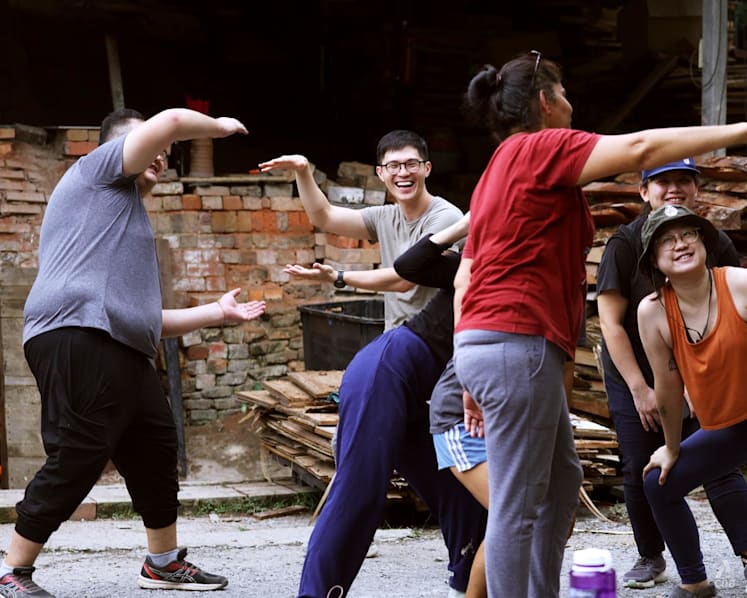
A group of young potters who are new to wood-firing taking photos near the kiln. (Photo: CNA/Ooi Boon Keong)
Experienced and new potters forming a human chain to carry pieces of wood to be used for the firing. (Photo: CNA/Ooi Boon Keong)
Participants having a lively potluck dinner, a brief respite from the day’s hard work. (Photo: CNA/Ooi Boon Keong)
After dinner, potters sitting around and chatting in front of the fire while monitoring the kiln. (Photo: CNA/Ooi Boon Keong)

OPENING OF THE KILN

Six days after the firing at the dragon kiln, the participants returned to open the kiln and check on their art pieces. 

“Shall we form a chain?” someone suggested to facilitate the removal of the brick walls. 

Without hesitation, a human chain quickly formed as the potters unsealed the kiln, one brick at a time. 

Potters in the process of dismantling the brick walls, in order to get into the kiln's chambers. (Photo: CNA/Ooi Boon Keong)
Breaking down the final wall to reach the last shelves holding pottery items. (Photo: CNA/Ooi Boon Keong)
The residual heat from the firing was keenly felt by the potters inside the kiln. (Photo: CNA/Ooi Boon Keong)
Each piece of pottery was removed carefully from the shelves and moved out in batches. (Photo: CNA/Ooi Boon Keong)
Finally, potters reached the chamber closest to the fire box. Only one person is able to reach the items in the narrow chamber. (Photo: CNA/Ooi Boon Keong)

A collective “wow” sounded as the final bricks were removed, revealing the final outcome of the nine-day process that comprised three days of firing and six days of cooling.

The potters carefully removed the art pieces from the shelves, while admiring the effects that the fire had on their work. 

Advertisement

In Pixels

Meet the 70-year-old lorry driver who is also a 'kite doctor'

Meet the 70-year-old lorry driver who is also a 'kite doctor'

Kite maker Tan Poh Wah flying his handmade dragon kite at the Marina Barrage. (Photo: CNA/Nuria Ling)

30 Nov 2024 09:30PM (Updated: 16 Oct 2025 12:08AM)

Rolling up to Marina Barrage with a trolley bag full of handmade kites and repair tools, Mr Tan Poh Wah had one clear mission for the day: To share his love of kite-flying with others. 

Known informally as the “kite doctor” among the regular visitors there, the 70-year-old spends most Sundays repairing kites or offering his handmade ones – mostly for free – to people at the open-air space that is the venue of Singapore's largest reservoir. 

“Watching people fly my kites makes me really happy,” Mr Tan said.  

This weekend, In Pixels speaks to four enthusiasts to find out what excites them about kite-flying. 

A FAMILIAR FIGURE

CNA Games
Show More
Show Less

Shortly after Mr Tan turned up at Marina Barrage in the Marina Bay area, a handful of people who wanted their kites repaired immediately made a beeline towards him. 

They offered him drinks and snacks to thank him for his service. 

Mr Tan Poh Wah fixing a kite for a member of the public at the Marina Barrage. (Photo: CNA/Mak Jia Kee)
A variety of sticks and other kite parts are some of the things in Mr Tan Poh Wah’s kit that he takes to the Marina Barrage. (Photo: CNA/Nuria Ling)

When he was done with the repairs, Mr Tan pulled a kite from his bag and launched it to the sky. 

He flew it with ease, strolling around the field, eager to find someone who will take the kite as a gift. 

His masterpieces are made mostly from recycled materials including plastic bags, discarded blinds, banners and umbrellas. 

Mr Tan Poh Wah holding up a kite he made using a supermarket plastic bag. (Photo: CNA/Mak Jia Kee)
Mr Tan Poh Wah with a handmade kite made out of recycled materials. (Photo: CNA/Nuria Ling)

Mr Tan is part of a group known as Singapore Original Kites, an informal gathering of adults in their 60s and 70s who share the same interest in making and flying kites.  

A semi-retired Chinese physician ​​Ong Cheng Her, 75, is the founder of the group.

He said that the only prerequisite to join the group is one’s ability to make a kite from scratch.  

He proudly showed CNA TODAY one of his creations, a red and white "umbrella kite". 

“Umbrellas are used for shade and rain protection, so why hasn’t anyone flown an umbrella kite? I decided to take on the challenge,” Mr Ong added.

Mr Ong Cheng Her, founder of the Singapore Original Kites group, holding an "umbrella kite" that he made in 2023. (Photo: CNA/Nuria Ling )
Mr Ong Cheng Her holding a kite he made, featuring flower and leaf patterns inspired by traditional Chinese paintings. (Photo: CNA/Mak Jia Kee)

HIS WORKSPACE AT HOME

As for Mr Tan, he is not retired, so flying and making kites is what he does only on Sundays.

He works six days a week as a lorry driver.

“I work to live, to fill my stomach so I can make kites.”

Stepping into his flat, Mr Tan led us to his "studio", which is a room filled with a bountiful supply of kites and raw materials. 

He described his workspace as a “chaotic but organised mess”. 

“My wife sometimes asks why I collect so many umbrellas, but she doesn’t interfere much because she knows I enjoy making these things.”

Mr Tan Poh Wah tying a ribbon to a bamboo stick to form part of a kite. (Photo: CNA/Nuria Ling)

Mr Tan has loved kite flying since he was a child, but it was not until he was in his 30s that he took to making kites himself.

A self-taught craftsman, he said that he learnt how to make kites by observing other kite-makers whenever an opportunity comes along. 

Mr Tan Poh Wah crafting a squid kite in his workshop that he set up in his flat. (Photo: CNA/Nuria Ling)
Mr Tan Poh Wah laying out pieces of a 70m-long "dragon kite" in his living room. (Photo: CNA/Nuria Ling)

Recently, Mr Tan finished repairing a 70m-long "dragon kite" that he first constructed in 2000. It broke at a kite festival in Taiwan in 2019 and required extensive repairs. 

After CNA TODAY approached him for an interview, Mr Tan said that he found new inspiration to repair the kite, which took him four Sundays to complete.

It was obvious that he is most proud of this kite among the many in his collection.

“Anyone who hasn't made a dragon or a phoenix kite isn't truly considered a kite maker,” he said, adding that these long kites are made up of many different sections and each needed to be crafted with great precision before they are finally stitched together. 

A 70m-long "dragon kite" made by Mr Tan Poh Wah flying at Marina Barrage. (Photo: CNA/Nuria Ling)

"GIANTS" IN THE SKY

Over at East Coast Park, another group of kite enthusiasts have gathered and their presence could be spotted from afar. 

The kites they have taken out, called "inflatable show kites", are gigantic balloon-like kites that are typically several metres in length when inflated.

Traditional kites rely on rigid frames for support, but inflatable show kites have no hard structures. They inflate as they catch on the wind and have to be anchored to the ground.

An inflatable show kite flying at East Coast Park. (Photo: CNA/Nuria Ling)
Mr Johnny Yap checking on a 10m-tall seahorse-shaped inflatable show kite. (Photo: CNA/Mak Jia Kee)

Project coordinator Johnny Yap and his wife Maggie Mok, a homemaker, both 51, are the founders of Show Kites Singapore, a group of people who are into these inflatable show kites.

The duo's interest in this started nearly 20 years ago when they took their children kite-flying. 

In the end, it was the couple themselves who got hooked on the activity. 

“We started flying bigger and bigger kites and before long, we realised that stick kites have a limit,” Mr Yap said.

This led them to explore inflatable ones in 2009 and they came across these kites online before buying their first. The sky is the limit when it comes to the sizes of such kites.

Ms Maggie Mok examining the flying cord of an inflatable show kite. (Photo: CNA/Mak Jia Kee)
Mr Johnny Yap fixing the attached strings on his show kite. (Photo: CNA/Nuria Ling)
Mr Johnny Yap holding open an inflation vent for air to fill up the kite. (Photo: CNA/Nuria Ling)

As their interests grew, Mr Yap and Ms Mok started travelling overseas to take part in international kite festivals. 

In September, they were at the International Kite Festival in Melaka, Malaysia, where they flew an inflatable show kite in the form of Singapore's tourism icon, the Merlion.

Advertisement

In Pixels

Inside a dragon kiln where temperatures go up to 1,300°C

Inside a dragon kiln where temperatures go up to 1,300°C

Wood-firing at a dragon kiln is a community effort that requires round-the-clock monitoring. (Photo: CNA/Ooi Boon Keong)

15 Nov 2024 09:30PM (Updated: 16 Oct 2025 12:09AM)

Nestled in an industrial estate in the western part of Singapore is an 84-year-old dragon kiln, the oldest and the only operational dragon kiln in the country. 

Built in 1940, the kiln at Thow Kwang Pottery Jungle was originally used for the mass production of household and industrial items such as cups and flower pots.

Over the decades, the place has evolved into a community space, now offering classes and events for potters to hone their craft. 

CNA TODAY joined the potter community for a wood-firing session that happens only two or three times a year.

CNA Games
Show More
Show Less

In Pixels takes you through the experience, as new and seasoned potters bond over fire and perspiration, creating unique works of art. 

PRAYERS TO THE "KILN GOD"  

At Thow Kwang Pottery Jungle, which is located a short distance from Nanyang Technological University, a group of around 30 people gathered on a Friday last month in front of the kiln.

This was at the request of the owners, Mr Tan Teck Yoke, 68, and his wife Yulianti Tan, 66. 

A prayer ceremony to the "kiln god" was about to begin. 

“We are praying to the ‘kiln god’ for a successful firing, for the pieces to achieve the desired effects,” Mr Tan explained to the enthusiastic participants. 

To this, the crowd responded by shouting, “Heng, ong, huat, ah,” a phrase in the Chinese dialect of Hokkien that collectively means wishing for good fortune.

Mrs Yulianti Tan and Mr Tan Teck Yoke, owners of Thow Kwang Pottery Jungle, praying for a successful wood-firing session. (Photo: CNA/Ooi Boon Keong)

After the prayers were done, the fire box, which is a small opening at the front of the kiln, was lit. 

The participants each picked up a piece of wood to throw into the fire, hoping to add more "luck" to the process. 

During wood-firing in a kiln, the fire and the ashes from the wood react with the glaze on the ceramic items to produce a unique and rustic look. (Photo: CNA/Ooi Boon Keong)

The dragon kiln was bought by Mr Tan’s father in 1965 and has been owned by the family since then.

It sits on a slope, is 27-metres long, 2-metres wide and curves around the side, resembling the body of a dragon in Chinese mythology. 

Its lengthy chambers are made out of bricks and there is a chimney at the end, located at the top of the slope.

The kiln can fit thousands of pieces of ceramic items, depending on the size of the pots. 

For this firing session, around 400 to 500 pieces were loaded in the kiln. 

NEW WAYS TO IMPROVE PROCESS

Temperatures in the dragon kiln can reach up to 1,300°C. 

They can fluctuate significantly due to the shape of the furnace and the use of wood as a fuel.

That is why one of the most crucial parts of the process is to monitor the temperature for all three days of the firing session.

Mr Chua Hee Lai, who is in his 50s and a hobbyist-turned-kiln master, helped to plan and lead each firing session. 

Mr Chua Hee Lai (right) installing thermocouples on the slopes of an 84-year-old kiln to monitor the temperatures. (Photo: CNA/Ooi Boon Keong)

In 2019, Mr Chua, with the help of another potter, introduced a digital monitoring system that allowed them to track the temperatures remotely and give instructions to the potters doing shift work on site. 

Previously, they had to monitor the temperature by looking at the colour of the flame or record temperatures manually and then draw up prediction charts – a process that requires them to be on site for longer periods of time.

When the temperatures start to dip, potters will add more wood into the fire. (Photo: CNA/Ooi Boon Keong)
Potters handling large pieces of wood to be fed into a fire box. (Photo: CNA/Ooi Boon Keong)
The effect of burning heat can be seen in the different skin colours of a potter’s arms, after he stood near the kiln's fire box for some time to keep the flame going. (Photo: CNA/Ooi Boon Keong)
Cheers breaking out as the target wood-firing temperature of 1,260°C was about to be reached. (Photo: CNA/Ooi Boon Keong)

THE "KAMPUNG SPIRIT"

Advertising executive Vanessa Low and product manager Goh Wei Ting, both 31, have been practising pottery at another pottery studio for around five years and this was their first time taking part in the wood-firing process.

Compared to a regular firing in an electric or gas kiln, wood-firing is "tiring and physically demanding", Mr Goh said.

However, they were buoyed by the “kampung spirit” or the sense of camaraderie that came about as participants laboured together. 

 “You just don’t feel tired, you just do (the work),” Mr Goh added. 
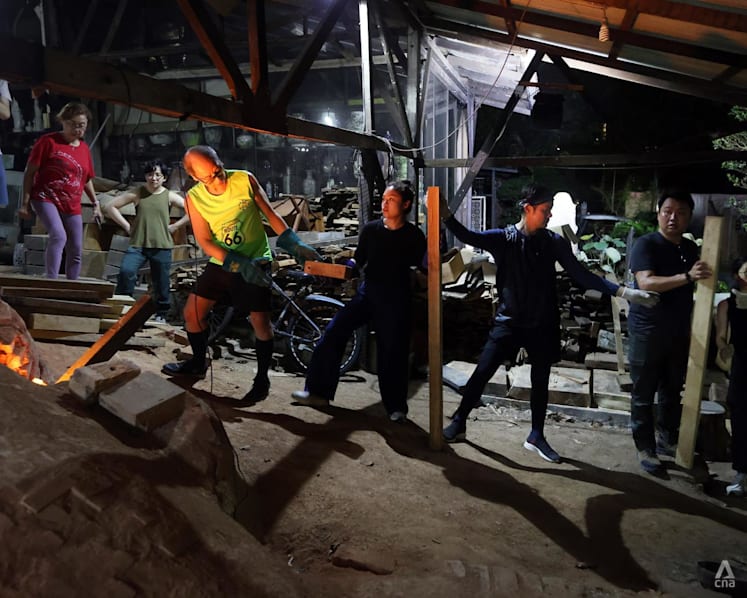
A group of young potters who are new to wood-firing taking photos near the kiln. (Photo: CNA/Ooi Boon Keong)
Experienced and new potters forming a human chain to carry pieces of wood to be used for the firing. (Photo: CNA/Ooi Boon Keong)
Participants having a lively potluck dinner, a brief respite from the day’s hard work. (Photo: CNA/Ooi Boon Keong)
After dinner, potters sitting around and chatting in front of the fire while monitoring the kiln. (Photo: CNA/Ooi Boon Keong)

OPENING OF THE KILN

Six days after the firing at the dragon kiln, the participants returned to open the kiln and check on their art pieces. 

“Shall we form a chain?” someone suggested to facilitate the removal of the brick walls. 

Without hesitation, a human chain quickly formed as the potters unsealed the kiln, one brick at a time. 

Potters in the process of dismantling the brick walls, in order to get into the kiln's chambers. (Photo: CNA/Ooi Boon Keong)
Breaking down the final wall to reach the last shelves holding pottery items. (Photo: CNA/Ooi Boon Keong)
The residual heat from the firing was keenly felt by the potters inside the kiln. (Photo: CNA/Ooi Boon Keong)
Each piece of pottery was removed carefully from the shelves and moved out in batches. (Photo: CNA/Ooi Boon Keong)
Finally, potters reached the chamber closest to the fire box. Only one person is able to reach the items in the narrow chamber. (Photo: CNA/Ooi Boon Keong)

A collective “wow” sounded as the final bricks were removed, revealing the final outcome of the nine-day process that comprised three days of firing and six days of cooling.

The potters carefully removed the art pieces from the shelves, while admiring the effects that the fire had on their work. 

Advertisement

In Pixels

Meet the 70-year-old lorry driver who is also a 'kite doctor'

Meet the 70-year-old lorry driver who is also a 'kite doctor'

Kite maker Tan Poh Wah flying his handmade dragon kite at the Marina Barrage. (Photo: CNA/Nuria Ling)

30 Nov 2024 09:30PM (Updated: 16 Oct 2025 12:08AM)

Rolling up to Marina Barrage with a trolley bag full of handmade kites and repair tools, Mr Tan Poh Wah had one clear mission for the day: To share his love of kite-flying with others. 

Known informally as the “kite doctor” among the regular visitors there, the 70-year-old spends most Sundays repairing kites or offering his handmade ones – mostly for free – to people at the open-air space that is the venue of Singapore's largest reservoir. 

“Watching people fly my kites makes me really happy,” Mr Tan said.  

This weekend, In Pixels speaks to four enthusiasts to find out what excites them about kite-flying. 

A FAMILIAR FIGURE

CNA Games
Show More
Show Less

Shortly after Mr Tan turned up at Marina Barrage in the Marina Bay area, a handful of people who wanted their kites repaired immediately made a beeline towards him. 

They offered him drinks and snacks to thank him for his service. 

Mr Tan Poh Wah fixing a kite for a member of the public at the Marina Barrage. (Photo: CNA/Mak Jia Kee)
A variety of sticks and other kite parts are some of the things in Mr Tan Poh Wah’s kit that he takes to the Marina Barrage. (Photo: CNA/Nuria Ling)

When he was done with the repairs, Mr Tan pulled a kite from his bag and launched it to the sky. 

He flew it with ease, strolling around the field, eager to find someone who will take the kite as a gift. 

His masterpieces are made mostly from recycled materials including plastic bags, discarded blinds, banners and umbrellas. 

Mr Tan Poh Wah holding up a kite he made using a supermarket plastic bag. (Photo: CNA/Mak Jia Kee)
Mr Tan Poh Wah with a handmade kite made out of recycled materials. (Photo: CNA/Nuria Ling)

Mr Tan is part of a group known as Singapore Original Kites, an informal gathering of adults in their 60s and 70s who share the same interest in making and flying kites.  

A semi-retired Chinese physician ​​Ong Cheng Her, 75, is the founder of the group.

He said that the only prerequisite to join the group is one’s ability to make a kite from scratch.  

He proudly showed CNA TODAY one of his creations, a red and white "umbrella kite". 

“Umbrellas are used for shade and rain protection, so why hasn’t anyone flown an umbrella kite? I decided to take on the challenge,” Mr Ong added.

Mr Ong Cheng Her, founder of the Singapore Original Kites group, holding an "umbrella kite" that he made in 2023. (Photo: CNA/Nuria Ling )
Mr Ong Cheng Her holding a kite he made, featuring flower and leaf patterns inspired by traditional Chinese paintings. (Photo: CNA/Mak Jia Kee)

HIS WORKSPACE AT HOME

As for Mr Tan, he is not retired, so flying and making kites is what he does only on Sundays.

He works six days a week as a lorry driver.

“I work to live, to fill my stomach so I can make kites.”

Stepping into his flat, Mr Tan led us to his "studio", which is a room filled with a bountiful supply of kites and raw materials. 

He described his workspace as a “chaotic but organised mess”. 

“My wife sometimes asks why I collect so many umbrellas, but she doesn’t interfere much because she knows I enjoy making these things.”

Mr Tan Poh Wah tying a ribbon to a bamboo stick to form part of a kite. (Photo: CNA/Nuria Ling)

Mr Tan has loved kite flying since he was a child, but it was not until he was in his 30s that he took to making kites himself.

A self-taught craftsman, he said that he learnt how to make kites by observing other kite-makers whenever an opportunity comes along. 

Mr Tan Poh Wah crafting a squid kite in his workshop that he set up in his flat. (Photo: CNA/Nuria Ling)
Mr Tan Poh Wah laying out pieces of a 70m-long "dragon kite" in his living room. (Photo: CNA/Nuria Ling)

Recently, Mr Tan finished repairing a 70m-long "dragon kite" that he first constructed in 2000. It broke at a kite festival in Taiwan in 2019 and required extensive repairs. 

After CNA TODAY approached him for an interview, Mr Tan said that he found new inspiration to repair the kite, which took him four Sundays to complete.

It was obvious that he is most proud of this kite among the many in his collection.

“Anyone who hasn't made a dragon or a phoenix kite isn't truly considered a kite maker,” he said, adding that these long kites are made up of many different sections and each needed to be crafted with great precision before they are finally stitched together. 

A 70m-long "dragon kite" made by Mr Tan Poh Wah flying at Marina Barrage. (Photo: CNA/Nuria Ling)

"GIANTS" IN THE SKY

Over at East Coast Park, another group of kite enthusiasts have gathered and their presence could be spotted from afar. 

The kites they have taken out, called "inflatable show kites", are gigantic balloon-like kites that are typically several metres in length when inflated.

Traditional kites rely on rigid frames for support, but inflatable show kites have no hard structures. They inflate as they catch on the wind and have to be anchored to the ground.

An inflatable show kite flying at East Coast Park. (Photo: CNA/Nuria Ling)
Mr Johnny Yap checking on a 10m-tall seahorse-shaped inflatable show kite. (Photo: CNA/Mak Jia Kee)

Project coordinator Johnny Yap and his wife Maggie Mok, a homemaker, both 51, are the founders of Show Kites Singapore, a group of people who are into these inflatable show kites.

The duo's interest in this started nearly 20 years ago when they took their children kite-flying. 

In the end, it was the couple themselves who got hooked on the activity. 

“We started flying bigger and bigger kites and before long, we realised that stick kites have a limit,” Mr Yap said.

This led them to explore inflatable ones in 2009 and they came across these kites online before buying their first. The sky is the limit when it comes to the sizes of such kites.

Ms Maggie Mok examining the flying cord of an inflatable show kite. (Photo: CNA/Mak Jia Kee)
Mr Johnny Yap fixing the attached strings on his show kite. (Photo: CNA/Nuria Ling)
Mr Johnny Yap holding open an inflation vent for air to fill up the kite. (Photo: CNA/Nuria Ling)

As their interests grew, Mr Yap and Ms Mok started travelling overseas to take part in international kite festivals. 

In September, they were at the International Kite Festival in Melaka, Malaysia, where they flew an inflatable show kite in the form of Singapore's tourism icon, the Merlion.

Advertisement

In Pixels

Inside a dragon kiln where temperatures go up to 1,300°C

Inside a dragon kiln where temperatures go up to 1,300°C

Wood-firing at a dragon kiln is a community effort that requires round-the-clock monitoring. (Photo: CNA/Ooi Boon Keong)

15 Nov 2024 09:30PM (Updated: 16 Oct 2025 12:09AM)

Nestled in an industrial estate in the western part of Singapore is an 84-year-old dragon kiln, the oldest and the only operational dragon kiln in the country. 

Built in 1940, the kiln at Thow Kwang Pottery Jungle was originally used for the mass production of household and industrial items such as cups and flower pots.

Over the decades, the place has evolved into a community space, now offering classes and events for potters to hone their craft. 

CNA TODAY joined the potter community for a wood-firing session that happens only two or three times a year.

CNA Games
Show More
Show Less

In Pixels takes you through the experience, as new and seasoned potters bond over fire and perspiration, creating unique works of art. 

PRAYERS TO THE "KILN GOD"  

At Thow Kwang Pottery Jungle, which is located a short distance from Nanyang Technological University, a group of around 30 people gathered on a Friday last month in front of the kiln.

This was at the request of the owners, Mr Tan Teck Yoke, 68, and his wife Yulianti Tan, 66. 

A prayer ceremony to the "kiln god" was about to begin. 

“We are praying to the ‘kiln god’ for a successful firing, for the pieces to achieve the desired effects,” Mr Tan explained to the enthusiastic participants. 

To this, the crowd responded by shouting, “Heng, ong, huat, ah,” a phrase in the Chinese dialect of Hokkien that collectively means wishing for good fortune.

Mrs Yulianti Tan and Mr Tan Teck Yoke, owners of Thow Kwang Pottery Jungle, praying for a successful wood-firing session. (Photo: CNA/Ooi Boon Keong)

After the prayers were done, the fire box, which is a small opening at the front of the kiln, was lit. 

The participants each picked up a piece of wood to throw into the fire, hoping to add more "luck" to the process. 

During wood-firing in a kiln, the fire and the ashes from the wood react with the glaze on the ceramic items to produce a unique and rustic look. (Photo: CNA/Ooi Boon Keong)

The dragon kiln was bought by Mr Tan’s father in 1965 and has been owned by the family since then.

It sits on a slope, is 27-metres long, 2-metres wide and curves around the side, resembling the body of a dragon in Chinese mythology. 

Its lengthy chambers are made out of bricks and there is a chimney at the end, located at the top of the slope.

The kiln can fit thousands of pieces of ceramic items, depending on the size of the pots. 

For this firing session, around 400 to 500 pieces were loaded in the kiln. 

NEW WAYS TO IMPROVE PROCESS

Temperatures in the dragon kiln can reach up to 1,300°C. 

They can fluctuate significantly due to the shape of the furnace and the use of wood as a fuel.

That is why one of the most crucial parts of the process is to monitor the temperature for all three days of the firing session.

Mr Chua Hee Lai, who is in his 50s and a hobbyist-turned-kiln master, helped to plan and lead each firing session. 

Mr Chua Hee Lai (right) installing thermocouples on the slopes of an 84-year-old kiln to monitor the temperatures. (Photo: CNA/Ooi Boon Keong)

In 2019, Mr Chua, with the help of another potter, introduced a digital monitoring system that allowed them to track the temperatures remotely and give instructions to the potters doing shift work on site. 

Previously, they had to monitor the temperature by looking at the colour of the flame or record temperatures manually and then draw up prediction charts – a process that requires them to be on site for longer periods of time.

When the temperatures start to dip, potters will add more wood into the fire. (Photo: CNA/Ooi Boon Keong)
Potters handling large pieces of wood to be fed into a fire box. (Photo: CNA/Ooi Boon Keong)
The effect of burning heat can be seen in the different skin colours of a potter’s arms, after he stood near the kiln's fire box for some time to keep the flame going. (Photo: CNA/Ooi Boon Keong)
Cheers breaking out as the target wood-firing temperature of 1,260°C was about to be reached. (Photo: CNA/Ooi Boon Keong)

THE "KAMPUNG SPIRIT"

Advertising executive Vanessa Low and product manager Goh Wei Ting, both 31, have been practising pottery at another pottery studio for around five years and this was their first time taking part in the wood-firing process.

Compared to a regular firing in an electric or gas kiln, wood-firing is "tiring and physically demanding", Mr Goh said.

However, they were buoyed by the “kampung spirit” or the sense of camaraderie that came about as participants laboured together. 

 “You just don’t feel tired, you just do (the work),” Mr Goh added. 
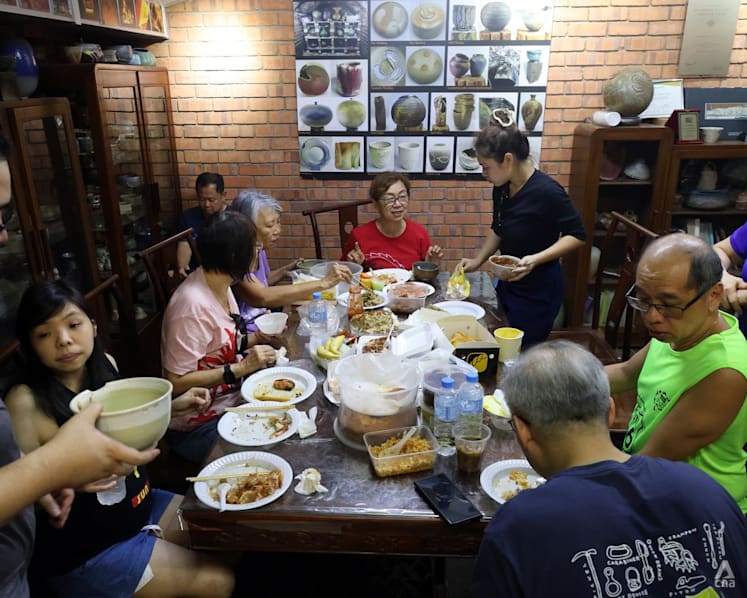
A group of young potters who are new to wood-firing taking photos near the kiln. (Photo: CNA/Ooi Boon Keong)
Experienced and new potters forming a human chain to carry pieces of wood to be used for the firing. (Photo: CNA/Ooi Boon Keong)
Participants having a lively potluck dinner, a brief respite from the day’s hard work. (Photo: CNA/Ooi Boon Keong)
After dinner, potters sitting around and chatting in front of the fire while monitoring the kiln. (Photo: CNA/Ooi Boon Keong)

OPENING OF THE KILN

Six days after the firing at the dragon kiln, the participants returned to open the kiln and check on their art pieces. 

“Shall we form a chain?” someone suggested to facilitate the removal of the brick walls. 

Without hesitation, a human chain quickly formed as the potters unsealed the kiln, one brick at a time. 

Potters in the process of dismantling the brick walls, in order to get into the kiln's chambers. (Photo: CNA/Ooi Boon Keong)
Breaking down the final wall to reach the last shelves holding pottery items. (Photo: CNA/Ooi Boon Keong)
The residual heat from the firing was keenly felt by the potters inside the kiln. (Photo: CNA/Ooi Boon Keong)
Each piece of pottery was removed carefully from the shelves and moved out in batches. (Photo: CNA/Ooi Boon Keong)
Finally, potters reached the chamber closest to the fire box. Only one person is able to reach the items in the narrow chamber. (Photo: CNA/Ooi Boon Keong)

A collective “wow” sounded as the final bricks were removed, revealing the final outcome of the nine-day process that comprised three days of firing and six days of cooling.

The potters carefully removed the art pieces from the shelves, while admiring the effects that the fire had on their work. 

Advertisement

In Pixels

Meet the 70-year-old lorry driver who is also a 'kite doctor'

Meet the 70-year-old lorry driver who is also a 'kite doctor'

Kite maker Tan Poh Wah flying his handmade dragon kite at the Marina Barrage. (Photo: CNA/Nuria Ling)

30 Nov 2024 09:30PM (Updated: 16 Oct 2025 12:08AM)

Rolling up to Marina Barrage with a trolley bag full of handmade kites and repair tools, Mr Tan Poh Wah had one clear mission for the day: To share his love of kite-flying with others. 

Known informally as the “kite doctor” among the regular visitors there, the 70-year-old spends most Sundays repairing kites or offering his handmade ones – mostly for free – to people at the open-air space that is the venue of Singapore's largest reservoir. 

“Watching people fly my kites makes me really happy,” Mr Tan said.  

This weekend, In Pixels speaks to four enthusiasts to find out what excites them about kite-flying. 

A FAMILIAR FIGURE

CNA Games
Show More
Show Less

Shortly after Mr Tan turned up at Marina Barrage in the Marina Bay area, a handful of people who wanted their kites repaired immediately made a beeline towards him. 

They offered him drinks and snacks to thank him for his service. 

Mr Tan Poh Wah fixing a kite for a member of the public at the Marina Barrage. (Photo: CNA/Mak Jia Kee)
A variety of sticks and other kite parts are some of the things in Mr Tan Poh Wah’s kit that he takes to the Marina Barrage. (Photo: CNA/Nuria Ling)

When he was done with the repairs, Mr Tan pulled a kite from his bag and launched it to the sky. 

He flew it with ease, strolling around the field, eager to find someone who will take the kite as a gift. 

His masterpieces are made mostly from recycled materials including plastic bags, discarded blinds, banners and umbrellas. 

Mr Tan Poh Wah holding up a kite he made using a supermarket plastic bag. (Photo: CNA/Mak Jia Kee)
Mr Tan Poh Wah with a handmade kite made out of recycled materials. (Photo: CNA/Nuria Ling)

Mr Tan is part of a group known as Singapore Original Kites, an informal gathering of adults in their 60s and 70s who share the same interest in making and flying kites.  

A semi-retired Chinese physician ​​Ong Cheng Her, 75, is the founder of the group.

He said that the only prerequisite to join the group is one’s ability to make a kite from scratch.  

He proudly showed CNA TODAY one of his creations, a red and white "umbrella kite". 

“Umbrellas are used for shade and rain protection, so why hasn’t anyone flown an umbrella kite? I decided to take on the challenge,” Mr Ong added.

Mr Ong Cheng Her, founder of the Singapore Original Kites group, holding an "umbrella kite" that he made in 2023. (Photo: CNA/Nuria Ling )
Mr Ong Cheng Her holding a kite he made, featuring flower and leaf patterns inspired by traditional Chinese paintings. (Photo: CNA/Mak Jia Kee)

HIS WORKSPACE AT HOME

As for Mr Tan, he is not retired, so flying and making kites is what he does only on Sundays.

He works six days a week as a lorry driver.

“I work to live, to fill my stomach so I can make kites.”

Stepping into his flat, Mr Tan led us to his "studio", which is a room filled with a bountiful supply of kites and raw materials. 

He described his workspace as a “chaotic but organised mess”. 

“My wife sometimes asks why I collect so many umbrellas, but she doesn’t interfere much because she knows I enjoy making these things.”

Mr Tan Poh Wah tying a ribbon to a bamboo stick to form part of a kite. (Photo: CNA/Nuria Ling)

Mr Tan has loved kite flying since he was a child, but it was not until he was in his 30s that he took to making kites himself.

A self-taught craftsman, he said that he learnt how to make kites by observing other kite-makers whenever an opportunity comes along. 

Mr Tan Poh Wah crafting a squid kite in his workshop that he set up in his flat. (Photo: CNA/Nuria Ling)
Mr Tan Poh Wah laying out pieces of a 70m-long "dragon kite" in his living room. (Photo: CNA/Nuria Ling)

Recently, Mr Tan finished repairing a 70m-long "dragon kite" that he first constructed in 2000. It broke at a kite festival in Taiwan in 2019 and required extensive repairs. 

After CNA TODAY approached him for an interview, Mr Tan said that he found new inspiration to repair the kite, which took him four Sundays to complete.

It was obvious that he is most proud of this kite among the many in his collection.

“Anyone who hasn't made a dragon or a phoenix kite isn't truly considered a kite maker,” he said, adding that these long kites are made up of many different sections and each needed to be crafted with great precision before they are finally stitched together. 

A 70m-long "dragon kite" made by Mr Tan Poh Wah flying at Marina Barrage. (Photo: CNA/Nuria Ling)

"GIANTS" IN THE SKY

Over at East Coast Park, another group of kite enthusiasts have gathered and their presence could be spotted from afar. 

The kites they have taken out, called "inflatable show kites", are gigantic balloon-like kites that are typically several metres in length when inflated.

Traditional kites rely on rigid frames for support, but inflatable show kites have no hard structures. They inflate as they catch on the wind and have to be anchored to the ground.

An inflatable show kite flying at East Coast Park. (Photo: CNA/Nuria Ling)
Mr Johnny Yap checking on a 10m-tall seahorse-shaped inflatable show kite. (Photo: CNA/Mak Jia Kee)

Project coordinator Johnny Yap and his wife Maggie Mok, a homemaker, both 51, are the founders of Show Kites Singapore, a group of people who are into these inflatable show kites.

The duo's interest in this started nearly 20 years ago when they took their children kite-flying. 

In the end, it was the couple themselves who got hooked on the activity. 

“We started flying bigger and bigger kites and before long, we realised that stick kites have a limit,” Mr Yap said.

This led them to explore inflatable ones in 2009 and they came across these kites online before buying their first. The sky is the limit when it comes to the sizes of such kites.

Ms Maggie Mok examining the flying cord of an inflatable show kite. (Photo: CNA/Mak Jia Kee)
Mr Johnny Yap fixing the attached strings on his show kite. (Photo: CNA/Nuria Ling)
Mr Johnny Yap holding open an inflation vent for air to fill up the kite. (Photo: CNA/Nuria Ling)

As their interests grew, Mr Yap and Ms Mok started travelling overseas to take part in international kite festivals. 

In September, they were at the International Kite Festival in Melaka, Malaysia, where they flew an inflatable show kite in the form of Singapore's tourism icon, the Merlion.

Advertisement

In Pixels

Inside a dragon kiln where temperatures go up to 1,300°C

Inside a dragon kiln where temperatures go up to 1,300°C

Wood-firing at a dragon kiln is a community effort that requires round-the-clock monitoring. (Photo: CNA/Ooi Boon Keong)

15 Nov 2024 09:30PM (Updated: 16 Oct 2025 12:09AM)

Nestled in an industrial estate in the western part of Singapore is an 84-year-old dragon kiln, the oldest and the only operational dragon kiln in the country. 

Built in 1940, the kiln at Thow Kwang Pottery Jungle was originally used for the mass production of household and industrial items such as cups and flower pots.

Over the decades, the place has evolved into a community space, now offering classes and events for potters to hone their craft. 

CNA TODAY joined the potter community for a wood-firing session that happens only two or three times a year.

CNA Games
Show More
Show Less

In Pixels takes you through the experience, as new and seasoned potters bond over fire and perspiration, creating unique works of art. 

PRAYERS TO THE "KILN GOD"  

At Thow Kwang Pottery Jungle, which is located a short distance from Nanyang Technological University, a group of around 30 people gathered on a Friday last month in front of the kiln.

This was at the request of the owners, Mr Tan Teck Yoke, 68, and his wife Yulianti Tan, 66. 

A prayer ceremony to the "kiln god" was about to begin. 

“We are praying to the ‘kiln god’ for a successful firing, for the pieces to achieve the desired effects,” Mr Tan explained to the enthusiastic participants. 

To this, the crowd responded by shouting, “Heng, ong, huat, ah,” a phrase in the Chinese dialect of Hokkien that collectively means wishing for good fortune.

Mrs Yulianti Tan and Mr Tan Teck Yoke, owners of Thow Kwang Pottery Jungle, praying for a successful wood-firing session. (Photo: CNA/Ooi Boon Keong)

After the prayers were done, the fire box, which is a small opening at the front of the kiln, was lit. 

The participants each picked up a piece of wood to throw into the fire, hoping to add more "luck" to the process. 

During wood-firing in a kiln, the fire and the ashes from the wood react with the glaze on the ceramic items to produce a unique and rustic look. (Photo: CNA/Ooi Boon Keong)

The dragon kiln was bought by Mr Tan’s father in 1965 and has been owned by the family since then.

It sits on a slope, is 27-metres long, 2-metres wide and curves around the side, resembling the body of a dragon in Chinese mythology. 

Its lengthy chambers are made out of bricks and there is a chimney at the end, located at the top of the slope.

The kiln can fit thousands of pieces of ceramic items, depending on the size of the pots. 

For this firing session, around 400 to 500 pieces were loaded in the kiln. 

NEW WAYS TO IMPROVE PROCESS

Temperatures in the dragon kiln can reach up to 1,300°C. 

They can fluctuate significantly due to the shape of the furnace and the use of wood as a fuel.

That is why one of the most crucial parts of the process is to monitor the temperature for all three days of the firing session.

Mr Chua Hee Lai, who is in his 50s and a hobbyist-turned-kiln master, helped to plan and lead each firing session. 

Mr Chua Hee Lai (right) installing thermocouples on the slopes of an 84-year-old kiln to monitor the temperatures. (Photo: CNA/Ooi Boon Keong)

In 2019, Mr Chua, with the help of another potter, introduced a digital monitoring system that allowed them to track the temperatures remotely and give instructions to the potters doing shift work on site. 

Previously, they had to monitor the temperature by looking at the colour of the flame or record temperatures manually and then draw up prediction charts – a process that requires them to be on site for longer periods of time.

When the temperatures start to dip, potters will add more wood into the fire. (Photo: CNA/Ooi Boon Keong)
Potters handling large pieces of wood to be fed into a fire box. (Photo: CNA/Ooi Boon Keong)
The effect of burning heat can be seen in the different skin colours of a potter’s arms, after he stood near the kiln's fire box for some time to keep the flame going. (Photo: CNA/Ooi Boon Keong)
Cheers breaking out as the target wood-firing temperature of 1,260°C was about to be reached. (Photo: CNA/Ooi Boon Keong)

THE "KAMPUNG SPIRIT"

Advertising executive Vanessa Low and product manager Goh Wei Ting, both 31, have been practising pottery at another pottery studio for around five years and this was their first time taking part in the wood-firing process.

Compared to a regular firing in an electric or gas kiln, wood-firing is "tiring and physically demanding", Mr Goh said.

However, they were buoyed by the “kampung spirit” or the sense of camaraderie that came about as participants laboured together. 

 “You just don’t feel tired, you just do (the work),” Mr Goh added. 
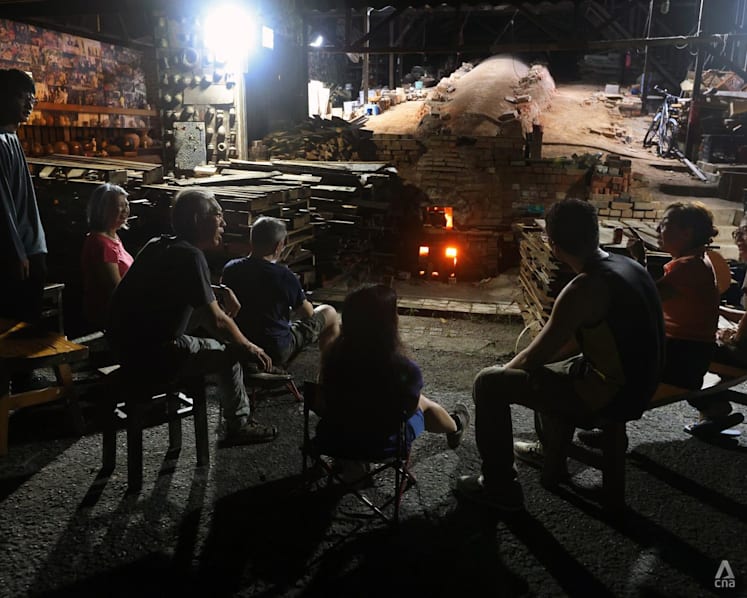
A group of young potters who are new to wood-firing taking photos near the kiln. (Photo: CNA/Ooi Boon Keong)
Experienced and new potters forming a human chain to carry pieces of wood to be used for the firing. (Photo: CNA/Ooi Boon Keong)
Participants having a lively potluck dinner, a brief respite from the day’s hard work. (Photo: CNA/Ooi Boon Keong)
After dinner, potters sitting around and chatting in front of the fire while monitoring the kiln. (Photo: CNA/Ooi Boon Keong)

OPENING OF THE KILN

Six days after the firing at the dragon kiln, the participants returned to open the kiln and check on their art pieces. 

“Shall we form a chain?” someone suggested to facilitate the removal of the brick walls. 

Without hesitation, a human chain quickly formed as the potters unsealed the kiln, one brick at a time. 
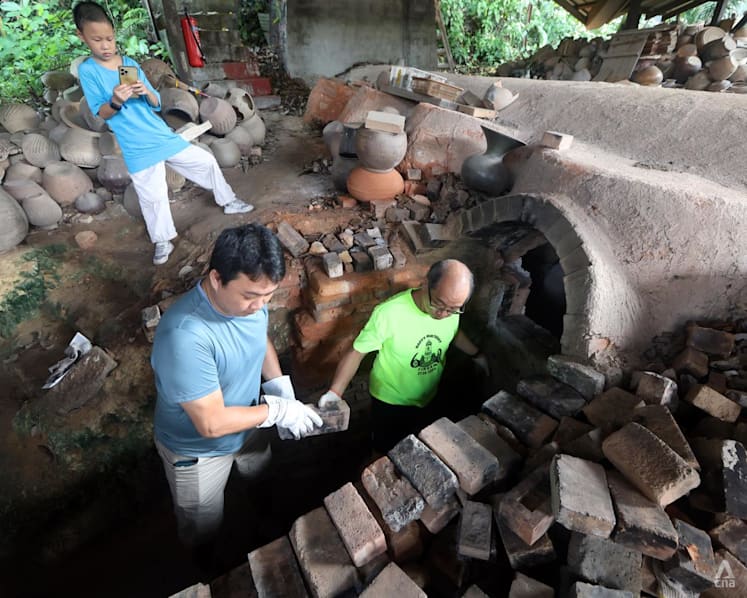
Potters in the process of dismantling the brick walls, in order to get into the kiln's chambers. (Photo: CNA/Ooi Boon Keong)
Breaking down the final wall to reach the last shelves holding pottery items. (Photo: CNA/Ooi Boon Keong)
The residual heat from the firing was keenly felt by the potters inside the kiln. (Photo: CNA/Ooi Boon Keong)
Each piece of pottery was removed carefully from the shelves and moved out in batches. (Photo: CNA/Ooi Boon Keong)
Finally, potters reached the chamber closest to the fire box. Only one person is able to reach the items in the narrow chamber. (Photo: CNA/Ooi Boon Keong)

A collective “wow” sounded as the final bricks were removed, revealing the final outcome of the nine-day process that comprised three days of firing and six days of cooling.

The potters carefully removed the art pieces from the shelves, while admiring the effects that the fire had on their work. 

Advertisement

In Pixels

Meet the 70-year-old lorry driver who is also a 'kite doctor'

Meet the 70-year-old lorry driver who is also a 'kite doctor'

Kite maker Tan Poh Wah flying his handmade dragon kite at the Marina Barrage. (Photo: CNA/Nuria Ling)

30 Nov 2024 09:30PM (Updated: 16 Oct 2025 12:08AM)

Rolling up to Marina Barrage with a trolley bag full of handmade kites and repair tools, Mr Tan Poh Wah had one clear mission for the day: To share his love of kite-flying with others. 

Known informally as the “kite doctor” among the regular visitors there, the 70-year-old spends most Sundays repairing kites or offering his handmade ones – mostly for free – to people at the open-air space that is the venue of Singapore's largest reservoir. 

“Watching people fly my kites makes me really happy,” Mr Tan said.  

This weekend, In Pixels speaks to four enthusiasts to find out what excites them about kite-flying. 

A FAMILIAR FIGURE

CNA Games
Show More
Show Less

Shortly after Mr Tan turned up at Marina Barrage in the Marina Bay area, a handful of people who wanted their kites repaired immediately made a beeline towards him. 

They offered him drinks and snacks to thank him for his service. 

Mr Tan Poh Wah fixing a kite for a member of the public at the Marina Barrage. (Photo: CNA/Mak Jia Kee)
A variety of sticks and other kite parts are some of the things in Mr Tan Poh Wah’s kit that he takes to the Marina Barrage. (Photo: CNA/Nuria Ling)

When he was done with the repairs, Mr Tan pulled a kite from his bag and launched it to the sky. 

He flew it with ease, strolling around the field, eager to find someone who will take the kite as a gift. 

His masterpieces are made mostly from recycled materials including plastic bags, discarded blinds, banners and umbrellas. 

Mr Tan Poh Wah holding up a kite he made using a supermarket plastic bag. (Photo: CNA/Mak Jia Kee)
Mr Tan Poh Wah with a handmade kite made out of recycled materials. (Photo: CNA/Nuria Ling)

Mr Tan is part of a group known as Singapore Original Kites, an informal gathering of adults in their 60s and 70s who share the same interest in making and flying kites.  

A semi-retired Chinese physician ​​Ong Cheng Her, 75, is the founder of the group.

He said that the only prerequisite to join the group is one’s ability to make a kite from scratch.  

He proudly showed CNA TODAY one of his creations, a red and white "umbrella kite". 

“Umbrellas are used for shade and rain protection, so why hasn’t anyone flown an umbrella kite? I decided to take on the challenge,” Mr Ong added.

Mr Ong Cheng Her, founder of the Singapore Original Kites group, holding an "umbrella kite" that he made in 2023. (Photo: CNA/Nuria Ling )
Mr Ong Cheng Her holding a kite he made, featuring flower and leaf patterns inspired by traditional Chinese paintings. (Photo: CNA/Mak Jia Kee)

HIS WORKSPACE AT HOME

As for Mr Tan, he is not retired, so flying and making kites is what he does only on Sundays.

He works six days a week as a lorry driver.

“I work to live, to fill my stomach so I can make kites.”

Stepping into his flat, Mr Tan led us to his "studio", which is a room filled with a bountiful supply of kites and raw materials. 

He described his workspace as a “chaotic but organised mess”. 

“My wife sometimes asks why I collect so many umbrellas, but she doesn’t interfere much because she knows I enjoy making these things.”

Mr Tan Poh Wah tying a ribbon to a bamboo stick to form part of a kite. (Photo: CNA/Nuria Ling)

Mr Tan has loved kite flying since he was a child, but it was not until he was in his 30s that he took to making kites himself.

A self-taught craftsman, he said that he learnt how to make kites by observing other kite-makers whenever an opportunity comes along. 

Mr Tan Poh Wah crafting a squid kite in his workshop that he set up in his flat. (Photo: CNA/Nuria Ling)
Mr Tan Poh Wah laying out pieces of a 70m-long "dragon kite" in his living room. (Photo: CNA/Nuria Ling)

Recently, Mr Tan finished repairing a 70m-long "dragon kite" that he first constructed in 2000. It broke at a kite festival in Taiwan in 2019 and required extensive repairs. 

After CNA TODAY approached him for an interview, Mr Tan said that he found new inspiration to repair the kite, which took him four Sundays to complete.

It was obvious that he is most proud of this kite among the many in his collection.

“Anyone who hasn't made a dragon or a phoenix kite isn't truly considered a kite maker,” he said, adding that these long kites are made up of many different sections and each needed to be crafted with great precision before they are finally stitched together. 

A 70m-long "dragon kite" made by Mr Tan Poh Wah flying at Marina Barrage. (Photo: CNA/Nuria Ling)

"GIANTS" IN THE SKY

Over at East Coast Park, another group of kite enthusiasts have gathered and their presence could be spotted from afar. 

The kites they have taken out, called "inflatable show kites", are gigantic balloon-like kites that are typically several metres in length when inflated.

Traditional kites rely on rigid frames for support, but inflatable show kites have no hard structures. They inflate as they catch on the wind and have to be anchored to the ground.

An inflatable show kite flying at East Coast Park. (Photo: CNA/Nuria Ling)
Mr Johnny Yap checking on a 10m-tall seahorse-shaped inflatable show kite. (Photo: CNA/Mak Jia Kee)

Project coordinator Johnny Yap and his wife Maggie Mok, a homemaker, both 51, are the founders of Show Kites Singapore, a group of people who are into these inflatable show kites.

The duo's interest in this started nearly 20 years ago when they took their children kite-flying. 

In the end, it was the couple themselves who got hooked on the activity. 

“We started flying bigger and bigger kites and before long, we realised that stick kites have a limit,” Mr Yap said.

This led them to explore inflatable ones in 2009 and they came across these kites online before buying their first. The sky is the limit when it comes to the sizes of such kites.

Ms Maggie Mok examining the flying cord of an inflatable show kite. (Photo: CNA/Mak Jia Kee)
Mr Johnny Yap fixing the attached strings on his show kite. (Photo: CNA/Nuria Ling)
Mr Johnny Yap holding open an inflation vent for air to fill up the kite. (Photo: CNA/Nuria Ling)

As their interests grew, Mr Yap and Ms Mok started travelling overseas to take part in international kite festivals. 

In September, they were at the International Kite Festival in Melaka, Malaysia, where they flew an inflatable show kite in the form of Singapore's tourism icon, the Merlion.

Advertisement

In Pixels

Inside a dragon kiln where temperatures go up to 1,300°C

Inside a dragon kiln where temperatures go up to 1,300°C

Wood-firing at a dragon kiln is a community effort that requires round-the-clock monitoring. (Photo: CNA/Ooi Boon Keong)

15 Nov 2024 09:30PM (Updated: 16 Oct 2025 12:09AM)

Nestled in an industrial estate in the western part of Singapore is an 84-year-old dragon kiln, the oldest and the only operational dragon kiln in the country. 

Built in 1940, the kiln at Thow Kwang Pottery Jungle was originally used for the mass production of household and industrial items such as cups and flower pots.

Over the decades, the place has evolved into a community space, now offering classes and events for potters to hone their craft. 

CNA TODAY joined the potter community for a wood-firing session that happens only two or three times a year.

CNA Games
Show More
Show Less

In Pixels takes you through the experience, as new and seasoned potters bond over fire and perspiration, creating unique works of art. 

PRAYERS TO THE "KILN GOD"  

At Thow Kwang Pottery Jungle, which is located a short distance from Nanyang Technological University, a group of around 30 people gathered on a Friday last month in front of the kiln.

This was at the request of the owners, Mr Tan Teck Yoke, 68, and his wife Yulianti Tan, 66. 

A prayer ceremony to the "kiln god" was about to begin. 

“We are praying to the ‘kiln god’ for a successful firing, for the pieces to achieve the desired effects,” Mr Tan explained to the enthusiastic participants. 

To this, the crowd responded by shouting, “Heng, ong, huat, ah,” a phrase in the Chinese dialect of Hokkien that collectively means wishing for good fortune.

Mrs Yulianti Tan and Mr Tan Teck Yoke, owners of Thow Kwang Pottery Jungle, praying for a successful wood-firing session. (Photo: CNA/Ooi Boon Keong)

After the prayers were done, the fire box, which is a small opening at the front of the kiln, was lit. 

The participants each picked up a piece of wood to throw into the fire, hoping to add more "luck" to the process. 

During wood-firing in a kiln, the fire and the ashes from the wood react with the glaze on the ceramic items to produce a unique and rustic look. (Photo: CNA/Ooi Boon Keong)

The dragon kiln was bought by Mr Tan’s father in 1965 and has been owned by the family since then.

It sits on a slope, is 27-metres long, 2-metres wide and curves around the side, resembling the body of a dragon in Chinese mythology. 

Its lengthy chambers are made out of bricks and there is a chimney at the end, located at the top of the slope.

The kiln can fit thousands of pieces of ceramic items, depending on the size of the pots. 

For this firing session, around 400 to 500 pieces were loaded in the kiln. 

NEW WAYS TO IMPROVE PROCESS

Temperatures in the dragon kiln can reach up to 1,300°C. 

They can fluctuate significantly due to the shape of the furnace and the use of wood as a fuel.

That is why one of the most crucial parts of the process is to monitor the temperature for all three days of the firing session.

Mr Chua Hee Lai, who is in his 50s and a hobbyist-turned-kiln master, helped to plan and lead each firing session. 

Mr Chua Hee Lai (right) installing thermocouples on the slopes of an 84-year-old kiln to monitor the temperatures. (Photo: CNA/Ooi Boon Keong)

In 2019, Mr Chua, with the help of another potter, introduced a digital monitoring system that allowed them to track the temperatures remotely and give instructions to the potters doing shift work on site. 

Previously, they had to monitor the temperature by looking at the colour of the flame or record temperatures manually and then draw up prediction charts – a process that requires them to be on site for longer periods of time.

When the temperatures start to dip, potters will add more wood into the fire. (Photo: CNA/Ooi Boon Keong)
Potters handling large pieces of wood to be fed into a fire box. (Photo: CNA/Ooi Boon Keong)
The effect of burning heat can be seen in the different skin colours of a potter’s arms, after he stood near the kiln's fire box for some time to keep the flame going. (Photo: CNA/Ooi Boon Keong)
Cheers breaking out as the target wood-firing temperature of 1,260°C was about to be reached. (Photo: CNA/Ooi Boon Keong)

THE "KAMPUNG SPIRIT"

Advertising executive Vanessa Low and product manager Goh Wei Ting, both 31, have been practising pottery at another pottery studio for around five years and this was their first time taking part in the wood-firing process.

Compared to a regular firing in an electric or gas kiln, wood-firing is "tiring and physically demanding", Mr Goh said.

However, they were buoyed by the “kampung spirit” or the sense of camaraderie that came about as participants laboured together. 

 “You just don’t feel tired, you just do (the work),” Mr Goh added. 

A group of young potters who are new to wood-firing taking photos near the kiln. (Photo: CNA/Ooi Boon Keong)
Experienced and new potters forming a human chain to carry pieces of wood to be used for the firing. (Photo: CNA/Ooi Boon Keong)
Participants having a lively potluck dinner, a brief respite from the day’s hard work. (Photo: CNA/Ooi Boon Keong)
After dinner, potters sitting around and chatting in front of the fire while monitoring the kiln. (Photo: CNA/Ooi Boon Keong)

OPENING OF THE KILN

Six days after the firing at the dragon kiln, the participants returned to open the kiln and check on their art pieces. 

“Shall we form a chain?” someone suggested to facilitate the removal of the brick walls. 

Without hesitation, a human chain quickly formed as the potters unsealed the kiln, one brick at a time. 
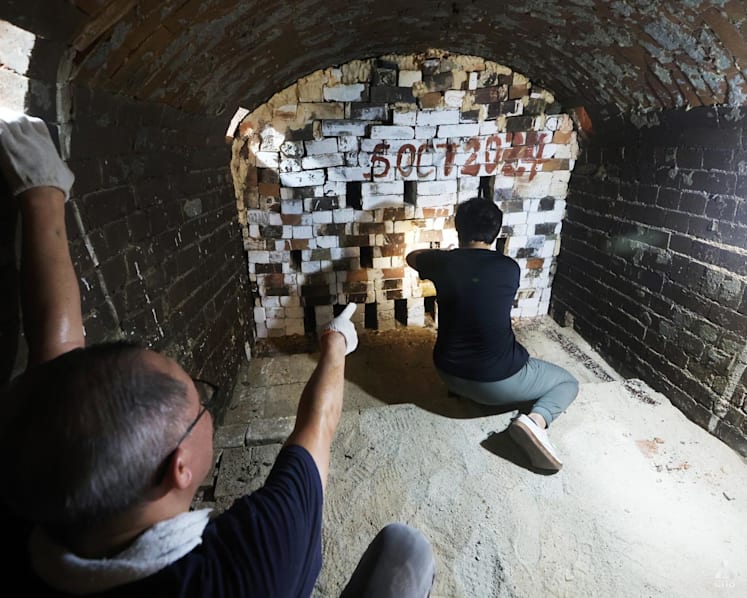
Potters in the process of dismantling the brick walls, in order to get into the kiln's chambers. (Photo: CNA/Ooi Boon Keong)
Breaking down the final wall to reach the last shelves holding pottery items. (Photo: CNA/Ooi Boon Keong)
The residual heat from the firing was keenly felt by the potters inside the kiln. (Photo: CNA/Ooi Boon Keong)
Each piece of pottery was removed carefully from the shelves and moved out in batches. (Photo: CNA/Ooi Boon Keong)
Finally, potters reached the chamber closest to the fire box. Only one person is able to reach the items in the narrow chamber. (Photo: CNA/Ooi Boon Keong)

A collective “wow” sounded as the final bricks were removed, revealing the final outcome of the nine-day process that comprised three days of firing and six days of cooling.

The potters carefully removed the art pieces from the shelves, while admiring the effects that the fire had on their work. 

Advertisement

In Pixels

Meet the 70-year-old lorry driver who is also a 'kite doctor'

Meet the 70-year-old lorry driver who is also a 'kite doctor'

Kite maker Tan Poh Wah flying his handmade dragon kite at the Marina Barrage. (Photo: CNA/Nuria Ling)

30 Nov 2024 09:30PM (Updated: 16 Oct 2025 12:08AM)

Rolling up to Marina Barrage with a trolley bag full of handmade kites and repair tools, Mr Tan Poh Wah had one clear mission for the day: To share his love of kite-flying with others. 

Known informally as the “kite doctor” among the regular visitors there, the 70-year-old spends most Sundays repairing kites or offering his handmade ones – mostly for free – to people at the open-air space that is the venue of Singapore's largest reservoir. 

“Watching people fly my kites makes me really happy,” Mr Tan said.  

This weekend, In Pixels speaks to four enthusiasts to find out what excites them about kite-flying. 

A FAMILIAR FIGURE

CNA Games
Show More
Show Less

Shortly after Mr Tan turned up at Marina Barrage in the Marina Bay area, a handful of people who wanted their kites repaired immediately made a beeline towards him. 

They offered him drinks and snacks to thank him for his service. 

Mr Tan Poh Wah fixing a kite for a member of the public at the Marina Barrage. (Photo: CNA/Mak Jia Kee)
A variety of sticks and other kite parts are some of the things in Mr Tan Poh Wah’s kit that he takes to the Marina Barrage. (Photo: CNA/Nuria Ling)

When he was done with the repairs, Mr Tan pulled a kite from his bag and launched it to the sky. 

He flew it with ease, strolling around the field, eager to find someone who will take the kite as a gift. 

His masterpieces are made mostly from recycled materials including plastic bags, discarded blinds, banners and umbrellas. 

Mr Tan Poh Wah holding up a kite he made using a supermarket plastic bag. (Photo: CNA/Mak Jia Kee)
Mr Tan Poh Wah with a handmade kite made out of recycled materials. (Photo: CNA/Nuria Ling)

Mr Tan is part of a group known as Singapore Original Kites, an informal gathering of adults in their 60s and 70s who share the same interest in making and flying kites.  

A semi-retired Chinese physician ​​Ong Cheng Her, 75, is the founder of the group.

He said that the only prerequisite to join the group is one’s ability to make a kite from scratch.  

He proudly showed CNA TODAY one of his creations, a red and white "umbrella kite". 

“Umbrellas are used for shade and rain protection, so why hasn’t anyone flown an umbrella kite? I decided to take on the challenge,” Mr Ong added.

Mr Ong Cheng Her, founder of the Singapore Original Kites group, holding an "umbrella kite" that he made in 2023. (Photo: CNA/Nuria Ling )
Mr Ong Cheng Her holding a kite he made, featuring flower and leaf patterns inspired by traditional Chinese paintings. (Photo: CNA/Mak Jia Kee)

HIS WORKSPACE AT HOME

As for Mr Tan, he is not retired, so flying and making kites is what he does only on Sundays.

He works six days a week as a lorry driver.

“I work to live, to fill my stomach so I can make kites.”

Stepping into his flat, Mr Tan led us to his "studio", which is a room filled with a bountiful supply of kites and raw materials. 

He described his workspace as a “chaotic but organised mess”. 

“My wife sometimes asks why I collect so many umbrellas, but she doesn’t interfere much because she knows I enjoy making these things.”

Mr Tan Poh Wah tying a ribbon to a bamboo stick to form part of a kite. (Photo: CNA/Nuria Ling)

Mr Tan has loved kite flying since he was a child, but it was not until he was in his 30s that he took to making kites himself.

A self-taught craftsman, he said that he learnt how to make kites by observing other kite-makers whenever an opportunity comes along. 

Mr Tan Poh Wah crafting a squid kite in his workshop that he set up in his flat. (Photo: CNA/Nuria Ling)
Mr Tan Poh Wah laying out pieces of a 70m-long "dragon kite" in his living room. (Photo: CNA/Nuria Ling)

Recently, Mr Tan finished repairing a 70m-long "dragon kite" that he first constructed in 2000. It broke at a kite festival in Taiwan in 2019 and required extensive repairs. 

After CNA TODAY approached him for an interview, Mr Tan said that he found new inspiration to repair the kite, which took him four Sundays to complete.

It was obvious that he is most proud of this kite among the many in his collection.

“Anyone who hasn't made a dragon or a phoenix kite isn't truly considered a kite maker,” he said, adding that these long kites are made up of many different sections and each needed to be crafted with great precision before they are finally stitched together. 

A 70m-long "dragon kite" made by Mr Tan Poh Wah flying at Marina Barrage. (Photo: CNA/Nuria Ling)

"GIANTS" IN THE SKY

Over at East Coast Park, another group of kite enthusiasts have gathered and their presence could be spotted from afar. 

The kites they have taken out, called "inflatable show kites", are gigantic balloon-like kites that are typically several metres in length when inflated.

Traditional kites rely on rigid frames for support, but inflatable show kites have no hard structures. They inflate as they catch on the wind and have to be anchored to the ground.

An inflatable show kite flying at East Coast Park. (Photo: CNA/Nuria Ling)
Mr Johnny Yap checking on a 10m-tall seahorse-shaped inflatable show kite. (Photo: CNA/Mak Jia Kee)

Project coordinator Johnny Yap and his wife Maggie Mok, a homemaker, both 51, are the founders of Show Kites Singapore, a group of people who are into these inflatable show kites.

The duo's interest in this started nearly 20 years ago when they took their children kite-flying. 

In the end, it was the couple themselves who got hooked on the activity. 

“We started flying bigger and bigger kites and before long, we realised that stick kites have a limit,” Mr Yap said.

This led them to explore inflatable ones in 2009 and they came across these kites online before buying their first. The sky is the limit when it comes to the sizes of such kites.

Ms Maggie Mok examining the flying cord of an inflatable show kite. (Photo: CNA/Mak Jia Kee)
Mr Johnny Yap fixing the attached strings on his show kite. (Photo: CNA/Nuria Ling)
Mr Johnny Yap holding open an inflation vent for air to fill up the kite. (Photo: CNA/Nuria Ling)

As their interests grew, Mr Yap and Ms Mok started travelling overseas to take part in international kite festivals. 

In September, they were at the International Kite Festival in Melaka, Malaysia, where they flew an inflatable show kite in the form of Singapore's tourism icon, the Merlion.

Advertisement

In Pixels

Inside a dragon kiln where temperatures go up to 1,300°C

Inside a dragon kiln where temperatures go up to 1,300°C

Wood-firing at a dragon kiln is a community effort that requires round-the-clock monitoring. (Photo: CNA/Ooi Boon Keong)

15 Nov 2024 09:30PM (Updated: 16 Oct 2025 12:09AM)

Nestled in an industrial estate in the western part of Singapore is an 84-year-old dragon kiln, the oldest and the only operational dragon kiln in the country. 

Built in 1940, the kiln at Thow Kwang Pottery Jungle was originally used for the mass production of household and industrial items such as cups and flower pots.

Over the decades, the place has evolved into a community space, now offering classes and events for potters to hone their craft. 

CNA TODAY joined the potter community for a wood-firing session that happens only two or three times a year.

CNA Games
Show More
Show Less

In Pixels takes you through the experience, as new and seasoned potters bond over fire and perspiration, creating unique works of art. 

PRAYERS TO THE "KILN GOD"  

At Thow Kwang Pottery Jungle, which is located a short distance from Nanyang Technological University, a group of around 30 people gathered on a Friday last month in front of the kiln.

This was at the request of the owners, Mr Tan Teck Yoke, 68, and his wife Yulianti Tan, 66. 

A prayer ceremony to the "kiln god" was about to begin. 

“We are praying to the ‘kiln god’ for a successful firing, for the pieces to achieve the desired effects,” Mr Tan explained to the enthusiastic participants. 

To this, the crowd responded by shouting, “Heng, ong, huat, ah,” a phrase in the Chinese dialect of Hokkien that collectively means wishing for good fortune.

Mrs Yulianti Tan and Mr Tan Teck Yoke, owners of Thow Kwang Pottery Jungle, praying for a successful wood-firing session. (Photo: CNA/Ooi Boon Keong)

After the prayers were done, the fire box, which is a small opening at the front of the kiln, was lit. 

The participants each picked up a piece of wood to throw into the fire, hoping to add more "luck" to the process. 

During wood-firing in a kiln, the fire and the ashes from the wood react with the glaze on the ceramic items to produce a unique and rustic look. (Photo: CNA/Ooi Boon Keong)

The dragon kiln was bought by Mr Tan’s father in 1965 and has been owned by the family since then.

It sits on a slope, is 27-metres long, 2-metres wide and curves around the side, resembling the body of a dragon in Chinese mythology. 

Its lengthy chambers are made out of bricks and there is a chimney at the end, located at the top of the slope.

The kiln can fit thousands of pieces of ceramic items, depending on the size of the pots. 

For this firing session, around 400 to 500 pieces were loaded in the kiln. 

NEW WAYS TO IMPROVE PROCESS

Temperatures in the dragon kiln can reach up to 1,300°C. 

They can fluctuate significantly due to the shape of the furnace and the use of wood as a fuel.

That is why one of the most crucial parts of the process is to monitor the temperature for all three days of the firing session.

Mr Chua Hee Lai, who is in his 50s and a hobbyist-turned-kiln master, helped to plan and lead each firing session. 

Mr Chua Hee Lai (right) installing thermocouples on the slopes of an 84-year-old kiln to monitor the temperatures. (Photo: CNA/Ooi Boon Keong)

In 2019, Mr Chua, with the help of another potter, introduced a digital monitoring system that allowed them to track the temperatures remotely and give instructions to the potters doing shift work on site. 

Previously, they had to monitor the temperature by looking at the colour of the flame or record temperatures manually and then draw up prediction charts – a process that requires them to be on site for longer periods of time.

When the temperatures start to dip, potters will add more wood into the fire. (Photo: CNA/Ooi Boon Keong)
Potters handling large pieces of wood to be fed into a fire box. (Photo: CNA/Ooi Boon Keong)
The effect of burning heat can be seen in the different skin colours of a potter’s arms, after he stood near the kiln's fire box for some time to keep the flame going. (Photo: CNA/Ooi Boon Keong)
Cheers breaking out as the target wood-firing temperature of 1,260°C was about to be reached. (Photo: CNA/Ooi Boon Keong)

THE "KAMPUNG SPIRIT"

Advertising executive Vanessa Low and product manager Goh Wei Ting, both 31, have been practising pottery at another pottery studio for around five years and this was their first time taking part in the wood-firing process.

Compared to a regular firing in an electric or gas kiln, wood-firing is "tiring and physically demanding", Mr Goh said.

However, they were buoyed by the “kampung spirit” or the sense of camaraderie that came about as participants laboured together. 

 “You just don’t feel tired, you just do (the work),” Mr Goh added. 

A group of young potters who are new to wood-firing taking photos near the kiln. (Photo: CNA/Ooi Boon Keong)
Experienced and new potters forming a human chain to carry pieces of wood to be used for the firing. (Photo: CNA/Ooi Boon Keong)
Participants having a lively potluck dinner, a brief respite from the day’s hard work. (Photo: CNA/Ooi Boon Keong)
After dinner, potters sitting around and chatting in front of the fire while monitoring the kiln. (Photo: CNA/Ooi Boon Keong)

OPENING OF THE KILN

Six days after the firing at the dragon kiln, the participants returned to open the kiln and check on their art pieces. 

“Shall we form a chain?” someone suggested to facilitate the removal of the brick walls. 

Without hesitation, a human chain quickly formed as the potters unsealed the kiln, one brick at a time. 
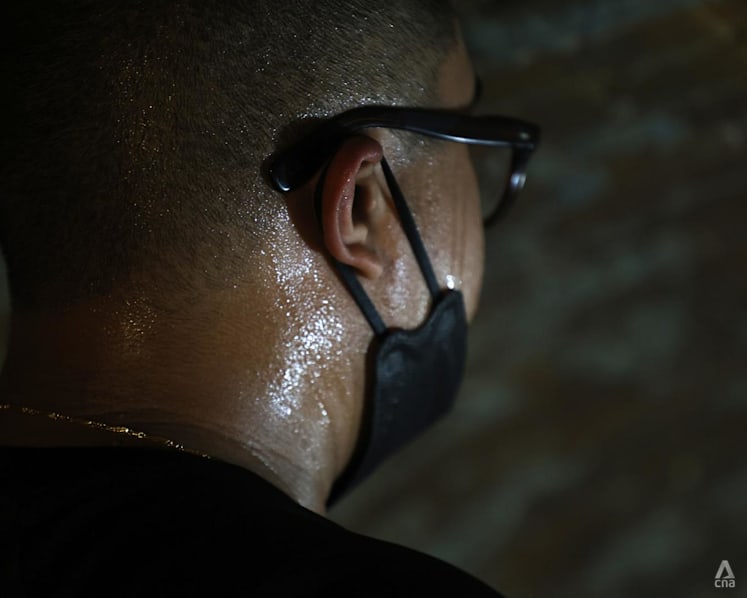
Potters in the process of dismantling the brick walls, in order to get into the kiln's chambers. (Photo: CNA/Ooi Boon Keong)
Breaking down the final wall to reach the last shelves holding pottery items. (Photo: CNA/Ooi Boon Keong)
The residual heat from the firing was keenly felt by the potters inside the kiln. (Photo: CNA/Ooi Boon Keong)
Each piece of pottery was removed carefully from the shelves and moved out in batches. (Photo: CNA/Ooi Boon Keong)
Finally, potters reached the chamber closest to the fire box. Only one person is able to reach the items in the narrow chamber. (Photo: CNA/Ooi Boon Keong)

A collective “wow” sounded as the final bricks were removed, revealing the final outcome of the nine-day process that comprised three days of firing and six days of cooling.

The potters carefully removed the art pieces from the shelves, while admiring the effects that the fire had on their work. 

Advertisement

In Pixels

Meet the 70-year-old lorry driver who is also a 'kite doctor'

Meet the 70-year-old lorry driver who is also a 'kite doctor'

Kite maker Tan Poh Wah flying his handmade dragon kite at the Marina Barrage. (Photo: CNA/Nuria Ling)

30 Nov 2024 09:30PM (Updated: 16 Oct 2025 12:08AM)

Rolling up to Marina Barrage with a trolley bag full of handmade kites and repair tools, Mr Tan Poh Wah had one clear mission for the day: To share his love of kite-flying with others. 

Known informally as the “kite doctor” among the regular visitors there, the 70-year-old spends most Sundays repairing kites or offering his handmade ones – mostly for free – to people at the open-air space that is the venue of Singapore's largest reservoir. 

“Watching people fly my kites makes me really happy,” Mr Tan said.  

This weekend, In Pixels speaks to four enthusiasts to find out what excites them about kite-flying. 

A FAMILIAR FIGURE

CNA Games
Show More
Show Less

Shortly after Mr Tan turned up at Marina Barrage in the Marina Bay area, a handful of people who wanted their kites repaired immediately made a beeline towards him. 

They offered him drinks and snacks to thank him for his service. 

Mr Tan Poh Wah fixing a kite for a member of the public at the Marina Barrage. (Photo: CNA/Mak Jia Kee)
A variety of sticks and other kite parts are some of the things in Mr Tan Poh Wah’s kit that he takes to the Marina Barrage. (Photo: CNA/Nuria Ling)

When he was done with the repairs, Mr Tan pulled a kite from his bag and launched it to the sky. 

He flew it with ease, strolling around the field, eager to find someone who will take the kite as a gift. 

His masterpieces are made mostly from recycled materials including plastic bags, discarded blinds, banners and umbrellas. 

Mr Tan Poh Wah holding up a kite he made using a supermarket plastic bag. (Photo: CNA/Mak Jia Kee)
Mr Tan Poh Wah with a handmade kite made out of recycled materials. (Photo: CNA/Nuria Ling)

Mr Tan is part of a group known as Singapore Original Kites, an informal gathering of adults in their 60s and 70s who share the same interest in making and flying kites.  

A semi-retired Chinese physician ​​Ong Cheng Her, 75, is the founder of the group.

He said that the only prerequisite to join the group is one’s ability to make a kite from scratch.  

He proudly showed CNA TODAY one of his creations, a red and white "umbrella kite". 

“Umbrellas are used for shade and rain protection, so why hasn’t anyone flown an umbrella kite? I decided to take on the challenge,” Mr Ong added.

Mr Ong Cheng Her, founder of the Singapore Original Kites group, holding an "umbrella kite" that he made in 2023. (Photo: CNA/Nuria Ling )
Mr Ong Cheng Her holding a kite he made, featuring flower and leaf patterns inspired by traditional Chinese paintings. (Photo: CNA/Mak Jia Kee)

HIS WORKSPACE AT HOME

As for Mr Tan, he is not retired, so flying and making kites is what he does only on Sundays.

He works six days a week as a lorry driver.

“I work to live, to fill my stomach so I can make kites.”

Stepping into his flat, Mr Tan led us to his "studio", which is a room filled with a bountiful supply of kites and raw materials. 

He described his workspace as a “chaotic but organised mess”. 

“My wife sometimes asks why I collect so many umbrellas, but she doesn’t interfere much because she knows I enjoy making these things.”

Mr Tan Poh Wah tying a ribbon to a bamboo stick to form part of a kite. (Photo: CNA/Nuria Ling)

Mr Tan has loved kite flying since he was a child, but it was not until he was in his 30s that he took to making kites himself.

A self-taught craftsman, he said that he learnt how to make kites by observing other kite-makers whenever an opportunity comes along. 

Mr Tan Poh Wah crafting a squid kite in his workshop that he set up in his flat. (Photo: CNA/Nuria Ling)
Mr Tan Poh Wah laying out pieces of a 70m-long "dragon kite" in his living room. (Photo: CNA/Nuria Ling)

Recently, Mr Tan finished repairing a 70m-long "dragon kite" that he first constructed in 2000. It broke at a kite festival in Taiwan in 2019 and required extensive repairs. 

After CNA TODAY approached him for an interview, Mr Tan said that he found new inspiration to repair the kite, which took him four Sundays to complete.

It was obvious that he is most proud of this kite among the many in his collection.

“Anyone who hasn't made a dragon or a phoenix kite isn't truly considered a kite maker,” he said, adding that these long kites are made up of many different sections and each needed to be crafted with great precision before they are finally stitched together. 

A 70m-long "dragon kite" made by Mr Tan Poh Wah flying at Marina Barrage. (Photo: CNA/Nuria Ling)

"GIANTS" IN THE SKY

Over at East Coast Park, another group of kite enthusiasts have gathered and their presence could be spotted from afar. 

The kites they have taken out, called "inflatable show kites", are gigantic balloon-like kites that are typically several metres in length when inflated.

Traditional kites rely on rigid frames for support, but inflatable show kites have no hard structures. They inflate as they catch on the wind and have to be anchored to the ground.

An inflatable show kite flying at East Coast Park. (Photo: CNA/Nuria Ling)
Mr Johnny Yap checking on a 10m-tall seahorse-shaped inflatable show kite. (Photo: CNA/Mak Jia Kee)

Project coordinator Johnny Yap and his wife Maggie Mok, a homemaker, both 51, are the founders of Show Kites Singapore, a group of people who are into these inflatable show kites.

The duo's interest in this started nearly 20 years ago when they took their children kite-flying. 

In the end, it was the couple themselves who got hooked on the activity. 

“We started flying bigger and bigger kites and before long, we realised that stick kites have a limit,” Mr Yap said.

This led them to explore inflatable ones in 2009 and they came across these kites online before buying their first. The sky is the limit when it comes to the sizes of such kites.

Ms Maggie Mok examining the flying cord of an inflatable show kite. (Photo: CNA/Mak Jia Kee)
Mr Johnny Yap fixing the attached strings on his show kite. (Photo: CNA/Nuria Ling)
Mr Johnny Yap holding open an inflation vent for air to fill up the kite. (Photo: CNA/Nuria Ling)

As their interests grew, Mr Yap and Ms Mok started travelling overseas to take part in international kite festivals. 

In September, they were at the International Kite Festival in Melaka, Malaysia, where they flew an inflatable show kite in the form of Singapore's tourism icon, the Merlion.

Advertisement

In Pixels

Inside a dragon kiln where temperatures go up to 1,300°C

Inside a dragon kiln where temperatures go up to 1,300°C

Wood-firing at a dragon kiln is a community effort that requires round-the-clock monitoring. (Photo: CNA/Ooi Boon Keong)

15 Nov 2024 09:30PM (Updated: 16 Oct 2025 12:09AM)

Nestled in an industrial estate in the western part of Singapore is an 84-year-old dragon kiln, the oldest and the only operational dragon kiln in the country. 

Built in 1940, the kiln at Thow Kwang Pottery Jungle was originally used for the mass production of household and industrial items such as cups and flower pots.

Over the decades, the place has evolved into a community space, now offering classes and events for potters to hone their craft. 

CNA TODAY joined the potter community for a wood-firing session that happens only two or three times a year.

CNA Games
Show More
Show Less

In Pixels takes you through the experience, as new and seasoned potters bond over fire and perspiration, creating unique works of art. 

PRAYERS TO THE "KILN GOD"  

At Thow Kwang Pottery Jungle, which is located a short distance from Nanyang Technological University, a group of around 30 people gathered on a Friday last month in front of the kiln.

This was at the request of the owners, Mr Tan Teck Yoke, 68, and his wife Yulianti Tan, 66. 

A prayer ceremony to the "kiln god" was about to begin. 

“We are praying to the ‘kiln god’ for a successful firing, for the pieces to achieve the desired effects,” Mr Tan explained to the enthusiastic participants. 

To this, the crowd responded by shouting, “Heng, ong, huat, ah,” a phrase in the Chinese dialect of Hokkien that collectively means wishing for good fortune.

Mrs Yulianti Tan and Mr Tan Teck Yoke, owners of Thow Kwang Pottery Jungle, praying for a successful wood-firing session. (Photo: CNA/Ooi Boon Keong)

After the prayers were done, the fire box, which is a small opening at the front of the kiln, was lit. 

The participants each picked up a piece of wood to throw into the fire, hoping to add more "luck" to the process. 

During wood-firing in a kiln, the fire and the ashes from the wood react with the glaze on the ceramic items to produce a unique and rustic look. (Photo: CNA/Ooi Boon Keong)

The dragon kiln was bought by Mr Tan’s father in 1965 and has been owned by the family since then.

It sits on a slope, is 27-metres long, 2-metres wide and curves around the side, resembling the body of a dragon in Chinese mythology. 

Its lengthy chambers are made out of bricks and there is a chimney at the end, located at the top of the slope.

The kiln can fit thousands of pieces of ceramic items, depending on the size of the pots. 

For this firing session, around 400 to 500 pieces were loaded in the kiln. 

NEW WAYS TO IMPROVE PROCESS

Temperatures in the dragon kiln can reach up to 1,300°C. 

They can fluctuate significantly due to the shape of the furnace and the use of wood as a fuel.

That is why one of the most crucial parts of the process is to monitor the temperature for all three days of the firing session.

Mr Chua Hee Lai, who is in his 50s and a hobbyist-turned-kiln master, helped to plan and lead each firing session. 

Mr Chua Hee Lai (right) installing thermocouples on the slopes of an 84-year-old kiln to monitor the temperatures. (Photo: CNA/Ooi Boon Keong)

In 2019, Mr Chua, with the help of another potter, introduced a digital monitoring system that allowed them to track the temperatures remotely and give instructions to the potters doing shift work on site. 

Previously, they had to monitor the temperature by looking at the colour of the flame or record temperatures manually and then draw up prediction charts – a process that requires them to be on site for longer periods of time.

When the temperatures start to dip, potters will add more wood into the fire. (Photo: CNA/Ooi Boon Keong)
Potters handling large pieces of wood to be fed into a fire box. (Photo: CNA/Ooi Boon Keong)
The effect of burning heat can be seen in the different skin colours of a potter’s arms, after he stood near the kiln's fire box for some time to keep the flame going. (Photo: CNA/Ooi Boon Keong)
Cheers breaking out as the target wood-firing temperature of 1,260°C was about to be reached. (Photo: CNA/Ooi Boon Keong)

THE "KAMPUNG SPIRIT"

Advertising executive Vanessa Low and product manager Goh Wei Ting, both 31, have been practising pottery at another pottery studio for around five years and this was their first time taking part in the wood-firing process.

Compared to a regular firing in an electric or gas kiln, wood-firing is "tiring and physically demanding", Mr Goh said.

However, they were buoyed by the “kampung spirit” or the sense of camaraderie that came about as participants laboured together. 

 “You just don’t feel tired, you just do (the work),” Mr Goh added. 

A group of young potters who are new to wood-firing taking photos near the kiln. (Photo: CNA/Ooi Boon Keong)
Experienced and new potters forming a human chain to carry pieces of wood to be used for the firing. (Photo: CNA/Ooi Boon Keong)
Participants having a lively potluck dinner, a brief respite from the day’s hard work. (Photo: CNA/Ooi Boon Keong)
After dinner, potters sitting around and chatting in front of the fire while monitoring the kiln. (Photo: CNA/Ooi Boon Keong)

OPENING OF THE KILN

Six days after the firing at the dragon kiln, the participants returned to open the kiln and check on their art pieces. 

“Shall we form a chain?” someone suggested to facilitate the removal of the brick walls. 

Without hesitation, a human chain quickly formed as the potters unsealed the kiln, one brick at a time. 
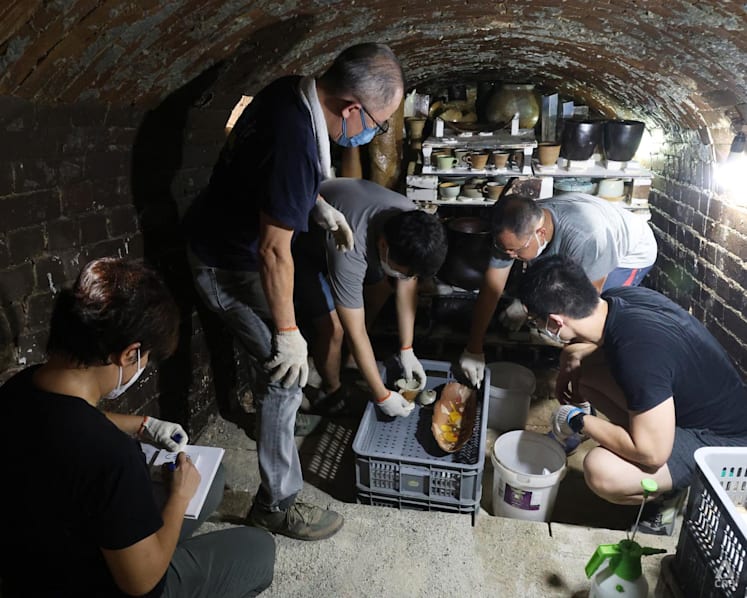
Potters in the process of dismantling the brick walls, in order to get into the kiln's chambers. (Photo: CNA/Ooi Boon Keong)
Breaking down the final wall to reach the last shelves holding pottery items. (Photo: CNA/Ooi Boon Keong)
The residual heat from the firing was keenly felt by the potters inside the kiln. (Photo: CNA/Ooi Boon Keong)
Each piece of pottery was removed carefully from the shelves and moved out in batches. (Photo: CNA/Ooi Boon Keong)
Finally, potters reached the chamber closest to the fire box. Only one person is able to reach the items in the narrow chamber. (Photo: CNA/Ooi Boon Keong)

A collective “wow” sounded as the final bricks were removed, revealing the final outcome of the nine-day process that comprised three days of firing and six days of cooling.

The potters carefully removed the art pieces from the shelves, while admiring the effects that the fire had on their work. 

Advertisement

In Pixels

Meet the 70-year-old lorry driver who is also a 'kite doctor'

Meet the 70-year-old lorry driver who is also a 'kite doctor'

Kite maker Tan Poh Wah flying his handmade dragon kite at the Marina Barrage. (Photo: CNA/Nuria Ling)

30 Nov 2024 09:30PM (Updated: 16 Oct 2025 12:08AM)

Rolling up to Marina Barrage with a trolley bag full of handmade kites and repair tools, Mr Tan Poh Wah had one clear mission for the day: To share his love of kite-flying with others. 

Known informally as the “kite doctor” among the regular visitors there, the 70-year-old spends most Sundays repairing kites or offering his handmade ones – mostly for free – to people at the open-air space that is the venue of Singapore's largest reservoir. 

“Watching people fly my kites makes me really happy,” Mr Tan said.  

This weekend, In Pixels speaks to four enthusiasts to find out what excites them about kite-flying. 

A FAMILIAR FIGURE

CNA Games
Show More
Show Less

Shortly after Mr Tan turned up at Marina Barrage in the Marina Bay area, a handful of people who wanted their kites repaired immediately made a beeline towards him. 

They offered him drinks and snacks to thank him for his service. 

Mr Tan Poh Wah fixing a kite for a member of the public at the Marina Barrage. (Photo: CNA/Mak Jia Kee)
A variety of sticks and other kite parts are some of the things in Mr Tan Poh Wah’s kit that he takes to the Marina Barrage. (Photo: CNA/Nuria Ling)

When he was done with the repairs, Mr Tan pulled a kite from his bag and launched it to the sky. 

He flew it with ease, strolling around the field, eager to find someone who will take the kite as a gift. 

His masterpieces are made mostly from recycled materials including plastic bags, discarded blinds, banners and umbrellas. 

Mr Tan Poh Wah holding up a kite he made using a supermarket plastic bag. (Photo: CNA/Mak Jia Kee)
Mr Tan Poh Wah with a handmade kite made out of recycled materials. (Photo: CNA/Nuria Ling)

Mr Tan is part of a group known as Singapore Original Kites, an informal gathering of adults in their 60s and 70s who share the same interest in making and flying kites.  

A semi-retired Chinese physician ​​Ong Cheng Her, 75, is the founder of the group.

He said that the only prerequisite to join the group is one’s ability to make a kite from scratch.  

He proudly showed CNA TODAY one of his creations, a red and white "umbrella kite". 

“Umbrellas are used for shade and rain protection, so why hasn’t anyone flown an umbrella kite? I decided to take on the challenge,” Mr Ong added.

Mr Ong Cheng Her, founder of the Singapore Original Kites group, holding an "umbrella kite" that he made in 2023. (Photo: CNA/Nuria Ling )
Mr Ong Cheng Her holding a kite he made, featuring flower and leaf patterns inspired by traditional Chinese paintings. (Photo: CNA/Mak Jia Kee)

HIS WORKSPACE AT HOME

As for Mr Tan, he is not retired, so flying and making kites is what he does only on Sundays.

He works six days a week as a lorry driver.

“I work to live, to fill my stomach so I can make kites.”

Stepping into his flat, Mr Tan led us to his "studio", which is a room filled with a bountiful supply of kites and raw materials. 

He described his workspace as a “chaotic but organised mess”. 

“My wife sometimes asks why I collect so many umbrellas, but she doesn’t interfere much because she knows I enjoy making these things.”

Mr Tan Poh Wah tying a ribbon to a bamboo stick to form part of a kite. (Photo: CNA/Nuria Ling)

Mr Tan has loved kite flying since he was a child, but it was not until he was in his 30s that he took to making kites himself.

A self-taught craftsman, he said that he learnt how to make kites by observing other kite-makers whenever an opportunity comes along. 

Mr Tan Poh Wah crafting a squid kite in his workshop that he set up in his flat. (Photo: CNA/Nuria Ling)
Mr Tan Poh Wah laying out pieces of a 70m-long "dragon kite" in his living room. (Photo: CNA/Nuria Ling)

Recently, Mr Tan finished repairing a 70m-long "dragon kite" that he first constructed in 2000. It broke at a kite festival in Taiwan in 2019 and required extensive repairs. 

After CNA TODAY approached him for an interview, Mr Tan said that he found new inspiration to repair the kite, which took him four Sundays to complete.

It was obvious that he is most proud of this kite among the many in his collection.

“Anyone who hasn't made a dragon or a phoenix kite isn't truly considered a kite maker,” he said, adding that these long kites are made up of many different sections and each needed to be crafted with great precision before they are finally stitched together. 

A 70m-long "dragon kite" made by Mr Tan Poh Wah flying at Marina Barrage. (Photo: CNA/Nuria Ling)

"GIANTS" IN THE SKY

Over at East Coast Park, another group of kite enthusiasts have gathered and their presence could be spotted from afar. 

The kites they have taken out, called "inflatable show kites", are gigantic balloon-like kites that are typically several metres in length when inflated.

Traditional kites rely on rigid frames for support, but inflatable show kites have no hard structures. They inflate as they catch on the wind and have to be anchored to the ground.

An inflatable show kite flying at East Coast Park. (Photo: CNA/Nuria Ling)
Mr Johnny Yap checking on a 10m-tall seahorse-shaped inflatable show kite. (Photo: CNA/Mak Jia Kee)

Project coordinator Johnny Yap and his wife Maggie Mok, a homemaker, both 51, are the founders of Show Kites Singapore, a group of people who are into these inflatable show kites.

The duo's interest in this started nearly 20 years ago when they took their children kite-flying. 

In the end, it was the couple themselves who got hooked on the activity. 

“We started flying bigger and bigger kites and before long, we realised that stick kites have a limit,” Mr Yap said.

This led them to explore inflatable ones in 2009 and they came across these kites online before buying their first. The sky is the limit when it comes to the sizes of such kites.

Ms Maggie Mok examining the flying cord of an inflatable show kite. (Photo: CNA/Mak Jia Kee)
Mr Johnny Yap fixing the attached strings on his show kite. (Photo: CNA/Nuria Ling)
Mr Johnny Yap holding open an inflation vent for air to fill up the kite. (Photo: CNA/Nuria Ling)

As their interests grew, Mr Yap and Ms Mok started travelling overseas to take part in international kite festivals. 

In September, they were at the International Kite Festival in Melaka, Malaysia, where they flew an inflatable show kite in the form of Singapore's tourism icon, the Merlion.

Advertisement

In Pixels

Inside a dragon kiln where temperatures go up to 1,300°C

Inside a dragon kiln where temperatures go up to 1,300°C

Wood-firing at a dragon kiln is a community effort that requires round-the-clock monitoring. (Photo: CNA/Ooi Boon Keong)

15 Nov 2024 09:30PM (Updated: 16 Oct 2025 12:09AM)

Nestled in an industrial estate in the western part of Singapore is an 84-year-old dragon kiln, the oldest and the only operational dragon kiln in the country. 

Built in 1940, the kiln at Thow Kwang Pottery Jungle was originally used for the mass production of household and industrial items such as cups and flower pots.

Over the decades, the place has evolved into a community space, now offering classes and events for potters to hone their craft. 

CNA TODAY joined the potter community for a wood-firing session that happens only two or three times a year.

CNA Games
Show More
Show Less

In Pixels takes you through the experience, as new and seasoned potters bond over fire and perspiration, creating unique works of art. 

PRAYERS TO THE "KILN GOD"  

At Thow Kwang Pottery Jungle, which is located a short distance from Nanyang Technological University, a group of around 30 people gathered on a Friday last month in front of the kiln.

This was at the request of the owners, Mr Tan Teck Yoke, 68, and his wife Yulianti Tan, 66. 

A prayer ceremony to the "kiln god" was about to begin. 

“We are praying to the ‘kiln god’ for a successful firing, for the pieces to achieve the desired effects,” Mr Tan explained to the enthusiastic participants. 

To this, the crowd responded by shouting, “Heng, ong, huat, ah,” a phrase in the Chinese dialect of Hokkien that collectively means wishing for good fortune.

Mrs Yulianti Tan and Mr Tan Teck Yoke, owners of Thow Kwang Pottery Jungle, praying for a successful wood-firing session. (Photo: CNA/Ooi Boon Keong)

After the prayers were done, the fire box, which is a small opening at the front of the kiln, was lit. 

The participants each picked up a piece of wood to throw into the fire, hoping to add more "luck" to the process. 

During wood-firing in a kiln, the fire and the ashes from the wood react with the glaze on the ceramic items to produce a unique and rustic look. (Photo: CNA/Ooi Boon Keong)

The dragon kiln was bought by Mr Tan’s father in 1965 and has been owned by the family since then.

It sits on a slope, is 27-metres long, 2-metres wide and curves around the side, resembling the body of a dragon in Chinese mythology. 

Its lengthy chambers are made out of bricks and there is a chimney at the end, located at the top of the slope.

The kiln can fit thousands of pieces of ceramic items, depending on the size of the pots. 

For this firing session, around 400 to 500 pieces were loaded in the kiln. 

NEW WAYS TO IMPROVE PROCESS

Temperatures in the dragon kiln can reach up to 1,300°C. 

They can fluctuate significantly due to the shape of the furnace and the use of wood as a fuel.

That is why one of the most crucial parts of the process is to monitor the temperature for all three days of the firing session.

Mr Chua Hee Lai, who is in his 50s and a hobbyist-turned-kiln master, helped to plan and lead each firing session. 

Mr Chua Hee Lai (right) installing thermocouples on the slopes of an 84-year-old kiln to monitor the temperatures. (Photo: CNA/Ooi Boon Keong)

In 2019, Mr Chua, with the help of another potter, introduced a digital monitoring system that allowed them to track the temperatures remotely and give instructions to the potters doing shift work on site. 

Previously, they had to monitor the temperature by looking at the colour of the flame or record temperatures manually and then draw up prediction charts – a process that requires them to be on site for longer periods of time.

When the temperatures start to dip, potters will add more wood into the fire. (Photo: CNA/Ooi Boon Keong)
Potters handling large pieces of wood to be fed into a fire box. (Photo: CNA/Ooi Boon Keong)
The effect of burning heat can be seen in the different skin colours of a potter’s arms, after he stood near the kiln's fire box for some time to keep the flame going. (Photo: CNA/Ooi Boon Keong)
Cheers breaking out as the target wood-firing temperature of 1,260°C was about to be reached. (Photo: CNA/Ooi Boon Keong)

THE "KAMPUNG SPIRIT"

Advertising executive Vanessa Low and product manager Goh Wei Ting, both 31, have been practising pottery at another pottery studio for around five years and this was their first time taking part in the wood-firing process.

Compared to a regular firing in an electric or gas kiln, wood-firing is "tiring and physically demanding", Mr Goh said.

However, they were buoyed by the “kampung spirit” or the sense of camaraderie that came about as participants laboured together. 

 “You just don’t feel tired, you just do (the work),” Mr Goh added. 

A group of young potters who are new to wood-firing taking photos near the kiln. (Photo: CNA/Ooi Boon Keong)
Experienced and new potters forming a human chain to carry pieces of wood to be used for the firing. (Photo: CNA/Ooi Boon Keong)
Participants having a lively potluck dinner, a brief respite from the day’s hard work. (Photo: CNA/Ooi Boon Keong)
After dinner, potters sitting around and chatting in front of the fire while monitoring the kiln. (Photo: CNA/Ooi Boon Keong)

OPENING OF THE KILN

Six days after the firing at the dragon kiln, the participants returned to open the kiln and check on their art pieces. 

“Shall we form a chain?” someone suggested to facilitate the removal of the brick walls. 

Without hesitation, a human chain quickly formed as the potters unsealed the kiln, one brick at a time. 
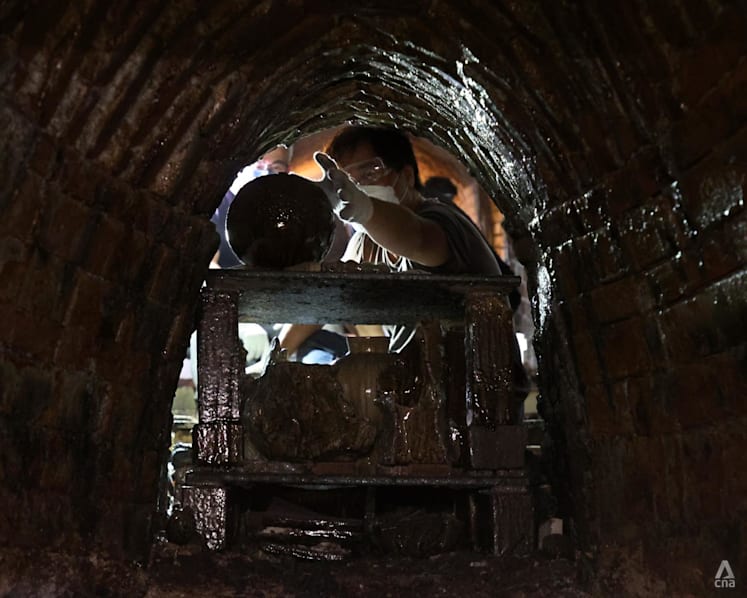
Potters in the process of dismantling the brick walls, in order to get into the kiln's chambers. (Photo: CNA/Ooi Boon Keong)
Breaking down the final wall to reach the last shelves holding pottery items. (Photo: CNA/Ooi Boon Keong)
The residual heat from the firing was keenly felt by the potters inside the kiln. (Photo: CNA/Ooi Boon Keong)
Each piece of pottery was removed carefully from the shelves and moved out in batches. (Photo: CNA/Ooi Boon Keong)
Finally, potters reached the chamber closest to the fire box. Only one person is able to reach the items in the narrow chamber. (Photo: CNA/Ooi Boon Keong)

A collective “wow” sounded as the final bricks were removed, revealing the final outcome of the nine-day process that comprised three days of firing and six days of cooling.

The potters carefully removed the art pieces from the shelves, while admiring the effects that the fire had on their work. 

Advertisement

In Pixels

Meet the 70-year-old lorry driver who is also a 'kite doctor'
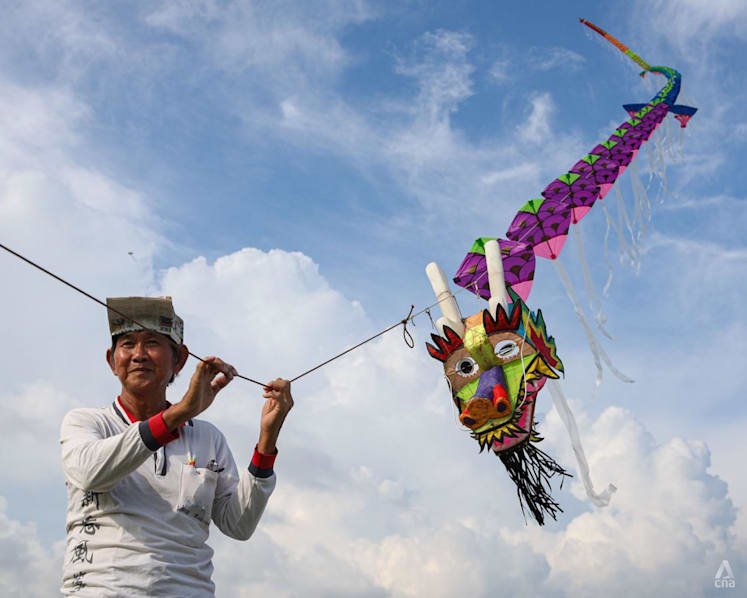
Meet the 70-year-old lorry driver who is also a 'kite doctor'

Kite maker Tan Poh Wah flying his handmade dragon kite at the Marina Barrage. (Photo: CNA/Nuria Ling)

30 Nov 2024 09:30PM (Updated: 16 Oct 2025 12:08AM)

Rolling up to Marina Barrage with a trolley bag full of handmade kites and repair tools, Mr Tan Poh Wah had one clear mission for the day: To share his love of kite-flying with others. 

Known informally as the “kite doctor” among the regular visitors there, the 70-year-old spends most Sundays repairing kites or offering his handmade ones – mostly for free – to people at the open-air space that is the venue of Singapore's largest reservoir. 

“Watching people fly my kites makes me really happy,” Mr Tan said.  

This weekend, In Pixels speaks to four enthusiasts to find out what excites them about kite-flying. 

A FAMILIAR FIGURE

CNA Games
Show More
Show Less

Shortly after Mr Tan turned up at Marina Barrage in the Marina Bay area, a handful of people who wanted their kites repaired immediately made a beeline towards him. 

They offered him drinks and snacks to thank him for his service. 

When he was done with the repairs, Mr Tan pulled a kite from his bag and launched it to the sky. 

He flew it with ease, strolling around the field, eager to find someone who will take the kite as a gift. 

His masterpieces are made mostly from recycled materials including plastic bags, discarded blinds, banners and umbrellas. 

Mr Tan Poh Wah holding up a kite he made using a supermarket plastic bag. (Photo: CNA/Mak Jia Kee)
Mr Tan Poh Wah with a handmade kite made out of recycled materials. (Photo: CNA/Nuria Ling)

Mr Tan is part of a group known as Singapore Original Kites, an informal gathering of adults in their 60s and 70s who share the same interest in making and flying kites.  

A semi-retired Chinese physician ​​Ong Cheng Her, 75, is the founder of the group.

He said that the only prerequisite to join the group is one’s ability to make a kite from scratch.  

He proudly showed CNA TODAY one of his creations, a red and white "umbrella kite". 

“Umbrellas are used for shade and rain protection, so why hasn’t anyone flown an umbrella kite? I decided to take on the challenge,” Mr Ong added.

Mr Ong Cheng Her, founder of the Singapore Original Kites group, holding an "umbrella kite" that he made in 2023. (Photo: CNA/Nuria Ling )
Mr Ong Cheng Her holding a kite he made, featuring flower and leaf patterns inspired by traditional Chinese paintings. (Photo: CNA/Mak Jia Kee)

HIS WORKSPACE AT HOME

As for Mr Tan, he is not retired, so flying and making kites is what he does only on Sundays.

He works six days a week as a lorry driver.

“I work to live, to fill my stomach so I can make kites.”

Stepping into his flat, Mr Tan led us to his "studio", which is a room filled with a bountiful supply of kites and raw materials. 

He described his workspace as a “chaotic but organised mess”. 

“My wife sometimes asks why I collect so many umbrellas, but she doesn’t interfere much because she knows I enjoy making these things.”

Mr Tan Poh Wah tying a ribbon to a bamboo stick to form part of a kite. (Photo: CNA/Nuria Ling)

Mr Tan has loved kite flying since he was a child, but it was not until he was in his 30s that he took to making kites himself.

A self-taught craftsman, he said that he learnt how to make kites by observing other kite-makers whenever an opportunity comes along. 

Mr Tan Poh Wah crafting a squid kite in his workshop that he set up in his flat. (Photo: CNA/Nuria Ling)
Mr Tan Poh Wah laying out pieces of a 70m-long "dragon kite" in his living room. (Photo: CNA/Nuria Ling)

Recently, Mr Tan finished repairing a 70m-long "dragon kite" that he first constructed in 2000. It broke at a kite festival in Taiwan in 2019 and required extensive repairs. 

After CNA TODAY approached him for an interview, Mr Tan said that he found new inspiration to repair the kite, which took him four Sundays to complete.

It was obvious that he is most proud of this kite among the many in his collection.

“Anyone who hasn't made a dragon or a phoenix kite isn't truly considered a kite maker,” he said, adding that these long kites are made up of many different sections and each needed to be crafted with great precision before they are finally stitched together. 

A 70m-long "dragon kite" made by Mr Tan Poh Wah flying at Marina Barrage. (Photo: CNA/Nuria Ling)

"GIANTS" IN THE SKY

Over at East Coast Park, another group of kite enthusiasts have gathered and their presence could be spotted from afar. 

The kites they have taken out, called "inflatable show kites", are gigantic balloon-like kites that are typically several metres in length when inflated.

Traditional kites rely on rigid frames for support, but inflatable show kites have no hard structures. They inflate as they catch on the wind and have to be anchored to the ground.

An inflatable show kite flying at East Coast Park. (Photo: CNA/Nuria Ling)
Mr Johnny Yap checking on a 10m-tall seahorse-shaped inflatable show kite. (Photo: CNA/Mak Jia Kee)

Project coordinator Johnny Yap and his wife Maggie Mok, a homemaker, both 51, are the founders of Show Kites Singapore, a group of people who are into these inflatable show kites.

The duo's interest in this started nearly 20 years ago when they took their children kite-flying. 

In the end, it was the couple themselves who got hooked on the activity. 

“We started flying bigger and bigger kites and before long, we realised that stick kites have a limit,” Mr Yap said.

This led them to explore inflatable ones in 2009 and they came across these kites online before buying their first. The sky is the limit when it comes to the sizes of such kites.

Ms Maggie Mok examining the flying cord of an inflatable show kite. (Photo: CNA/Mak Jia Kee)
Mr Johnny Yap fixing the attached strings on his show kite. (Photo: CNA/Nuria Ling)
Mr Johnny Yap holding open an inflation vent for air to fill up the kite. (Photo: CNA/Nuria Ling)

As their interests grew, Mr Yap and Ms Mok started travelling overseas to take part in international kite festivals. 

In September, they were at the International Kite Festival in Melaka, Malaysia, where they flew an inflatable show kite in the form of Singapore's tourism icon, the Merlion.

Advertisement

In Pixels

Inside a dragon kiln where temperatures go up to 1,300°C

Inside a dragon kiln where temperatures go up to 1,300°C

Wood-firing at a dragon kiln is a community effort that requires round-the-clock monitoring. (Photo: CNA/Ooi Boon Keong)

15 Nov 2024 09:30PM (Updated: 16 Oct 2025 12:09AM)

Nestled in an industrial estate in the western part of Singapore is an 84-year-old dragon kiln, the oldest and the only operational dragon kiln in the country. 

Built in 1940, the kiln at Thow Kwang Pottery Jungle was originally used for the mass production of household and industrial items such as cups and flower pots.

Over the decades, the place has evolved into a community space, now offering classes and events for potters to hone their craft. 

CNA TODAY joined the potter community for a wood-firing session that happens only two or three times a year.

CNA Games
Show More
Show Less

In Pixels takes you through the experience, as new and seasoned potters bond over fire and perspiration, creating unique works of art. 

PRAYERS TO THE "KILN GOD"  

At Thow Kwang Pottery Jungle, which is located a short distance from Nanyang Technological University, a group of around 30 people gathered on a Friday last month in front of the kiln.

This was at the request of the owners, Mr Tan Teck Yoke, 68, and his wife Yulianti Tan, 66. 

A prayer ceremony to the "kiln god" was about to begin. 

“We are praying to the ‘kiln god’ for a successful firing, for the pieces to achieve the desired effects,” Mr Tan explained to the enthusiastic participants. 

To this, the crowd responded by shouting, “Heng, ong, huat, ah,” a phrase in the Chinese dialect of Hokkien that collectively means wishing for good fortune.

Mrs Yulianti Tan and Mr Tan Teck Yoke, owners of Thow Kwang Pottery Jungle, praying for a successful wood-firing session. (Photo: CNA/Ooi Boon Keong)

After the prayers were done, the fire box, which is a small opening at the front of the kiln, was lit. 

The participants each picked up a piece of wood to throw into the fire, hoping to add more "luck" to the process. 

During wood-firing in a kiln, the fire and the ashes from the wood react with the glaze on the ceramic items to produce a unique and rustic look. (Photo: CNA/Ooi Boon Keong)

The dragon kiln was bought by Mr Tan’s father in 1965 and has been owned by the family since then.

It sits on a slope, is 27-metres long, 2-metres wide and curves around the side, resembling the body of a dragon in Chinese mythology. 

Its lengthy chambers are made out of bricks and there is a chimney at the end, located at the top of the slope.

The kiln can fit thousands of pieces of ceramic items, depending on the size of the pots. 

For this firing session, around 400 to 500 pieces were loaded in the kiln. 

NEW WAYS TO IMPROVE PROCESS

Temperatures in the dragon kiln can reach up to 1,300°C. 

They can fluctuate significantly due to the shape of the furnace and the use of wood as a fuel.

That is why one of the most crucial parts of the process is to monitor the temperature for all three days of the firing session.

Mr Chua Hee Lai, who is in his 50s and a hobbyist-turned-kiln master, helped to plan and lead each firing session. 

Mr Chua Hee Lai (right) installing thermocouples on the slopes of an 84-year-old kiln to monitor the temperatures. (Photo: CNA/Ooi Boon Keong)

In 2019, Mr Chua, with the help of another potter, introduced a digital monitoring system that allowed them to track the temperatures remotely and give instructions to the potters doing shift work on site. 

Previously, they had to monitor the temperature by looking at the colour of the flame or record temperatures manually and then draw up prediction charts – a process that requires them to be on site for longer periods of time.

When the temperatures start to dip, potters will add more wood into the fire. (Photo: CNA/Ooi Boon Keong)
Potters handling large pieces of wood to be fed into a fire box. (Photo: CNA/Ooi Boon Keong)
The effect of burning heat can be seen in the different skin colours of a potter’s arms, after he stood near the kiln's fire box for some time to keep the flame going. (Photo: CNA/Ooi Boon Keong)
Cheers breaking out as the target wood-firing temperature of 1,260°C was about to be reached. (Photo: CNA/Ooi Boon Keong)

THE "KAMPUNG SPIRIT"

Advertising executive Vanessa Low and product manager Goh Wei Ting, both 31, have been practising pottery at another pottery studio for around five years and this was their first time taking part in the wood-firing process.

Compared to a regular firing in an electric or gas kiln, wood-firing is "tiring and physically demanding", Mr Goh said.

However, they were buoyed by the “kampung spirit” or the sense of camaraderie that came about as participants laboured together. 

 “You just don’t feel tired, you just do (the work),” Mr Goh added. 

A group of young potters who are new to wood-firing taking photos near the kiln. (Photo: CNA/Ooi Boon Keong)
Experienced and new potters forming a human chain to carry pieces of wood to be used for the firing. (Photo: CNA/Ooi Boon Keong)
Participants having a lively potluck dinner, a brief respite from the day’s hard work. (Photo: CNA/Ooi Boon Keong)
After dinner, potters sitting around and chatting in front of the fire while monitoring the kiln. (Photo: CNA/Ooi Boon Keong)

OPENING OF THE KILN

Six days after the firing at the dragon kiln, the participants returned to open the kiln and check on their art pieces. 

“Shall we form a chain?” someone suggested to facilitate the removal of the brick walls. 

Without hesitation, a human chain quickly formed as the potters unsealed the kiln, one brick at a time. 

Potters in the process of dismantling the brick walls, in order to get into the kiln's chambers. (Photo: CNA/Ooi Boon Keong)
Breaking down the final wall to reach the last shelves holding pottery items. (Photo: CNA/Ooi Boon Keong)
The residual heat from the firing was keenly felt by the potters inside the kiln. (Photo: CNA/Ooi Boon Keong)
Each piece of pottery was removed carefully from the shelves and moved out in batches. (Photo: CNA/Ooi Boon Keong)
Finally, potters reached the chamber closest to the fire box. Only one person is able to reach the items in the narrow chamber. (Photo: CNA/Ooi Boon Keong)

A collective “wow” sounded as the final bricks were removed, revealing the final outcome of the nine-day process that comprised three days of firing and six days of cooling.

The potters carefully removed the art pieces from the shelves, while admiring the effects that the fire had on their work. 

Advertisement

In Pixels

Meet the 70-year-old lorry driver who is also a 'kite doctor'

Meet the 70-year-old lorry driver who is also a 'kite doctor'

Kite maker Tan Poh Wah flying his handmade dragon kite at the Marina Barrage. (Photo: CNA/Nuria Ling)

30 Nov 2024 09:30PM (Updated: 16 Oct 2025 12:08AM)

Rolling up to Marina Barrage with a trolley bag full of handmade kites and repair tools, Mr Tan Poh Wah had one clear mission for the day: To share his love of kite-flying with others. 

Known informally as the “kite doctor” among the regular visitors there, the 70-year-old spends most Sundays repairing kites or offering his handmade ones – mostly for free – to people at the open-air space that is the venue of Singapore's largest reservoir. 

“Watching people fly my kites makes me really happy,” Mr Tan said.  

This weekend, In Pixels speaks to four enthusiasts to find out what excites them about kite-flying. 

A FAMILIAR FIGURE

CNA Games
Show More
Show Less

Shortly after Mr Tan turned up at Marina Barrage in the Marina Bay area, a handful of people who wanted their kites repaired immediately made a beeline towards him. 

They offered him drinks and snacks to thank him for his service. 
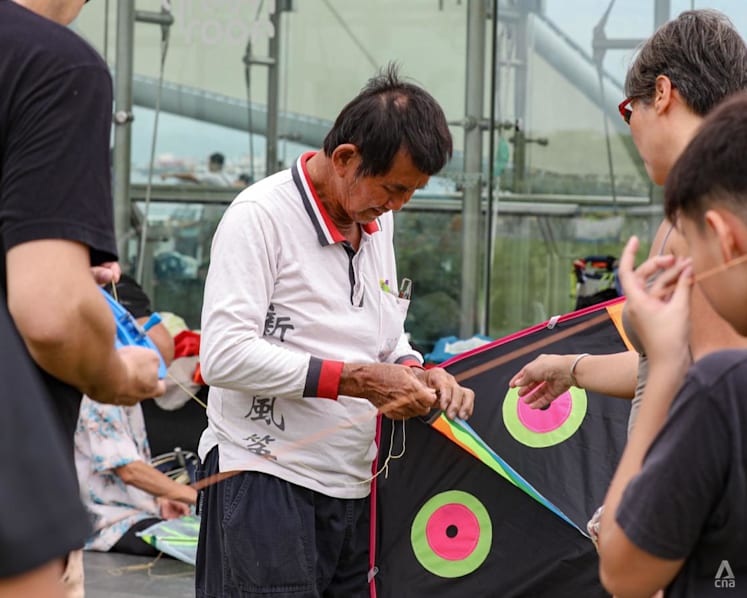
When he was done with the repairs, Mr Tan pulled a kite from his bag and launched it to the sky. 

He flew it with ease, strolling around the field, eager to find someone who will take the kite as a gift. 

His masterpieces are made mostly from recycled materials including plastic bags, discarded blinds, banners and umbrellas. 

Mr Tan Poh Wah holding up a kite he made using a supermarket plastic bag. (Photo: CNA/Mak Jia Kee)
Mr Tan Poh Wah with a handmade kite made out of recycled materials. (Photo: CNA/Nuria Ling)

Mr Tan is part of a group known as Singapore Original Kites, an informal gathering of adults in their 60s and 70s who share the same interest in making and flying kites.  

A semi-retired Chinese physician ​​Ong Cheng Her, 75, is the founder of the group.

He said that the only prerequisite to join the group is one’s ability to make a kite from scratch.  

He proudly showed CNA TODAY one of his creations, a red and white "umbrella kite". 

“Umbrellas are used for shade and rain protection, so why hasn’t anyone flown an umbrella kite? I decided to take on the challenge,” Mr Ong added.

Mr Ong Cheng Her, founder of the Singapore Original Kites group, holding an "umbrella kite" that he made in 2023. (Photo: CNA/Nuria Ling )
Mr Ong Cheng Her holding a kite he made, featuring flower and leaf patterns inspired by traditional Chinese paintings. (Photo: CNA/Mak Jia Kee)

HIS WORKSPACE AT HOME

As for Mr Tan, he is not retired, so flying and making kites is what he does only on Sundays.

He works six days a week as a lorry driver.

“I work to live, to fill my stomach so I can make kites.”

Stepping into his flat, Mr Tan led us to his "studio", which is a room filled with a bountiful supply of kites and raw materials. 

He described his workspace as a “chaotic but organised mess”. 

“My wife sometimes asks why I collect so many umbrellas, but she doesn’t interfere much because she knows I enjoy making these things.”

Mr Tan Poh Wah tying a ribbon to a bamboo stick to form part of a kite. (Photo: CNA/Nuria Ling)

Mr Tan has loved kite flying since he was a child, but it was not until he was in his 30s that he took to making kites himself.

A self-taught craftsman, he said that he learnt how to make kites by observing other kite-makers whenever an opportunity comes along. 

Mr Tan Poh Wah crafting a squid kite in his workshop that he set up in his flat. (Photo: CNA/Nuria Ling)
Mr Tan Poh Wah laying out pieces of a 70m-long "dragon kite" in his living room. (Photo: CNA/Nuria Ling)

Recently, Mr Tan finished repairing a 70m-long "dragon kite" that he first constructed in 2000. It broke at a kite festival in Taiwan in 2019 and required extensive repairs. 

After CNA TODAY approached him for an interview, Mr Tan said that he found new inspiration to repair the kite, which took him four Sundays to complete.

It was obvious that he is most proud of this kite among the many in his collection.

“Anyone who hasn't made a dragon or a phoenix kite isn't truly considered a kite maker,” he said, adding that these long kites are made up of many different sections and each needed to be crafted with great precision before they are finally stitched together. 

A 70m-long "dragon kite" made by Mr Tan Poh Wah flying at Marina Barrage. (Photo: CNA/Nuria Ling)

"GIANTS" IN THE SKY

Over at East Coast Park, another group of kite enthusiasts have gathered and their presence could be spotted from afar. 

The kites they have taken out, called "inflatable show kites", are gigantic balloon-like kites that are typically several metres in length when inflated.

Traditional kites rely on rigid frames for support, but inflatable show kites have no hard structures. They inflate as they catch on the wind and have to be anchored to the ground.

An inflatable show kite flying at East Coast Park. (Photo: CNA/Nuria Ling)
Mr Johnny Yap checking on a 10m-tall seahorse-shaped inflatable show kite. (Photo: CNA/Mak Jia Kee)

Project coordinator Johnny Yap and his wife Maggie Mok, a homemaker, both 51, are the founders of Show Kites Singapore, a group of people who are into these inflatable show kites.

The duo's interest in this started nearly 20 years ago when they took their children kite-flying. 

In the end, it was the couple themselves who got hooked on the activity. 

“We started flying bigger and bigger kites and before long, we realised that stick kites have a limit,” Mr Yap said.

This led them to explore inflatable ones in 2009 and they came across these kites online before buying their first. The sky is the limit when it comes to the sizes of such kites.

Ms Maggie Mok examining the flying cord of an inflatable show kite. (Photo: CNA/Mak Jia Kee)
Mr Johnny Yap fixing the attached strings on his show kite. (Photo: CNA/Nuria Ling)
Mr Johnny Yap holding open an inflation vent for air to fill up the kite. (Photo: CNA/Nuria Ling)

As their interests grew, Mr Yap and Ms Mok started travelling overseas to take part in international kite festivals. 

In September, they were at the International Kite Festival in Melaka, Malaysia, where they flew an inflatable show kite in the form of Singapore's tourism icon, the Merlion.

Advertisement

In Pixels

Inside a dragon kiln where temperatures go up to 1,300°C

Inside a dragon kiln where temperatures go up to 1,300°C

Wood-firing at a dragon kiln is a community effort that requires round-the-clock monitoring. (Photo: CNA/Ooi Boon Keong)

15 Nov 2024 09:30PM (Updated: 16 Oct 2025 12:09AM)

Nestled in an industrial estate in the western part of Singapore is an 84-year-old dragon kiln, the oldest and the only operational dragon kiln in the country. 

Built in 1940, the kiln at Thow Kwang Pottery Jungle was originally used for the mass production of household and industrial items such as cups and flower pots.

Over the decades, the place has evolved into a community space, now offering classes and events for potters to hone their craft. 

CNA TODAY joined the potter community for a wood-firing session that happens only two or three times a year.

CNA Games
Show More
Show Less

In Pixels takes you through the experience, as new and seasoned potters bond over fire and perspiration, creating unique works of art. 

PRAYERS TO THE "KILN GOD"  

At Thow Kwang Pottery Jungle, which is located a short distance from Nanyang Technological University, a group of around 30 people gathered on a Friday last month in front of the kiln.

This was at the request of the owners, Mr Tan Teck Yoke, 68, and his wife Yulianti Tan, 66. 

A prayer ceremony to the "kiln god" was about to begin. 

“We are praying to the ‘kiln god’ for a successful firing, for the pieces to achieve the desired effects,” Mr Tan explained to the enthusiastic participants. 

To this, the crowd responded by shouting, “Heng, ong, huat, ah,” a phrase in the Chinese dialect of Hokkien that collectively means wishing for good fortune.

Mrs Yulianti Tan and Mr Tan Teck Yoke, owners of Thow Kwang Pottery Jungle, praying for a successful wood-firing session. (Photo: CNA/Ooi Boon Keong)

After the prayers were done, the fire box, which is a small opening at the front of the kiln, was lit. 

The participants each picked up a piece of wood to throw into the fire, hoping to add more "luck" to the process. 

During wood-firing in a kiln, the fire and the ashes from the wood react with the glaze on the ceramic items to produce a unique and rustic look. (Photo: CNA/Ooi Boon Keong)

The dragon kiln was bought by Mr Tan’s father in 1965 and has been owned by the family since then.

It sits on a slope, is 27-metres long, 2-metres wide and curves around the side, resembling the body of a dragon in Chinese mythology. 

Its lengthy chambers are made out of bricks and there is a chimney at the end, located at the top of the slope.

The kiln can fit thousands of pieces of ceramic items, depending on the size of the pots. 

For this firing session, around 400 to 500 pieces were loaded in the kiln. 

NEW WAYS TO IMPROVE PROCESS

Temperatures in the dragon kiln can reach up to 1,300°C. 

They can fluctuate significantly due to the shape of the furnace and the use of wood as a fuel.

That is why one of the most crucial parts of the process is to monitor the temperature for all three days of the firing session.

Mr Chua Hee Lai, who is in his 50s and a hobbyist-turned-kiln master, helped to plan and lead each firing session. 

Mr Chua Hee Lai (right) installing thermocouples on the slopes of an 84-year-old kiln to monitor the temperatures. (Photo: CNA/Ooi Boon Keong)

In 2019, Mr Chua, with the help of another potter, introduced a digital monitoring system that allowed them to track the temperatures remotely and give instructions to the potters doing shift work on site. 

Previously, they had to monitor the temperature by looking at the colour of the flame or record temperatures manually and then draw up prediction charts – a process that requires them to be on site for longer periods of time.

When the temperatures start to dip, potters will add more wood into the fire. (Photo: CNA/Ooi Boon Keong)
Potters handling large pieces of wood to be fed into a fire box. (Photo: CNA/Ooi Boon Keong)
The effect of burning heat can be seen in the different skin colours of a potter’s arms, after he stood near the kiln's fire box for some time to keep the flame going. (Photo: CNA/Ooi Boon Keong)
Cheers breaking out as the target wood-firing temperature of 1,260°C was about to be reached. (Photo: CNA/Ooi Boon Keong)

THE "KAMPUNG SPIRIT"

Advertising executive Vanessa Low and product manager Goh Wei Ting, both 31, have been practising pottery at another pottery studio for around five years and this was their first time taking part in the wood-firing process.

Compared to a regular firing in an electric or gas kiln, wood-firing is "tiring and physically demanding", Mr Goh said.

However, they were buoyed by the “kampung spirit” or the sense of camaraderie that came about as participants laboured together. 

 “You just don’t feel tired, you just do (the work),” Mr Goh added. 

A group of young potters who are new to wood-firing taking photos near the kiln. (Photo: CNA/Ooi Boon Keong)
Experienced and new potters forming a human chain to carry pieces of wood to be used for the firing. (Photo: CNA/Ooi Boon Keong)
Participants having a lively potluck dinner, a brief respite from the day’s hard work. (Photo: CNA/Ooi Boon Keong)
After dinner, potters sitting around and chatting in front of the fire while monitoring the kiln. (Photo: CNA/Ooi Boon Keong)

OPENING OF THE KILN

Six days after the firing at the dragon kiln, the participants returned to open the kiln and check on their art pieces. 

“Shall we form a chain?” someone suggested to facilitate the removal of the brick walls. 

Without hesitation, a human chain quickly formed as the potters unsealed the kiln, one brick at a time. 

Potters in the process of dismantling the brick walls, in order to get into the kiln's chambers. (Photo: CNA/Ooi Boon Keong)
Breaking down the final wall to reach the last shelves holding pottery items. (Photo: CNA/Ooi Boon Keong)
The residual heat from the firing was keenly felt by the potters inside the kiln. (Photo: CNA/Ooi Boon Keong)
Each piece of pottery was removed carefully from the shelves and moved out in batches. (Photo: CNA/Ooi Boon Keong)
Finally, potters reached the chamber closest to the fire box. Only one person is able to reach the items in the narrow chamber. (Photo: CNA/Ooi Boon Keong)

A collective “wow” sounded as the final bricks were removed, revealing the final outcome of the nine-day process that comprised three days of firing and six days of cooling.

The potters carefully removed the art pieces from the shelves, while admiring the effects that the fire had on their work. 

Advertisement

In Pixels

Meet the 70-year-old lorry driver who is also a 'kite doctor'

Meet the 70-year-old lorry driver who is also a 'kite doctor'

Kite maker Tan Poh Wah flying his handmade dragon kite at the Marina Barrage. (Photo: CNA/Nuria Ling)

30 Nov 2024 09:30PM (Updated: 16 Oct 2025 12:08AM)

Rolling up to Marina Barrage with a trolley bag full of handmade kites and repair tools, Mr Tan Poh Wah had one clear mission for the day: To share his love of kite-flying with others. 

Known informally as the “kite doctor” among the regular visitors there, the 70-year-old spends most Sundays repairing kites or offering his handmade ones – mostly for free – to people at the open-air space that is the venue of Singapore's largest reservoir. 

“Watching people fly my kites makes me really happy,” Mr Tan said.  

This weekend, In Pixels speaks to four enthusiasts to find out what excites them about kite-flying. 

A FAMILIAR FIGURE

CNA Games
Show More
Show Less

Shortly after Mr Tan turned up at Marina Barrage in the Marina Bay area, a handful of people who wanted their kites repaired immediately made a beeline towards him. 

They offered him drinks and snacks to thank him for his service. 
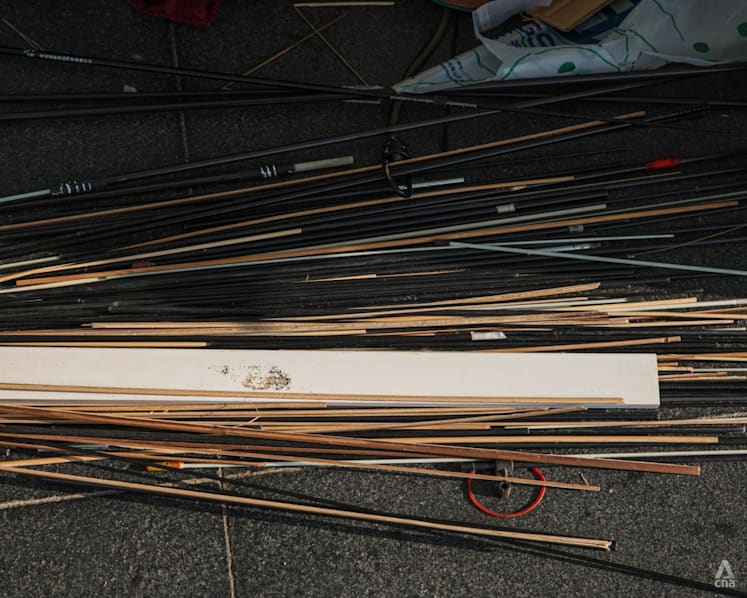
When he was done with the repairs, Mr Tan pulled a kite from his bag and launched it to the sky. 

He flew it with ease, strolling around the field, eager to find someone who will take the kite as a gift. 

His masterpieces are made mostly from recycled materials including plastic bags, discarded blinds, banners and umbrellas. 
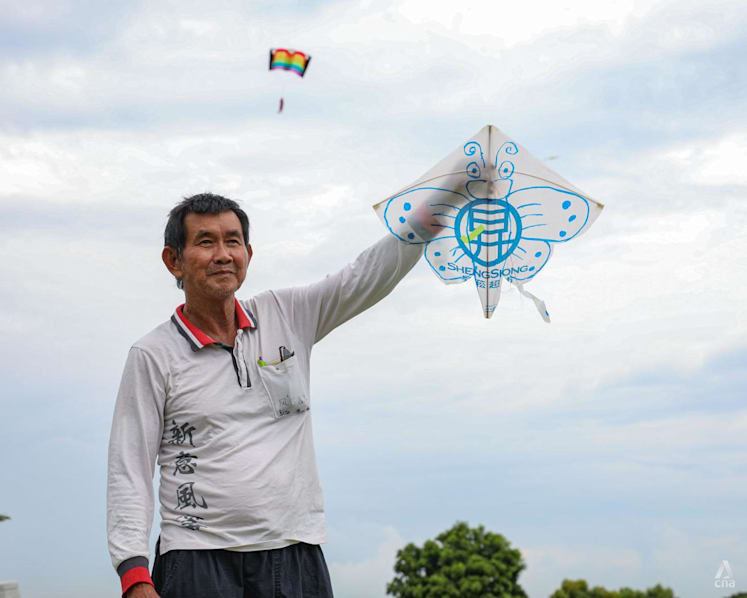
Mr Tan Poh Wah holding up a kite he made using a supermarket plastic bag. (Photo: CNA/Mak Jia Kee)
Mr Tan Poh Wah with a handmade kite made out of recycled materials. (Photo: CNA/Nuria Ling)

Mr Tan is part of a group known as Singapore Original Kites, an informal gathering of adults in their 60s and 70s who share the same interest in making and flying kites.  

A semi-retired Chinese physician ​​Ong Cheng Her, 75, is the founder of the group.

He said that the only prerequisite to join the group is one’s ability to make a kite from scratch.  

He proudly showed CNA TODAY one of his creations, a red and white "umbrella kite". 

“Umbrellas are used for shade and rain protection, so why hasn’t anyone flown an umbrella kite? I decided to take on the challenge,” Mr Ong added.

Mr Ong Cheng Her, founder of the Singapore Original Kites group, holding an "umbrella kite" that he made in 2023. (Photo: CNA/Nuria Ling )
Mr Ong Cheng Her holding a kite he made, featuring flower and leaf patterns inspired by traditional Chinese paintings. (Photo: CNA/Mak Jia Kee)

HIS WORKSPACE AT HOME

As for Mr Tan, he is not retired, so flying and making kites is what he does only on Sundays.

He works six days a week as a lorry driver.

“I work to live, to fill my stomach so I can make kites.”

Stepping into his flat, Mr Tan led us to his "studio", which is a room filled with a bountiful supply of kites and raw materials. 

He described his workspace as a “chaotic but organised mess”. 

“My wife sometimes asks why I collect so many umbrellas, but she doesn’t interfere much because she knows I enjoy making these things.”

Mr Tan Poh Wah tying a ribbon to a bamboo stick to form part of a kite. (Photo: CNA/Nuria Ling)

Mr Tan has loved kite flying since he was a child, but it was not until he was in his 30s that he took to making kites himself.

A self-taught craftsman, he said that he learnt how to make kites by observing other kite-makers whenever an opportunity comes along. 

Mr Tan Poh Wah crafting a squid kite in his workshop that he set up in his flat. (Photo: CNA/Nuria Ling)
Mr Tan Poh Wah laying out pieces of a 70m-long "dragon kite" in his living room. (Photo: CNA/Nuria Ling)

Recently, Mr Tan finished repairing a 70m-long "dragon kite" that he first constructed in 2000. It broke at a kite festival in Taiwan in 2019 and required extensive repairs. 

After CNA TODAY approached him for an interview, Mr Tan said that he found new inspiration to repair the kite, which took him four Sundays to complete.

It was obvious that he is most proud of this kite among the many in his collection.

“Anyone who hasn't made a dragon or a phoenix kite isn't truly considered a kite maker,” he said, adding that these long kites are made up of many different sections and each needed to be crafted with great precision before they are finally stitched together. 

A 70m-long "dragon kite" made by Mr Tan Poh Wah flying at Marina Barrage. (Photo: CNA/Nuria Ling)

"GIANTS" IN THE SKY

Over at East Coast Park, another group of kite enthusiasts have gathered and their presence could be spotted from afar. 

The kites they have taken out, called "inflatable show kites", are gigantic balloon-like kites that are typically several metres in length when inflated.

Traditional kites rely on rigid frames for support, but inflatable show kites have no hard structures. They inflate as they catch on the wind and have to be anchored to the ground.

An inflatable show kite flying at East Coast Park. (Photo: CNA/Nuria Ling)
Mr Johnny Yap checking on a 10m-tall seahorse-shaped inflatable show kite. (Photo: CNA/Mak Jia Kee)

Project coordinator Johnny Yap and his wife Maggie Mok, a homemaker, both 51, are the founders of Show Kites Singapore, a group of people who are into these inflatable show kites.

The duo's interest in this started nearly 20 years ago when they took their children kite-flying. 

In the end, it was the couple themselves who got hooked on the activity. 

“We started flying bigger and bigger kites and before long, we realised that stick kites have a limit,” Mr Yap said.

This led them to explore inflatable ones in 2009 and they came across these kites online before buying their first. The sky is the limit when it comes to the sizes of such kites.

Ms Maggie Mok examining the flying cord of an inflatable show kite. (Photo: CNA/Mak Jia Kee)
Mr Johnny Yap fixing the attached strings on his show kite. (Photo: CNA/Nuria Ling)
Mr Johnny Yap holding open an inflation vent for air to fill up the kite. (Photo: CNA/Nuria Ling)

As their interests grew, Mr Yap and Ms Mok started travelling overseas to take part in international kite festivals. 

In September, they were at the International Kite Festival in Melaka, Malaysia, where they flew an inflatable show kite in the form of Singapore's tourism icon, the Merlion.

Advertisement

In Pixels

Inside a dragon kiln where temperatures go up to 1,300°C

Inside a dragon kiln where temperatures go up to 1,300°C

Wood-firing at a dragon kiln is a community effort that requires round-the-clock monitoring. (Photo: CNA/Ooi Boon Keong)

15 Nov 2024 09:30PM (Updated: 16 Oct 2025 12:09AM)

Nestled in an industrial estate in the western part of Singapore is an 84-year-old dragon kiln, the oldest and the only operational dragon kiln in the country. 

Built in 1940, the kiln at Thow Kwang Pottery Jungle was originally used for the mass production of household and industrial items such as cups and flower pots.

Over the decades, the place has evolved into a community space, now offering classes and events for potters to hone their craft. 

CNA TODAY joined the potter community for a wood-firing session that happens only two or three times a year.

CNA Games
Show More
Show Less

In Pixels takes you through the experience, as new and seasoned potters bond over fire and perspiration, creating unique works of art. 

PRAYERS TO THE "KILN GOD"  

At Thow Kwang Pottery Jungle, which is located a short distance from Nanyang Technological University, a group of around 30 people gathered on a Friday last month in front of the kiln.

This was at the request of the owners, Mr Tan Teck Yoke, 68, and his wife Yulianti Tan, 66. 

A prayer ceremony to the "kiln god" was about to begin. 

“We are praying to the ‘kiln god’ for a successful firing, for the pieces to achieve the desired effects,” Mr Tan explained to the enthusiastic participants. 

To this, the crowd responded by shouting, “Heng, ong, huat, ah,” a phrase in the Chinese dialect of Hokkien that collectively means wishing for good fortune.

Mrs Yulianti Tan and Mr Tan Teck Yoke, owners of Thow Kwang Pottery Jungle, praying for a successful wood-firing session. (Photo: CNA/Ooi Boon Keong)

After the prayers were done, the fire box, which is a small opening at the front of the kiln, was lit. 

The participants each picked up a piece of wood to throw into the fire, hoping to add more "luck" to the process. 

During wood-firing in a kiln, the fire and the ashes from the wood react with the glaze on the ceramic items to produce a unique and rustic look. (Photo: CNA/Ooi Boon Keong)

The dragon kiln was bought by Mr Tan’s father in 1965 and has been owned by the family since then.

It sits on a slope, is 27-metres long, 2-metres wide and curves around the side, resembling the body of a dragon in Chinese mythology. 

Its lengthy chambers are made out of bricks and there is a chimney at the end, located at the top of the slope.

The kiln can fit thousands of pieces of ceramic items, depending on the size of the pots. 

For this firing session, around 400 to 500 pieces were loaded in the kiln. 

NEW WAYS TO IMPROVE PROCESS

Temperatures in the dragon kiln can reach up to 1,300°C. 

They can fluctuate significantly due to the shape of the furnace and the use of wood as a fuel.

That is why one of the most crucial parts of the process is to monitor the temperature for all three days of the firing session.

Mr Chua Hee Lai, who is in his 50s and a hobbyist-turned-kiln master, helped to plan and lead each firing session. 

Mr Chua Hee Lai (right) installing thermocouples on the slopes of an 84-year-old kiln to monitor the temperatures. (Photo: CNA/Ooi Boon Keong)

In 2019, Mr Chua, with the help of another potter, introduced a digital monitoring system that allowed them to track the temperatures remotely and give instructions to the potters doing shift work on site. 

Previously, they had to monitor the temperature by looking at the colour of the flame or record temperatures manually and then draw up prediction charts – a process that requires them to be on site for longer periods of time.

When the temperatures start to dip, potters will add more wood into the fire. (Photo: CNA/Ooi Boon Keong)
Potters handling large pieces of wood to be fed into a fire box. (Photo: CNA/Ooi Boon Keong)
The effect of burning heat can be seen in the different skin colours of a potter’s arms, after he stood near the kiln's fire box for some time to keep the flame going. (Photo: CNA/Ooi Boon Keong)
Cheers breaking out as the target wood-firing temperature of 1,260°C was about to be reached. (Photo: CNA/Ooi Boon Keong)

THE "KAMPUNG SPIRIT"

Advertising executive Vanessa Low and product manager Goh Wei Ting, both 31, have been practising pottery at another pottery studio for around five years and this was their first time taking part in the wood-firing process.

Compared to a regular firing in an electric or gas kiln, wood-firing is "tiring and physically demanding", Mr Goh said.

However, they were buoyed by the “kampung spirit” or the sense of camaraderie that came about as participants laboured together. 

 “You just don’t feel tired, you just do (the work),” Mr Goh added. 

A group of young potters who are new to wood-firing taking photos near the kiln. (Photo: CNA/Ooi Boon Keong)
Experienced and new potters forming a human chain to carry pieces of wood to be used for the firing. (Photo: CNA/Ooi Boon Keong)
Participants having a lively potluck dinner, a brief respite from the day’s hard work. (Photo: CNA/Ooi Boon Keong)
After dinner, potters sitting around and chatting in front of the fire while monitoring the kiln. (Photo: CNA/Ooi Boon Keong)

OPENING OF THE KILN

Six days after the firing at the dragon kiln, the participants returned to open the kiln and check on their art pieces. 

“Shall we form a chain?” someone suggested to facilitate the removal of the brick walls. 

Without hesitation, a human chain quickly formed as the potters unsealed the kiln, one brick at a time. 

Potters in the process of dismantling the brick walls, in order to get into the kiln's chambers. (Photo: CNA/Ooi Boon Keong)
Breaking down the final wall to reach the last shelves holding pottery items. (Photo: CNA/Ooi Boon Keong)
The residual heat from the firing was keenly felt by the potters inside the kiln. (Photo: CNA/Ooi Boon Keong)
Each piece of pottery was removed carefully from the shelves and moved out in batches. (Photo: CNA/Ooi Boon Keong)
Finally, potters reached the chamber closest to the fire box. Only one person is able to reach the items in the narrow chamber. (Photo: CNA/Ooi Boon Keong)

A collective “wow” sounded as the final bricks were removed, revealing the final outcome of the nine-day process that comprised three days of firing and six days of cooling.

The potters carefully removed the art pieces from the shelves, while admiring the effects that the fire had on their work. 

Advertisement

In Pixels

Meet the 70-year-old lorry driver who is also a 'kite doctor'

Meet the 70-year-old lorry driver who is also a 'kite doctor'

Kite maker Tan Poh Wah flying his handmade dragon kite at the Marina Barrage. (Photo: CNA/Nuria Ling)

30 Nov 2024 09:30PM (Updated: 16 Oct 2025 12:08AM)

Rolling up to Marina Barrage with a trolley bag full of handmade kites and repair tools, Mr Tan Poh Wah had one clear mission for the day: To share his love of kite-flying with others. 

Known informally as the “kite doctor” among the regular visitors there, the 70-year-old spends most Sundays repairing kites or offering his handmade ones – mostly for free – to people at the open-air space that is the venue of Singapore's largest reservoir. 

“Watching people fly my kites makes me really happy,” Mr Tan said.  

This weekend, In Pixels speaks to four enthusiasts to find out what excites them about kite-flying. 

A FAMILIAR FIGURE

CNA Games
Show More
Show Less

Shortly after Mr Tan turned up at Marina Barrage in the Marina Bay area, a handful of people who wanted their kites repaired immediately made a beeline towards him. 

They offered him drinks and snacks to thank him for his service. 

When he was done with the repairs, Mr Tan pulled a kite from his bag and launched it to the sky. 

He flew it with ease, strolling around the field, eager to find someone who will take the kite as a gift. 

His masterpieces are made mostly from recycled materials including plastic bags, discarded blinds, banners and umbrellas. 
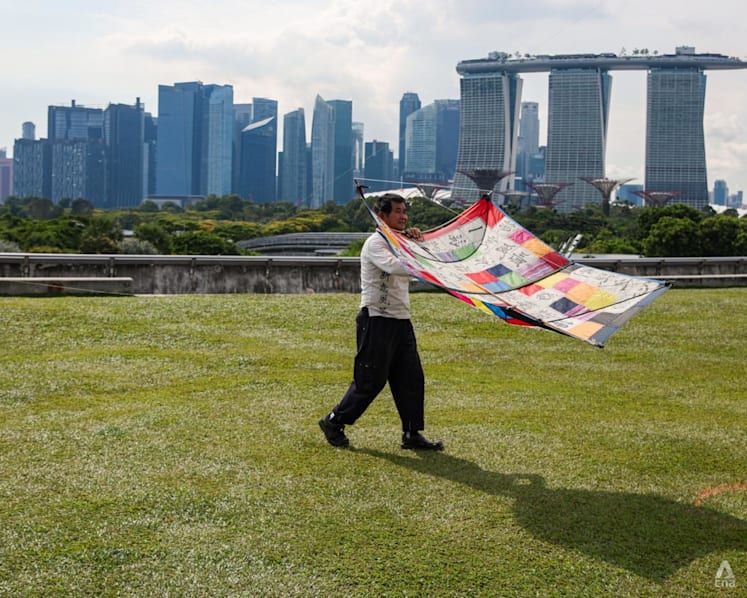
Mr Tan Poh Wah holding up a kite he made using a supermarket plastic bag. (Photo: CNA/Mak Jia Kee)
Mr Tan Poh Wah with a handmade kite made out of recycled materials. (Photo: CNA/Nuria Ling)

Mr Tan is part of a group known as Singapore Original Kites, an informal gathering of adults in their 60s and 70s who share the same interest in making and flying kites.  

A semi-retired Chinese physician ​​Ong Cheng Her, 75, is the founder of the group.

He said that the only prerequisite to join the group is one’s ability to make a kite from scratch.  

He proudly showed CNA TODAY one of his creations, a red and white "umbrella kite". 

“Umbrellas are used for shade and rain protection, so why hasn’t anyone flown an umbrella kite? I decided to take on the challenge,” Mr Ong added.
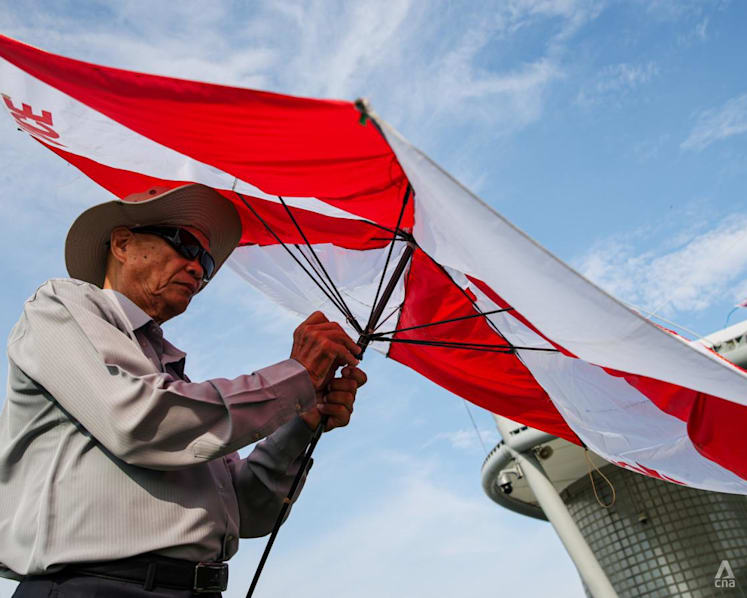
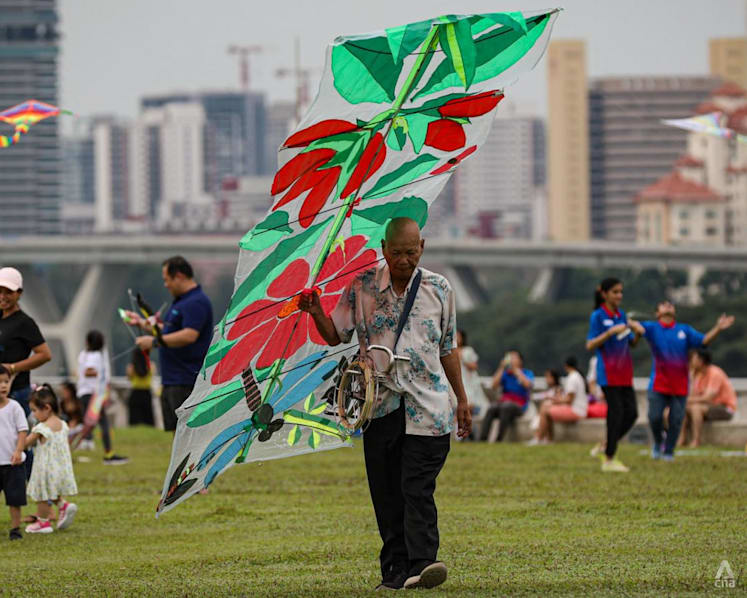
Mr Ong Cheng Her, founder of the Singapore Original Kites group, holding an "umbrella kite" that he made in 2023. (Photo: CNA/Nuria Ling )
Mr Ong Cheng Her holding a kite he made, featuring flower and leaf patterns inspired by traditional Chinese paintings. (Photo: CNA/Mak Jia Kee)

HIS WORKSPACE AT HOME

As for Mr Tan, he is not retired, so flying and making kites is what he does only on Sundays.

He works six days a week as a lorry driver.

“I work to live, to fill my stomach so I can make kites.”

Stepping into his flat, Mr Tan led us to his "studio", which is a room filled with a bountiful supply of kites and raw materials. 

He described his workspace as a “chaotic but organised mess”. 

“My wife sometimes asks why I collect so many umbrellas, but she doesn’t interfere much because she knows I enjoy making these things.”
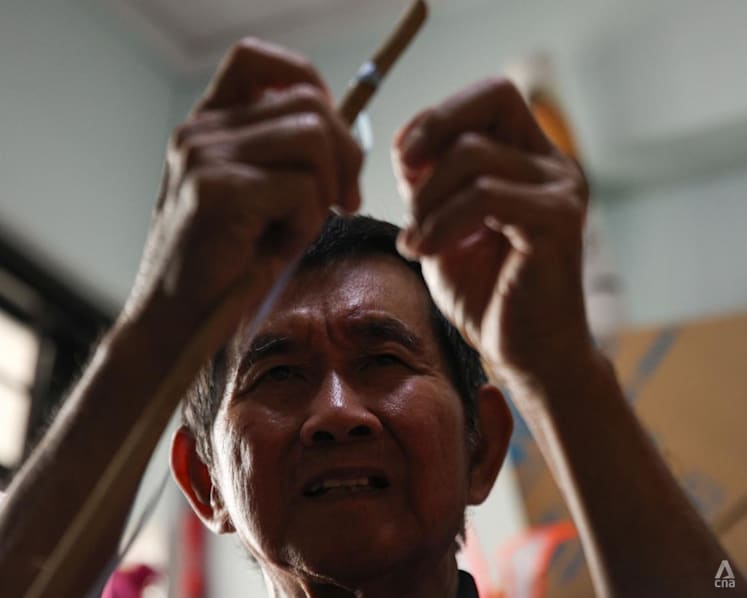
Mr Tan Poh Wah tying a ribbon to a bamboo stick to form part of a kite. (Photo: CNA/Nuria Ling)

Mr Tan has loved kite flying since he was a child, but it was not until he was in his 30s that he took to making kites himself.

A self-taught craftsman, he said that he learnt how to make kites by observing other kite-makers whenever an opportunity comes along. 
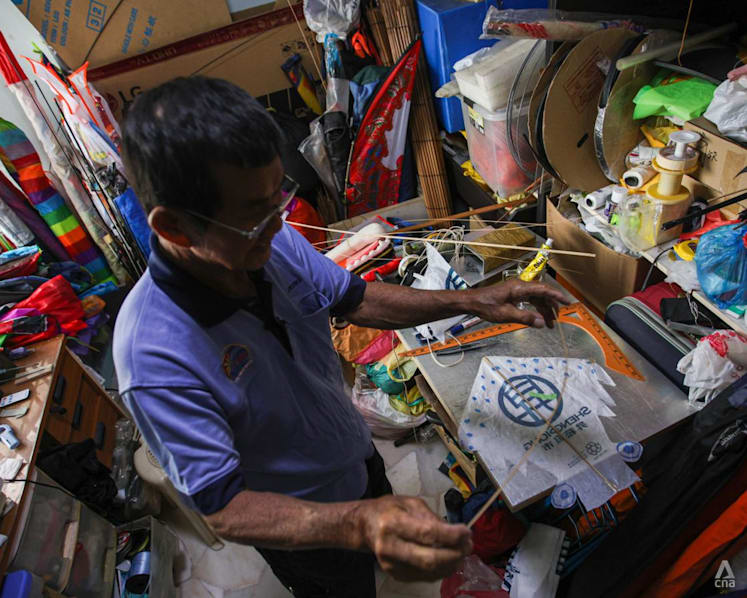
Mr Tan Poh Wah crafting a squid kite in his workshop that he set up in his flat. (Photo: CNA/Nuria Ling)
Mr Tan Poh Wah laying out pieces of a 70m-long "dragon kite" in his living room. (Photo: CNA/Nuria Ling)

Recently, Mr Tan finished repairing a 70m-long "dragon kite" that he first constructed in 2000. It broke at a kite festival in Taiwan in 2019 and required extensive repairs. 

After CNA TODAY approached him for an interview, Mr Tan said that he found new inspiration to repair the kite, which took him four Sundays to complete.

It was obvious that he is most proud of this kite among the many in his collection.

“Anyone who hasn't made a dragon or a phoenix kite isn't truly considered a kite maker,” he said, adding that these long kites are made up of many different sections and each needed to be crafted with great precision before they are finally stitched together. 

A 70m-long "dragon kite" made by Mr Tan Poh Wah flying at Marina Barrage. (Photo: CNA/Nuria Ling)

"GIANTS" IN THE SKY

Over at East Coast Park, another group of kite enthusiasts have gathered and their presence could be spotted from afar. 

The kites they have taken out, called "inflatable show kites", are gigantic balloon-like kites that are typically several metres in length when inflated.

Traditional kites rely on rigid frames for support, but inflatable show kites have no hard structures. They inflate as they catch on the wind and have to be anchored to the ground.

An inflatable show kite flying at East Coast Park. (Photo: CNA/Nuria Ling)
Mr Johnny Yap checking on a 10m-tall seahorse-shaped inflatable show kite. (Photo: CNA/Mak Jia Kee)

Project coordinator Johnny Yap and his wife Maggie Mok, a homemaker, both 51, are the founders of Show Kites Singapore, a group of people who are into these inflatable show kites.

The duo's interest in this started nearly 20 years ago when they took their children kite-flying. 

In the end, it was the couple themselves who got hooked on the activity. 

“We started flying bigger and bigger kites and before long, we realised that stick kites have a limit,” Mr Yap said.

This led them to explore inflatable ones in 2009 and they came across these kites online before buying their first. The sky is the limit when it comes to the sizes of such kites.

Ms Maggie Mok examining the flying cord of an inflatable show kite. (Photo: CNA/Mak Jia Kee)
Mr Johnny Yap fixing the attached strings on his show kite. (Photo: CNA/Nuria Ling)
Mr Johnny Yap holding open an inflation vent for air to fill up the kite. (Photo: CNA/Nuria Ling)

As their interests grew, Mr Yap and Ms Mok started travelling overseas to take part in international kite festivals. 

In September, they were at the International Kite Festival in Melaka, Malaysia, where they flew an inflatable show kite in the form of Singapore's tourism icon, the Merlion.

Advertisement

In Pixels

Inside a dragon kiln where temperatures go up to 1,300°C

Inside a dragon kiln where temperatures go up to 1,300°C

Wood-firing at a dragon kiln is a community effort that requires round-the-clock monitoring. (Photo: CNA/Ooi Boon Keong)

15 Nov 2024 09:30PM (Updated: 16 Oct 2025 12:09AM)

Nestled in an industrial estate in the western part of Singapore is an 84-year-old dragon kiln, the oldest and the only operational dragon kiln in the country. 

Built in 1940, the kiln at Thow Kwang Pottery Jungle was originally used for the mass production of household and industrial items such as cups and flower pots.

Over the decades, the place has evolved into a community space, now offering classes and events for potters to hone their craft. 

CNA TODAY joined the potter community for a wood-firing session that happens only two or three times a year.

CNA Games
Show More
Show Less

In Pixels takes you through the experience, as new and seasoned potters bond over fire and perspiration, creating unique works of art. 

PRAYERS TO THE "KILN GOD"  

At Thow Kwang Pottery Jungle, which is located a short distance from Nanyang Technological University, a group of around 30 people gathered on a Friday last month in front of the kiln.

This was at the request of the owners, Mr Tan Teck Yoke, 68, and his wife Yulianti Tan, 66. 

A prayer ceremony to the "kiln god" was about to begin. 

“We are praying to the ‘kiln god’ for a successful firing, for the pieces to achieve the desired effects,” Mr Tan explained to the enthusiastic participants. 

To this, the crowd responded by shouting, “Heng, ong, huat, ah,” a phrase in the Chinese dialect of Hokkien that collectively means wishing for good fortune.

Mrs Yulianti Tan and Mr Tan Teck Yoke, owners of Thow Kwang Pottery Jungle, praying for a successful wood-firing session. (Photo: CNA/Ooi Boon Keong)

After the prayers were done, the fire box, which is a small opening at the front of the kiln, was lit. 

The participants each picked up a piece of wood to throw into the fire, hoping to add more "luck" to the process. 

During wood-firing in a kiln, the fire and the ashes from the wood react with the glaze on the ceramic items to produce a unique and rustic look. (Photo: CNA/Ooi Boon Keong)

The dragon kiln was bought by Mr Tan’s father in 1965 and has been owned by the family since then.

It sits on a slope, is 27-metres long, 2-metres wide and curves around the side, resembling the body of a dragon in Chinese mythology. 

Its lengthy chambers are made out of bricks and there is a chimney at the end, located at the top of the slope.

The kiln can fit thousands of pieces of ceramic items, depending on the size of the pots. 

For this firing session, around 400 to 500 pieces were loaded in the kiln. 

NEW WAYS TO IMPROVE PROCESS

Temperatures in the dragon kiln can reach up to 1,300°C. 

They can fluctuate significantly due to the shape of the furnace and the use of wood as a fuel.

That is why one of the most crucial parts of the process is to monitor the temperature for all three days of the firing session.

Mr Chua Hee Lai, who is in his 50s and a hobbyist-turned-kiln master, helped to plan and lead each firing session. 

Mr Chua Hee Lai (right) installing thermocouples on the slopes of an 84-year-old kiln to monitor the temperatures. (Photo: CNA/Ooi Boon Keong)

In 2019, Mr Chua, with the help of another potter, introduced a digital monitoring system that allowed them to track the temperatures remotely and give instructions to the potters doing shift work on site. 

Previously, they had to monitor the temperature by looking at the colour of the flame or record temperatures manually and then draw up prediction charts – a process that requires them to be on site for longer periods of time.

When the temperatures start to dip, potters will add more wood into the fire. (Photo: CNA/Ooi Boon Keong)
Potters handling large pieces of wood to be fed into a fire box. (Photo: CNA/Ooi Boon Keong)
The effect of burning heat can be seen in the different skin colours of a potter’s arms, after he stood near the kiln's fire box for some time to keep the flame going. (Photo: CNA/Ooi Boon Keong)
Cheers breaking out as the target wood-firing temperature of 1,260°C was about to be reached. (Photo: CNA/Ooi Boon Keong)

THE "KAMPUNG SPIRIT"

Advertising executive Vanessa Low and product manager Goh Wei Ting, both 31, have been practising pottery at another pottery studio for around five years and this was their first time taking part in the wood-firing process.

Compared to a regular firing in an electric or gas kiln, wood-firing is "tiring and physically demanding", Mr Goh said.

However, they were buoyed by the “kampung spirit” or the sense of camaraderie that came about as participants laboured together. 

 “You just don’t feel tired, you just do (the work),” Mr Goh added. 

A group of young potters who are new to wood-firing taking photos near the kiln. (Photo: CNA/Ooi Boon Keong)
Experienced and new potters forming a human chain to carry pieces of wood to be used for the firing. (Photo: CNA/Ooi Boon Keong)
Participants having a lively potluck dinner, a brief respite from the day’s hard work. (Photo: CNA/Ooi Boon Keong)
After dinner, potters sitting around and chatting in front of the fire while monitoring the kiln. (Photo: CNA/Ooi Boon Keong)

OPENING OF THE KILN

Six days after the firing at the dragon kiln, the participants returned to open the kiln and check on their art pieces. 

“Shall we form a chain?” someone suggested to facilitate the removal of the brick walls. 

Without hesitation, a human chain quickly formed as the potters unsealed the kiln, one brick at a time. 

Potters in the process of dismantling the brick walls, in order to get into the kiln's chambers. (Photo: CNA/Ooi Boon Keong)
Breaking down the final wall to reach the last shelves holding pottery items. (Photo: CNA/Ooi Boon Keong)
The residual heat from the firing was keenly felt by the potters inside the kiln. (Photo: CNA/Ooi Boon Keong)
Each piece of pottery was removed carefully from the shelves and moved out in batches. (Photo: CNA/Ooi Boon Keong)
Finally, potters reached the chamber closest to the fire box. Only one person is able to reach the items in the narrow chamber. (Photo: CNA/Ooi Boon Keong)

A collective “wow” sounded as the final bricks were removed, revealing the final outcome of the nine-day process that comprised three days of firing and six days of cooling.

The potters carefully removed the art pieces from the shelves, while admiring the effects that the fire had on their work. 

Advertisement

In Pixels

Meet the 70-year-old lorry driver who is also a 'kite doctor'

Meet the 70-year-old lorry driver who is also a 'kite doctor'

Kite maker Tan Poh Wah flying his handmade dragon kite at the Marina Barrage. (Photo: CNA/Nuria Ling)

30 Nov 2024 09:30PM (Updated: 16 Oct 2025 12:08AM)

Rolling up to Marina Barrage with a trolley bag full of handmade kites and repair tools, Mr Tan Poh Wah had one clear mission for the day: To share his love of kite-flying with others. 

Known informally as the “kite doctor” among the regular visitors there, the 70-year-old spends most Sundays repairing kites or offering his handmade ones – mostly for free – to people at the open-air space that is the venue of Singapore's largest reservoir. 

“Watching people fly my kites makes me really happy,” Mr Tan said.  

This weekend, In Pixels speaks to four enthusiasts to find out what excites them about kite-flying. 

A FAMILIAR FIGURE

CNA Games
Show More
Show Less

Shortly after Mr Tan turned up at Marina Barrage in the Marina Bay area, a handful of people who wanted their kites repaired immediately made a beeline towards him. 

They offered him drinks and snacks to thank him for his service. 

When he was done with the repairs, Mr Tan pulled a kite from his bag and launched it to the sky. 

He flew it with ease, strolling around the field, eager to find someone who will take the kite as a gift. 

His masterpieces are made mostly from recycled materials including plastic bags, discarded blinds, banners and umbrellas. 

Mr Tan Poh Wah holding up a kite he made using a supermarket plastic bag. (Photo: CNA/Mak Jia Kee)
Mr Tan Poh Wah with a handmade kite made out of recycled materials. (Photo: CNA/Nuria Ling)

Mr Tan is part of a group known as Singapore Original Kites, an informal gathering of adults in their 60s and 70s who share the same interest in making and flying kites.  

A semi-retired Chinese physician ​​Ong Cheng Her, 75, is the founder of the group.

He said that the only prerequisite to join the group is one’s ability to make a kite from scratch.  

He proudly showed CNA TODAY one of his creations, a red and white "umbrella kite". 

“Umbrellas are used for shade and rain protection, so why hasn’t anyone flown an umbrella kite? I decided to take on the challenge,” Mr Ong added.

Mr Ong Cheng Her, founder of the Singapore Original Kites group, holding an "umbrella kite" that he made in 2023. (Photo: CNA/Nuria Ling )
Mr Ong Cheng Her holding a kite he made, featuring flower and leaf patterns inspired by traditional Chinese paintings. (Photo: CNA/Mak Jia Kee)

HIS WORKSPACE AT HOME

As for Mr Tan, he is not retired, so flying and making kites is what he does only on Sundays.

He works six days a week as a lorry driver.

“I work to live, to fill my stomach so I can make kites.”

Stepping into his flat, Mr Tan led us to his "studio", which is a room filled with a bountiful supply of kites and raw materials. 

He described his workspace as a “chaotic but organised mess”. 

“My wife sometimes asks why I collect so many umbrellas, but she doesn’t interfere much because she knows I enjoy making these things.”

Mr Tan Poh Wah tying a ribbon to a bamboo stick to form part of a kite. (Photo: CNA/Nuria Ling)

Mr Tan has loved kite flying since he was a child, but it was not until he was in his 30s that he took to making kites himself.

A self-taught craftsman, he said that he learnt how to make kites by observing other kite-makers whenever an opportunity comes along. 
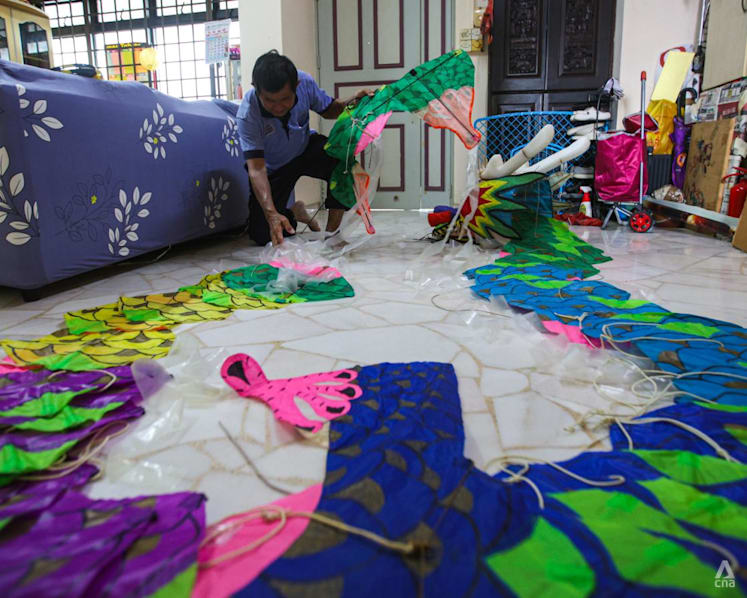
Mr Tan Poh Wah crafting a squid kite in his workshop that he set up in his flat. (Photo: CNA/Nuria Ling)
Mr Tan Poh Wah laying out pieces of a 70m-long "dragon kite" in his living room. (Photo: CNA/Nuria Ling)

Recently, Mr Tan finished repairing a 70m-long "dragon kite" that he first constructed in 2000. It broke at a kite festival in Taiwan in 2019 and required extensive repairs. 

After CNA TODAY approached him for an interview, Mr Tan said that he found new inspiration to repair the kite, which took him four Sundays to complete.

It was obvious that he is most proud of this kite among the many in his collection.

“Anyone who hasn't made a dragon or a phoenix kite isn't truly considered a kite maker,” he said, adding that these long kites are made up of many different sections and each needed to be crafted with great precision before they are finally stitched together. 
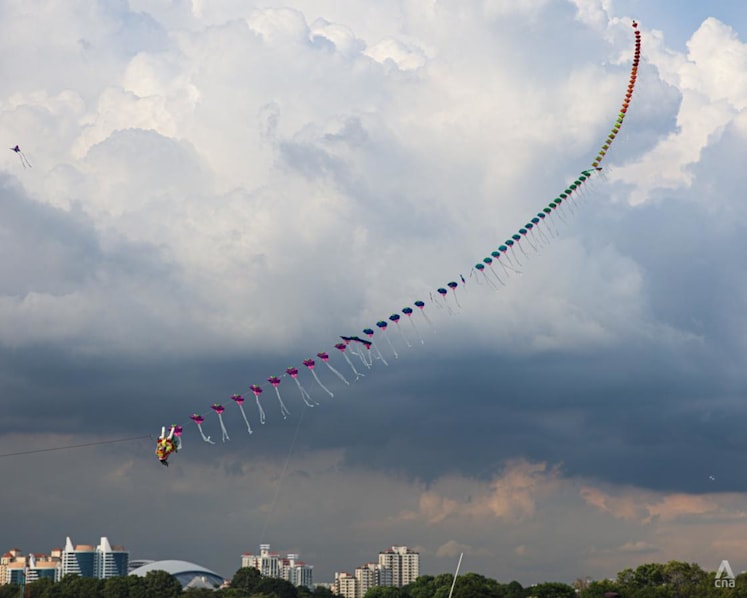
A 70m-long "dragon kite" made by Mr Tan Poh Wah flying at Marina Barrage. (Photo: CNA/Nuria Ling)

"GIANTS" IN THE SKY

Over at East Coast Park, another group of kite enthusiasts have gathered and their presence could be spotted from afar. 

The kites they have taken out, called "inflatable show kites", are gigantic balloon-like kites that are typically several metres in length when inflated.

Traditional kites rely on rigid frames for support, but inflatable show kites have no hard structures. They inflate as they catch on the wind and have to be anchored to the ground.
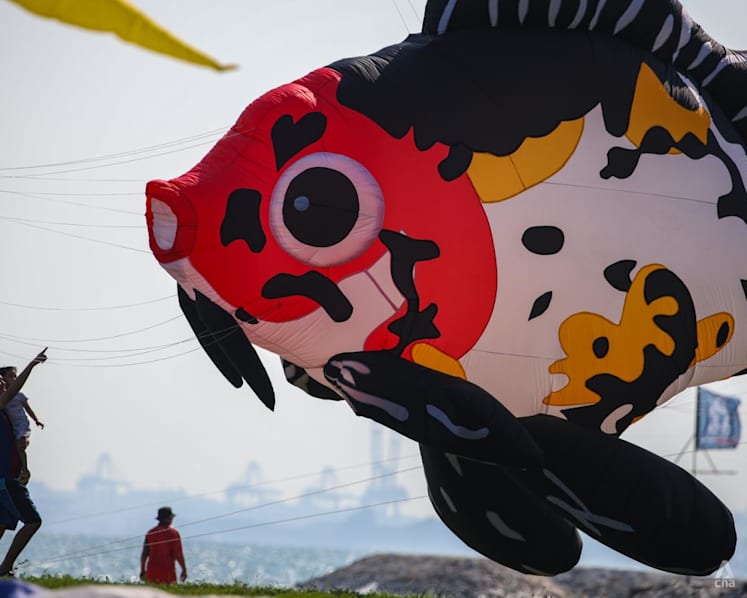
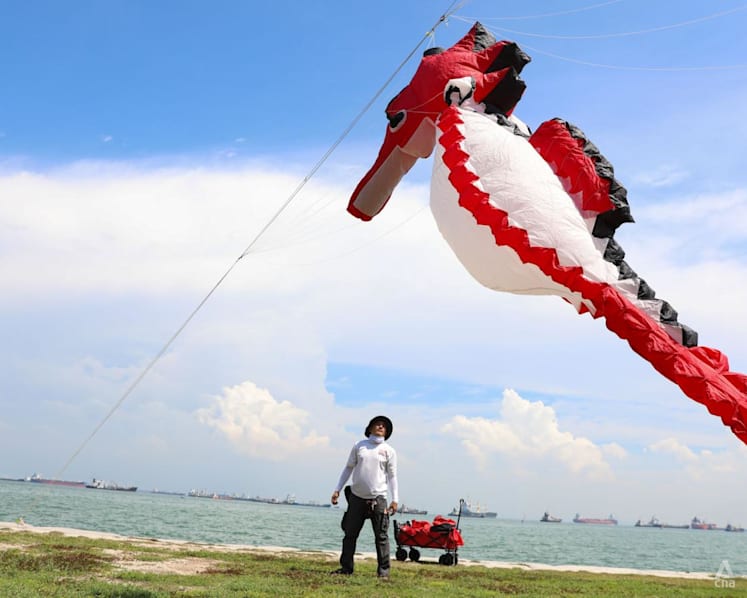
An inflatable show kite flying at East Coast Park. (Photo: CNA/Nuria Ling)
Mr Johnny Yap checking on a 10m-tall seahorse-shaped inflatable show kite. (Photo: CNA/Mak Jia Kee)

Project coordinator Johnny Yap and his wife Maggie Mok, a homemaker, both 51, are the founders of Show Kites Singapore, a group of people who are into these inflatable show kites.

The duo's interest in this started nearly 20 years ago when they took their children kite-flying. 

In the end, it was the couple themselves who got hooked on the activity. 

“We started flying bigger and bigger kites and before long, we realised that stick kites have a limit,” Mr Yap said.

This led them to explore inflatable ones in 2009 and they came across these kites online before buying their first. The sky is the limit when it comes to the sizes of such kites.
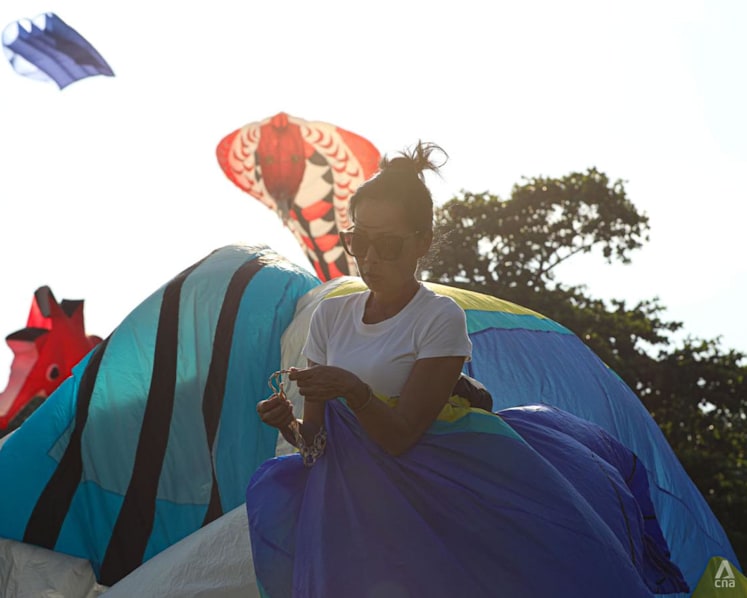
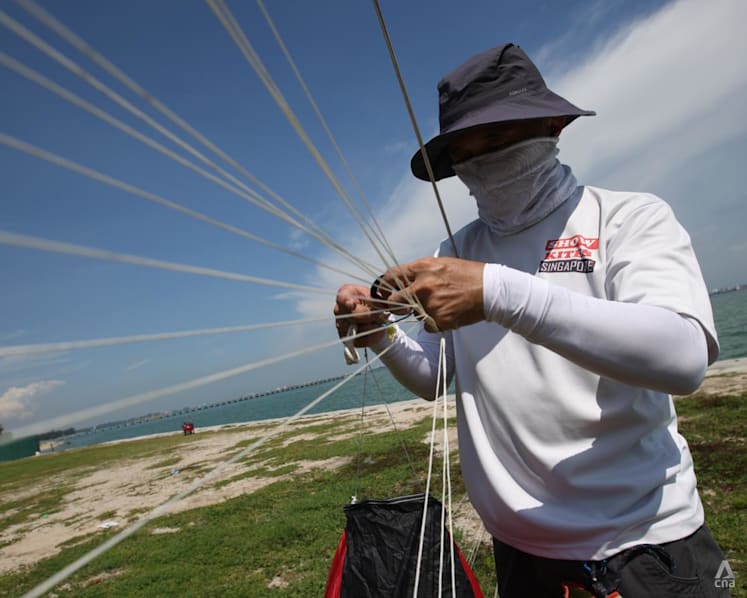
Ms Maggie Mok examining the flying cord of an inflatable show kite. (Photo: CNA/Mak Jia Kee)
Mr Johnny Yap fixing the attached strings on his show kite. (Photo: CNA/Nuria Ling)
Mr Johnny Yap holding open an inflation vent for air to fill up the kite. (Photo: CNA/Nuria Ling)

As their interests grew, Mr Yap and Ms Mok started travelling overseas to take part in international kite festivals. 

In September, they were at the International Kite Festival in Melaka, Malaysia, where they flew an inflatable show kite in the form of Singapore's tourism icon, the Merlion.

Advertisement

In Pixels

Inside a dragon kiln where temperatures go up to 1,300°C

Inside a dragon kiln where temperatures go up to 1,300°C

Wood-firing at a dragon kiln is a community effort that requires round-the-clock monitoring. (Photo: CNA/Ooi Boon Keong)

15 Nov 2024 09:30PM (Updated: 16 Oct 2025 12:09AM)

Nestled in an industrial estate in the western part of Singapore is an 84-year-old dragon kiln, the oldest and the only operational dragon kiln in the country. 

Built in 1940, the kiln at Thow Kwang Pottery Jungle was originally used for the mass production of household and industrial items such as cups and flower pots.

Over the decades, the place has evolved into a community space, now offering classes and events for potters to hone their craft. 

CNA TODAY joined the potter community for a wood-firing session that happens only two or three times a year.

CNA Games
Show More
Show Less

In Pixels takes you through the experience, as new and seasoned potters bond over fire and perspiration, creating unique works of art. 

PRAYERS TO THE "KILN GOD"  

At Thow Kwang Pottery Jungle, which is located a short distance from Nanyang Technological University, a group of around 30 people gathered on a Friday last month in front of the kiln.

This was at the request of the owners, Mr Tan Teck Yoke, 68, and his wife Yulianti Tan, 66. 

A prayer ceremony to the "kiln god" was about to begin. 

“We are praying to the ‘kiln god’ for a successful firing, for the pieces to achieve the desired effects,” Mr Tan explained to the enthusiastic participants. 

To this, the crowd responded by shouting, “Heng, ong, huat, ah,” a phrase in the Chinese dialect of Hokkien that collectively means wishing for good fortune.

Mrs Yulianti Tan and Mr Tan Teck Yoke, owners of Thow Kwang Pottery Jungle, praying for a successful wood-firing session. (Photo: CNA/Ooi Boon Keong)

After the prayers were done, the fire box, which is a small opening at the front of the kiln, was lit. 

The participants each picked up a piece of wood to throw into the fire, hoping to add more "luck" to the process. 

During wood-firing in a kiln, the fire and the ashes from the wood react with the glaze on the ceramic items to produce a unique and rustic look. (Photo: CNA/Ooi Boon Keong)

The dragon kiln was bought by Mr Tan’s father in 1965 and has been owned by the family since then.

It sits on a slope, is 27-metres long, 2-metres wide and curves around the side, resembling the body of a dragon in Chinese mythology. 

Its lengthy chambers are made out of bricks and there is a chimney at the end, located at the top of the slope.

The kiln can fit thousands of pieces of ceramic items, depending on the size of the pots. 

For this firing session, around 400 to 500 pieces were loaded in the kiln. 

NEW WAYS TO IMPROVE PROCESS

Temperatures in the dragon kiln can reach up to 1,300°C. 

They can fluctuate significantly due to the shape of the furnace and the use of wood as a fuel.

That is why one of the most crucial parts of the process is to monitor the temperature for all three days of the firing session.

Mr Chua Hee Lai, who is in his 50s and a hobbyist-turned-kiln master, helped to plan and lead each firing session. 

Mr Chua Hee Lai (right) installing thermocouples on the slopes of an 84-year-old kiln to monitor the temperatures. (Photo: CNA/Ooi Boon Keong)

In 2019, Mr Chua, with the help of another potter, introduced a digital monitoring system that allowed them to track the temperatures remotely and give instructions to the potters doing shift work on site. 

Previously, they had to monitor the temperature by looking at the colour of the flame or record temperatures manually and then draw up prediction charts – a process that requires them to be on site for longer periods of time.

When the temperatures start to dip, potters will add more wood into the fire. (Photo: CNA/Ooi Boon Keong)
Potters handling large pieces of wood to be fed into a fire box. (Photo: CNA/Ooi Boon Keong)
The effect of burning heat can be seen in the different skin colours of a potter’s arms, after he stood near the kiln's fire box for some time to keep the flame going. (Photo: CNA/Ooi Boon Keong)
Cheers breaking out as the target wood-firing temperature of 1,260°C was about to be reached. (Photo: CNA/Ooi Boon Keong)

THE "KAMPUNG SPIRIT"

Advertising executive Vanessa Low and product manager Goh Wei Ting, both 31, have been practising pottery at another pottery studio for around five years and this was their first time taking part in the wood-firing process.

Compared to a regular firing in an electric or gas kiln, wood-firing is "tiring and physically demanding", Mr Goh said.

However, they were buoyed by the “kampung spirit” or the sense of camaraderie that came about as participants laboured together. 

 “You just don’t feel tired, you just do (the work),” Mr Goh added. 

A group of young potters who are new to wood-firing taking photos near the kiln. (Photo: CNA/Ooi Boon Keong)
Experienced and new potters forming a human chain to carry pieces of wood to be used for the firing. (Photo: CNA/Ooi Boon Keong)
Participants having a lively potluck dinner, a brief respite from the day’s hard work. (Photo: CNA/Ooi Boon Keong)
After dinner, potters sitting around and chatting in front of the fire while monitoring the kiln. (Photo: CNA/Ooi Boon Keong)

OPENING OF THE KILN

Six days after the firing at the dragon kiln, the participants returned to open the kiln and check on their art pieces. 

“Shall we form a chain?” someone suggested to facilitate the removal of the brick walls. 

Without hesitation, a human chain quickly formed as the potters unsealed the kiln, one brick at a time. 

Potters in the process of dismantling the brick walls, in order to get into the kiln's chambers. (Photo: CNA/Ooi Boon Keong)
Breaking down the final wall to reach the last shelves holding pottery items. (Photo: CNA/Ooi Boon Keong)
The residual heat from the firing was keenly felt by the potters inside the kiln. (Photo: CNA/Ooi Boon Keong)
Each piece of pottery was removed carefully from the shelves and moved out in batches. (Photo: CNA/Ooi Boon Keong)
Finally, potters reached the chamber closest to the fire box. Only one person is able to reach the items in the narrow chamber. (Photo: CNA/Ooi Boon Keong)

A collective “wow” sounded as the final bricks were removed, revealing the final outcome of the nine-day process that comprised three days of firing and six days of cooling.

The potters carefully removed the art pieces from the shelves, while admiring the effects that the fire had on their work. 

Advertisement

In Pixels

Meet the 70-year-old lorry driver who is also a 'kite doctor'

Meet the 70-year-old lorry driver who is also a 'kite doctor'

Kite maker Tan Poh Wah flying his handmade dragon kite at the Marina Barrage. (Photo: CNA/Nuria Ling)

30 Nov 2024 09:30PM (Updated: 16 Oct 2025 12:08AM)

Rolling up to Marina Barrage with a trolley bag full of handmade kites and repair tools, Mr Tan Poh Wah had one clear mission for the day: To share his love of kite-flying with others. 

Known informally as the “kite doctor” among the regular visitors there, the 70-year-old spends most Sundays repairing kites or offering his handmade ones – mostly for free – to people at the open-air space that is the venue of Singapore's largest reservoir. 

“Watching people fly my kites makes me really happy,” Mr Tan said.  

This weekend, In Pixels speaks to four enthusiasts to find out what excites them about kite-flying. 

A FAMILIAR FIGURE

CNA Games
Show More
Show Less

Shortly after Mr Tan turned up at Marina Barrage in the Marina Bay area, a handful of people who wanted their kites repaired immediately made a beeline towards him. 

They offered him drinks and snacks to thank him for his service. 

When he was done with the repairs, Mr Tan pulled a kite from his bag and launched it to the sky. 

He flew it with ease, strolling around the field, eager to find someone who will take the kite as a gift. 

His masterpieces are made mostly from recycled materials including plastic bags, discarded blinds, banners and umbrellas. 

Mr Tan Poh Wah holding up a kite he made using a supermarket plastic bag. (Photo: CNA/Mak Jia Kee)
Mr Tan Poh Wah with a handmade kite made out of recycled materials. (Photo: CNA/Nuria Ling)

Mr Tan is part of a group known as Singapore Original Kites, an informal gathering of adults in their 60s and 70s who share the same interest in making and flying kites.  

A semi-retired Chinese physician ​​Ong Cheng Her, 75, is the founder of the group.

He said that the only prerequisite to join the group is one’s ability to make a kite from scratch.  

He proudly showed CNA TODAY one of his creations, a red and white "umbrella kite". 

“Umbrellas are used for shade and rain protection, so why hasn’t anyone flown an umbrella kite? I decided to take on the challenge,” Mr Ong added.

Mr Ong Cheng Her, founder of the Singapore Original Kites group, holding an "umbrella kite" that he made in 2023. (Photo: CNA/Nuria Ling )
Mr Ong Cheng Her holding a kite he made, featuring flower and leaf patterns inspired by traditional Chinese paintings. (Photo: CNA/Mak Jia Kee)

HIS WORKSPACE AT HOME

As for Mr Tan, he is not retired, so flying and making kites is what he does only on Sundays.

He works six days a week as a lorry driver.

“I work to live, to fill my stomach so I can make kites.”

Stepping into his flat, Mr Tan led us to his "studio", which is a room filled with a bountiful supply of kites and raw materials. 

He described his workspace as a “chaotic but organised mess”. 

“My wife sometimes asks why I collect so many umbrellas, but she doesn’t interfere much because she knows I enjoy making these things.”

Mr Tan Poh Wah tying a ribbon to a bamboo stick to form part of a kite. (Photo: CNA/Nuria Ling)

Mr Tan has loved kite flying since he was a child, but it was not until he was in his 30s that he took to making kites himself.

A self-taught craftsman, he said that he learnt how to make kites by observing other kite-makers whenever an opportunity comes along. 

Mr Tan Poh Wah crafting a squid kite in his workshop that he set up in his flat. (Photo: CNA/Nuria Ling)
Mr Tan Poh Wah laying out pieces of a 70m-long "dragon kite" in his living room. (Photo: CNA/Nuria Ling)

Recently, Mr Tan finished repairing a 70m-long "dragon kite" that he first constructed in 2000. It broke at a kite festival in Taiwan in 2019 and required extensive repairs. 

After CNA TODAY approached him for an interview, Mr Tan said that he found new inspiration to repair the kite, which took him four Sundays to complete.

It was obvious that he is most proud of this kite among the many in his collection.

“Anyone who hasn't made a dragon or a phoenix kite isn't truly considered a kite maker,” he said, adding that these long kites are made up of many different sections and each needed to be crafted with great precision before they are finally stitched together. 

A 70m-long "dragon kite" made by Mr Tan Poh Wah flying at Marina Barrage. (Photo: CNA/Nuria Ling)

"GIANTS" IN THE SKY

Over at East Coast Park, another group of kite enthusiasts have gathered and their presence could be spotted from afar. 

The kites they have taken out, called "inflatable show kites", are gigantic balloon-like kites that are typically several metres in length when inflated.

Traditional kites rely on rigid frames for support, but inflatable show kites have no hard structures. They inflate as they catch on the wind and have to be anchored to the ground.

An inflatable show kite flying at East Coast Park. (Photo: CNA/Nuria Ling)
Mr Johnny Yap checking on a 10m-tall seahorse-shaped inflatable show kite. (Photo: CNA/Mak Jia Kee)

Project coordinator Johnny Yap and his wife Maggie Mok, a homemaker, both 51, are the founders of Show Kites Singapore, a group of people who are into these inflatable show kites.

The duo's interest in this started nearly 20 years ago when they took their children kite-flying. 

In the end, it was the couple themselves who got hooked on the activity. 

“We started flying bigger and bigger kites and before long, we realised that stick kites have a limit,” Mr Yap said.

This led them to explore inflatable ones in 2009 and they came across these kites online before buying their first. The sky is the limit when it comes to the sizes of such kites.
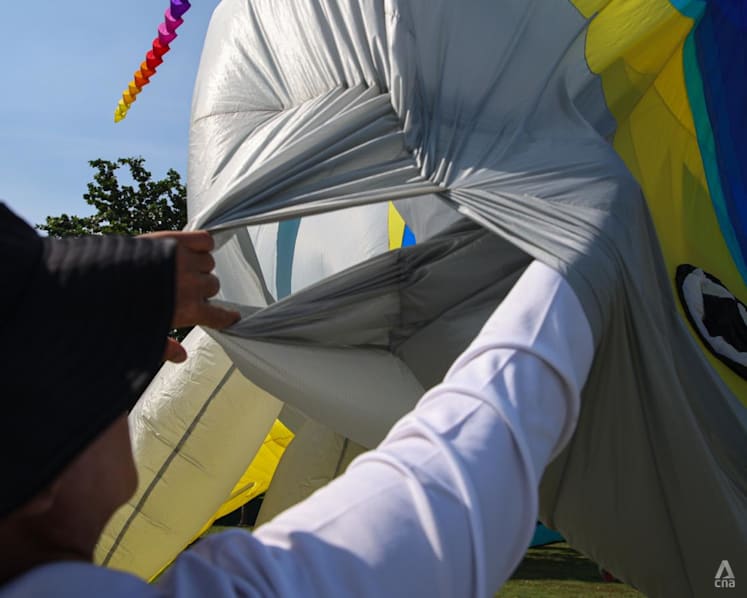
Ms Maggie Mok examining the flying cord of an inflatable show kite. (Photo: CNA/Mak Jia Kee)
Mr Johnny Yap fixing the attached strings on his show kite. (Photo: CNA/Nuria Ling)
Mr Johnny Yap holding open an inflation vent for air to fill up the kite. (Photo: CNA/Nuria Ling)

As their interests grew, Mr Yap and Ms Mok started travelling overseas to take part in international kite festivals. 

In September, they were at the International Kite Festival in Melaka, Malaysia, where they flew an inflatable show kite in the form of Singapore's tourism icon, the Merlion.

Advertisement

In Pixels

Inside a dragon kiln where temperatures go up to 1,300°C
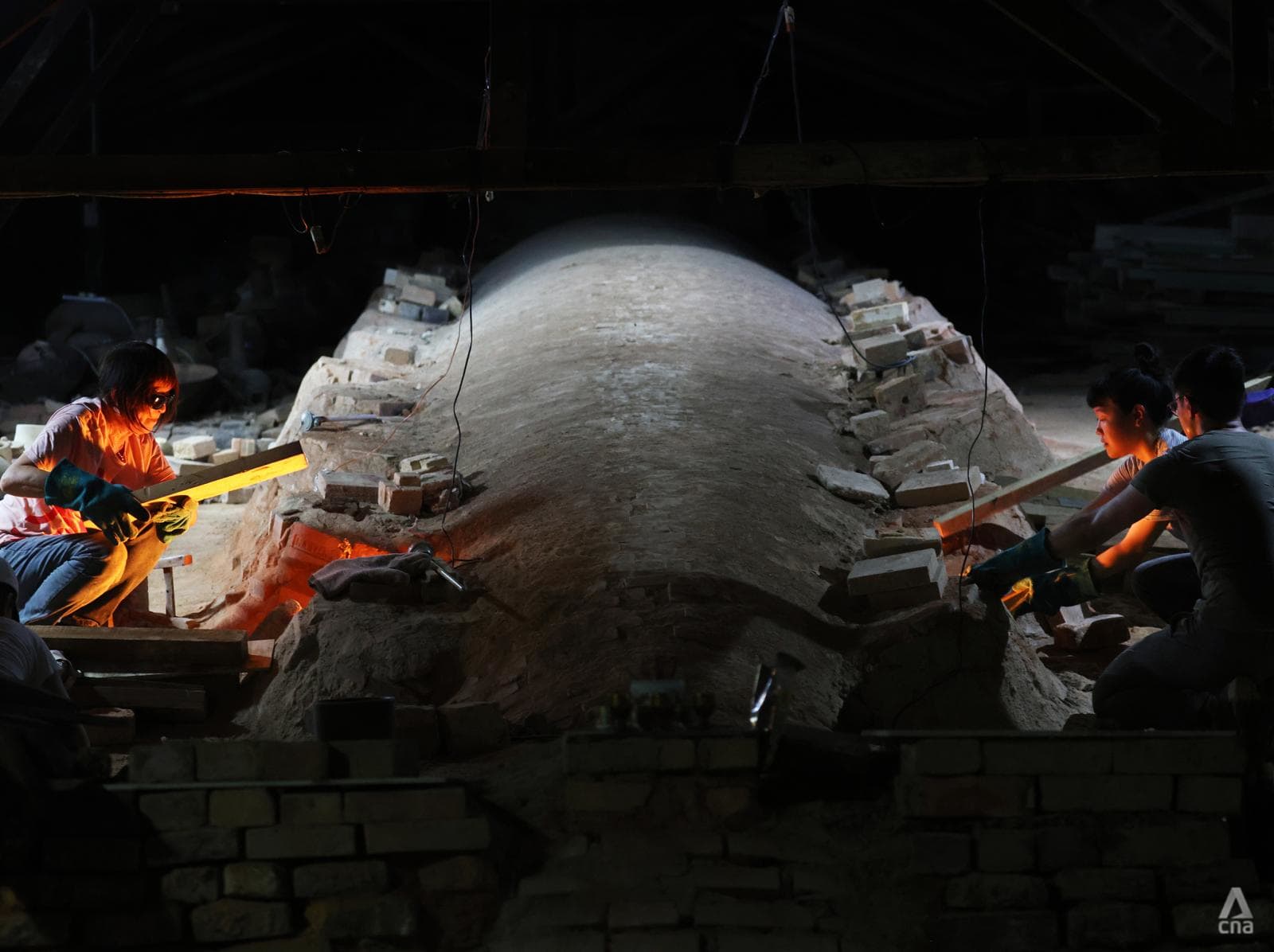
Inside a dragon kiln where temperatures go up to 1,300°C

Wood-firing at a dragon kiln is a community effort that requires round-the-clock monitoring. (Photo: CNA/Ooi Boon Keong)

15 Nov 2024 09:30PM (Updated: 16 Oct 2025 12:09AM)

Nestled in an industrial estate in the western part of Singapore is an 84-year-old dragon kiln, the oldest and the only operational dragon kiln in the country. 

Built in 1940, the kiln at Thow Kwang Pottery Jungle was originally used for the mass production of household and industrial items such as cups and flower pots.

Over the decades, the place has evolved into a community space, now offering classes and events for potters to hone their craft. 

CNA TODAY joined the potter community for a wood-firing session that happens only two or three times a year.

CNA Games
Show More
Show Less

In Pixels takes you through the experience, as new and seasoned potters bond over fire and perspiration, creating unique works of art. 

PRAYERS TO THE "KILN GOD"  

At Thow Kwang Pottery Jungle, which is located a short distance from Nanyang Technological University, a group of around 30 people gathered on a Friday last month in front of the kiln.

This was at the request of the owners, Mr Tan Teck Yoke, 68, and his wife Yulianti Tan, 66. 

A prayer ceremony to the "kiln god" was about to begin. 

“We are praying to the ‘kiln god’ for a successful firing, for the pieces to achieve the desired effects,” Mr Tan explained to the enthusiastic participants. 

To this, the crowd responded by shouting, “Heng, ong, huat, ah,” a phrase in the Chinese dialect of Hokkien that collectively means wishing for good fortune.

Mrs Yulianti Tan and Mr Tan Teck Yoke, owners of Thow Kwang Pottery Jungle, praying for a successful wood-firing session. (Photo: CNA/Ooi Boon Keong)

After the prayers were done, the fire box, which is a small opening at the front of the kiln, was lit. 

The participants each picked up a piece of wood to throw into the fire, hoping to add more "luck" to the process. 

During wood-firing in a kiln, the fire and the ashes from the wood react with the glaze on the ceramic items to produce a unique and rustic look. (Photo: CNA/Ooi Boon Keong)

The dragon kiln was bought by Mr Tan’s father in 1965 and has been owned by the family since then.

It sits on a slope, is 27-metres long, 2-metres wide and curves around the side, resembling the body of a dragon in Chinese mythology. 

Its lengthy chambers are made out of bricks and there is a chimney at the end, located at the top of the slope.

The kiln can fit thousands of pieces of ceramic items, depending on the size of the pots. 

For this firing session, around 400 to 500 pieces were loaded in the kiln. 

NEW WAYS TO IMPROVE PROCESS

Temperatures in the dragon kiln can reach up to 1,300°C. 

They can fluctuate significantly due to the shape of the furnace and the use of wood as a fuel.

That is why one of the most crucial parts of the process is to monitor the temperature for all three days of the firing session.

Mr Chua Hee Lai, who is in his 50s and a hobbyist-turned-kiln master, helped to plan and lead each firing session. 

Mr Chua Hee Lai (right) installing thermocouples on the slopes of an 84-year-old kiln to monitor the temperatures. (Photo: CNA/Ooi Boon Keong)

In 2019, Mr Chua, with the help of another potter, introduced a digital monitoring system that allowed them to track the temperatures remotely and give instructions to the potters doing shift work on site. 

Previously, they had to monitor the temperature by looking at the colour of the flame or record temperatures manually and then draw up prediction charts – a process that requires them to be on site for longer periods of time.

When the temperatures start to dip, potters will add more wood into the fire. (Photo: CNA/Ooi Boon Keong)
Potters handling large pieces of wood to be fed into a fire box. (Photo: CNA/Ooi Boon Keong)
The effect of burning heat can be seen in the different skin colours of a potter’s arms, after he stood near the kiln's fire box for some time to keep the flame going. (Photo: CNA/Ooi Boon Keong)
Cheers breaking out as the target wood-firing temperature of 1,260°C was about to be reached. (Photo: CNA/Ooi Boon Keong)

THE "KAMPUNG SPIRIT"

Advertising executive Vanessa Low and product manager Goh Wei Ting, both 31, have been practising pottery at another pottery studio for around five years and this was their first time taking part in the wood-firing process.

Compared to a regular firing in an electric or gas kiln, wood-firing is "tiring and physically demanding", Mr Goh said.

However, they were buoyed by the “kampung spirit” or the sense of camaraderie that came about as participants laboured together. 

 “You just don’t feel tired, you just do (the work),” Mr Goh added. 

A group of young potters who are new to wood-firing taking photos near the kiln. (Photo: CNA/Ooi Boon Keong)
Experienced and new potters forming a human chain to carry pieces of wood to be used for the firing. (Photo: CNA/Ooi Boon Keong)
Participants having a lively potluck dinner, a brief respite from the day’s hard work. (Photo: CNA/Ooi Boon Keong)
After dinner, potters sitting around and chatting in front of the fire while monitoring the kiln. (Photo: CNA/Ooi Boon Keong)

OPENING OF THE KILN

Six days after the firing at the dragon kiln, the participants returned to open the kiln and check on their art pieces. 

“Shall we form a chain?” someone suggested to facilitate the removal of the brick walls. 

Without hesitation, a human chain quickly formed as the potters unsealed the kiln, one brick at a time. 

Potters in the process of dismantling the brick walls, in order to get into the kiln's chambers. (Photo: CNA/Ooi Boon Keong)
Breaking down the final wall to reach the last shelves holding pottery items. (Photo: CNA/Ooi Boon Keong)
The residual heat from the firing was keenly felt by the potters inside the kiln. (Photo: CNA/Ooi Boon Keong)
Each piece of pottery was removed carefully from the shelves and moved out in batches. (Photo: CNA/Ooi Boon Keong)
Finally, potters reached the chamber closest to the fire box. Only one person is able to reach the items in the narrow chamber. (Photo: CNA/Ooi Boon Keong)

A collective “wow” sounded as the final bricks were removed, revealing the final outcome of the nine-day process that comprised three days of firing and six days of cooling.

The potters carefully removed the art pieces from the shelves, while admiring the effects that the fire had on their work. 

Advertisement

In Pixels

Meet the 70-year-old lorry driver who is also a 'kite doctor'

Meet the 70-year-old lorry driver who is also a 'kite doctor'

Kite maker Tan Poh Wah flying his handmade dragon kite at the Marina Barrage. (Photo: CNA/Nuria Ling)

30 Nov 2024 09:30PM (Updated: 16 Oct 2025 12:08AM)

Rolling up to Marina Barrage with a trolley bag full of handmade kites and repair tools, Mr Tan Poh Wah had one clear mission for the day: To share his love of kite-flying with others. 

Known informally as the “kite doctor” among the regular visitors there, the 70-year-old spends most Sundays repairing kites or offering his handmade ones – mostly for free – to people at the open-air space that is the venue of Singapore's largest reservoir. 

“Watching people fly my kites makes me really happy,” Mr Tan said.  

This weekend, In Pixels speaks to four enthusiasts to find out what excites them about kite-flying. 

A FAMILIAR FIGURE

CNA Games
Show More
Show Less

Shortly after Mr Tan turned up at Marina Barrage in the Marina Bay area, a handful of people who wanted their kites repaired immediately made a beeline towards him. 

They offered him drinks and snacks to thank him for his service. 

When he was done with the repairs, Mr Tan pulled a kite from his bag and launched it to the sky. 

He flew it with ease, strolling around the field, eager to find someone who will take the kite as a gift. 

His masterpieces are made mostly from recycled materials including plastic bags, discarded blinds, banners and umbrellas. 

Mr Tan Poh Wah holding up a kite he made using a supermarket plastic bag. (Photo: CNA/Mak Jia Kee)
Mr Tan Poh Wah with a handmade kite made out of recycled materials. (Photo: CNA/Nuria Ling)

Mr Tan is part of a group known as Singapore Original Kites, an informal gathering of adults in their 60s and 70s who share the same interest in making and flying kites.  

A semi-retired Chinese physician ​​Ong Cheng Her, 75, is the founder of the group.

He said that the only prerequisite to join the group is one’s ability to make a kite from scratch.  

He proudly showed CNA TODAY one of his creations, a red and white "umbrella kite". 

“Umbrellas are used for shade and rain protection, so why hasn’t anyone flown an umbrella kite? I decided to take on the challenge,” Mr Ong added.

Mr Ong Cheng Her, founder of the Singapore Original Kites group, holding an "umbrella kite" that he made in 2023. (Photo: CNA/Nuria Ling )
Mr Ong Cheng Her holding a kite he made, featuring flower and leaf patterns inspired by traditional Chinese paintings. (Photo: CNA/Mak Jia Kee)

HIS WORKSPACE AT HOME

As for Mr Tan, he is not retired, so flying and making kites is what he does only on Sundays.

He works six days a week as a lorry driver.

“I work to live, to fill my stomach so I can make kites.”

Stepping into his flat, Mr Tan led us to his "studio", which is a room filled with a bountiful supply of kites and raw materials. 

He described his workspace as a “chaotic but organised mess”. 

“My wife sometimes asks why I collect so many umbrellas, but she doesn’t interfere much because she knows I enjoy making these things.”

Mr Tan Poh Wah tying a ribbon to a bamboo stick to form part of a kite. (Photo: CNA/Nuria Ling)

Mr Tan has loved kite flying since he was a child, but it was not until he was in his 30s that he took to making kites himself.

A self-taught craftsman, he said that he learnt how to make kites by observing other kite-makers whenever an opportunity comes along. 

Mr Tan Poh Wah crafting a squid kite in his workshop that he set up in his flat. (Photo: CNA/Nuria Ling)
Mr Tan Poh Wah laying out pieces of a 70m-long "dragon kite" in his living room. (Photo: CNA/Nuria Ling)

Recently, Mr Tan finished repairing a 70m-long "dragon kite" that he first constructed in 2000. It broke at a kite festival in Taiwan in 2019 and required extensive repairs. 

After CNA TODAY approached him for an interview, Mr Tan said that he found new inspiration to repair the kite, which took him four Sundays to complete.

It was obvious that he is most proud of this kite among the many in his collection.

“Anyone who hasn't made a dragon or a phoenix kite isn't truly considered a kite maker,” he said, adding that these long kites are made up of many different sections and each needed to be crafted with great precision before they are finally stitched together. 

A 70m-long "dragon kite" made by Mr Tan Poh Wah flying at Marina Barrage. (Photo: CNA/Nuria Ling)

"GIANTS" IN THE SKY

Over at East Coast Park, another group of kite enthusiasts have gathered and their presence could be spotted from afar. 

The kites they have taken out, called "inflatable show kites", are gigantic balloon-like kites that are typically several metres in length when inflated.

Traditional kites rely on rigid frames for support, but inflatable show kites have no hard structures. They inflate as they catch on the wind and have to be anchored to the ground.

An inflatable show kite flying at East Coast Park. (Photo: CNA/Nuria Ling)
Mr Johnny Yap checking on a 10m-tall seahorse-shaped inflatable show kite. (Photo: CNA/Mak Jia Kee)

Project coordinator Johnny Yap and his wife Maggie Mok, a homemaker, both 51, are the founders of Show Kites Singapore, a group of people who are into these inflatable show kites.

The duo's interest in this started nearly 20 years ago when they took their children kite-flying. 

In the end, it was the couple themselves who got hooked on the activity. 

“We started flying bigger and bigger kites and before long, we realised that stick kites have a limit,” Mr Yap said.

This led them to explore inflatable ones in 2009 and they came across these kites online before buying their first. The sky is the limit when it comes to the sizes of such kites.

Ms Maggie Mok examining the flying cord of an inflatable show kite. (Photo: CNA/Mak Jia Kee)
Mr Johnny Yap fixing the attached strings on his show kite. (Photo: CNA/Nuria Ling)
Mr Johnny Yap holding open an inflation vent for air to fill up the kite. (Photo: CNA/Nuria Ling)

As their interests grew, Mr Yap and Ms Mok started travelling overseas to take part in international kite festivals. 

In September, they were at the International Kite Festival in Melaka, Malaysia, where they flew an inflatable show kite in the form of Singapore's tourism icon, the Merlion.

Advertisement

In Pixels

Inside a dragon kiln where temperatures go up to 1,300°C

Inside a dragon kiln where temperatures go up to 1,300°C

Wood-firing at a dragon kiln is a community effort that requires round-the-clock monitoring. (Photo: CNA/Ooi Boon Keong)

15 Nov 2024 09:30PM (Updated: 16 Oct 2025 12:09AM)

Nestled in an industrial estate in the western part of Singapore is an 84-year-old dragon kiln, the oldest and the only operational dragon kiln in the country. 

Built in 1940, the kiln at Thow Kwang Pottery Jungle was originally used for the mass production of household and industrial items such as cups and flower pots.

Over the decades, the place has evolved into a community space, now offering classes and events for potters to hone their craft. 

CNA TODAY joined the potter community for a wood-firing session that happens only two or three times a year.

CNA Games
Show More
Show Less

In Pixels takes you through the experience, as new and seasoned potters bond over fire and perspiration, creating unique works of art. 

PRAYERS TO THE "KILN GOD"  

At Thow Kwang Pottery Jungle, which is located a short distance from Nanyang Technological University, a group of around 30 people gathered on a Friday last month in front of the kiln.

This was at the request of the owners, Mr Tan Teck Yoke, 68, and his wife Yulianti Tan, 66. 

A prayer ceremony to the "kiln god" was about to begin. 

“We are praying to the ‘kiln god’ for a successful firing, for the pieces to achieve the desired effects,” Mr Tan explained to the enthusiastic participants. 

To this, the crowd responded by shouting, “Heng, ong, huat, ah,” a phrase in the Chinese dialect of Hokkien that collectively means wishing for good fortune.

After the prayers were done, the fire box, which is a small opening at the front of the kiln, was lit. 

The participants each picked up a piece of wood to throw into the fire, hoping to add more "luck" to the process. 

The dragon kiln was bought by Mr Tan’s father in 1965 and has been owned by the family since then.

It sits on a slope, is 27-metres long, 2-metres wide and curves around the side, resembling the body of a dragon in Chinese mythology. 

Its lengthy chambers are made out of bricks and there is a chimney at the end, located at the top of the slope.

The kiln can fit thousands of pieces of ceramic items, depending on the size of the pots. 

For this firing session, around 400 to 500 pieces were loaded in the kiln. 

NEW WAYS TO IMPROVE PROCESS

Temperatures in the dragon kiln can reach up to 1,300°C. 

They can fluctuate significantly due to the shape of the furnace and the use of wood as a fuel.

That is why one of the most crucial parts of the process is to monitor the temperature for all three days of the firing session.

Mr Chua Hee Lai, who is in his 50s and a hobbyist-turned-kiln master, helped to plan and lead each firing session. 

In 2019, Mr Chua, with the help of another potter, introduced a digital monitoring system that allowed them to track the temperatures remotely and give instructions to the potters doing shift work on site. 

Previously, they had to monitor the temperature by looking at the colour of the flame or record temperatures manually and then draw up prediction charts – a process that requires them to be on site for longer periods of time.

THE "KAMPUNG SPIRIT"

Advertising executive Vanessa Low and product manager Goh Wei Ting, both 31, have been practising pottery at another pottery studio for around five years and this was their first time taking part in the wood-firing process.

Compared to a regular firing in an electric or gas kiln, wood-firing is "tiring and physically demanding", Mr Goh said.

However, they were buoyed by the “kampung spirit” or the sense of camaraderie that came about as participants laboured together. 

 “You just don’t feel tired, you just do (the work),” Mr Goh added. 

OPENING OF THE KILN

Six days after the firing at the dragon kiln, the participants returned to open the kiln and check on their art pieces. 

“Shall we form a chain?” someone suggested to facilitate the removal of the brick walls. 

Without hesitation, a human chain quickly formed as the potters unsealed the kiln, one brick at a time. 

A collective “wow” sounded as the final bricks were removed, revealing the final outcome of the nine-day process that comprised three days of firing and six days of cooling.

The potters carefully removed the art pieces from the shelves, while admiring the effects that the fire had on their work. 

Ms Tia Boon Sim, 69, one of the founders of Thow Kwang Clay Artists, a community group, said: “In wood-firing, the ashes from the fire would fly around and drop on the pieces and these are the effects potters love.”

When asked if she would do this again, Ms Low said: “I would want to come back with my friends for this, have fun and learn new things together.”  

Participants moving the pottery pieces out of the kiln area by forming a human chain. (Photo: CNA/Ooi Boon Keong)
Ceramic items in different shapes, sizes and colours were placed on tables. (Photo: CNA/Ooi Boon Keong)
Mr Goh Wei Ting comparing his pottery work before and after the items were fired in the kiln. (Photo: CNA/Ooi Boon Keong)
A participant looking at a freshly fired pot, examining every detail. (Photo: CNA/Ooi Boon Keong)
Source: CNA/jl/sf

Recommended

In watching the kite-flyers, CNA TODAY observed that the age-old method of rolling out and pulling the kite lines or strings is still used for flying simple traditional kites regardless of their sizes.

For long, intricate traditional kites such as Mr Tan's dragon kite, as well as the inflatable show kites, they are anchored to the ground and usually fly without much supervision. They also tend to have a "pilot" kite attached to the main kite to provide a lift for the initial flight. 

Some kites need very little wind, whereas others may need strong wind conditions. 

Inflatable show kites at the International Kite Festival held in Melaka, Malaysia in September 2024. (Photo: Maggie Mok)
Most of the kites designed by Mr Johnny Yap are in red and white, which are colours representing Singapore’s flag. (Photo: CNA/Nuria Ling)

Most of the kites owned by Mr Yap and Ms Mok are designed by them. 

The bespoke kites can cost between a few hundred and a few thousand dollars and they are manufactured in China. 

“We know how to make the kite, but we just don't have time. It takes many, many hours of sewing,” Mr Yap explained.

“We stick to the principle that we must design our own kites.”

Mr Johnny Yap trying to anchor some inflatable show kites to the ground. (Photo: CNA/Mak Jia Kee)
Members of the public taking photos with several inflatable show kites at East Coast Park. (Photo: CNA/Nuria Ling)

Through the years, the couple have met people from all walks of life who have taken an interest in this activity. 

“We have doctors, taxi drivers, hawkers (in Show Kites Singapore). It’s the kites that bring us together,” Mr Yap said.

“There’s no application form (to join the group), so long as you are passionate, come join me every Sunday."

Members of Show Kites Singapore taking a break under the shade at East Coast Park. (Photo: CNA/Mak Jia Kee)
Inflatable show kites flying next to a construction site at East Coast Park. (Photo: CNA/Mak Jia Kee)
Advertisement

In Pixels

Snakes and marine life you don’t always see at Sentosa

Snakes and marine life you don’t always see at Sentosa

A 2-metre juvenile reticulated python slithering across a tree branch in front of filmmaker Jayaprakash Bojan. The snake was found near Palawan Green on Sentosa Island and was rehomed in a forested area nearby. (Photo: CNA/Raj Nadarajan)

04 Oct 2024 09:30PM (Updated: 16 Oct 2025 12:12AM)

There was palpable tension in the air as a black bag was taken to the forest. 

Inside was a 2-metre juvenile reticulated python. 

The snake with diamond-patterned skin was being relocated to a forested area on Sentosa Island by the wildlife management team of the Sentosa Development Corporation (SDC), after it was spotted in a high foot-traffic area.

Standing very still just a few metres away were two professional filmmakers and a photographer, patiently waiting for the snake to emerge. 

CNA Games
Show More
Show Less

They did not have to wait long.

In just a couple of minutes, the python slithered out of the bag and gradually made its way up a tree. 

The team then waited another four hours for the snake to make its way down from the tree as they observed its movements on camera.

In Pixels takes you this weekend on a visual trip with wildlife filmmakers Jayaprakash “JP” Bojan and Ian Mun, as they document Sentosa’s biodiversity and conservation efforts for Earth in Focus, a nature film festival set to take place in November on the resort island south of mainland Singapore. 

Reticulated pythons are native to Singapore and they are commonly found in secondary forests with a water supply. (Photo: CNA/Raj Nadarajan)
Photographer and filmmaker Jayaprakash Bojan, fondly known as JP, attaching a camera to a monopod to capture footage of a python from a safe distance. (Photo: CNA/Raj Nadarajan)
A spitting cobra found in a drain at Fort Siloso in Sentosa was relocated to a forested area on the island. A team of filmmakers had been shooting in Sentosa thrice a week for three months but this was the first time that they were coming face-to-face with a venomous snake on the island. (Photo: CNA/Nuria Ling)

Sentosa is a tourist destination known for its themed parks and sandy beaches. The island’s free-roaming peacocks are probably its most well-known wildlife. 

Off the beaten tracks, though, in the forested areas or along the rocky shores, there is a rich biodiversity of flora and fauna unknown to many visitors.

One rare species found in the coastal forests is the Xylocarpus rumphii, a critically endangered plant that has not been discovered elsewhere on mainland Singapore. 

There is also the elusive lesser bamboo bat, one of the smallest mammals on earth. 

This vulnerable bat species, which weighs just a few grams, has a flattened skull that allows it to squeeze in a hollow bamboo shoot to roost, through narrow slits created by beetles.

A bamboo bat captured on video after being awakened by the endoscope. (Photo: CNA/Nuria Ling)
An endoscope being used to check on lesser bamboo bats that live inside bamboo plants. (Photo: CNA/Nuria Ling)

Sentosa is home to 850 flora and fauna species. 

Setting up camera traps is one way that the conservation team is able to track and protect the wildlife on the island.  

Unlike what it sounds, camera traps do not trap animals. They are cameras with sensors put up in animal habitats for a duration to record images of wildlife and collect data on them.

The team has deployed eight such cameras in biodiversity-sensitive habitats around the island and the cameras are checked every alternate month. 

Advertisement

In Pixels

Inside a dragon kiln where temperatures go up to 1,300°C

Inside a dragon kiln where temperatures go up to 1,300°C

Wood-firing at a dragon kiln is a community effort that requires round-the-clock monitoring. (Photo: CNA/Ooi Boon Keong)

15 Nov 2024 09:30PM (Updated: 16 Oct 2025 12:09AM)

Nestled in an industrial estate in the western part of Singapore is an 84-year-old dragon kiln, the oldest and the only operational dragon kiln in the country. 

Built in 1940, the kiln at Thow Kwang Pottery Jungle was originally used for the mass production of household and industrial items such as cups and flower pots.

Over the decades, the place has evolved into a community space, now offering classes and events for potters to hone their craft. 

CNA TODAY joined the potter community for a wood-firing session that happens only two or three times a year.

CNA Games
Show More
Show Less

In Pixels takes you through the experience, as new and seasoned potters bond over fire and perspiration, creating unique works of art. 

PRAYERS TO THE "KILN GOD"  

At Thow Kwang Pottery Jungle, which is located a short distance from Nanyang Technological University, a group of around 30 people gathered on a Friday last month in front of the kiln.

This was at the request of the owners, Mr Tan Teck Yoke, 68, and his wife Yulianti Tan, 66. 

A prayer ceremony to the "kiln god" was about to begin. 

“We are praying to the ‘kiln god’ for a successful firing, for the pieces to achieve the desired effects,” Mr Tan explained to the enthusiastic participants. 

To this, the crowd responded by shouting, “Heng, ong, huat, ah,” a phrase in the Chinese dialect of Hokkien that collectively means wishing for good fortune.

After the prayers were done, the fire box, which is a small opening at the front of the kiln, was lit. 

The participants each picked up a piece of wood to throw into the fire, hoping to add more "luck" to the process. 

The dragon kiln was bought by Mr Tan’s father in 1965 and has been owned by the family since then.

It sits on a slope, is 27-metres long, 2-metres wide and curves around the side, resembling the body of a dragon in Chinese mythology. 

Its lengthy chambers are made out of bricks and there is a chimney at the end, located at the top of the slope.

The kiln can fit thousands of pieces of ceramic items, depending on the size of the pots. 

For this firing session, around 400 to 500 pieces were loaded in the kiln. 

NEW WAYS TO IMPROVE PROCESS

Temperatures in the dragon kiln can reach up to 1,300°C. 

They can fluctuate significantly due to the shape of the furnace and the use of wood as a fuel.

That is why one of the most crucial parts of the process is to monitor the temperature for all three days of the firing session.

Mr Chua Hee Lai, who is in his 50s and a hobbyist-turned-kiln master, helped to plan and lead each firing session. 

In 2019, Mr Chua, with the help of another potter, introduced a digital monitoring system that allowed them to track the temperatures remotely and give instructions to the potters doing shift work on site. 

Previously, they had to monitor the temperature by looking at the colour of the flame or record temperatures manually and then draw up prediction charts – a process that requires them to be on site for longer periods of time.

THE "KAMPUNG SPIRIT"

Advertising executive Vanessa Low and product manager Goh Wei Ting, both 31, have been practising pottery at another pottery studio for around five years and this was their first time taking part in the wood-firing process.

Compared to a regular firing in an electric or gas kiln, wood-firing is "tiring and physically demanding", Mr Goh said.

However, they were buoyed by the “kampung spirit” or the sense of camaraderie that came about as participants laboured together. 

 “You just don’t feel tired, you just do (the work),” Mr Goh added. 

OPENING OF THE KILN

Six days after the firing at the dragon kiln, the participants returned to open the kiln and check on their art pieces. 

“Shall we form a chain?” someone suggested to facilitate the removal of the brick walls. 

Without hesitation, a human chain quickly formed as the potters unsealed the kiln, one brick at a time. 

A collective “wow” sounded as the final bricks were removed, revealing the final outcome of the nine-day process that comprised three days of firing and six days of cooling.

The potters carefully removed the art pieces from the shelves, while admiring the effects that the fire had on their work. 

Ms Tia Boon Sim, 69, one of the founders of Thow Kwang Clay Artists, a community group, said: “In wood-firing, the ashes from the fire would fly around and drop on the pieces and these are the effects potters love.”

When asked if she would do this again, Ms Low said: “I would want to come back with my friends for this, have fun and learn new things together.”  

Participants moving the pottery pieces out of the kiln area by forming a human chain. (Photo: CNA/Ooi Boon Keong)
Ceramic items in different shapes, sizes and colours were placed on tables. (Photo: CNA/Ooi Boon Keong)
Mr Goh Wei Ting comparing his pottery work before and after the items were fired in the kiln. (Photo: CNA/Ooi Boon Keong)
A participant looking at a freshly fired pot, examining every detail. (Photo: CNA/Ooi Boon Keong)
Source: CNA/jl/sf

Recommended

Advertisement

In Pixels

Meet the 70-year-old lorry driver who is also a 'kite doctor'

Meet the 70-year-old lorry driver who is also a 'kite doctor'

Kite maker Tan Poh Wah flying his handmade dragon kite at the Marina Barrage. (Photo: CNA/Nuria Ling)

30 Nov 2024 09:30PM (Updated: 16 Oct 2025 12:08AM)

Rolling up to Marina Barrage with a trolley bag full of handmade kites and repair tools, Mr Tan Poh Wah had one clear mission for the day: To share his love of kite-flying with others. 

Known informally as the “kite doctor” among the regular visitors there, the 70-year-old spends most Sundays repairing kites or offering his handmade ones – mostly for free – to people at the open-air space that is the venue of Singapore's largest reservoir. 

“Watching people fly my kites makes me really happy,” Mr Tan said.  

This weekend, In Pixels speaks to four enthusiasts to find out what excites them about kite-flying. 

A FAMILIAR FIGURE

CNA Games
Show More
Show Less

Shortly after Mr Tan turned up at Marina Barrage in the Marina Bay area, a handful of people who wanted their kites repaired immediately made a beeline towards him. 

They offered him drinks and snacks to thank him for his service. 

When he was done with the repairs, Mr Tan pulled a kite from his bag and launched it to the sky. 

He flew it with ease, strolling around the field, eager to find someone who will take the kite as a gift. 

His masterpieces are made mostly from recycled materials including plastic bags, discarded blinds, banners and umbrellas. 

Mr Tan is part of a group known as Singapore Original Kites, an informal gathering of adults in their 60s and 70s who share the same interest in making and flying kites.  

A semi-retired Chinese physician ​​Ong Cheng Her, 75, is the founder of the group.

He said that the only prerequisite to join the group is one’s ability to make a kite from scratch.  

He proudly showed CNA TODAY one of his creations, a red and white "umbrella kite". 

“Umbrellas are used for shade and rain protection, so why hasn’t anyone flown an umbrella kite? I decided to take on the challenge,” Mr Ong added.

HIS WORKSPACE AT HOME

As for Mr Tan, he is not retired, so flying and making kites is what he does only on Sundays.

He works six days a week as a lorry driver.

“I work to live, to fill my stomach so I can make kites.”

Stepping into his flat, Mr Tan led us to his "studio", which is a room filled with a bountiful supply of kites and raw materials. 

He described his workspace as a “chaotic but organised mess”. 

“My wife sometimes asks why I collect so many umbrellas, but she doesn’t interfere much because she knows I enjoy making these things.”

Mr Tan has loved kite flying since he was a child, but it was not until he was in his 30s that he took to making kites himself.

A self-taught craftsman, he said that he learnt how to make kites by observing other kite-makers whenever an opportunity comes along. 

Recently, Mr Tan finished repairing a 70m-long "dragon kite" that he first constructed in 2000. It broke at a kite festival in Taiwan in 2019 and required extensive repairs. 

After CNA TODAY approached him for an interview, Mr Tan said that he found new inspiration to repair the kite, which took him four Sundays to complete.

It was obvious that he is most proud of this kite among the many in his collection.

“Anyone who hasn't made a dragon or a phoenix kite isn't truly considered a kite maker,” he said, adding that these long kites are made up of many different sections and each needed to be crafted with great precision before they are finally stitched together. 

"GIANTS" IN THE SKY

Over at East Coast Park, another group of kite enthusiasts have gathered and their presence could be spotted from afar. 

The kites they have taken out, called "inflatable show kites", are gigantic balloon-like kites that are typically several metres in length when inflated.

Traditional kites rely on rigid frames for support, but inflatable show kites have no hard structures. They inflate as they catch on the wind and have to be anchored to the ground.

Project coordinator Johnny Yap and his wife Maggie Mok, a homemaker, both 51, are the founders of Show Kites Singapore, a group of people who are into these inflatable show kites.

The duo's interest in this started nearly 20 years ago when they took their children kite-flying. 

In the end, it was the couple themselves who got hooked on the activity. 

“We started flying bigger and bigger kites and before long, we realised that stick kites have a limit,” Mr Yap said.

This led them to explore inflatable ones in 2009 and they came across these kites online before buying their first. The sky is the limit when it comes to the sizes of such kites.

As their interests grew, Mr Yap and Ms Mok started travelling overseas to take part in international kite festivals. 

In September, they were at the International Kite Festival in Melaka, Malaysia, where they flew an inflatable show kite in the form of Singapore's tourism icon, the Merlion.

In watching the kite-flyers, CNA TODAY observed that the age-old method of rolling out and pulling the kite lines or strings is still used for flying simple traditional kites regardless of their sizes.

For long, intricate traditional kites such as Mr Tan's dragon kite, as well as the inflatable show kites, they are anchored to the ground and usually fly without much supervision. They also tend to have a "pilot" kite attached to the main kite to provide a lift for the initial flight. 

Some kites need very little wind, whereas others may need strong wind conditions. 

Most of the kites owned by Mr Yap and Ms Mok are designed by them. 

The bespoke kites can cost between a few hundred and a few thousand dollars and they are manufactured in China. 

“We know how to make the kite, but we just don't have time. It takes many, many hours of sewing,” Mr Yap explained.

“We stick to the principle that we must design our own kites.”

Through the years, the couple have met people from all walks of life who have taken an interest in this activity. 

“We have doctors, taxi drivers, hawkers (in Show Kites Singapore). It’s the kites that bring us together,” Mr Yap said.

“There’s no application form (to join the group), so long as you are passionate, come join me every Sunday."

Source: CNA/jl/sf

Recommended

SDC said: “We urge guests to be mindful as they explore Sentosa and to treat our fragile ecosystems with care.”

Visits to some areas such as Tanjong Rimau and Mount Serapong are available only through guided tours by SDC or SDC-approved tours. 

Tanjong Rimau, also known as Siloso Headland, is located at the western-most tip of Sentosa and is one of Singapore's last remaining coastal cliffs and rocky shores that are habitats for marine life.

Mount Serapong, located around the north-eastern part of the island, has a mature tropical rainforest and also a coastal forest nearer the shore.

“Guests should also observe our nature areas guidelines so that everyone can enjoy the greenery and wildlife that Sentosa has to offer,” SDC said.

Senior supervisor Justin David (left) and senior animal handler Joshua Sathasivam Shanmugam (right) from the Sentosa wildlife management team setting up a camera trap. (Photo: CNA/Nuria Ling)
A Goffin's cockatoo captured on a camera trap set up along Sentosa’s coastal trail. (Photo: CNA/Nuria Ling)
Photographers and filmmakers JP (right) and Ian Mun (left) looking for hornbills that have previously been spotted in the area. (Photo: CNA/Nuria Ling)
A family of up to 11 hornbills were spotted by filmmaker and photographer JP near a plant nursery. JP and fellow team mate Ian Mun were also able to capture footage of other bird species including hawk eagles, parakeets and blue-throated bee-eaters. (Photo: CNA/Nuria Ling)

JP, who is the 2017 National Geographic Nature Photographer of the Year, said: “The excitement of not knowing what you’re going to get is amazing. I know I’m going to get something but I don’t know what.”

The seasoned nature photographer of 20 years said that there is “nothing in your control” when it comes to capturing wildlife. 

For instance, an extra low tide on the north-western tip of Sentosa accompanied a supermoon in August, making it a rare occasion and perfect opportunity to capture intertidal marine life.

A filmmaking team set out before sunrise to capture the wild marine life at Sentosa’s intertidal zone along the north-western tip of the island, an area of fragile habitats closed to the public except for approved guided tours. (Photo: CNA/Nuria Ling)
Filmmakers found small fish in tide pools along the rocky shores of north-western Sentosa. (Photo: CNA/Nuria Ling)
A live coral found in a tide pool, which was exposed during low tide. (Photo: CNA/Nuria Ling)
Chitons seen here during low tide. They are a type of mollusc such as snails and clams that resemble fossils. They typically have eight overlapping plates along the centre and a powerful suction that clings on to rocks. (Photo: CNA/ Nuria Ling)
A highlight for photographer Ian Mun while shooting in the intertidal zone was spotting a red egg crab chasing a reef octopus. “Inter-species interaction is always interesting to observe,” he said. (Photo: CNA/Nuria Ling)
A red egg crab chasing a reef octopus spotted at Sentosa’s intertidal zone at Tanjong Rimau. (Photo: Ian Mun)
Source: CNA/jl/sf

Recommended

Source: CNA/jl/sf

Recommended

Ms Tia Boon Sim, 69, one of the founders of Thow Kwang Clay Artists, a community group, said: “In wood-firing, the ashes from the fire would fly around and drop on the pieces and these are the effects potters love.”

When asked if she would do this again, Ms Low said: “I would want to come back with my friends for this, have fun and learn new things together.”  

Participants moving the pottery pieces out of the kiln area by forming a human chain. (Photo: CNA/Ooi Boon Keong)
Ceramic items in different shapes, sizes and colours were placed on tables. (Photo: CNA/Ooi Boon Keong)
Mr Goh Wei Ting comparing his pottery work before and after the items were fired in the kiln. (Photo: CNA/Ooi Boon Keong)
A participant looking at a freshly fired pot, examining every detail. (Photo: CNA/Ooi Boon Keong)
Source: CNA/jl/sf

Recommended

In watching the kite-flyers, CNA TODAY observed that the age-old method of rolling out and pulling the kite lines or strings is still used for flying simple traditional kites regardless of their sizes.

For long, intricate traditional kites such as Mr Tan's dragon kite, as well as the inflatable show kites, they are anchored to the ground and usually fly without much supervision. They also tend to have a "pilot" kite attached to the main kite to provide a lift for the initial flight. 

Some kites need very little wind, whereas others may need strong wind conditions. 

Most of the kites owned by Mr Yap and Ms Mok are designed by them. 

The bespoke kites can cost between a few hundred and a few thousand dollars and they are manufactured in China. 

“We know how to make the kite, but we just don't have time. It takes many, many hours of sewing,” Mr Yap explained.

“We stick to the principle that we must design our own kites.”

Through the years, the couple have met people from all walks of life who have taken an interest in this activity. 

“We have doctors, taxi drivers, hawkers (in Show Kites Singapore). It’s the kites that bring us together,” Mr Yap said.

“There’s no application form (to join the group), so long as you are passionate, come join me every Sunday."

Source: CNA/jl/sf

Recommended

Ms Tia Boon Sim, 69, one of the founders of Thow Kwang Clay Artists, a community group, said: “In wood-firing, the ashes from the fire would fly around and drop on the pieces and these are the effects potters love.”

When asked if she would do this again, Ms Low said: “I would want to come back with my friends for this, have fun and learn new things together.”  

Source: CNA/jl/sf

Recommended

Advertisement

In Pixels

Snakes and marine life you don’t always see at Sentosa

Snakes and marine life you don’t always see at Sentosa

A 2-metre juvenile reticulated python slithering across a tree branch in front of filmmaker Jayaprakash Bojan. The snake was found near Palawan Green on Sentosa Island and was rehomed in a forested area nearby. (Photo: CNA/Raj Nadarajan)

04 Oct 2024 09:30PM (Updated: 16 Oct 2025 12:12AM)

There was palpable tension in the air as a black bag was taken to the forest. 

Inside was a 2-metre juvenile reticulated python. 

The snake with diamond-patterned skin was being relocated to a forested area on Sentosa Island by the wildlife management team of the Sentosa Development Corporation (SDC), after it was spotted in a high foot-traffic area.

Standing very still just a few metres away were two professional filmmakers and a photographer, patiently waiting for the snake to emerge. 

CNA Games
Show More
Show Less

They did not have to wait long.

In just a couple of minutes, the python slithered out of the bag and gradually made its way up a tree. 

The team then waited another four hours for the snake to make its way down from the tree as they observed its movements on camera.

In Pixels takes you this weekend on a visual trip with wildlife filmmakers Jayaprakash “JP” Bojan and Ian Mun, as they document Sentosa’s biodiversity and conservation efforts for Earth in Focus, a nature film festival set to take place in November on the resort island south of mainland Singapore. 

Reticulated pythons are native to Singapore and they are commonly found in secondary forests with a water supply. (Photo: CNA/Raj Nadarajan)
Photographer and filmmaker Jayaprakash Bojan, fondly known as JP, attaching a camera to a monopod to capture footage of a python from a safe distance. (Photo: CNA/Raj Nadarajan)
A spitting cobra found in a drain at Fort Siloso in Sentosa was relocated to a forested area on the island. A team of filmmakers had been shooting in Sentosa thrice a week for three months but this was the first time that they were coming face-to-face with a venomous snake on the island. (Photo: CNA/Nuria Ling)

Sentosa is a tourist destination known for its themed parks and sandy beaches. The island’s free-roaming peacocks are probably its most well-known wildlife. 

Off the beaten tracks, though, in the forested areas or along the rocky shores, there is a rich biodiversity of flora and fauna unknown to many visitors.

One rare species found in the coastal forests is the Xylocarpus rumphii, a critically endangered plant that has not been discovered elsewhere on mainland Singapore. 

There is also the elusive lesser bamboo bat, one of the smallest mammals on earth. 

This vulnerable bat species, which weighs just a few grams, has a flattened skull that allows it to squeeze in a hollow bamboo shoot to roost, through narrow slits created by beetles.

A bamboo bat captured on video after being awakened by the endoscope. (Photo: CNA/Nuria Ling)
An endoscope being used to check on lesser bamboo bats that live inside bamboo plants. (Photo: CNA/Nuria Ling)

Sentosa is home to 850 flora and fauna species. 

Setting up camera traps is one way that the conservation team is able to track and protect the wildlife on the island.  

Unlike what it sounds, camera traps do not trap animals. They are cameras with sensors put up in animal habitats for a duration to record images of wildlife and collect data on them.

The team has deployed eight such cameras in biodiversity-sensitive habitats around the island and the cameras are checked every alternate month. 

Advertisement

In Pixels

Inside a dragon kiln where temperatures go up to 1,300°C

Inside a dragon kiln where temperatures go up to 1,300°C

Wood-firing at a dragon kiln is a community effort that requires round-the-clock monitoring. (Photo: CNA/Ooi Boon Keong)

15 Nov 2024 09:30PM (Updated: 16 Oct 2025 12:09AM)

Nestled in an industrial estate in the western part of Singapore is an 84-year-old dragon kiln, the oldest and the only operational dragon kiln in the country. 

Built in 1940, the kiln at Thow Kwang Pottery Jungle was originally used for the mass production of household and industrial items such as cups and flower pots.

Over the decades, the place has evolved into a community space, now offering classes and events for potters to hone their craft. 

CNA TODAY joined the potter community for a wood-firing session that happens only two or three times a year.

CNA Games
Show More
Show Less

In Pixels takes you through the experience, as new and seasoned potters bond over fire and perspiration, creating unique works of art. 

PRAYERS TO THE "KILN GOD"  

At Thow Kwang Pottery Jungle, which is located a short distance from Nanyang Technological University, a group of around 30 people gathered on a Friday last month in front of the kiln.

This was at the request of the owners, Mr Tan Teck Yoke, 68, and his wife Yulianti Tan, 66. 

A prayer ceremony to the "kiln god" was about to begin. 

“We are praying to the ‘kiln god’ for a successful firing, for the pieces to achieve the desired effects,” Mr Tan explained to the enthusiastic participants. 

To this, the crowd responded by shouting, “Heng, ong, huat, ah,” a phrase in the Chinese dialect of Hokkien that collectively means wishing for good fortune.

After the prayers were done, the fire box, which is a small opening at the front of the kiln, was lit. 

The participants each picked up a piece of wood to throw into the fire, hoping to add more "luck" to the process. 

The dragon kiln was bought by Mr Tan’s father in 1965 and has been owned by the family since then.

It sits on a slope, is 27-metres long, 2-metres wide and curves around the side, resembling the body of a dragon in Chinese mythology. 

Its lengthy chambers are made out of bricks and there is a chimney at the end, located at the top of the slope.

The kiln can fit thousands of pieces of ceramic items, depending on the size of the pots. 

For this firing session, around 400 to 500 pieces were loaded in the kiln. 

NEW WAYS TO IMPROVE PROCESS

Temperatures in the dragon kiln can reach up to 1,300°C. 

They can fluctuate significantly due to the shape of the furnace and the use of wood as a fuel.

That is why one of the most crucial parts of the process is to monitor the temperature for all three days of the firing session.

Mr Chua Hee Lai, who is in his 50s and a hobbyist-turned-kiln master, helped to plan and lead each firing session. 

In 2019, Mr Chua, with the help of another potter, introduced a digital monitoring system that allowed them to track the temperatures remotely and give instructions to the potters doing shift work on site. 

Previously, they had to monitor the temperature by looking at the colour of the flame or record temperatures manually and then draw up prediction charts – a process that requires them to be on site for longer periods of time.

THE "KAMPUNG SPIRIT"

Advertising executive Vanessa Low and product manager Goh Wei Ting, both 31, have been practising pottery at another pottery studio for around five years and this was their first time taking part in the wood-firing process.

Compared to a regular firing in an electric or gas kiln, wood-firing is "tiring and physically demanding", Mr Goh said.

However, they were buoyed by the “kampung spirit” or the sense of camaraderie that came about as participants laboured together. 

 “You just don’t feel tired, you just do (the work),” Mr Goh added. 

OPENING OF THE KILN

Six days after the firing at the dragon kiln, the participants returned to open the kiln and check on their art pieces. 

“Shall we form a chain?” someone suggested to facilitate the removal of the brick walls. 

Without hesitation, a human chain quickly formed as the potters unsealed the kiln, one brick at a time. 

A collective “wow” sounded as the final bricks were removed, revealing the final outcome of the nine-day process that comprised three days of firing and six days of cooling.

The potters carefully removed the art pieces from the shelves, while admiring the effects that the fire had on their work. 

Ms Tia Boon Sim, 69, one of the founders of Thow Kwang Clay Artists, a community group, said: “In wood-firing, the ashes from the fire would fly around and drop on the pieces and these are the effects potters love.”

When asked if she would do this again, Ms Low said: “I would want to come back with my friends for this, have fun and learn new things together.”  

Participants moving the pottery pieces out of the kiln area by forming a human chain. (Photo: CNA/Ooi Boon Keong)
Ceramic items in different shapes, sizes and colours were placed on tables. (Photo: CNA/Ooi Boon Keong)
Mr Goh Wei Ting comparing his pottery work before and after the items were fired in the kiln. (Photo: CNA/Ooi Boon Keong)
A participant looking at a freshly fired pot, examining every detail. (Photo: CNA/Ooi Boon Keong)
Source: CNA/jl/sf

Recommended

Advertisement

In Pixels

Meet the 70-year-old lorry driver who is also a 'kite doctor'

Meet the 70-year-old lorry driver who is also a 'kite doctor'

Kite maker Tan Poh Wah flying his handmade dragon kite at the Marina Barrage. (Photo: CNA/Nuria Ling)

30 Nov 2024 09:30PM (Updated: 16 Oct 2025 12:08AM)

Rolling up to Marina Barrage with a trolley bag full of handmade kites and repair tools, Mr Tan Poh Wah had one clear mission for the day: To share his love of kite-flying with others. 

Known informally as the “kite doctor” among the regular visitors there, the 70-year-old spends most Sundays repairing kites or offering his handmade ones – mostly for free – to people at the open-air space that is the venue of Singapore's largest reservoir. 

“Watching people fly my kites makes me really happy,” Mr Tan said.  

This weekend, In Pixels speaks to four enthusiasts to find out what excites them about kite-flying. 

A FAMILIAR FIGURE

CNA Games
Show More
Show Less

Shortly after Mr Tan turned up at Marina Barrage in the Marina Bay area, a handful of people who wanted their kites repaired immediately made a beeline towards him. 

They offered him drinks and snacks to thank him for his service. 

When he was done with the repairs, Mr Tan pulled a kite from his bag and launched it to the sky. 

He flew it with ease, strolling around the field, eager to find someone who will take the kite as a gift. 

His masterpieces are made mostly from recycled materials including plastic bags, discarded blinds, banners and umbrellas. 

Mr Tan is part of a group known as Singapore Original Kites, an informal gathering of adults in their 60s and 70s who share the same interest in making and flying kites.  

A semi-retired Chinese physician ​​Ong Cheng Her, 75, is the founder of the group.

He said that the only prerequisite to join the group is one’s ability to make a kite from scratch.  

He proudly showed CNA TODAY one of his creations, a red and white "umbrella kite". 

“Umbrellas are used for shade and rain protection, so why hasn’t anyone flown an umbrella kite? I decided to take on the challenge,” Mr Ong added.

HIS WORKSPACE AT HOME

As for Mr Tan, he is not retired, so flying and making kites is what he does only on Sundays.

He works six days a week as a lorry driver.

“I work to live, to fill my stomach so I can make kites.”

Stepping into his flat, Mr Tan led us to his "studio", which is a room filled with a bountiful supply of kites and raw materials. 

He described his workspace as a “chaotic but organised mess”. 

“My wife sometimes asks why I collect so many umbrellas, but she doesn’t interfere much because she knows I enjoy making these things.”

Mr Tan has loved kite flying since he was a child, but it was not until he was in his 30s that he took to making kites himself.

A self-taught craftsman, he said that he learnt how to make kites by observing other kite-makers whenever an opportunity comes along. 

Recently, Mr Tan finished repairing a 70m-long "dragon kite" that he first constructed in 2000. It broke at a kite festival in Taiwan in 2019 and required extensive repairs. 

After CNA TODAY approached him for an interview, Mr Tan said that he found new inspiration to repair the kite, which took him four Sundays to complete.

It was obvious that he is most proud of this kite among the many in his collection.

“Anyone who hasn't made a dragon or a phoenix kite isn't truly considered a kite maker,” he said, adding that these long kites are made up of many different sections and each needed to be crafted with great precision before they are finally stitched together. 

"GIANTS" IN THE SKY

Over at East Coast Park, another group of kite enthusiasts have gathered and their presence could be spotted from afar. 

The kites they have taken out, called "inflatable show kites", are gigantic balloon-like kites that are typically several metres in length when inflated.

Traditional kites rely on rigid frames for support, but inflatable show kites have no hard structures. They inflate as they catch on the wind and have to be anchored to the ground.

Project coordinator Johnny Yap and his wife Maggie Mok, a homemaker, both 51, are the founders of Show Kites Singapore, a group of people who are into these inflatable show kites.

The duo's interest in this started nearly 20 years ago when they took their children kite-flying. 

In the end, it was the couple themselves who got hooked on the activity. 

“We started flying bigger and bigger kites and before long, we realised that stick kites have a limit,” Mr Yap said.

This led them to explore inflatable ones in 2009 and they came across these kites online before buying their first. The sky is the limit when it comes to the sizes of such kites.

As their interests grew, Mr Yap and Ms Mok started travelling overseas to take part in international kite festivals. 

In September, they were at the International Kite Festival in Melaka, Malaysia, where they flew an inflatable show kite in the form of Singapore's tourism icon, the Merlion.

In watching the kite-flyers, CNA TODAY observed that the age-old method of rolling out and pulling the kite lines or strings is still used for flying simple traditional kites regardless of their sizes.

For long, intricate traditional kites such as Mr Tan's dragon kite, as well as the inflatable show kites, they are anchored to the ground and usually fly without much supervision. They also tend to have a "pilot" kite attached to the main kite to provide a lift for the initial flight. 

Some kites need very little wind, whereas others may need strong wind conditions. 

Inflatable show kites at the International Kite Festival held in Melaka, Malaysia in September 2024. (Photo: Maggie Mok)
Most of the kites designed by Mr Johnny Yap are in red and white, which are colours representing Singapore’s flag. (Photo: CNA/Nuria Ling)

Most of the kites owned by Mr Yap and Ms Mok are designed by them. 

The bespoke kites can cost between a few hundred and a few thousand dollars and they are manufactured in China. 

“We know how to make the kite, but we just don't have time. It takes many, many hours of sewing,” Mr Yap explained.

“We stick to the principle that we must design our own kites.”

Mr Johnny Yap trying to anchor some inflatable show kites to the ground. (Photo: CNA/Mak Jia Kee)
Members of the public taking photos with several inflatable show kites at East Coast Park. (Photo: CNA/Nuria Ling)

Through the years, the couple have met people from all walks of life who have taken an interest in this activity. 

“We have doctors, taxi drivers, hawkers (in Show Kites Singapore). It’s the kites that bring us together,” Mr Yap said.

“There’s no application form (to join the group), so long as you are passionate, come join me every Sunday."

Members of Show Kites Singapore taking a break under the shade at East Coast Park. (Photo: CNA/Mak Jia Kee)
Inflatable show kites flying next to a construction site at East Coast Park. (Photo: CNA/Mak Jia Kee)
Advertisement

In Pixels

Snakes and marine life you don’t always see at Sentosa

Snakes and marine life you don’t always see at Sentosa

A 2-metre juvenile reticulated python slithering across a tree branch in front of filmmaker Jayaprakash Bojan. The snake was found near Palawan Green on Sentosa Island and was rehomed in a forested area nearby. (Photo: CNA/Raj Nadarajan)

04 Oct 2024 09:30PM (Updated: 16 Oct 2025 12:12AM)

There was palpable tension in the air as a black bag was taken to the forest. 

Inside was a 2-metre juvenile reticulated python. 

The snake with diamond-patterned skin was being relocated to a forested area on Sentosa Island by the wildlife management team of the Sentosa Development Corporation (SDC), after it was spotted in a high foot-traffic area.

Standing very still just a few metres away were two professional filmmakers and a photographer, patiently waiting for the snake to emerge. 

CNA Games
Show More
Show Less

They did not have to wait long.

In just a couple of minutes, the python slithered out of the bag and gradually made its way up a tree. 

The team then waited another four hours for the snake to make its way down from the tree as they observed its movements on camera.

In Pixels takes you this weekend on a visual trip with wildlife filmmakers Jayaprakash “JP” Bojan and Ian Mun, as they document Sentosa’s biodiversity and conservation efforts for Earth in Focus, a nature film festival set to take place in November on the resort island south of mainland Singapore. 

Reticulated pythons are native to Singapore and they are commonly found in secondary forests with a water supply. (Photo: CNA/Raj Nadarajan)
Photographer and filmmaker Jayaprakash Bojan, fondly known as JP, attaching a camera to a monopod to capture footage of a python from a safe distance. (Photo: CNA/Raj Nadarajan)
A spitting cobra found in a drain at Fort Siloso in Sentosa was relocated to a forested area on the island. A team of filmmakers had been shooting in Sentosa thrice a week for three months but this was the first time that they were coming face-to-face with a venomous snake on the island. (Photo: CNA/Nuria Ling)

Sentosa is a tourist destination known for its themed parks and sandy beaches. The island’s free-roaming peacocks are probably its most well-known wildlife. 

Off the beaten tracks, though, in the forested areas or along the rocky shores, there is a rich biodiversity of flora and fauna unknown to many visitors.

One rare species found in the coastal forests is the Xylocarpus rumphii, a critically endangered plant that has not been discovered elsewhere on mainland Singapore. 

There is also the elusive lesser bamboo bat, one of the smallest mammals on earth. 

This vulnerable bat species, which weighs just a few grams, has a flattened skull that allows it to squeeze in a hollow bamboo shoot to roost, through narrow slits created by beetles.

A bamboo bat captured on video after being awakened by the endoscope. (Photo: CNA/Nuria Ling)
An endoscope being used to check on lesser bamboo bats that live inside bamboo plants. (Photo: CNA/Nuria Ling)

Sentosa is home to 850 flora and fauna species. 

Setting up camera traps is one way that the conservation team is able to track and protect the wildlife on the island.  

Unlike what it sounds, camera traps do not trap animals. They are cameras with sensors put up in animal habitats for a duration to record images of wildlife and collect data on them.

The team has deployed eight such cameras in biodiversity-sensitive habitats around the island and the cameras are checked every alternate month. 

Advertisement