Advertisement

Up Close

This owner of a 50-year-old Katong hobby shop aims to keep model-building alive in screen-obsessed world

Younger generations are spending more time online, but 61-year-old Peter Chiang believes the benefits of a hands-on hobby such as model-building make his efforts to keep these hobbies alive worth it. 

This owner of a 50-year-old Katong hobby shop aims to keep model-building alive in screen-obsessed world

Mr Peter Chiang, 61, owner of Hobby Bounties & Morgan Hobbycraft Centre, holds up a Scalextric Grand Prix race set on Apr 8, 2026. (Photo: CNA/Liew Zhi Xin)

New: You can now listen to articles.

This audio is generated by an AI tool.

11 Apr 2026 09:30PM (Updated: 22 Apr 2026 02:40PM)

When I first meet Mr Peter Chiang, he's in a pair of dress pants, long-sleeved shirt and tie.

I was a little surprised that in Singapore's hot and humid weather, the 61-year-old would eschew the locals' de facto uniform of T-shirt and shorts when outside an office.

After all, who would have more licence to dress down than the owner of a scale model hobby shop that deals with a wide, whimsical array of toy figurines, model kits and collectibles?

But Mr Chiang appeared no less comfortable in his formal get-up than I felt in my T-shirt and jeans. During my visit to his shop on Wednesday (Apr 8), one of his long-time customers-turned-friends quipped that he was "born wearing a tie".


CNA Games
Show More
Show Less

Mr Chiang attributed his day-to-day style in part to his schooling years in the United Kingdom where, in his words, "this is considered informal".

Another habit he traces back to his formative UK years: He signs off his text messages with "Yours sincerely, Peter" – a level of formality I have not encountered outside of the comically deadpan Captain Raymond Holt from the popular sitcom Brooklyn Nine-Nine.

He even signs off comments on Facebook this way. "I treat everyone the same," he said.

When it comes to discussing his business, the 50-year-old Hobby Bounties & Morgan Hobbycraft Centre, Mr Chiang's tone and seriousness matches the formality of his appearance.

For instance, he was sombre when discussing the challenges facing the business – which have been rapidly growing more acute in a day and age where children would sooner stay glued to screens for hours on end than find an offline hobby. 

"We can't compete against that because it's easy and quickly within reach," he said.

Advertisement

In Pixels

From Tamagotchi to cassette players, Gen Zers and millennials can't get enough of these retro gadgets
From Tamagotchi to cassette players, Gen Zers and millennials can't get enough of these retro gadgets

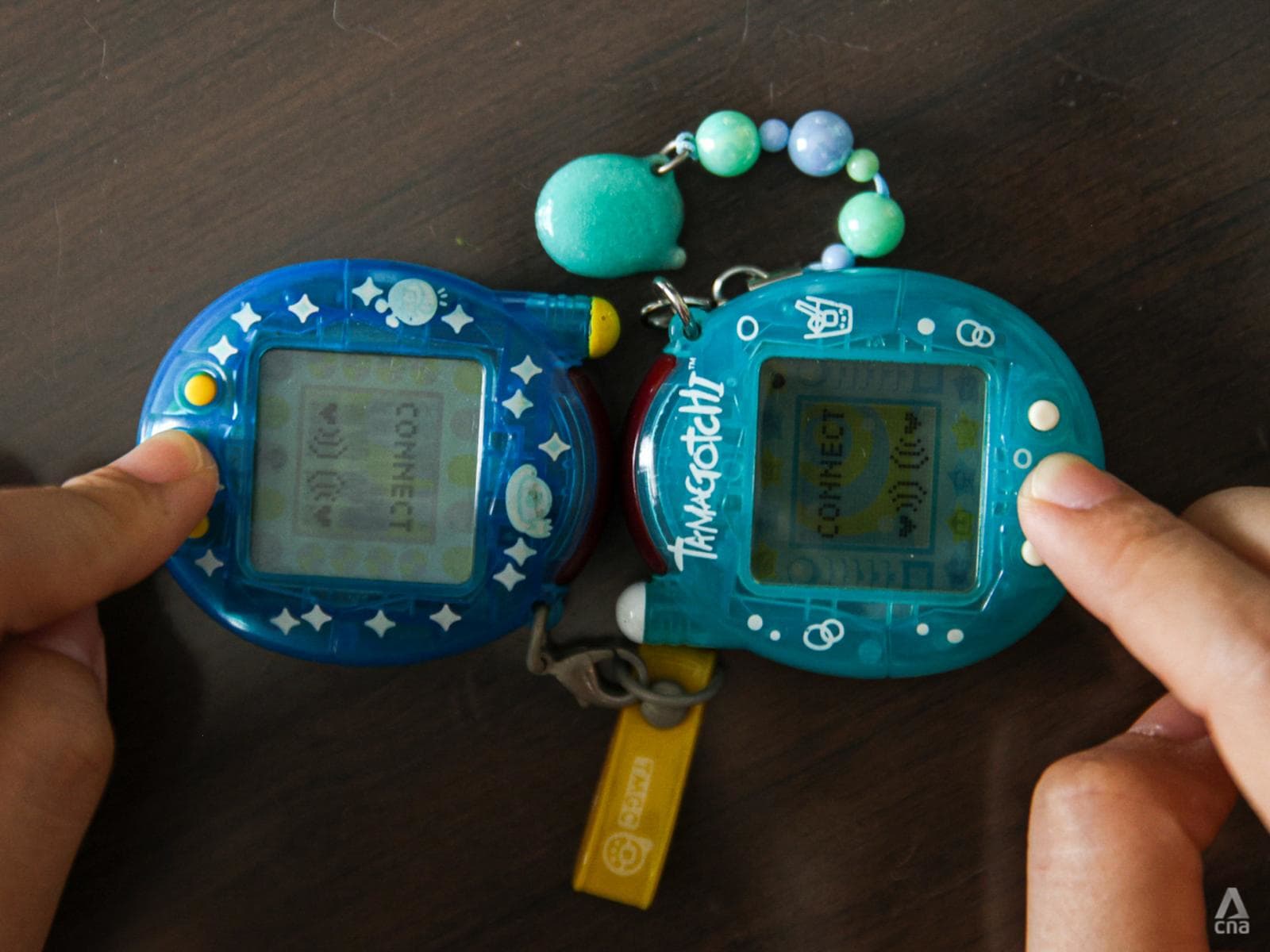
Ms Rachel Liew connecting two vintage Tamagotchi Connection Version 3 devices via infrared technology. (Photo: CNA/Nuria Ling)

27 Dec 2024 09:30PM (Updated: 16 Oct 2025 12:05AM)

It was a game from Japan that became a rage in the 1990s, with people glued to a round-shaped gadget where they had to feed, clean and give some tender loving care to a virtual pet they "hatched" or else it will die.

Tamagotchi, the game and "handheld toy", also created a stir because it was deemed disruptive, with players obsessed with minding and tending to a cyber creature at every beep and notification from the bright and colourful device, to the detriment of their studies and other real-life activities.

Most of the children and adults who had played Tamagotchi may have outgrown it by now, but the game is not dead.

It has launched a comeback, captivating the interest of a new generation of digital natives and reviving the interest of some hardcore fans who had grown up with the game.  

CNA Games
Show More
Show Less

Ms Rachel Liew, 34, a human resource trainer, was one of those who had played with a Tamagotchi pet as a child. She said: “To me, Tamagotchi is not a toy. It’s more like a companion."

“It’s like a friend or a pet that is constantly sticking by your side and giving you that emotional support.”

Ms Liew started collecting the toy in 2013 and now has 180 of them in her possession. 

Some of her rare Tamagotchi devices are even on loan to the National Museum of Singapore for an ongoing exhibition. 

This weekend, In Pixels looks at some retro gadgets from the 1990s owned by three collectors, to find out why some millennials (also known as Generation Y, born between 1981 and 1996) and Gen Zers (born from 1997 onwards) are keeping them humming. 
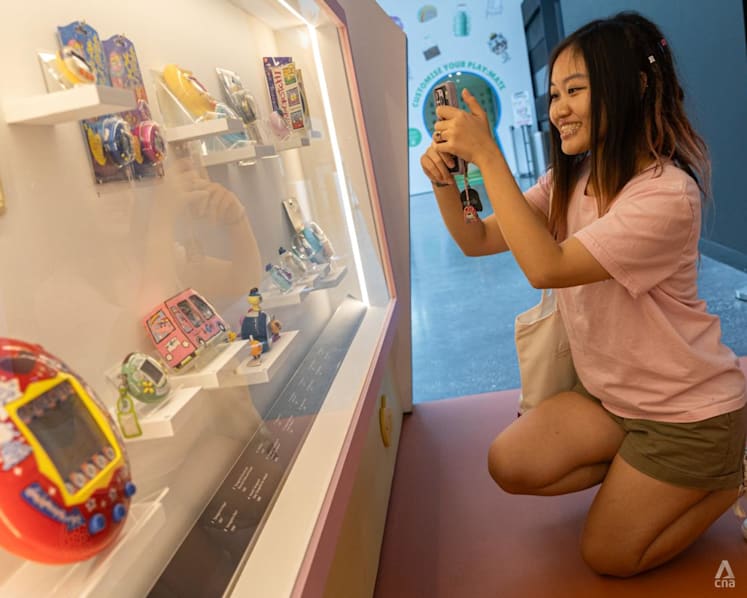
Ms Rachel Liew taking a video of her Tamagotchi collection that she has lent to the National Museum of Singapore for its Play:Date exhibition. (Photo: CNA/Nuria Ling)

THE ORIGINAL DIGITAL PET

Like many millennials who wanted a Tamagotchi toy as a child, Ms Liew got her first virtual pet at seven years old because a real pet would be, in her parents’ words, “too much responsibility”.

“I still remember carrying it everywhere, even to church,” she said.

“My mum would take it with her and help me take care of it during school hours and return it to me after school.”
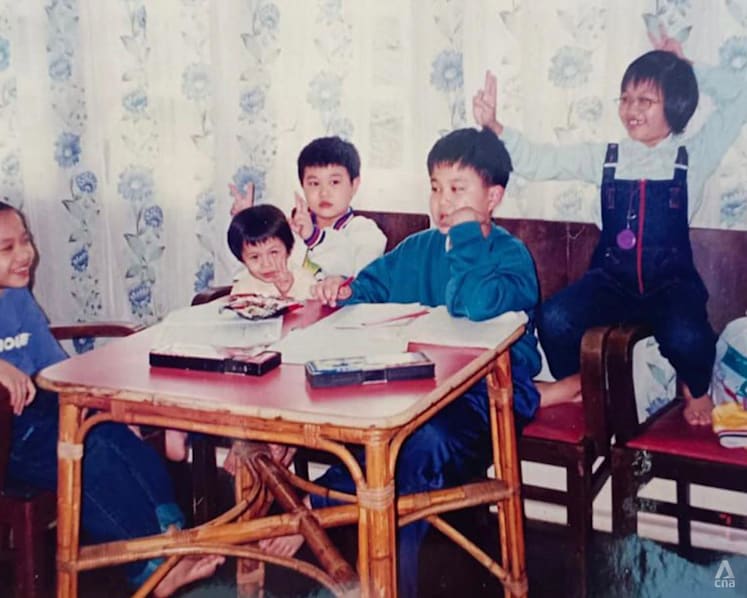
A photo of Ms Rachel Liew as a child (far right) taken when she was nine years old, with a handheld virtual pet worn around her neck. (Photo: Rachel Liew)
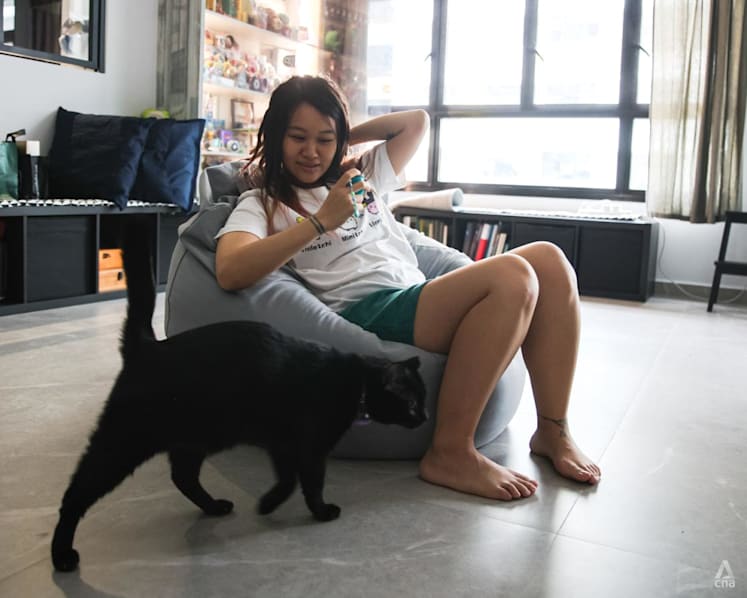
Quinn, one of Ms Liew’s three pet cats, walking past her as she plays with her Tamagotchi virtual pet. (Photo: CNA/Nuria Ling)
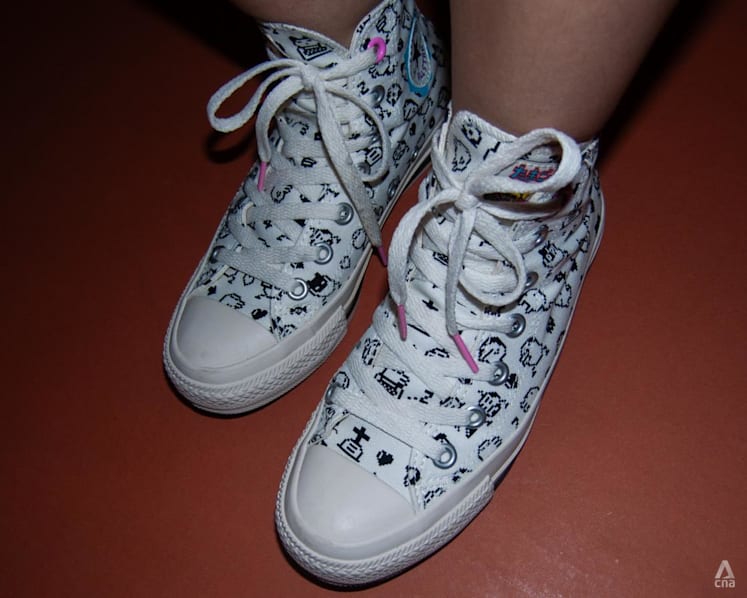
Ms Rachel Liew’s Tamagotchi-themed sneakers that she bought in Japan. (Photo: CNA/Nuria Ling)
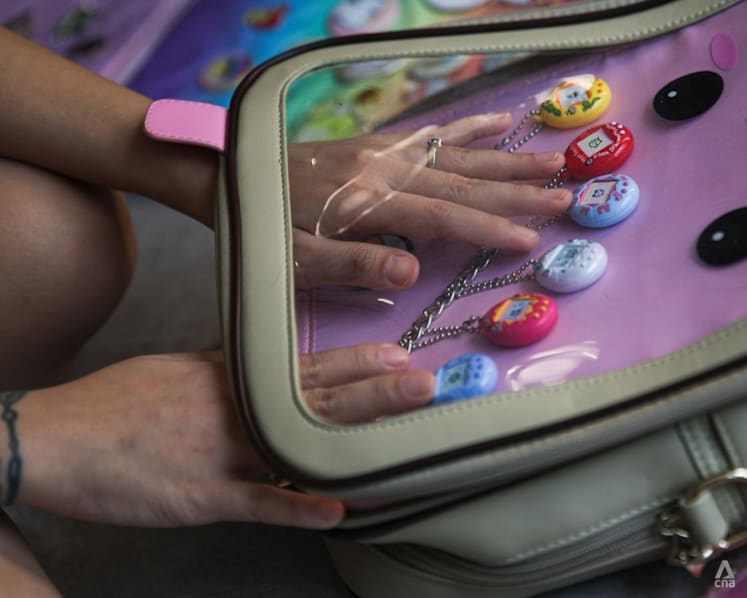
Ms Rachel Liew arranging Tamagotchi keychains on her bag for display. (Photo: CNA/Nuria Ling)

Ms Liew's love for Tamagotchi was rekindled when she started working and could afford to buy her own toys.

Over the years, she has spent around S$6,000 to S$7,000 on her collection but she estimates that it is now worth three times more. 

For instance, a S$50 Tamagotchi she bought in a toy store in Singapore in 2011 comes with a full-colour screen and is now selling for as much as S$400 online. 
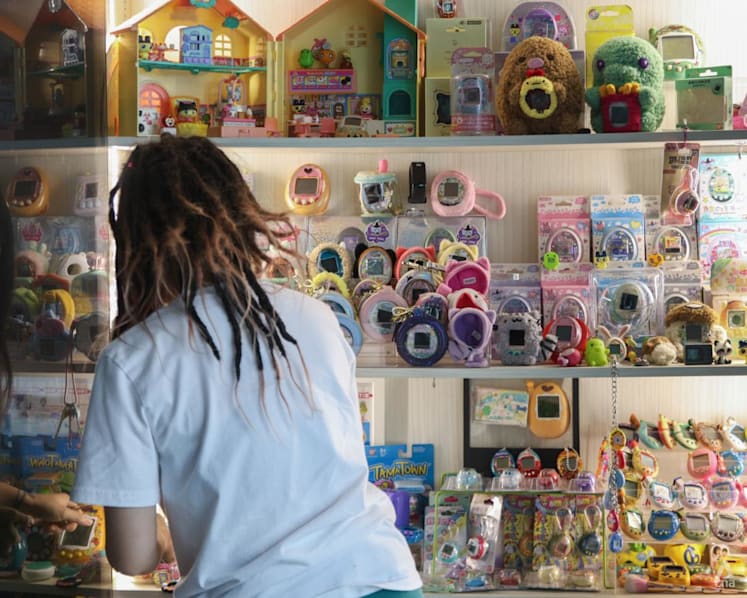
A view of the glass cabinet where Ms Rachel Liew keeps her Tamagotchi toys. The cabinet has ultraviolet protection to prevent the plastic shells of the devices from turning yellow (Photo: CNA/Nuria Ling).

The game, first launched in 1996, is not just for collectors. 

British news channel BBC reported that global sales of Tamagotchi more than doubled between 2022 and 2023. 

The gadget is sold at several of the major toy stores in Singapore. 

Bandai Namco, the company behind the toy, released exact replicas of the first generation of Tamagotchi in 2017, as well as other vintage models over the years. 

Rare versions that are out of production have become collectors' items that can fetch hundreds of dollars. They are sold online on auction sites such as eBay, Tamagotchi trading groups on Facebook or on platforms trading secondhand goods.

The newest versions of the Tamagotchi have extra features such as a full-colour screen, Wi-Fi connection and the option to “purchase furniture” to design your Tamagotchi’s room.

Advertisement

In Pixels

Snakes and marine life you don’t always see at Sentosa
Snakes and marine life you don’t always see at Sentosa

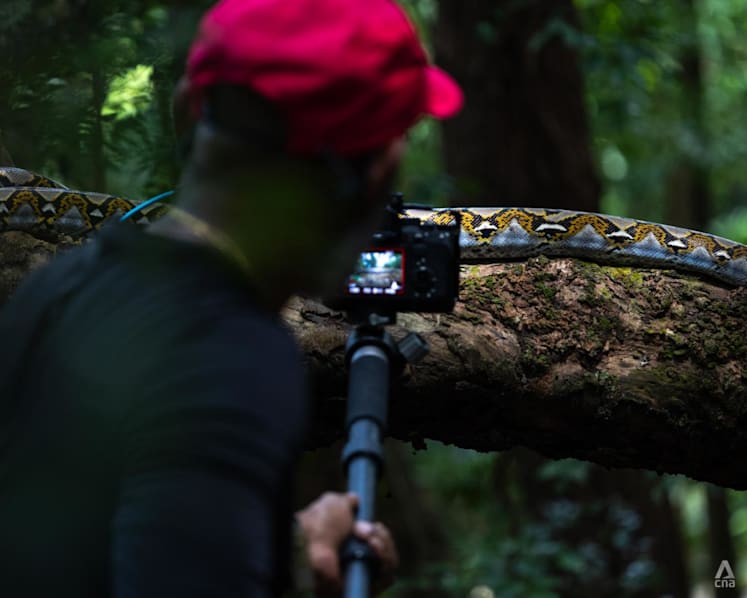
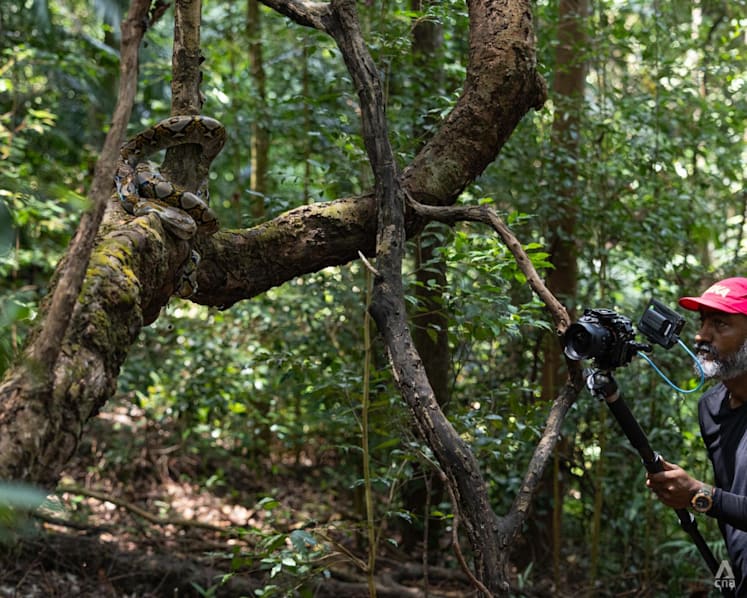
A 2-metre juvenile reticulated python slithering across a tree branch in front of filmmaker Jayaprakash Bojan. The snake was found near Palawan Green on Sentosa Island and was rehomed in a forested area nearby. (Photo: CNA/Raj Nadarajan)

04 Oct 2024 09:30PM (Updated: 16 Oct 2025 12:12AM)

There was palpable tension in the air as a black bag was taken to the forest. 

Inside was a 2-metre juvenile reticulated python. 

The snake with diamond-patterned skin was being relocated to a forested area on Sentosa Island by the wildlife management team of the Sentosa Development Corporation (SDC), after it was spotted in a high foot-traffic area.

Standing very still just a few metres away were two professional filmmakers and a photographer, patiently waiting for the snake to emerge. 

CNA Games
Show More
Show Less

They did not have to wait long.

In just a couple of minutes, the python slithered out of the bag and gradually made its way up a tree. 

The team then waited another four hours for the snake to make its way down from the tree as they observed its movements on camera.

In Pixels takes you this weekend on a visual trip with wildlife filmmakers Jayaprakash “JP” Bojan and Ian Mun, as they document Sentosa’s biodiversity and conservation efforts for Earth in Focus, a nature film festival set to take place in November on the resort island south of mainland Singapore. 
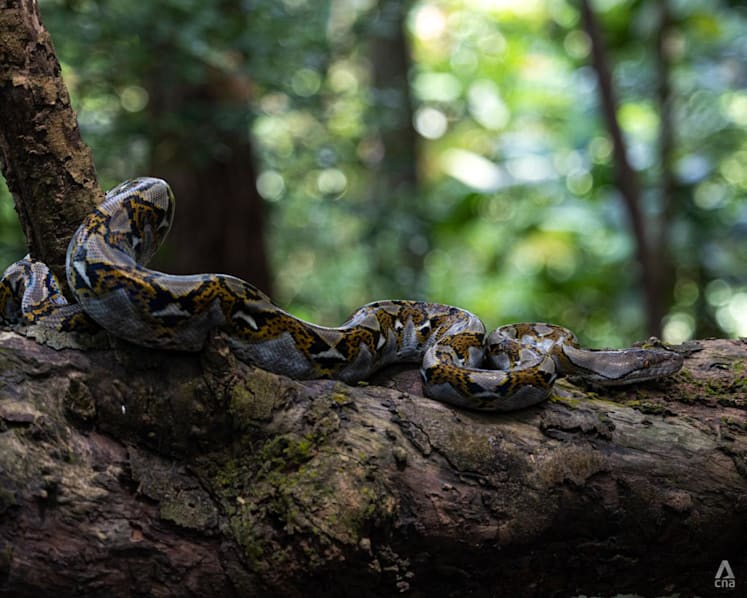
Reticulated pythons are native to Singapore and they are commonly found in secondary forests with a water supply. (Photo: CNA/Raj Nadarajan)
Photographer and filmmaker Jayaprakash Bojan, fondly known as JP, attaching a camera to a monopod to capture footage of a python from a safe distance. (Photo: CNA/Raj Nadarajan)
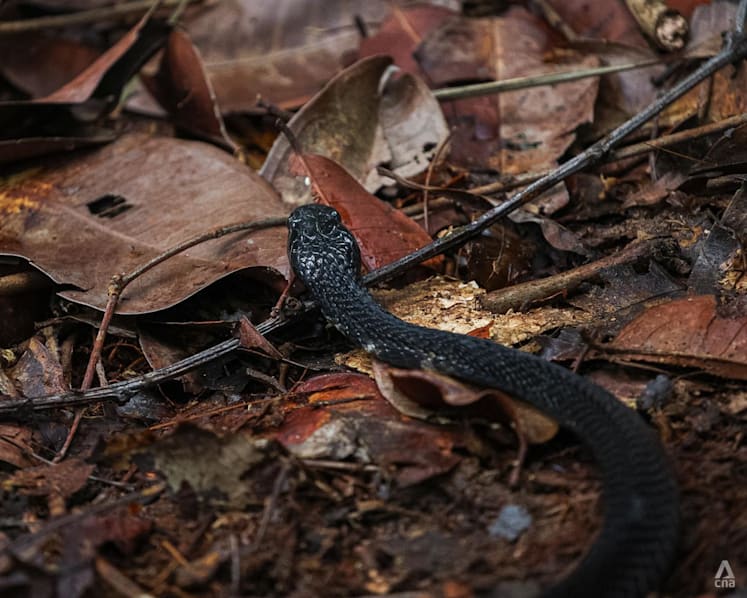
A spitting cobra found in a drain at Fort Siloso in Sentosa was relocated to a forested area on the island. A team of filmmakers had been shooting in Sentosa thrice a week for three months but this was the first time that they were coming face-to-face with a venomous snake on the island. (Photo: CNA/Nuria Ling)

Sentosa is a tourist destination known for its themed parks and sandy beaches. The island’s free-roaming peacocks are probably its most well-known wildlife. 

Off the beaten tracks, though, in the forested areas or along the rocky shores, there is a rich biodiversity of flora and fauna unknown to many visitors.

One rare species found in the coastal forests is the Xylocarpus rumphii, a critically endangered plant that has not been discovered elsewhere on mainland Singapore. 

There is also the elusive lesser bamboo bat, one of the smallest mammals on earth. 

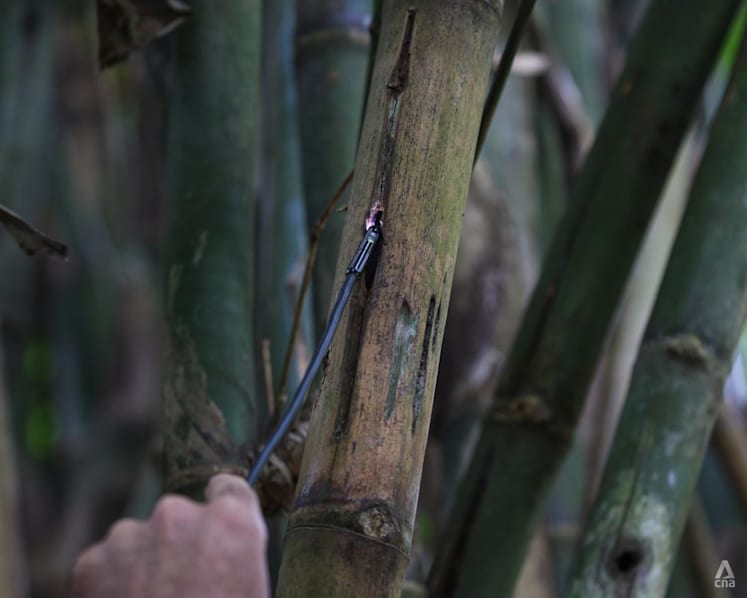
This vulnerable bat species, which weighs just a few grams, has a flattened skull that allows it to squeeze in a hollow bamboo shoot to roost, through narrow slits created by beetles.

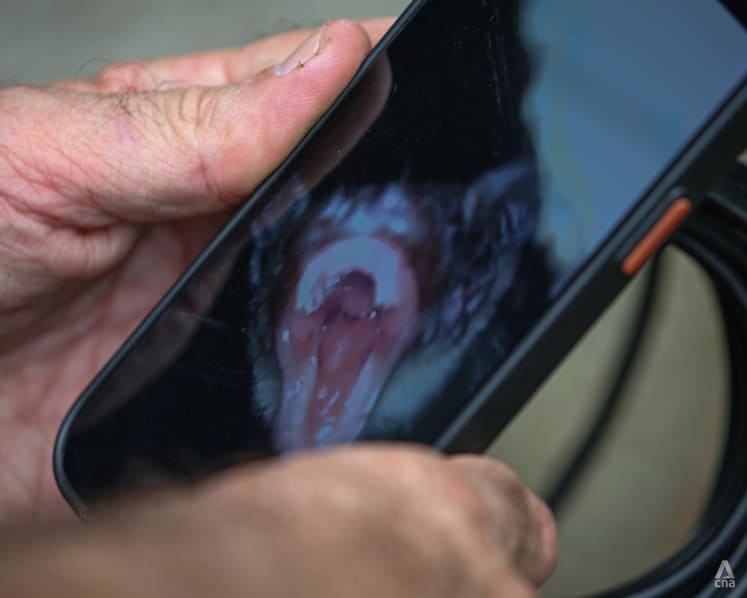
A bamboo bat captured on video after being awakened by the endoscope. (Photo: CNA/Nuria Ling)
An endoscope being used to check on lesser bamboo bats that live inside bamboo plants. (Photo: CNA/Nuria Ling)

Sentosa is home to 850 flora and fauna species. 

Setting up camera traps is one way that the conservation team is able to track and protect the wildlife on the island.  

Unlike what it sounds, camera traps do not trap animals. They are cameras with sensors put up in animal habitats for a duration to record images of wildlife and collect data on them.

The team has deployed eight such cameras in biodiversity-sensitive habitats around the island and the cameras are checked every alternate month. 

Advertisement

In Pixels

Inside a dragon kiln where temperatures go up to 1,300°C

Inside a dragon kiln where temperatures go up to 1,300°C

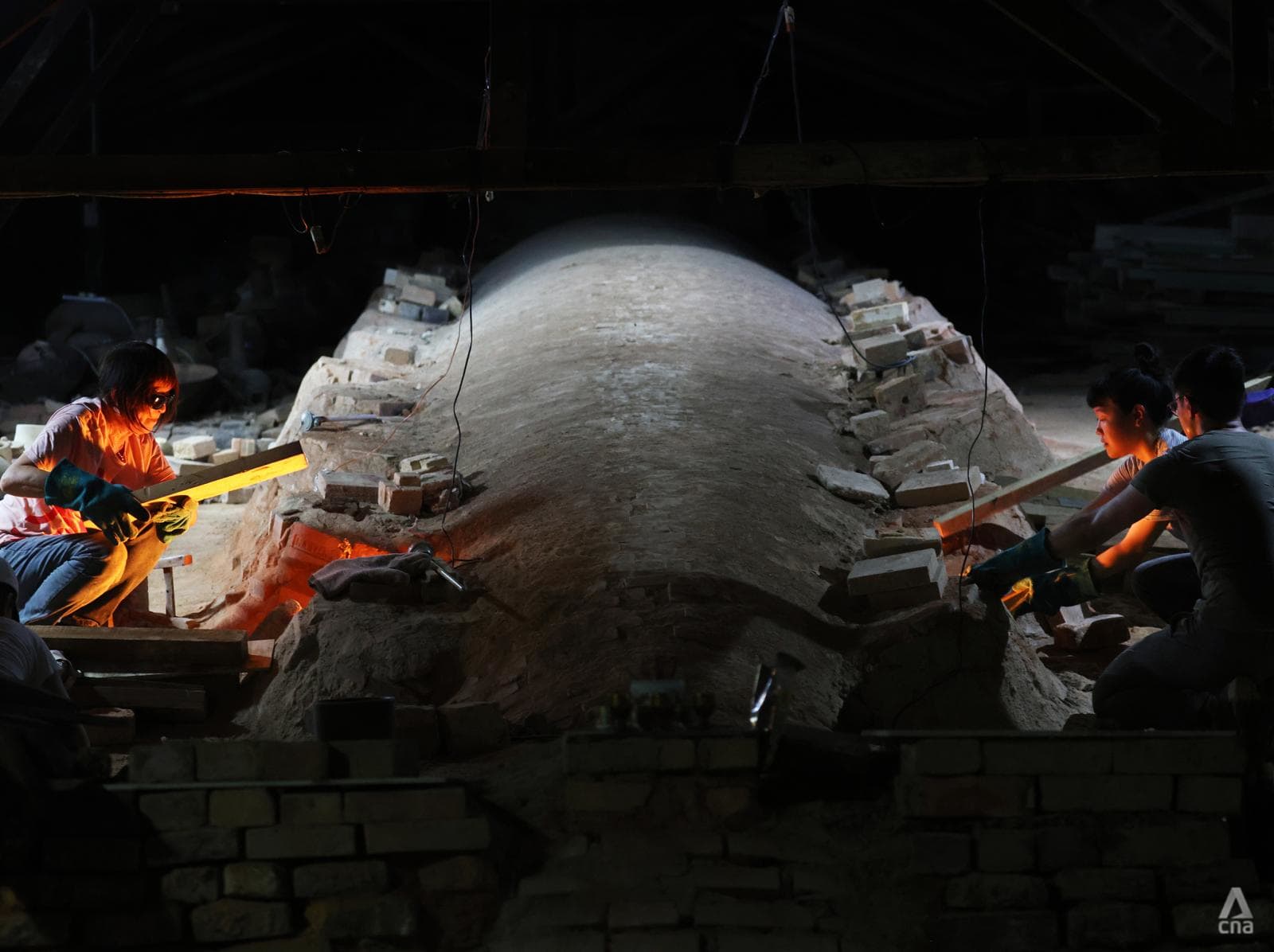
Wood-firing at a dragon kiln is a community effort that requires round-the-clock monitoring. (Photo: CNA/Ooi Boon Keong)

15 Nov 2024 09:30PM (Updated: 16 Oct 2025 12:09AM)

Nestled in an industrial estate in the western part of Singapore is an 84-year-old dragon kiln, the oldest and the only operational dragon kiln in the country. 

Built in 1940, the kiln at Thow Kwang Pottery Jungle was originally used for the mass production of household and industrial items such as cups and flower pots.

Over the decades, the place has evolved into a community space, now offering classes and events for potters to hone their craft. 

CNA TODAY joined the potter community for a wood-firing session that happens only two or three times a year.

CNA Games
Show More
Show Less

In Pixels takes you through the experience, as new and seasoned potters bond over fire and perspiration, creating unique works of art. 

PRAYERS TO THE "KILN GOD"  

At Thow Kwang Pottery Jungle, which is located a short distance from Nanyang Technological University, a group of around 30 people gathered on a Friday last month in front of the kiln.

This was at the request of the owners, Mr Tan Teck Yoke, 68, and his wife Yulianti Tan, 66. 

A prayer ceremony to the "kiln god" was about to begin. 

“We are praying to the ‘kiln god’ for a successful firing, for the pieces to achieve the desired effects,” Mr Tan explained to the enthusiastic participants. 

To this, the crowd responded by shouting, “Heng, ong, huat, ah,” a phrase in the Chinese dialect of Hokkien that collectively means wishing for good fortune.

Mrs Yulianti Tan and Mr Tan Teck Yoke, owners of Thow Kwang Pottery Jungle, praying for a successful wood-firing session. (Photo: CNA/Ooi Boon Keong)

After the prayers were done, the fire box, which is a small opening at the front of the kiln, was lit. 

The participants each picked up a piece of wood to throw into the fire, hoping to add more "luck" to the process. 

During wood-firing in a kiln, the fire and the ashes from the wood react with the glaze on the ceramic items to produce a unique and rustic look. (Photo: CNA/Ooi Boon Keong)

The dragon kiln was bought by Mr Tan’s father in 1965 and has been owned by the family since then.

It sits on a slope, is 27-metres long, 2-metres wide and curves around the side, resembling the body of a dragon in Chinese mythology. 

Its lengthy chambers are made out of bricks and there is a chimney at the end, located at the top of the slope.

The kiln can fit thousands of pieces of ceramic items, depending on the size of the pots. 

For this firing session, around 400 to 500 pieces were loaded in the kiln. 

NEW WAYS TO IMPROVE PROCESS

Temperatures in the dragon kiln can reach up to 1,300°C. 

They can fluctuate significantly due to the shape of the furnace and the use of wood as a fuel.

That is why one of the most crucial parts of the process is to monitor the temperature for all three days of the firing session.

Mr Chua Hee Lai, who is in his 50s and a hobbyist-turned-kiln master, helped to plan and lead each firing session. 

Mr Chua Hee Lai (right) installing thermocouples on the slopes of an 84-year-old kiln to monitor the temperatures. (Photo: CNA/Ooi Boon Keong)

In 2019, Mr Chua, with the help of another potter, introduced a digital monitoring system that allowed them to track the temperatures remotely and give instructions to the potters doing shift work on site. 

Previously, they had to monitor the temperature by looking at the colour of the flame or record temperatures manually and then draw up prediction charts – a process that requires them to be on site for longer periods of time.

When the temperatures start to dip, potters will add more wood into the fire. (Photo: CNA/Ooi Boon Keong)
Potters handling large pieces of wood to be fed into a fire box. (Photo: CNA/Ooi Boon Keong)
The effect of burning heat can be seen in the different skin colours of a potter’s arms, after he stood near the kiln's fire box for some time to keep the flame going. (Photo: CNA/Ooi Boon Keong)
Cheers breaking out as the target wood-firing temperature of 1,260°C was about to be reached. (Photo: CNA/Ooi Boon Keong)

THE "KAMPUNG SPIRIT"

Advertising executive Vanessa Low and product manager Goh Wei Ting, both 31, have been practising pottery at another pottery studio for around five years and this was their first time taking part in the wood-firing process.

Compared to a regular firing in an electric or gas kiln, wood-firing is "tiring and physically demanding", Mr Goh said.

However, they were buoyed by the “kampung spirit” or the sense of camaraderie that came about as participants laboured together. 

 “You just don’t feel tired, you just do (the work),” Mr Goh added. 

A group of young potters who are new to wood-firing taking photos near the kiln. (Photo: CNA/Ooi Boon Keong)
Experienced and new potters forming a human chain to carry pieces of wood to be used for the firing. (Photo: CNA/Ooi Boon Keong)
Participants having a lively potluck dinner, a brief respite from the day’s hard work. (Photo: CNA/Ooi Boon Keong)
After dinner, potters sitting around and chatting in front of the fire while monitoring the kiln. (Photo: CNA/Ooi Boon Keong)

OPENING OF THE KILN

Six days after the firing at the dragon kiln, the participants returned to open the kiln and check on their art pieces. 

“Shall we form a chain?” someone suggested to facilitate the removal of the brick walls. 

Without hesitation, a human chain quickly formed as the potters unsealed the kiln, one brick at a time. 

Potters in the process of dismantling the brick walls, in order to get into the kiln's chambers. (Photo: CNA/Ooi Boon Keong)
Breaking down the final wall to reach the last shelves holding pottery items. (Photo: CNA/Ooi Boon Keong)
The residual heat from the firing was keenly felt by the potters inside the kiln. (Photo: CNA/Ooi Boon Keong)
Each piece of pottery was removed carefully from the shelves and moved out in batches. (Photo: CNA/Ooi Boon Keong)
Finally, potters reached the chamber closest to the fire box. Only one person is able to reach the items in the narrow chamber. (Photo: CNA/Ooi Boon Keong)

A collective “wow” sounded as the final bricks were removed, revealing the final outcome of the nine-day process that comprised three days of firing and six days of cooling.

The potters carefully removed the art pieces from the shelves, while admiring the effects that the fire had on their work. 

Advertisement

In Pixels

Meet the 70-year-old lorry driver who is also a 'kite doctor'

Meet the 70-year-old lorry driver who is also a 'kite doctor'

Kite maker Tan Poh Wah flying his handmade dragon kite at the Marina Barrage. (Photo: CNA/Nuria Ling)

30 Nov 2024 09:30PM (Updated: 16 Oct 2025 12:08AM)

Rolling up to Marina Barrage with a trolley bag full of handmade kites and repair tools, Mr Tan Poh Wah had one clear mission for the day: To share his love of kite-flying with others. 

Known informally as the “kite doctor” among the regular visitors there, the 70-year-old spends most Sundays repairing kites or offering his handmade ones – mostly for free – to people at the open-air space that is the venue of Singapore's largest reservoir. 

“Watching people fly my kites makes me really happy,” Mr Tan said.  

This weekend, In Pixels speaks to four enthusiasts to find out what excites them about kite-flying. 

A FAMILIAR FIGURE

CNA Games
Show More
Show Less

Shortly after Mr Tan turned up at Marina Barrage in the Marina Bay area, a handful of people who wanted their kites repaired immediately made a beeline towards him. 

They offered him drinks and snacks to thank him for his service. 

Mr Tan Poh Wah fixing a kite for a member of the public at the Marina Barrage. (Photo: CNA/Mak Jia Kee)
A variety of sticks and other kite parts are some of the things in Mr Tan Poh Wah’s kit that he takes to the Marina Barrage. (Photo: CNA/Nuria Ling)

When he was done with the repairs, Mr Tan pulled a kite from his bag and launched it to the sky. 

He flew it with ease, strolling around the field, eager to find someone who will take the kite as a gift. 

His masterpieces are made mostly from recycled materials including plastic bags, discarded blinds, banners and umbrellas. 

Mr Tan Poh Wah holding up a kite he made using a supermarket plastic bag. (Photo: CNA/Mak Jia Kee)
Mr Tan Poh Wah with a handmade kite made out of recycled materials. (Photo: CNA/Nuria Ling)

Mr Tan is part of a group known as Singapore Original Kites, an informal gathering of adults in their 60s and 70s who share the same interest in making and flying kites.  

A semi-retired Chinese physician ​​Ong Cheng Her, 75, is the founder of the group.

He said that the only prerequisite to join the group is one’s ability to make a kite from scratch.  

He proudly showed CNA TODAY one of his creations, a red and white "umbrella kite". 

“Umbrellas are used for shade and rain protection, so why hasn’t anyone flown an umbrella kite? I decided to take on the challenge,” Mr Ong added.

Mr Ong Cheng Her, founder of the Singapore Original Kites group, holding an "umbrella kite" that he made in 2023. (Photo: CNA/Nuria Ling )
Mr Ong Cheng Her holding a kite he made, featuring flower and leaf patterns inspired by traditional Chinese paintings. (Photo: CNA/Mak Jia Kee)

HIS WORKSPACE AT HOME

As for Mr Tan, he is not retired, so flying and making kites is what he does only on Sundays.

He works six days a week as a lorry driver.

“I work to live, to fill my stomach so I can make kites.”

Stepping into his flat, Mr Tan led us to his "studio", which is a room filled with a bountiful supply of kites and raw materials. 

He described his workspace as a “chaotic but organised mess”. 

“My wife sometimes asks why I collect so many umbrellas, but she doesn’t interfere much because she knows I enjoy making these things.”

Mr Tan Poh Wah tying a ribbon to a bamboo stick to form part of a kite. (Photo: CNA/Nuria Ling)

Mr Tan has loved kite flying since he was a child, but it was not until he was in his 30s that he took to making kites himself.

A self-taught craftsman, he said that he learnt how to make kites by observing other kite-makers whenever an opportunity comes along. 

Mr Tan Poh Wah crafting a squid kite in his workshop that he set up in his flat. (Photo: CNA/Nuria Ling)
Mr Tan Poh Wah laying out pieces of a 70m-long "dragon kite" in his living room. (Photo: CNA/Nuria Ling)

Recently, Mr Tan finished repairing a 70m-long "dragon kite" that he first constructed in 2000. It broke at a kite festival in Taiwan in 2019 and required extensive repairs. 

After CNA TODAY approached him for an interview, Mr Tan said that he found new inspiration to repair the kite, which took him four Sundays to complete.

It was obvious that he is most proud of this kite among the many in his collection.

“Anyone who hasn't made a dragon or a phoenix kite isn't truly considered a kite maker,” he said, adding that these long kites are made up of many different sections and each needed to be crafted with great precision before they are finally stitched together. 

A 70m-long "dragon kite" made by Mr Tan Poh Wah flying at Marina Barrage. (Photo: CNA/Nuria Ling)

"GIANTS" IN THE SKY

Over at East Coast Park, another group of kite enthusiasts have gathered and their presence could be spotted from afar. 

The kites they have taken out, called "inflatable show kites", are gigantic balloon-like kites that are typically several metres in length when inflated.

Traditional kites rely on rigid frames for support, but inflatable show kites have no hard structures. They inflate as they catch on the wind and have to be anchored to the ground.

An inflatable show kite flying at East Coast Park. (Photo: CNA/Nuria Ling)
Mr Johnny Yap checking on a 10m-tall seahorse-shaped inflatable show kite. (Photo: CNA/Mak Jia Kee)

Project coordinator Johnny Yap and his wife Maggie Mok, a homemaker, both 51, are the founders of Show Kites Singapore, a group of people who are into these inflatable show kites.

The duo's interest in this started nearly 20 years ago when they took their children kite-flying. 

In the end, it was the couple themselves who got hooked on the activity. 

“We started flying bigger and bigger kites and before long, we realised that stick kites have a limit,” Mr Yap said.

This led them to explore inflatable ones in 2009 and they came across these kites online before buying their first. The sky is the limit when it comes to the sizes of such kites.

Ms Maggie Mok examining the flying cord of an inflatable show kite. (Photo: CNA/Mak Jia Kee)
Mr Johnny Yap fixing the attached strings on his show kite. (Photo: CNA/Nuria Ling)
Mr Johnny Yap holding open an inflation vent for air to fill up the kite. (Photo: CNA/Nuria Ling)

As their interests grew, Mr Yap and Ms Mok started travelling overseas to take part in international kite festivals. 

In September, they were at the International Kite Festival in Melaka, Malaysia, where they flew an inflatable show kite in the form of Singapore's tourism icon, the Merlion.

Advertisement

In Pixels

Inside a dragon kiln where temperatures go up to 1,300°C

Inside a dragon kiln where temperatures go up to 1,300°C

Wood-firing at a dragon kiln is a community effort that requires round-the-clock monitoring. (Photo: CNA/Ooi Boon Keong)

15 Nov 2024 09:30PM (Updated: 16 Oct 2025 12:09AM)

Nestled in an industrial estate in the western part of Singapore is an 84-year-old dragon kiln, the oldest and the only operational dragon kiln in the country. 

Built in 1940, the kiln at Thow Kwang Pottery Jungle was originally used for the mass production of household and industrial items such as cups and flower pots.

Over the decades, the place has evolved into a community space, now offering classes and events for potters to hone their craft. 

CNA TODAY joined the potter community for a wood-firing session that happens only two or three times a year.

CNA Games
Show More
Show Less

In Pixels takes you through the experience, as new and seasoned potters bond over fire and perspiration, creating unique works of art. 

PRAYERS TO THE "KILN GOD"  

At Thow Kwang Pottery Jungle, which is located a short distance from Nanyang Technological University, a group of around 30 people gathered on a Friday last month in front of the kiln.

This was at the request of the owners, Mr Tan Teck Yoke, 68, and his wife Yulianti Tan, 66. 

A prayer ceremony to the "kiln god" was about to begin. 

“We are praying to the ‘kiln god’ for a successful firing, for the pieces to achieve the desired effects,” Mr Tan explained to the enthusiastic participants. 

To this, the crowd responded by shouting, “Heng, ong, huat, ah,” a phrase in the Chinese dialect of Hokkien that collectively means wishing for good fortune.

Mrs Yulianti Tan and Mr Tan Teck Yoke, owners of Thow Kwang Pottery Jungle, praying for a successful wood-firing session. (Photo: CNA/Ooi Boon Keong)

After the prayers were done, the fire box, which is a small opening at the front of the kiln, was lit. 

The participants each picked up a piece of wood to throw into the fire, hoping to add more "luck" to the process. 

During wood-firing in a kiln, the fire and the ashes from the wood react with the glaze on the ceramic items to produce a unique and rustic look. (Photo: CNA/Ooi Boon Keong)

The dragon kiln was bought by Mr Tan’s father in 1965 and has been owned by the family since then.

It sits on a slope, is 27-metres long, 2-metres wide and curves around the side, resembling the body of a dragon in Chinese mythology. 

Its lengthy chambers are made out of bricks and there is a chimney at the end, located at the top of the slope.

The kiln can fit thousands of pieces of ceramic items, depending on the size of the pots. 

For this firing session, around 400 to 500 pieces were loaded in the kiln. 

NEW WAYS TO IMPROVE PROCESS

Temperatures in the dragon kiln can reach up to 1,300°C. 

They can fluctuate significantly due to the shape of the furnace and the use of wood as a fuel.

That is why one of the most crucial parts of the process is to monitor the temperature for all three days of the firing session.

Mr Chua Hee Lai, who is in his 50s and a hobbyist-turned-kiln master, helped to plan and lead each firing session. 

Mr Chua Hee Lai (right) installing thermocouples on the slopes of an 84-year-old kiln to monitor the temperatures. (Photo: CNA/Ooi Boon Keong)

In 2019, Mr Chua, with the help of another potter, introduced a digital monitoring system that allowed them to track the temperatures remotely and give instructions to the potters doing shift work on site. 

Previously, they had to monitor the temperature by looking at the colour of the flame or record temperatures manually and then draw up prediction charts – a process that requires them to be on site for longer periods of time.

When the temperatures start to dip, potters will add more wood into the fire. (Photo: CNA/Ooi Boon Keong)
Potters handling large pieces of wood to be fed into a fire box. (Photo: CNA/Ooi Boon Keong)
The effect of burning heat can be seen in the different skin colours of a potter’s arms, after he stood near the kiln's fire box for some time to keep the flame going. (Photo: CNA/Ooi Boon Keong)
Cheers breaking out as the target wood-firing temperature of 1,260°C was about to be reached. (Photo: CNA/Ooi Boon Keong)

THE "KAMPUNG SPIRIT"

Advertising executive Vanessa Low and product manager Goh Wei Ting, both 31, have been practising pottery at another pottery studio for around five years and this was their first time taking part in the wood-firing process.

Compared to a regular firing in an electric or gas kiln, wood-firing is "tiring and physically demanding", Mr Goh said.

However, they were buoyed by the “kampung spirit” or the sense of camaraderie that came about as participants laboured together. 

 “You just don’t feel tired, you just do (the work),” Mr Goh added. 

A group of young potters who are new to wood-firing taking photos near the kiln. (Photo: CNA/Ooi Boon Keong)
Experienced and new potters forming a human chain to carry pieces of wood to be used for the firing. (Photo: CNA/Ooi Boon Keong)
Participants having a lively potluck dinner, a brief respite from the day’s hard work. (Photo: CNA/Ooi Boon Keong)
After dinner, potters sitting around and chatting in front of the fire while monitoring the kiln. (Photo: CNA/Ooi Boon Keong)

OPENING OF THE KILN

Six days after the firing at the dragon kiln, the participants returned to open the kiln and check on their art pieces. 

“Shall we form a chain?” someone suggested to facilitate the removal of the brick walls. 

Without hesitation, a human chain quickly formed as the potters unsealed the kiln, one brick at a time. 

Potters in the process of dismantling the brick walls, in order to get into the kiln's chambers. (Photo: CNA/Ooi Boon Keong)
Breaking down the final wall to reach the last shelves holding pottery items. (Photo: CNA/Ooi Boon Keong)
The residual heat from the firing was keenly felt by the potters inside the kiln. (Photo: CNA/Ooi Boon Keong)
Each piece of pottery was removed carefully from the shelves and moved out in batches. (Photo: CNA/Ooi Boon Keong)
Finally, potters reached the chamber closest to the fire box. Only one person is able to reach the items in the narrow chamber. (Photo: CNA/Ooi Boon Keong)

A collective “wow” sounded as the final bricks were removed, revealing the final outcome of the nine-day process that comprised three days of firing and six days of cooling.

The potters carefully removed the art pieces from the shelves, while admiring the effects that the fire had on their work. 

Advertisement

In Pixels

Meet the 70-year-old lorry driver who is also a 'kite doctor'

Meet the 70-year-old lorry driver who is also a 'kite doctor'

Kite maker Tan Poh Wah flying his handmade dragon kite at the Marina Barrage. (Photo: CNA/Nuria Ling)

30 Nov 2024 09:30PM (Updated: 16 Oct 2025 12:08AM)

Rolling up to Marina Barrage with a trolley bag full of handmade kites and repair tools, Mr Tan Poh Wah had one clear mission for the day: To share his love of kite-flying with others. 

Known informally as the “kite doctor” among the regular visitors there, the 70-year-old spends most Sundays repairing kites or offering his handmade ones – mostly for free – to people at the open-air space that is the venue of Singapore's largest reservoir. 

“Watching people fly my kites makes me really happy,” Mr Tan said.  

This weekend, In Pixels speaks to four enthusiasts to find out what excites them about kite-flying. 

A FAMILIAR FIGURE

CNA Games
Show More
Show Less

Shortly after Mr Tan turned up at Marina Barrage in the Marina Bay area, a handful of people who wanted their kites repaired immediately made a beeline towards him. 

They offered him drinks and snacks to thank him for his service. 

When he was done with the repairs, Mr Tan pulled a kite from his bag and launched it to the sky. 

He flew it with ease, strolling around the field, eager to find someone who will take the kite as a gift. 

His masterpieces are made mostly from recycled materials including plastic bags, discarded blinds, banners and umbrellas. 

Mr Tan Poh Wah holding up a kite he made using a supermarket plastic bag. (Photo: CNA/Mak Jia Kee)
Mr Tan Poh Wah with a handmade kite made out of recycled materials. (Photo: CNA/Nuria Ling)

Mr Tan is part of a group known as Singapore Original Kites, an informal gathering of adults in their 60s and 70s who share the same interest in making and flying kites.  

A semi-retired Chinese physician ​​Ong Cheng Her, 75, is the founder of the group.

He said that the only prerequisite to join the group is one’s ability to make a kite from scratch.  

He proudly showed CNA TODAY one of his creations, a red and white "umbrella kite". 

“Umbrellas are used for shade and rain protection, so why hasn’t anyone flown an umbrella kite? I decided to take on the challenge,” Mr Ong added.

Mr Ong Cheng Her, founder of the Singapore Original Kites group, holding an "umbrella kite" that he made in 2023. (Photo: CNA/Nuria Ling )
Mr Ong Cheng Her holding a kite he made, featuring flower and leaf patterns inspired by traditional Chinese paintings. (Photo: CNA/Mak Jia Kee)

HIS WORKSPACE AT HOME

As for Mr Tan, he is not retired, so flying and making kites is what he does only on Sundays.

He works six days a week as a lorry driver.

“I work to live, to fill my stomach so I can make kites.”

Stepping into his flat, Mr Tan led us to his "studio", which is a room filled with a bountiful supply of kites and raw materials. 

He described his workspace as a “chaotic but organised mess”. 

“My wife sometimes asks why I collect so many umbrellas, but she doesn’t interfere much because she knows I enjoy making these things.”

Mr Tan Poh Wah tying a ribbon to a bamboo stick to form part of a kite. (Photo: CNA/Nuria Ling)

Mr Tan has loved kite flying since he was a child, but it was not until he was in his 30s that he took to making kites himself.

A self-taught craftsman, he said that he learnt how to make kites by observing other kite-makers whenever an opportunity comes along. 

Mr Tan Poh Wah crafting a squid kite in his workshop that he set up in his flat. (Photo: CNA/Nuria Ling)
Mr Tan Poh Wah laying out pieces of a 70m-long "dragon kite" in his living room. (Photo: CNA/Nuria Ling)

Recently, Mr Tan finished repairing a 70m-long "dragon kite" that he first constructed in 2000. It broke at a kite festival in Taiwan in 2019 and required extensive repairs. 

After CNA TODAY approached him for an interview, Mr Tan said that he found new inspiration to repair the kite, which took him four Sundays to complete.

It was obvious that he is most proud of this kite among the many in his collection.

“Anyone who hasn't made a dragon or a phoenix kite isn't truly considered a kite maker,” he said, adding that these long kites are made up of many different sections and each needed to be crafted with great precision before they are finally stitched together. 

A 70m-long "dragon kite" made by Mr Tan Poh Wah flying at Marina Barrage. (Photo: CNA/Nuria Ling)

"GIANTS" IN THE SKY

Over at East Coast Park, another group of kite enthusiasts have gathered and their presence could be spotted from afar. 

The kites they have taken out, called "inflatable show kites", are gigantic balloon-like kites that are typically several metres in length when inflated.

Traditional kites rely on rigid frames for support, but inflatable show kites have no hard structures. They inflate as they catch on the wind and have to be anchored to the ground.

An inflatable show kite flying at East Coast Park. (Photo: CNA/Nuria Ling)
Mr Johnny Yap checking on a 10m-tall seahorse-shaped inflatable show kite. (Photo: CNA/Mak Jia Kee)

Project coordinator Johnny Yap and his wife Maggie Mok, a homemaker, both 51, are the founders of Show Kites Singapore, a group of people who are into these inflatable show kites.

The duo's interest in this started nearly 20 years ago when they took their children kite-flying. 

In the end, it was the couple themselves who got hooked on the activity. 

“We started flying bigger and bigger kites and before long, we realised that stick kites have a limit,” Mr Yap said.

This led them to explore inflatable ones in 2009 and they came across these kites online before buying their first. The sky is the limit when it comes to the sizes of such kites.

Ms Maggie Mok examining the flying cord of an inflatable show kite. (Photo: CNA/Mak Jia Kee)
Mr Johnny Yap fixing the attached strings on his show kite. (Photo: CNA/Nuria Ling)
Mr Johnny Yap holding open an inflation vent for air to fill up the kite. (Photo: CNA/Nuria Ling)

As their interests grew, Mr Yap and Ms Mok started travelling overseas to take part in international kite festivals. 

In September, they were at the International Kite Festival in Melaka, Malaysia, where they flew an inflatable show kite in the form of Singapore's tourism icon, the Merlion.

Advertisement

In Pixels

Inside a dragon kiln where temperatures go up to 1,300°C

Inside a dragon kiln where temperatures go up to 1,300°C

Wood-firing at a dragon kiln is a community effort that requires round-the-clock monitoring. (Photo: CNA/Ooi Boon Keong)

15 Nov 2024 09:30PM (Updated: 16 Oct 2025 12:09AM)

Nestled in an industrial estate in the western part of Singapore is an 84-year-old dragon kiln, the oldest and the only operational dragon kiln in the country. 

Built in 1940, the kiln at Thow Kwang Pottery Jungle was originally used for the mass production of household and industrial items such as cups and flower pots.

Over the decades, the place has evolved into a community space, now offering classes and events for potters to hone their craft. 

CNA TODAY joined the potter community for a wood-firing session that happens only two or three times a year.

CNA Games
Show More
Show Less

In Pixels takes you through the experience, as new and seasoned potters bond over fire and perspiration, creating unique works of art. 

PRAYERS TO THE "KILN GOD"  

At Thow Kwang Pottery Jungle, which is located a short distance from Nanyang Technological University, a group of around 30 people gathered on a Friday last month in front of the kiln.

This was at the request of the owners, Mr Tan Teck Yoke, 68, and his wife Yulianti Tan, 66. 

A prayer ceremony to the "kiln god" was about to begin. 

“We are praying to the ‘kiln god’ for a successful firing, for the pieces to achieve the desired effects,” Mr Tan explained to the enthusiastic participants. 

To this, the crowd responded by shouting, “Heng, ong, huat, ah,” a phrase in the Chinese dialect of Hokkien that collectively means wishing for good fortune.

After the prayers were done, the fire box, which is a small opening at the front of the kiln, was lit. 

The participants each picked up a piece of wood to throw into the fire, hoping to add more "luck" to the process. 

The dragon kiln was bought by Mr Tan’s father in 1965 and has been owned by the family since then.

It sits on a slope, is 27-metres long, 2-metres wide and curves around the side, resembling the body of a dragon in Chinese mythology. 

Its lengthy chambers are made out of bricks and there is a chimney at the end, located at the top of the slope.

The kiln can fit thousands of pieces of ceramic items, depending on the size of the pots. 

For this firing session, around 400 to 500 pieces were loaded in the kiln. 

NEW WAYS TO IMPROVE PROCESS

Temperatures in the dragon kiln can reach up to 1,300°C. 

They can fluctuate significantly due to the shape of the furnace and the use of wood as a fuel.

That is why one of the most crucial parts of the process is to monitor the temperature for all three days of the firing session.

Mr Chua Hee Lai, who is in his 50s and a hobbyist-turned-kiln master, helped to plan and lead each firing session. 

In 2019, Mr Chua, with the help of another potter, introduced a digital monitoring system that allowed them to track the temperatures remotely and give instructions to the potters doing shift work on site. 

Previously, they had to monitor the temperature by looking at the colour of the flame or record temperatures manually and then draw up prediction charts – a process that requires them to be on site for longer periods of time.

THE "KAMPUNG SPIRIT"

Advertising executive Vanessa Low and product manager Goh Wei Ting, both 31, have been practising pottery at another pottery studio for around five years and this was their first time taking part in the wood-firing process.

Compared to a regular firing in an electric or gas kiln, wood-firing is "tiring and physically demanding", Mr Goh said.

However, they were buoyed by the “kampung spirit” or the sense of camaraderie that came about as participants laboured together. 

 “You just don’t feel tired, you just do (the work),” Mr Goh added. 

OPENING OF THE KILN

Six days after the firing at the dragon kiln, the participants returned to open the kiln and check on their art pieces. 

“Shall we form a chain?” someone suggested to facilitate the removal of the brick walls. 

Without hesitation, a human chain quickly formed as the potters unsealed the kiln, one brick at a time. 

A collective “wow” sounded as the final bricks were removed, revealing the final outcome of the nine-day process that comprised three days of firing and six days of cooling.

The potters carefully removed the art pieces from the shelves, while admiring the effects that the fire had on their work. 

Ms Tia Boon Sim, 69, one of the founders of Thow Kwang Clay Artists, a community group, said: “In wood-firing, the ashes from the fire would fly around and drop on the pieces and these are the effects potters love.”

When asked if she would do this again, Ms Low said: “I would want to come back with my friends for this, have fun and learn new things together.”  

Participants moving the pottery pieces out of the kiln area by forming a human chain. (Photo: CNA/Ooi Boon Keong)
Ceramic items in different shapes, sizes and colours were placed on tables. (Photo: CNA/Ooi Boon Keong)
Mr Goh Wei Ting comparing his pottery work before and after the items were fired in the kiln. (Photo: CNA/Ooi Boon Keong)
A participant looking at a freshly fired pot, examining every detail. (Photo: CNA/Ooi Boon Keong)
Source: CNA/jl/sf

Recommended

In watching the kite-flyers, CNA TODAY observed that the age-old method of rolling out and pulling the kite lines or strings is still used for flying simple traditional kites regardless of their sizes.

For long, intricate traditional kites such as Mr Tan's dragon kite, as well as the inflatable show kites, they are anchored to the ground and usually fly without much supervision. They also tend to have a "pilot" kite attached to the main kite to provide a lift for the initial flight. 

Some kites need very little wind, whereas others may need strong wind conditions. 

Inflatable show kites at the International Kite Festival held in Melaka, Malaysia in September 2024. (Photo: Maggie Mok)
Most of the kites designed by Mr Johnny Yap are in red and white, which are colours representing Singapore’s flag. (Photo: CNA/Nuria Ling)

Most of the kites owned by Mr Yap and Ms Mok are designed by them. 

The bespoke kites can cost between a few hundred and a few thousand dollars and they are manufactured in China. 

“We know how to make the kite, but we just don't have time. It takes many, many hours of sewing,” Mr Yap explained.

“We stick to the principle that we must design our own kites.”

Mr Johnny Yap trying to anchor some inflatable show kites to the ground. (Photo: CNA/Mak Jia Kee)
Members of the public taking photos with several inflatable show kites at East Coast Park. (Photo: CNA/Nuria Ling)

Through the years, the couple have met people from all walks of life who have taken an interest in this activity. 

“We have doctors, taxi drivers, hawkers (in Show Kites Singapore). It’s the kites that bring us together,” Mr Yap said.

“There’s no application form (to join the group), so long as you are passionate, come join me every Sunday."

Members of Show Kites Singapore taking a break under the shade at East Coast Park. (Photo: CNA/Mak Jia Kee)
Inflatable show kites flying next to a construction site at East Coast Park. (Photo: CNA/Mak Jia Kee)
Advertisement

In Pixels

Snakes and marine life you don’t always see at Sentosa

Snakes and marine life you don’t always see at Sentosa

A 2-metre juvenile reticulated python slithering across a tree branch in front of filmmaker Jayaprakash Bojan. The snake was found near Palawan Green on Sentosa Island and was rehomed in a forested area nearby. (Photo: CNA/Raj Nadarajan)

04 Oct 2024 09:30PM (Updated: 16 Oct 2025 12:12AM)

There was palpable tension in the air as a black bag was taken to the forest. 

Inside was a 2-metre juvenile reticulated python. 

The snake with diamond-patterned skin was being relocated to a forested area on Sentosa Island by the wildlife management team of the Sentosa Development Corporation (SDC), after it was spotted in a high foot-traffic area.

Standing very still just a few metres away were two professional filmmakers and a photographer, patiently waiting for the snake to emerge. 

CNA Games
Show More
Show Less

They did not have to wait long.

In just a couple of minutes, the python slithered out of the bag and gradually made its way up a tree. 

The team then waited another four hours for the snake to make its way down from the tree as they observed its movements on camera.

In Pixels takes you this weekend on a visual trip with wildlife filmmakers Jayaprakash “JP” Bojan and Ian Mun, as they document Sentosa’s biodiversity and conservation efforts for Earth in Focus, a nature film festival set to take place in November on the resort island south of mainland Singapore. 
Reticulated pythons are native to Singapore and they are commonly found in secondary forests with a water supply. (Photo: CNA/Raj Nadarajan)
Photographer and filmmaker Jayaprakash Bojan, fondly known as JP, attaching a camera to a monopod to capture footage of a python from a safe distance. (Photo: CNA/Raj Nadarajan)
A spitting cobra found in a drain at Fort Siloso in Sentosa was relocated to a forested area on the island. A team of filmmakers had been shooting in Sentosa thrice a week for three months but this was the first time that they were coming face-to-face with a venomous snake on the island. (Photo: CNA/Nuria Ling)

Sentosa is a tourist destination known for its themed parks and sandy beaches. The island’s free-roaming peacocks are probably its most well-known wildlife. 

Off the beaten tracks, though, in the forested areas or along the rocky shores, there is a rich biodiversity of flora and fauna unknown to many visitors.

One rare species found in the coastal forests is the Xylocarpus rumphii, a critically endangered plant that has not been discovered elsewhere on mainland Singapore. 

There is also the elusive lesser bamboo bat, one of the smallest mammals on earth. 

This vulnerable bat species, which weighs just a few grams, has a flattened skull that allows it to squeeze in a hollow bamboo shoot to roost, through narrow slits created by beetles.

A bamboo bat captured on video after being awakened by the endoscope. (Photo: CNA/Nuria Ling)
An endoscope being used to check on lesser bamboo bats that live inside bamboo plants. (Photo: CNA/Nuria Ling)

Sentosa is home to 850 flora and fauna species. 

Setting up camera traps is one way that the conservation team is able to track and protect the wildlife on the island.  

Unlike what it sounds, camera traps do not trap animals. They are cameras with sensors put up in animal habitats for a duration to record images of wildlife and collect data on them.

The team has deployed eight such cameras in biodiversity-sensitive habitats around the island and the cameras are checked every alternate month. 

Advertisement

In Pixels

Inside a dragon kiln where temperatures go up to 1,300°C

Inside a dragon kiln where temperatures go up to 1,300°C

Wood-firing at a dragon kiln is a community effort that requires round-the-clock monitoring. (Photo: CNA/Ooi Boon Keong)

15 Nov 2024 09:30PM (Updated: 16 Oct 2025 12:09AM)

Nestled in an industrial estate in the western part of Singapore is an 84-year-old dragon kiln, the oldest and the only operational dragon kiln in the country. 

Built in 1940, the kiln at Thow Kwang Pottery Jungle was originally used for the mass production of household and industrial items such as cups and flower pots.

Over the decades, the place has evolved into a community space, now offering classes and events for potters to hone their craft. 

CNA TODAY joined the potter community for a wood-firing session that happens only two or three times a year.

CNA Games
Show More
Show Less

In Pixels takes you through the experience, as new and seasoned potters bond over fire and perspiration, creating unique works of art. 

PRAYERS TO THE "KILN GOD"  

At Thow Kwang Pottery Jungle, which is located a short distance from Nanyang Technological University, a group of around 30 people gathered on a Friday last month in front of the kiln.

This was at the request of the owners, Mr Tan Teck Yoke, 68, and his wife Yulianti Tan, 66. 

A prayer ceremony to the "kiln god" was about to begin. 

“We are praying to the ‘kiln god’ for a successful firing, for the pieces to achieve the desired effects,” Mr Tan explained to the enthusiastic participants. 

To this, the crowd responded by shouting, “Heng, ong, huat, ah,” a phrase in the Chinese dialect of Hokkien that collectively means wishing for good fortune.

After the prayers were done, the fire box, which is a small opening at the front of the kiln, was lit. 

The participants each picked up a piece of wood to throw into the fire, hoping to add more "luck" to the process. 

The dragon kiln was bought by Mr Tan’s father in 1965 and has been owned by the family since then.

It sits on a slope, is 27-metres long, 2-metres wide and curves around the side, resembling the body of a dragon in Chinese mythology. 

Its lengthy chambers are made out of bricks and there is a chimney at the end, located at the top of the slope.

The kiln can fit thousands of pieces of ceramic items, depending on the size of the pots. 

For this firing session, around 400 to 500 pieces were loaded in the kiln. 

NEW WAYS TO IMPROVE PROCESS

Temperatures in the dragon kiln can reach up to 1,300°C. 

They can fluctuate significantly due to the shape of the furnace and the use of wood as a fuel.

That is why one of the most crucial parts of the process is to monitor the temperature for all three days of the firing session.

Mr Chua Hee Lai, who is in his 50s and a hobbyist-turned-kiln master, helped to plan and lead each firing session. 

In 2019, Mr Chua, with the help of another potter, introduced a digital monitoring system that allowed them to track the temperatures remotely and give instructions to the potters doing shift work on site. 

Previously, they had to monitor the temperature by looking at the colour of the flame or record temperatures manually and then draw up prediction charts – a process that requires them to be on site for longer periods of time.

THE "KAMPUNG SPIRIT"

Advertising executive Vanessa Low and product manager Goh Wei Ting, both 31, have been practising pottery at another pottery studio for around five years and this was their first time taking part in the wood-firing process.

Compared to a regular firing in an electric or gas kiln, wood-firing is "tiring and physically demanding", Mr Goh said.

However, they were buoyed by the “kampung spirit” or the sense of camaraderie that came about as participants laboured together. 

 “You just don’t feel tired, you just do (the work),” Mr Goh added. 

OPENING OF THE KILN

Six days after the firing at the dragon kiln, the participants returned to open the kiln and check on their art pieces. 

“Shall we form a chain?” someone suggested to facilitate the removal of the brick walls. 

Without hesitation, a human chain quickly formed as the potters unsealed the kiln, one brick at a time. 

A collective “wow” sounded as the final bricks were removed, revealing the final outcome of the nine-day process that comprised three days of firing and six days of cooling.

The potters carefully removed the art pieces from the shelves, while admiring the effects that the fire had on their work. 

Ms Tia Boon Sim, 69, one of the founders of Thow Kwang Clay Artists, a community group, said: “In wood-firing, the ashes from the fire would fly around and drop on the pieces and these are the effects potters love.”

When asked if she would do this again, Ms Low said: “I would want to come back with my friends for this, have fun and learn new things together.”  

Participants moving the pottery pieces out of the kiln area by forming a human chain. (Photo: CNA/Ooi Boon Keong)
Ceramic items in different shapes, sizes and colours were placed on tables. (Photo: CNA/Ooi Boon Keong)
Mr Goh Wei Ting comparing his pottery work before and after the items were fired in the kiln. (Photo: CNA/Ooi Boon Keong)
A participant looking at a freshly fired pot, examining every detail. (Photo: CNA/Ooi Boon Keong)
Source: CNA/jl/sf

Recommended

Advertisement

In Pixels

Meet the 70-year-old lorry driver who is also a 'kite doctor'

Meet the 70-year-old lorry driver who is also a 'kite doctor'

Kite maker Tan Poh Wah flying his handmade dragon kite at the Marina Barrage. (Photo: CNA/Nuria Ling)

30 Nov 2024 09:30PM (Updated: 16 Oct 2025 12:08AM)

Rolling up to Marina Barrage with a trolley bag full of handmade kites and repair tools, Mr Tan Poh Wah had one clear mission for the day: To share his love of kite-flying with others. 

Known informally as the “kite doctor” among the regular visitors there, the 70-year-old spends most Sundays repairing kites or offering his handmade ones – mostly for free – to people at the open-air space that is the venue of Singapore's largest reservoir. 

“Watching people fly my kites makes me really happy,” Mr Tan said.  

This weekend, In Pixels speaks to four enthusiasts to find out what excites them about kite-flying. 

A FAMILIAR FIGURE

CNA Games
Show More
Show Less

Shortly after Mr Tan turned up at Marina Barrage in the Marina Bay area, a handful of people who wanted their kites repaired immediately made a beeline towards him. 

They offered him drinks and snacks to thank him for his service. 

When he was done with the repairs, Mr Tan pulled a kite from his bag and launched it to the sky. 

He flew it with ease, strolling around the field, eager to find someone who will take the kite as a gift. 

His masterpieces are made mostly from recycled materials including plastic bags, discarded blinds, banners and umbrellas. 

Mr Tan is part of a group known as Singapore Original Kites, an informal gathering of adults in their 60s and 70s who share the same interest in making and flying kites.  

A semi-retired Chinese physician ​​Ong Cheng Her, 75, is the founder of the group.

He said that the only prerequisite to join the group is one’s ability to make a kite from scratch.  

He proudly showed CNA TODAY one of his creations, a red and white "umbrella kite". 

“Umbrellas are used for shade and rain protection, so why hasn’t anyone flown an umbrella kite? I decided to take on the challenge,” Mr Ong added.

HIS WORKSPACE AT HOME

As for Mr Tan, he is not retired, so flying and making kites is what he does only on Sundays.

He works six days a week as a lorry driver.

“I work to live, to fill my stomach so I can make kites.”

Stepping into his flat, Mr Tan led us to his "studio", which is a room filled with a bountiful supply of kites and raw materials. 

He described his workspace as a “chaotic but organised mess”. 

“My wife sometimes asks why I collect so many umbrellas, but she doesn’t interfere much because she knows I enjoy making these things.”

Mr Tan has loved kite flying since he was a child, but it was not until he was in his 30s that he took to making kites himself.

A self-taught craftsman, he said that he learnt how to make kites by observing other kite-makers whenever an opportunity comes along. 

Recently, Mr Tan finished repairing a 70m-long "dragon kite" that he first constructed in 2000. It broke at a kite festival in Taiwan in 2019 and required extensive repairs. 

After CNA TODAY approached him for an interview, Mr Tan said that he found new inspiration to repair the kite, which took him four Sundays to complete.

It was obvious that he is most proud of this kite among the many in his collection.

“Anyone who hasn't made a dragon or a phoenix kite isn't truly considered a kite maker,” he said, adding that these long kites are made up of many different sections and each needed to be crafted with great precision before they are finally stitched together. 

"GIANTS" IN THE SKY

Over at East Coast Park, another group of kite enthusiasts have gathered and their presence could be spotted from afar. 

The kites they have taken out, called "inflatable show kites", are gigantic balloon-like kites that are typically several metres in length when inflated.

Traditional kites rely on rigid frames for support, but inflatable show kites have no hard structures. They inflate as they catch on the wind and have to be anchored to the ground.

Project coordinator Johnny Yap and his wife Maggie Mok, a homemaker, both 51, are the founders of Show Kites Singapore, a group of people who are into these inflatable show kites.

The duo's interest in this started nearly 20 years ago when they took their children kite-flying. 

In the end, it was the couple themselves who got hooked on the activity. 

“We started flying bigger and bigger kites and before long, we realised that stick kites have a limit,” Mr Yap said.

This led them to explore inflatable ones in 2009 and they came across these kites online before buying their first. The sky is the limit when it comes to the sizes of such kites.

As their interests grew, Mr Yap and Ms Mok started travelling overseas to take part in international kite festivals. 

In September, they were at the International Kite Festival in Melaka, Malaysia, where they flew an inflatable show kite in the form of Singapore's tourism icon, the Merlion.

In watching the kite-flyers, CNA TODAY observed that the age-old method of rolling out and pulling the kite lines or strings is still used for flying simple traditional kites regardless of their sizes.

For long, intricate traditional kites such as Mr Tan's dragon kite, as well as the inflatable show kites, they are anchored to the ground and usually fly without much supervision. They also tend to have a "pilot" kite attached to the main kite to provide a lift for the initial flight. 

Some kites need very little wind, whereas others may need strong wind conditions. 

Inflatable show kites at the International Kite Festival held in Melaka, Malaysia in September 2024. (Photo: Maggie Mok)
Most of the kites designed by Mr Johnny Yap are in red and white, which are colours representing Singapore’s flag. (Photo: CNA/Nuria Ling)

Most of the kites owned by Mr Yap and Ms Mok are designed by them. 

The bespoke kites can cost between a few hundred and a few thousand dollars and they are manufactured in China. 

“We know how to make the kite, but we just don't have time. It takes many, many hours of sewing,” Mr Yap explained.

“We stick to the principle that we must design our own kites.”

Mr Johnny Yap trying to anchor some inflatable show kites to the ground. (Photo: CNA/Mak Jia Kee)
Members of the public taking photos with several inflatable show kites at East Coast Park. (Photo: CNA/Nuria Ling)

Through the years, the couple have met people from all walks of life who have taken an interest in this activity. 

“We have doctors, taxi drivers, hawkers (in Show Kites Singapore). It’s the kites that bring us together,” Mr Yap said.

“There’s no application form (to join the group), so long as you are passionate, come join me every Sunday."

Members of Show Kites Singapore taking a break under the shade at East Coast Park. (Photo: CNA/Mak Jia Kee)
Inflatable show kites flying next to a construction site at East Coast Park. (Photo: CNA/Mak Jia Kee)
Advertisement

In Pixels

Snakes and marine life you don’t always see at Sentosa

Snakes and marine life you don’t always see at Sentosa

A 2-metre juvenile reticulated python slithering across a tree branch in front of filmmaker Jayaprakash Bojan. The snake was found near Palawan Green on Sentosa Island and was rehomed in a forested area nearby. (Photo: CNA/Raj Nadarajan)

04 Oct 2024 09:30PM (Updated: 16 Oct 2025 12:12AM)

There was palpable tension in the air as a black bag was taken to the forest. 

Inside was a 2-metre juvenile reticulated python. 

The snake with diamond-patterned skin was being relocated to a forested area on Sentosa Island by the wildlife management team of the Sentosa Development Corporation (SDC), after it was spotted in a high foot-traffic area.

Standing very still just a few metres away were two professional filmmakers and a photographer, patiently waiting for the snake to emerge. 

CNA Games
Show More
Show Less

They did not have to wait long.

In just a couple of minutes, the python slithered out of the bag and gradually made its way up a tree. 

The team then waited another four hours for the snake to make its way down from the tree as they observed its movements on camera.

In Pixels takes you this weekend on a visual trip with wildlife filmmakers Jayaprakash “JP” Bojan and Ian Mun, as they document Sentosa’s biodiversity and conservation efforts for Earth in Focus, a nature film festival set to take place in November on the resort island south of mainland Singapore. 
Reticulated pythons are native to Singapore and they are commonly found in secondary forests with a water supply. (Photo: CNA/Raj Nadarajan)
Photographer and filmmaker Jayaprakash Bojan, fondly known as JP, attaching a camera to a monopod to capture footage of a python from a safe distance. (Photo: CNA/Raj Nadarajan)
A spitting cobra found in a drain at Fort Siloso in Sentosa was relocated to a forested area on the island. A team of filmmakers had been shooting in Sentosa thrice a week for three months but this was the first time that they were coming face-to-face with a venomous snake on the island. (Photo: CNA/Nuria Ling)

Sentosa is a tourist destination known for its themed parks and sandy beaches. The island’s free-roaming peacocks are probably its most well-known wildlife. 

Off the beaten tracks, though, in the forested areas or along the rocky shores, there is a rich biodiversity of flora and fauna unknown to many visitors.

One rare species found in the coastal forests is the Xylocarpus rumphii, a critically endangered plant that has not been discovered elsewhere on mainland Singapore. 

There is also the elusive lesser bamboo bat, one of the smallest mammals on earth. 

This vulnerable bat species, which weighs just a few grams, has a flattened skull that allows it to squeeze in a hollow bamboo shoot to roost, through narrow slits created by beetles.
A bamboo bat captured on video after being awakened by the endoscope. (Photo: CNA/Nuria Ling)
An endoscope being used to check on lesser bamboo bats that live inside bamboo plants. (Photo: CNA/Nuria Ling)

Sentosa is home to 850 flora and fauna species. 

Setting up camera traps is one way that the conservation team is able to track and protect the wildlife on the island.  

Unlike what it sounds, camera traps do not trap animals. They are cameras with sensors put up in animal habitats for a duration to record images of wildlife and collect data on them.

The team has deployed eight such cameras in biodiversity-sensitive habitats around the island and the cameras are checked every alternate month. 

Advertisement

In Pixels

Inside a dragon kiln where temperatures go up to 1,300°C
Inside a dragon kiln where temperatures go up to 1,300°C

Wood-firing at a dragon kiln is a community effort that requires round-the-clock monitoring. (Photo: CNA/Ooi Boon Keong)

15 Nov 2024 09:30PM (Updated: 16 Oct 2025 12:09AM)

Nestled in an industrial estate in the western part of Singapore is an 84-year-old dragon kiln, the oldest and the only operational dragon kiln in the country. 

Built in 1940, the kiln at Thow Kwang Pottery Jungle was originally used for the mass production of household and industrial items such as cups and flower pots.

Over the decades, the place has evolved into a community space, now offering classes and events for potters to hone their craft. 

CNA TODAY joined the potter community for a wood-firing session that happens only two or three times a year.

CNA Games
Show More
Show Less

In Pixels takes you through the experience, as new and seasoned potters bond over fire and perspiration, creating unique works of art. 

PRAYERS TO THE "KILN GOD"  

At Thow Kwang Pottery Jungle, which is located a short distance from Nanyang Technological University, a group of around 30 people gathered on a Friday last month in front of the kiln.

This was at the request of the owners, Mr Tan Teck Yoke, 68, and his wife Yulianti Tan, 66. 

A prayer ceremony to the "kiln god" was about to begin. 

“We are praying to the ‘kiln god’ for a successful firing, for the pieces to achieve the desired effects,” Mr Tan explained to the enthusiastic participants. 

To this, the crowd responded by shouting, “Heng, ong, huat, ah,” a phrase in the Chinese dialect of Hokkien that collectively means wishing for good fortune.

After the prayers were done, the fire box, which is a small opening at the front of the kiln, was lit. 

The participants each picked up a piece of wood to throw into the fire, hoping to add more "luck" to the process. 

The dragon kiln was bought by Mr Tan’s father in 1965 and has been owned by the family since then.

It sits on a slope, is 27-metres long, 2-metres wide and curves around the side, resembling the body of a dragon in Chinese mythology. 

Its lengthy chambers are made out of bricks and there is a chimney at the end, located at the top of the slope.

The kiln can fit thousands of pieces of ceramic items, depending on the size of the pots. 

For this firing session, around 400 to 500 pieces were loaded in the kiln. 

NEW WAYS TO IMPROVE PROCESS

Temperatures in the dragon kiln can reach up to 1,300°C. 

They can fluctuate significantly due to the shape of the furnace and the use of wood as a fuel.

That is why one of the most crucial parts of the process is to monitor the temperature for all three days of the firing session.

Mr Chua Hee Lai, who is in his 50s and a hobbyist-turned-kiln master, helped to plan and lead each firing session. 

In 2019, Mr Chua, with the help of another potter, introduced a digital monitoring system that allowed them to track the temperatures remotely and give instructions to the potters doing shift work on site. 

Previously, they had to monitor the temperature by looking at the colour of the flame or record temperatures manually and then draw up prediction charts – a process that requires them to be on site for longer periods of time.

THE "KAMPUNG SPIRIT"

Advertising executive Vanessa Low and product manager Goh Wei Ting, both 31, have been practising pottery at another pottery studio for around five years and this was their first time taking part in the wood-firing process.

Compared to a regular firing in an electric or gas kiln, wood-firing is "tiring and physically demanding", Mr Goh said.

However, they were buoyed by the “kampung spirit” or the sense of camaraderie that came about as participants laboured together. 

 “You just don’t feel tired, you just do (the work),” Mr Goh added. 

OPENING OF THE KILN

Six days after the firing at the dragon kiln, the participants returned to open the kiln and check on their art pieces. 

“Shall we form a chain?” someone suggested to facilitate the removal of the brick walls. 

Without hesitation, a human chain quickly formed as the potters unsealed the kiln, one brick at a time. 

A collective “wow” sounded as the final bricks were removed, revealing the final outcome of the nine-day process that comprised three days of firing and six days of cooling.

The potters carefully removed the art pieces from the shelves, while admiring the effects that the fire had on their work. 

Ms Tia Boon Sim, 69, one of the founders of Thow Kwang Clay Artists, a community group, said: “In wood-firing, the ashes from the fire would fly around and drop on the pieces and these are the effects potters love.”

When asked if she would do this again, Ms Low said: “I would want to come back with my friends for this, have fun and learn new things together.”  

Participants moving the pottery pieces out of the kiln area by forming a human chain. (Photo: CNA/Ooi Boon Keong)
Ceramic items in different shapes, sizes and colours were placed on tables. (Photo: CNA/Ooi Boon Keong)
Mr Goh Wei Ting comparing his pottery work before and after the items were fired in the kiln. (Photo: CNA/Ooi Boon Keong)
A participant looking at a freshly fired pot, examining every detail. (Photo: CNA/Ooi Boon Keong)
Source: CNA/jl/sf

Recommended

Advertisement

In Pixels

Meet the 70-year-old lorry driver who is also a 'kite doctor'

Meet the 70-year-old lorry driver who is also a 'kite doctor'

Kite maker Tan Poh Wah flying his handmade dragon kite at the Marina Barrage. (Photo: CNA/Nuria Ling)

30 Nov 2024 09:30PM (Updated: 16 Oct 2025 12:08AM)

Rolling up to Marina Barrage with a trolley bag full of handmade kites and repair tools, Mr Tan Poh Wah had one clear mission for the day: To share his love of kite-flying with others. 

Known informally as the “kite doctor” among the regular visitors there, the 70-year-old spends most Sundays repairing kites or offering his handmade ones – mostly for free – to people at the open-air space that is the venue of Singapore's largest reservoir. 

“Watching people fly my kites makes me really happy,” Mr Tan said.  

This weekend, In Pixels speaks to four enthusiasts to find out what excites them about kite-flying. 

A FAMILIAR FIGURE

CNA Games
Show More
Show Less

Shortly after Mr Tan turned up at Marina Barrage in the Marina Bay area, a handful of people who wanted their kites repaired immediately made a beeline towards him. 

They offered him drinks and snacks to thank him for his service. 

When he was done with the repairs, Mr Tan pulled a kite from his bag and launched it to the sky. 

He flew it with ease, strolling around the field, eager to find someone who will take the kite as a gift. 

His masterpieces are made mostly from recycled materials including plastic bags, discarded blinds, banners and umbrellas. 

Mr Tan is part of a group known as Singapore Original Kites, an informal gathering of adults in their 60s and 70s who share the same interest in making and flying kites.  

A semi-retired Chinese physician ​​Ong Cheng Her, 75, is the founder of the group.

He said that the only prerequisite to join the group is one’s ability to make a kite from scratch.  

He proudly showed CNA TODAY one of his creations, a red and white "umbrella kite". 

“Umbrellas are used for shade and rain protection, so why hasn’t anyone flown an umbrella kite? I decided to take on the challenge,” Mr Ong added.

HIS WORKSPACE AT HOME

As for Mr Tan, he is not retired, so flying and making kites is what he does only on Sundays.

He works six days a week as a lorry driver.

“I work to live, to fill my stomach so I can make kites.”

Stepping into his flat, Mr Tan led us to his "studio", which is a room filled with a bountiful supply of kites and raw materials. 

He described his workspace as a “chaotic but organised mess”. 

“My wife sometimes asks why I collect so many umbrellas, but she doesn’t interfere much because she knows I enjoy making these things.”

Mr Tan has loved kite flying since he was a child, but it was not until he was in his 30s that he took to making kites himself.

A self-taught craftsman, he said that he learnt how to make kites by observing other kite-makers whenever an opportunity comes along. 

Recently, Mr Tan finished repairing a 70m-long "dragon kite" that he first constructed in 2000. It broke at a kite festival in Taiwan in 2019 and required extensive repairs. 

After CNA TODAY approached him for an interview, Mr Tan said that he found new inspiration to repair the kite, which took him four Sundays to complete.

It was obvious that he is most proud of this kite among the many in his collection.

“Anyone who hasn't made a dragon or a phoenix kite isn't truly considered a kite maker,” he said, adding that these long kites are made up of many different sections and each needed to be crafted with great precision before they are finally stitched together. 

"GIANTS" IN THE SKY

Over at East Coast Park, another group of kite enthusiasts have gathered and their presence could be spotted from afar. 

The kites they have taken out, called "inflatable show kites", are gigantic balloon-like kites that are typically several metres in length when inflated.

Traditional kites rely on rigid frames for support, but inflatable show kites have no hard structures. They inflate as they catch on the wind and have to be anchored to the ground.

Project coordinator Johnny Yap and his wife Maggie Mok, a homemaker, both 51, are the founders of Show Kites Singapore, a group of people who are into these inflatable show kites.

The duo's interest in this started nearly 20 years ago when they took their children kite-flying. 

In the end, it was the couple themselves who got hooked on the activity. 

“We started flying bigger and bigger kites and before long, we realised that stick kites have a limit,” Mr Yap said.

This led them to explore inflatable ones in 2009 and they came across these kites online before buying their first. The sky is the limit when it comes to the sizes of such kites.

As their interests grew, Mr Yap and Ms Mok started travelling overseas to take part in international kite festivals. 

In September, they were at the International Kite Festival in Melaka, Malaysia, where they flew an inflatable show kite in the form of Singapore's tourism icon, the Merlion.

In watching the kite-flyers, CNA TODAY observed that the age-old method of rolling out and pulling the kite lines or strings is still used for flying simple traditional kites regardless of their sizes.

For long, intricate traditional kites such as Mr Tan's dragon kite, as well as the inflatable show kites, they are anchored to the ground and usually fly without much supervision. They also tend to have a "pilot" kite attached to the main kite to provide a lift for the initial flight. 

Some kites need very little wind, whereas others may need strong wind conditions. 

Inflatable show kites at the International Kite Festival held in Melaka, Malaysia in September 2024. (Photo: Maggie Mok)
Most of the kites designed by Mr Johnny Yap are in red and white, which are colours representing Singapore’s flag. (Photo: CNA/Nuria Ling)

Most of the kites owned by Mr Yap and Ms Mok are designed by them. 

The bespoke kites can cost between a few hundred and a few thousand dollars and they are manufactured in China. 

“We know how to make the kite, but we just don't have time. It takes many, many hours of sewing,” Mr Yap explained.

“We stick to the principle that we must design our own kites.”

Mr Johnny Yap trying to anchor some inflatable show kites to the ground. (Photo: CNA/Mak Jia Kee)
Members of the public taking photos with several inflatable show kites at East Coast Park. (Photo: CNA/Nuria Ling)

Through the years, the couple have met people from all walks of life who have taken an interest in this activity. 

“We have doctors, taxi drivers, hawkers (in Show Kites Singapore). It’s the kites that bring us together,” Mr Yap said.

“There’s no application form (to join the group), so long as you are passionate, come join me every Sunday."

Members of Show Kites Singapore taking a break under the shade at East Coast Park. (Photo: CNA/Mak Jia Kee)
Inflatable show kites flying next to a construction site at East Coast Park. (Photo: CNA/Mak Jia Kee)
Advertisement

In Pixels

Snakes and marine life you don’t always see at Sentosa

Snakes and marine life you don’t always see at Sentosa

A 2-metre juvenile reticulated python slithering across a tree branch in front of filmmaker Jayaprakash Bojan. The snake was found near Palawan Green on Sentosa Island and was rehomed in a forested area nearby. (Photo: CNA/Raj Nadarajan)

04 Oct 2024 09:30PM (Updated: 16 Oct 2025 12:12AM)

There was palpable tension in the air as a black bag was taken to the forest. 

Inside was a 2-metre juvenile reticulated python. 

The snake with diamond-patterned skin was being relocated to a forested area on Sentosa Island by the wildlife management team of the Sentosa Development Corporation (SDC), after it was spotted in a high foot-traffic area.

Standing very still just a few metres away were two professional filmmakers and a photographer, patiently waiting for the snake to emerge. 

CNA Games
Show More
Show Less

They did not have to wait long.

In just a couple of minutes, the python slithered out of the bag and gradually made its way up a tree. 

The team then waited another four hours for the snake to make its way down from the tree as they observed its movements on camera.

In Pixels takes you this weekend on a visual trip with wildlife filmmakers Jayaprakash “JP” Bojan and Ian Mun, as they document Sentosa’s biodiversity and conservation efforts for Earth in Focus, a nature film festival set to take place in November on the resort island south of mainland Singapore. 

Reticulated pythons are native to Singapore and they are commonly found in secondary forests with a water supply. (Photo: CNA/Raj Nadarajan)
Photographer and filmmaker Jayaprakash Bojan, fondly known as JP, attaching a camera to a monopod to capture footage of a python from a safe distance. (Photo: CNA/Raj Nadarajan)
A spitting cobra found in a drain at Fort Siloso in Sentosa was relocated to a forested area on the island. A team of filmmakers had been shooting in Sentosa thrice a week for three months but this was the first time that they were coming face-to-face with a venomous snake on the island. (Photo: CNA/Nuria Ling)

Sentosa is a tourist destination known for its themed parks and sandy beaches. The island’s free-roaming peacocks are probably its most well-known wildlife. 

Off the beaten tracks, though, in the forested areas or along the rocky shores, there is a rich biodiversity of flora and fauna unknown to many visitors.

One rare species found in the coastal forests is the Xylocarpus rumphii, a critically endangered plant that has not been discovered elsewhere on mainland Singapore. 

There is also the elusive lesser bamboo bat, one of the smallest mammals on earth. 

This vulnerable bat species, which weighs just a few grams, has a flattened skull that allows it to squeeze in a hollow bamboo shoot to roost, through narrow slits created by beetles.

A bamboo bat captured on video after being awakened by the endoscope. (Photo: CNA/Nuria Ling)
An endoscope being used to check on lesser bamboo bats that live inside bamboo plants. (Photo: CNA/Nuria Ling)

Sentosa is home to 850 flora and fauna species. 

Setting up camera traps is one way that the conservation team is able to track and protect the wildlife on the island.  

Unlike what it sounds, camera traps do not trap animals. They are cameras with sensors put up in animal habitats for a duration to record images of wildlife and collect data on them.

The team has deployed eight such cameras in biodiversity-sensitive habitats around the island and the cameras are checked every alternate month. 

Advertisement

In Pixels

Inside a dragon kiln where temperatures go up to 1,300°C

Inside a dragon kiln where temperatures go up to 1,300°C

Wood-firing at a dragon kiln is a community effort that requires round-the-clock monitoring. (Photo: CNA/Ooi Boon Keong)

15 Nov 2024 09:30PM (Updated: 16 Oct 2025 12:09AM)

Nestled in an industrial estate in the western part of Singapore is an 84-year-old dragon kiln, the oldest and the only operational dragon kiln in the country. 

Built in 1940, the kiln at Thow Kwang Pottery Jungle was originally used for the mass production of household and industrial items such as cups and flower pots.

Over the decades, the place has evolved into a community space, now offering classes and events for potters to hone their craft. 

CNA TODAY joined the potter community for a wood-firing session that happens only two or three times a year.

CNA Games
Show More
Show Less

In Pixels takes you through the experience, as new and seasoned potters bond over fire and perspiration, creating unique works of art. 

PRAYERS TO THE "KILN GOD"  

At Thow Kwang Pottery Jungle, which is located a short distance from Nanyang Technological University, a group of around 30 people gathered on a Friday last month in front of the kiln.

This was at the request of the owners, Mr Tan Teck Yoke, 68, and his wife Yulianti Tan, 66. 

A prayer ceremony to the "kiln god" was about to begin. 

“We are praying to the ‘kiln god’ for a successful firing, for the pieces to achieve the desired effects,” Mr Tan explained to the enthusiastic participants. 

To this, the crowd responded by shouting, “Heng, ong, huat, ah,” a phrase in the Chinese dialect of Hokkien that collectively means wishing for good fortune.
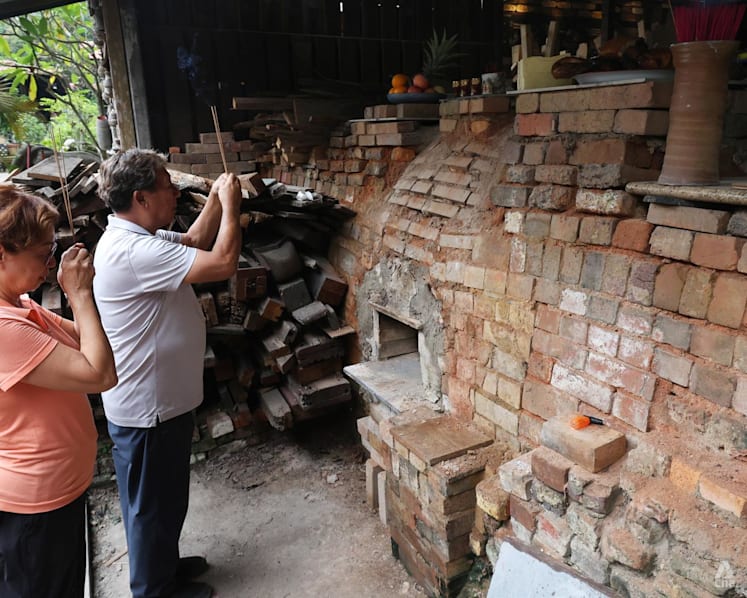
After the prayers were done, the fire box, which is a small opening at the front of the kiln, was lit. 

The participants each picked up a piece of wood to throw into the fire, hoping to add more "luck" to the process. 
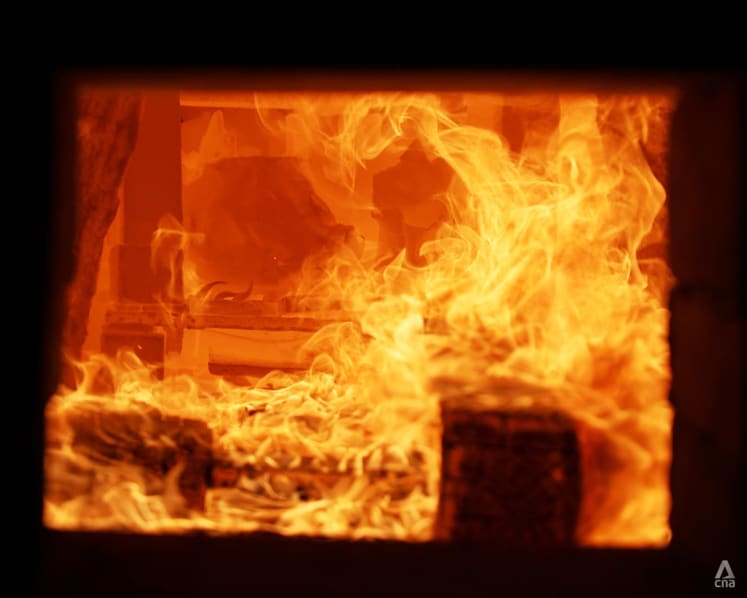
The dragon kiln was bought by Mr Tan’s father in 1965 and has been owned by the family since then.

It sits on a slope, is 27-metres long, 2-metres wide and curves around the side, resembling the body of a dragon in Chinese mythology. 

Its lengthy chambers are made out of bricks and there is a chimney at the end, located at the top of the slope.

The kiln can fit thousands of pieces of ceramic items, depending on the size of the pots. 

For this firing session, around 400 to 500 pieces were loaded in the kiln. 

NEW WAYS TO IMPROVE PROCESS

Temperatures in the dragon kiln can reach up to 1,300°C. 

They can fluctuate significantly due to the shape of the furnace and the use of wood as a fuel.

That is why one of the most crucial parts of the process is to monitor the temperature for all three days of the firing session.

Mr Chua Hee Lai, who is in his 50s and a hobbyist-turned-kiln master, helped to plan and lead each firing session. 
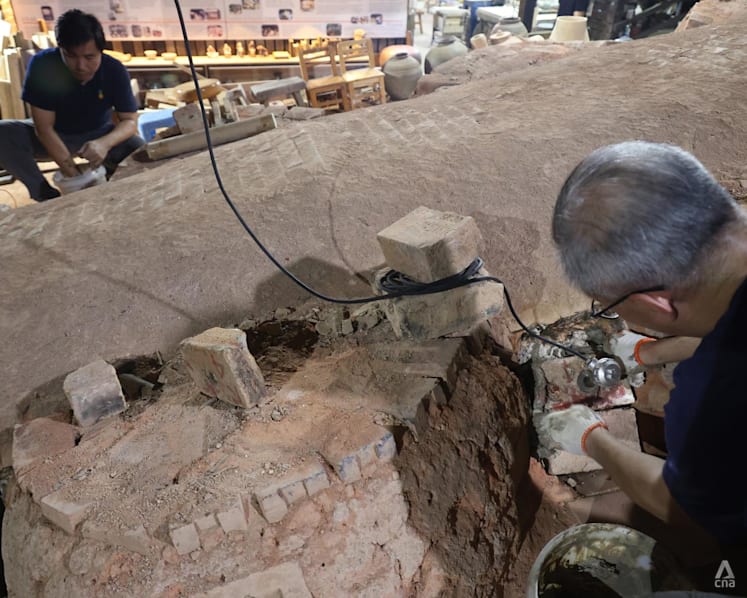
In 2019, Mr Chua, with the help of another potter, introduced a digital monitoring system that allowed them to track the temperatures remotely and give instructions to the potters doing shift work on site. 

Previously, they had to monitor the temperature by looking at the colour of the flame or record temperatures manually and then draw up prediction charts – a process that requires them to be on site for longer periods of time.
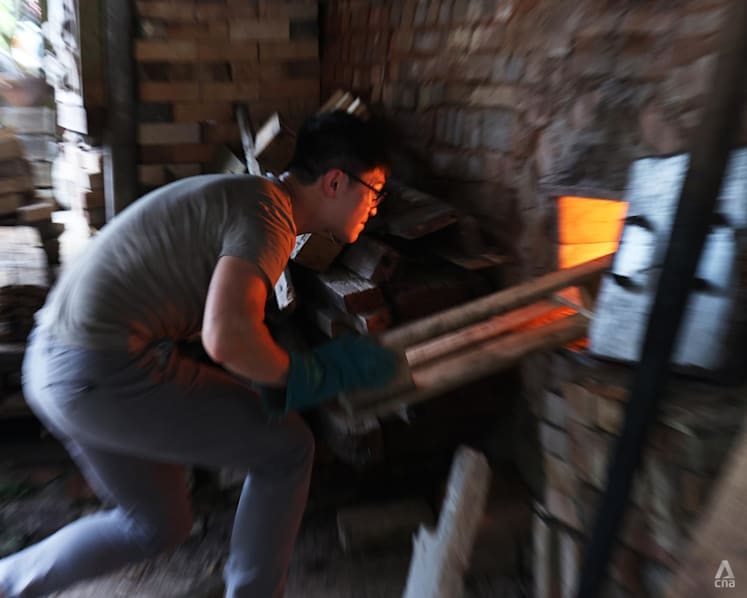
THE "KAMPUNG SPIRIT"

Advertising executive Vanessa Low and product manager Goh Wei Ting, both 31, have been practising pottery at another pottery studio for around five years and this was their first time taking part in the wood-firing process.

Compared to a regular firing in an electric or gas kiln, wood-firing is "tiring and physically demanding", Mr Goh said.

However, they were buoyed by the “kampung spirit” or the sense of camaraderie that came about as participants laboured together. 

 “You just don’t feel tired, you just do (the work),” Mr Goh added. 

OPENING OF THE KILN

Six days after the firing at the dragon kiln, the participants returned to open the kiln and check on their art pieces. 

“Shall we form a chain?” someone suggested to facilitate the removal of the brick walls. 

Without hesitation, a human chain quickly formed as the potters unsealed the kiln, one brick at a time. 

A collective “wow” sounded as the final bricks were removed, revealing the final outcome of the nine-day process that comprised three days of firing and six days of cooling.

The potters carefully removed the art pieces from the shelves, while admiring the effects that the fire had on their work. 

Ms Tia Boon Sim, 69, one of the founders of Thow Kwang Clay Artists, a community group, said: “In wood-firing, the ashes from the fire would fly around and drop on the pieces and these are the effects potters love.”

When asked if she would do this again, Ms Low said: “I would want to come back with my friends for this, have fun and learn new things together.”  

Participants moving the pottery pieces out of the kiln area by forming a human chain. (Photo: CNA/Ooi Boon Keong)
Ceramic items in different shapes, sizes and colours were placed on tables. (Photo: CNA/Ooi Boon Keong)
Mr Goh Wei Ting comparing his pottery work before and after the items were fired in the kiln. (Photo: CNA/Ooi Boon Keong)
A participant looking at a freshly fired pot, examining every detail. (Photo: CNA/Ooi Boon Keong)
Source: CNA/jl/sf

Recommended

Advertisement

In Pixels

Meet the 70-year-old lorry driver who is also a 'kite doctor'

Meet the 70-year-old lorry driver who is also a 'kite doctor'

Kite maker Tan Poh Wah flying his handmade dragon kite at the Marina Barrage. (Photo: CNA/Nuria Ling)

30 Nov 2024 09:30PM (Updated: 16 Oct 2025 12:08AM)

Rolling up to Marina Barrage with a trolley bag full of handmade kites and repair tools, Mr Tan Poh Wah had one clear mission for the day: To share his love of kite-flying with others. 

Known informally as the “kite doctor” among the regular visitors there, the 70-year-old spends most Sundays repairing kites or offering his handmade ones – mostly for free – to people at the open-air space that is the venue of Singapore's largest reservoir. 

“Watching people fly my kites makes me really happy,” Mr Tan said.  

This weekend, In Pixels speaks to four enthusiasts to find out what excites them about kite-flying. 

A FAMILIAR FIGURE

CNA Games
Show More
Show Less

Shortly after Mr Tan turned up at Marina Barrage in the Marina Bay area, a handful of people who wanted their kites repaired immediately made a beeline towards him. 

They offered him drinks and snacks to thank him for his service. 

When he was done with the repairs, Mr Tan pulled a kite from his bag and launched it to the sky. 

He flew it with ease, strolling around the field, eager to find someone who will take the kite as a gift. 

His masterpieces are made mostly from recycled materials including plastic bags, discarded blinds, banners and umbrellas. 

Mr Tan is part of a group known as Singapore Original Kites, an informal gathering of adults in their 60s and 70s who share the same interest in making and flying kites.  

A semi-retired Chinese physician ​​Ong Cheng Her, 75, is the founder of the group.

He said that the only prerequisite to join the group is one’s ability to make a kite from scratch.  

He proudly showed CNA TODAY one of his creations, a red and white "umbrella kite". 

“Umbrellas are used for shade and rain protection, so why hasn’t anyone flown an umbrella kite? I decided to take on the challenge,” Mr Ong added.

HIS WORKSPACE AT HOME

As for Mr Tan, he is not retired, so flying and making kites is what he does only on Sundays.

He works six days a week as a lorry driver.

“I work to live, to fill my stomach so I can make kites.”

Stepping into his flat, Mr Tan led us to his "studio", which is a room filled with a bountiful supply of kites and raw materials. 

He described his workspace as a “chaotic but organised mess”. 

“My wife sometimes asks why I collect so many umbrellas, but she doesn’t interfere much because she knows I enjoy making these things.”

Mr Tan has loved kite flying since he was a child, but it was not until he was in his 30s that he took to making kites himself.

A self-taught craftsman, he said that he learnt how to make kites by observing other kite-makers whenever an opportunity comes along. 

Recently, Mr Tan finished repairing a 70m-long "dragon kite" that he first constructed in 2000. It broke at a kite festival in Taiwan in 2019 and required extensive repairs. 

After CNA TODAY approached him for an interview, Mr Tan said that he found new inspiration to repair the kite, which took him four Sundays to complete.

It was obvious that he is most proud of this kite among the many in his collection.

“Anyone who hasn't made a dragon or a phoenix kite isn't truly considered a kite maker,” he said, adding that these long kites are made up of many different sections and each needed to be crafted with great precision before they are finally stitched together. 

"GIANTS" IN THE SKY

Over at East Coast Park, another group of kite enthusiasts have gathered and their presence could be spotted from afar. 

The kites they have taken out, called "inflatable show kites", are gigantic balloon-like kites that are typically several metres in length when inflated.

Traditional kites rely on rigid frames for support, but inflatable show kites have no hard structures. They inflate as they catch on the wind and have to be anchored to the ground.

Project coordinator Johnny Yap and his wife Maggie Mok, a homemaker, both 51, are the founders of Show Kites Singapore, a group of people who are into these inflatable show kites.

The duo's interest in this started nearly 20 years ago when they took their children kite-flying. 

In the end, it was the couple themselves who got hooked on the activity. 

“We started flying bigger and bigger kites and before long, we realised that stick kites have a limit,” Mr Yap said.

This led them to explore inflatable ones in 2009 and they came across these kites online before buying their first. The sky is the limit when it comes to the sizes of such kites.

As their interests grew, Mr Yap and Ms Mok started travelling overseas to take part in international kite festivals. 

In September, they were at the International Kite Festival in Melaka, Malaysia, where they flew an inflatable show kite in the form of Singapore's tourism icon, the Merlion.

In watching the kite-flyers, CNA TODAY observed that the age-old method of rolling out and pulling the kite lines or strings is still used for flying simple traditional kites regardless of their sizes.

For long, intricate traditional kites such as Mr Tan's dragon kite, as well as the inflatable show kites, they are anchored to the ground and usually fly without much supervision. They also tend to have a "pilot" kite attached to the main kite to provide a lift for the initial flight. 

Some kites need very little wind, whereas others may need strong wind conditions. 

Inflatable show kites at the International Kite Festival held in Melaka, Malaysia in September 2024. (Photo: Maggie Mok)
Most of the kites designed by Mr Johnny Yap are in red and white, which are colours representing Singapore’s flag. (Photo: CNA/Nuria Ling)

Most of the kites owned by Mr Yap and Ms Mok are designed by them. 

The bespoke kites can cost between a few hundred and a few thousand dollars and they are manufactured in China. 

“We know how to make the kite, but we just don't have time. It takes many, many hours of sewing,” Mr Yap explained.

“We stick to the principle that we must design our own kites.”

Mr Johnny Yap trying to anchor some inflatable show kites to the ground. (Photo: CNA/Mak Jia Kee)
Members of the public taking photos with several inflatable show kites at East Coast Park. (Photo: CNA/Nuria Ling)

Through the years, the couple have met people from all walks of life who have taken an interest in this activity. 

“We have doctors, taxi drivers, hawkers (in Show Kites Singapore). It’s the kites that bring us together,” Mr Yap said.

“There’s no application form (to join the group), so long as you are passionate, come join me every Sunday."

Members of Show Kites Singapore taking a break under the shade at East Coast Park. (Photo: CNA/Mak Jia Kee)
Inflatable show kites flying next to a construction site at East Coast Park. (Photo: CNA/Mak Jia Kee)
Advertisement

In Pixels

Snakes and marine life you don’t always see at Sentosa

Snakes and marine life you don’t always see at Sentosa

A 2-metre juvenile reticulated python slithering across a tree branch in front of filmmaker Jayaprakash Bojan. The snake was found near Palawan Green on Sentosa Island and was rehomed in a forested area nearby. (Photo: CNA/Raj Nadarajan)

04 Oct 2024 09:30PM (Updated: 16 Oct 2025 12:12AM)

There was palpable tension in the air as a black bag was taken to the forest. 

Inside was a 2-metre juvenile reticulated python. 

The snake with diamond-patterned skin was being relocated to a forested area on Sentosa Island by the wildlife management team of the Sentosa Development Corporation (SDC), after it was spotted in a high foot-traffic area.

Standing very still just a few metres away were two professional filmmakers and a photographer, patiently waiting for the snake to emerge. 

CNA Games
Show More
Show Less

They did not have to wait long.

In just a couple of minutes, the python slithered out of the bag and gradually made its way up a tree. 

The team then waited another four hours for the snake to make its way down from the tree as they observed its movements on camera.

In Pixels takes you this weekend on a visual trip with wildlife filmmakers Jayaprakash “JP” Bojan and Ian Mun, as they document Sentosa’s biodiversity and conservation efforts for Earth in Focus, a nature film festival set to take place in November on the resort island south of mainland Singapore. 

Reticulated pythons are native to Singapore and they are commonly found in secondary forests with a water supply. (Photo: CNA/Raj Nadarajan)
Photographer and filmmaker Jayaprakash Bojan, fondly known as JP, attaching a camera to a monopod to capture footage of a python from a safe distance. (Photo: CNA/Raj Nadarajan)
A spitting cobra found in a drain at Fort Siloso in Sentosa was relocated to a forested area on the island. A team of filmmakers had been shooting in Sentosa thrice a week for three months but this was the first time that they were coming face-to-face with a venomous snake on the island. (Photo: CNA/Nuria Ling)

Sentosa is a tourist destination known for its themed parks and sandy beaches. The island’s free-roaming peacocks are probably its most well-known wildlife. 

Off the beaten tracks, though, in the forested areas or along the rocky shores, there is a rich biodiversity of flora and fauna unknown to many visitors.

One rare species found in the coastal forests is the Xylocarpus rumphii, a critically endangered plant that has not been discovered elsewhere on mainland Singapore. 

There is also the elusive lesser bamboo bat, one of the smallest mammals on earth. 

This vulnerable bat species, which weighs just a few grams, has a flattened skull that allows it to squeeze in a hollow bamboo shoot to roost, through narrow slits created by beetles.

A bamboo bat captured on video after being awakened by the endoscope. (Photo: CNA/Nuria Ling)
An endoscope being used to check on lesser bamboo bats that live inside bamboo plants. (Photo: CNA/Nuria Ling)

Sentosa is home to 850 flora and fauna species. 

Setting up camera traps is one way that the conservation team is able to track and protect the wildlife on the island.  

Unlike what it sounds, camera traps do not trap animals. They are cameras with sensors put up in animal habitats for a duration to record images of wildlife and collect data on them.

The team has deployed eight such cameras in biodiversity-sensitive habitats around the island and the cameras are checked every alternate month. 

Advertisement

In Pixels

Inside a dragon kiln where temperatures go up to 1,300°C

Inside a dragon kiln where temperatures go up to 1,300°C

Wood-firing at a dragon kiln is a community effort that requires round-the-clock monitoring. (Photo: CNA/Ooi Boon Keong)

15 Nov 2024 09:30PM (Updated: 16 Oct 2025 12:09AM)

Nestled in an industrial estate in the western part of Singapore is an 84-year-old dragon kiln, the oldest and the only operational dragon kiln in the country. 

Built in 1940, the kiln at Thow Kwang Pottery Jungle was originally used for the mass production of household and industrial items such as cups and flower pots.

Over the decades, the place has evolved into a community space, now offering classes and events for potters to hone their craft. 

CNA TODAY joined the potter community for a wood-firing session that happens only two or three times a year.

CNA Games
Show More
Show Less

In Pixels takes you through the experience, as new and seasoned potters bond over fire and perspiration, creating unique works of art. 

PRAYERS TO THE "KILN GOD"  

At Thow Kwang Pottery Jungle, which is located a short distance from Nanyang Technological University, a group of around 30 people gathered on a Friday last month in front of the kiln.

This was at the request of the owners, Mr Tan Teck Yoke, 68, and his wife Yulianti Tan, 66. 

A prayer ceremony to the "kiln god" was about to begin. 

“We are praying to the ‘kiln god’ for a successful firing, for the pieces to achieve the desired effects,” Mr Tan explained to the enthusiastic participants. 

To this, the crowd responded by shouting, “Heng, ong, huat, ah,” a phrase in the Chinese dialect of Hokkien that collectively means wishing for good fortune.

After the prayers were done, the fire box, which is a small opening at the front of the kiln, was lit. 

The participants each picked up a piece of wood to throw into the fire, hoping to add more "luck" to the process. 

The dragon kiln was bought by Mr Tan’s father in 1965 and has been owned by the family since then.

It sits on a slope, is 27-metres long, 2-metres wide and curves around the side, resembling the body of a dragon in Chinese mythology. 

Its lengthy chambers are made out of bricks and there is a chimney at the end, located at the top of the slope.

The kiln can fit thousands of pieces of ceramic items, depending on the size of the pots. 

For this firing session, around 400 to 500 pieces were loaded in the kiln. 

NEW WAYS TO IMPROVE PROCESS

Temperatures in the dragon kiln can reach up to 1,300°C. 

They can fluctuate significantly due to the shape of the furnace and the use of wood as a fuel.

That is why one of the most crucial parts of the process is to monitor the temperature for all three days of the firing session.

Mr Chua Hee Lai, who is in his 50s and a hobbyist-turned-kiln master, helped to plan and lead each firing session. 

In 2019, Mr Chua, with the help of another potter, introduced a digital monitoring system that allowed them to track the temperatures remotely and give instructions to the potters doing shift work on site. 

Previously, they had to monitor the temperature by looking at the colour of the flame or record temperatures manually and then draw up prediction charts – a process that requires them to be on site for longer periods of time.
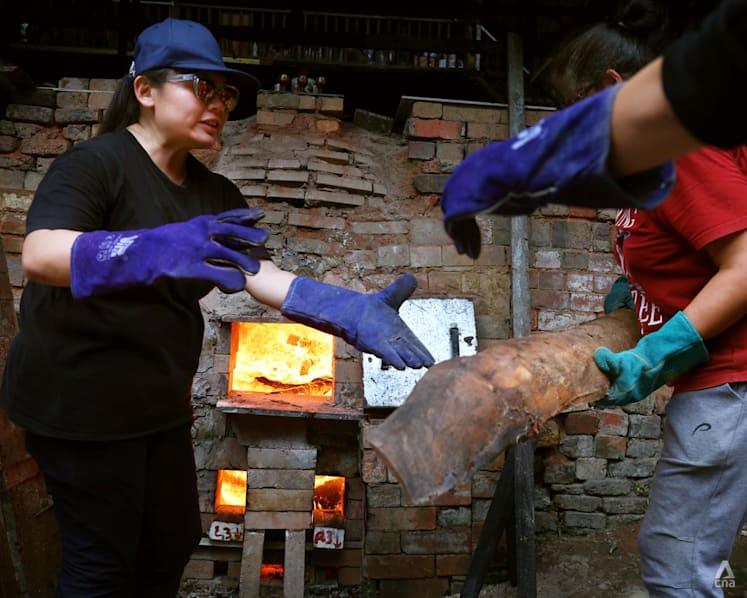
THE "KAMPUNG SPIRIT"

Advertising executive Vanessa Low and product manager Goh Wei Ting, both 31, have been practising pottery at another pottery studio for around five years and this was their first time taking part in the wood-firing process.

Compared to a regular firing in an electric or gas kiln, wood-firing is "tiring and physically demanding", Mr Goh said.

However, they were buoyed by the “kampung spirit” or the sense of camaraderie that came about as participants laboured together. 

 “You just don’t feel tired, you just do (the work),” Mr Goh added. 

OPENING OF THE KILN

Six days after the firing at the dragon kiln, the participants returned to open the kiln and check on their art pieces. 

“Shall we form a chain?” someone suggested to facilitate the removal of the brick walls. 

Without hesitation, a human chain quickly formed as the potters unsealed the kiln, one brick at a time. 

A collective “wow” sounded as the final bricks were removed, revealing the final outcome of the nine-day process that comprised three days of firing and six days of cooling.

The potters carefully removed the art pieces from the shelves, while admiring the effects that the fire had on their work. 

Ms Tia Boon Sim, 69, one of the founders of Thow Kwang Clay Artists, a community group, said: “In wood-firing, the ashes from the fire would fly around and drop on the pieces and these are the effects potters love.”

When asked if she would do this again, Ms Low said: “I would want to come back with my friends for this, have fun and learn new things together.”  

Participants moving the pottery pieces out of the kiln area by forming a human chain. (Photo: CNA/Ooi Boon Keong)
Ceramic items in different shapes, sizes and colours were placed on tables. (Photo: CNA/Ooi Boon Keong)
Mr Goh Wei Ting comparing his pottery work before and after the items were fired in the kiln. (Photo: CNA/Ooi Boon Keong)
A participant looking at a freshly fired pot, examining every detail. (Photo: CNA/Ooi Boon Keong)
Source: CNA/jl/sf

Recommended

Advertisement

In Pixels

Meet the 70-year-old lorry driver who is also a 'kite doctor'

Meet the 70-year-old lorry driver who is also a 'kite doctor'

Kite maker Tan Poh Wah flying his handmade dragon kite at the Marina Barrage. (Photo: CNA/Nuria Ling)

30 Nov 2024 09:30PM (Updated: 16 Oct 2025 12:08AM)

Rolling up to Marina Barrage with a trolley bag full of handmade kites and repair tools, Mr Tan Poh Wah had one clear mission for the day: To share his love of kite-flying with others. 

Known informally as the “kite doctor” among the regular visitors there, the 70-year-old spends most Sundays repairing kites or offering his handmade ones – mostly for free – to people at the open-air space that is the venue of Singapore's largest reservoir. 

“Watching people fly my kites makes me really happy,” Mr Tan said.  

This weekend, In Pixels speaks to four enthusiasts to find out what excites them about kite-flying. 

A FAMILIAR FIGURE

CNA Games
Show More
Show Less

Shortly after Mr Tan turned up at Marina Barrage in the Marina Bay area, a handful of people who wanted their kites repaired immediately made a beeline towards him. 

They offered him drinks and snacks to thank him for his service. 

When he was done with the repairs, Mr Tan pulled a kite from his bag and launched it to the sky. 

He flew it with ease, strolling around the field, eager to find someone who will take the kite as a gift. 

His masterpieces are made mostly from recycled materials including plastic bags, discarded blinds, banners and umbrellas. 

Mr Tan is part of a group known as Singapore Original Kites, an informal gathering of adults in their 60s and 70s who share the same interest in making and flying kites.  

A semi-retired Chinese physician ​​Ong Cheng Her, 75, is the founder of the group.

He said that the only prerequisite to join the group is one’s ability to make a kite from scratch.  

He proudly showed CNA TODAY one of his creations, a red and white "umbrella kite". 

“Umbrellas are used for shade and rain protection, so why hasn’t anyone flown an umbrella kite? I decided to take on the challenge,” Mr Ong added.

HIS WORKSPACE AT HOME

As for Mr Tan, he is not retired, so flying and making kites is what he does only on Sundays.

He works six days a week as a lorry driver.

“I work to live, to fill my stomach so I can make kites.”

Stepping into his flat, Mr Tan led us to his "studio", which is a room filled with a bountiful supply of kites and raw materials. 

He described his workspace as a “chaotic but organised mess”. 

“My wife sometimes asks why I collect so many umbrellas, but she doesn’t interfere much because she knows I enjoy making these things.”

Mr Tan has loved kite flying since he was a child, but it was not until he was in his 30s that he took to making kites himself.

A self-taught craftsman, he said that he learnt how to make kites by observing other kite-makers whenever an opportunity comes along. 

Recently, Mr Tan finished repairing a 70m-long "dragon kite" that he first constructed in 2000. It broke at a kite festival in Taiwan in 2019 and required extensive repairs. 

After CNA TODAY approached him for an interview, Mr Tan said that he found new inspiration to repair the kite, which took him four Sundays to complete.

It was obvious that he is most proud of this kite among the many in his collection.

“Anyone who hasn't made a dragon or a phoenix kite isn't truly considered a kite maker,” he said, adding that these long kites are made up of many different sections and each needed to be crafted with great precision before they are finally stitched together. 

"GIANTS" IN THE SKY

Over at East Coast Park, another group of kite enthusiasts have gathered and their presence could be spotted from afar. 

The kites they have taken out, called "inflatable show kites", are gigantic balloon-like kites that are typically several metres in length when inflated.

Traditional kites rely on rigid frames for support, but inflatable show kites have no hard structures. They inflate as they catch on the wind and have to be anchored to the ground.

Project coordinator Johnny Yap and his wife Maggie Mok, a homemaker, both 51, are the founders of Show Kites Singapore, a group of people who are into these inflatable show kites.

The duo's interest in this started nearly 20 years ago when they took their children kite-flying. 

In the end, it was the couple themselves who got hooked on the activity. 

“We started flying bigger and bigger kites and before long, we realised that stick kites have a limit,” Mr Yap said.

This led them to explore inflatable ones in 2009 and they came across these kites online before buying their first. The sky is the limit when it comes to the sizes of such kites.

As their interests grew, Mr Yap and Ms Mok started travelling overseas to take part in international kite festivals. 

In September, they were at the International Kite Festival in Melaka, Malaysia, where they flew an inflatable show kite in the form of Singapore's tourism icon, the Merlion.

In watching the kite-flyers, CNA TODAY observed that the age-old method of rolling out and pulling the kite lines or strings is still used for flying simple traditional kites regardless of their sizes.

For long, intricate traditional kites such as Mr Tan's dragon kite, as well as the inflatable show kites, they are anchored to the ground and usually fly without much supervision. They also tend to have a "pilot" kite attached to the main kite to provide a lift for the initial flight. 

Some kites need very little wind, whereas others may need strong wind conditions. 

Inflatable show kites at the International Kite Festival held in Melaka, Malaysia in September 2024. (Photo: Maggie Mok)
Most of the kites designed by Mr Johnny Yap are in red and white, which are colours representing Singapore’s flag. (Photo: CNA/Nuria Ling)

Most of the kites owned by Mr Yap and Ms Mok are designed by them. 

The bespoke kites can cost between a few hundred and a few thousand dollars and they are manufactured in China. 

“We know how to make the kite, but we just don't have time. It takes many, many hours of sewing,” Mr Yap explained.

“We stick to the principle that we must design our own kites.”

Mr Johnny Yap trying to anchor some inflatable show kites to the ground. (Photo: CNA/Mak Jia Kee)
Members of the public taking photos with several inflatable show kites at East Coast Park. (Photo: CNA/Nuria Ling)

Through the years, the couple have met people from all walks of life who have taken an interest in this activity. 

“We have doctors, taxi drivers, hawkers (in Show Kites Singapore). It’s the kites that bring us together,” Mr Yap said.

“There’s no application form (to join the group), so long as you are passionate, come join me every Sunday."

Members of Show Kites Singapore taking a break under the shade at East Coast Park. (Photo: CNA/Mak Jia Kee)
Inflatable show kites flying next to a construction site at East Coast Park. (Photo: CNA/Mak Jia Kee)
Advertisement

In Pixels

Snakes and marine life you don’t always see at Sentosa

Snakes and marine life you don’t always see at Sentosa

A 2-metre juvenile reticulated python slithering across a tree branch in front of filmmaker Jayaprakash Bojan. The snake was found near Palawan Green on Sentosa Island and was rehomed in a forested area nearby. (Photo: CNA/Raj Nadarajan)

04 Oct 2024 09:30PM (Updated: 16 Oct 2025 12:12AM)

There was palpable tension in the air as a black bag was taken to the forest. 

Inside was a 2-metre juvenile reticulated python. 

The snake with diamond-patterned skin was being relocated to a forested area on Sentosa Island by the wildlife management team of the Sentosa Development Corporation (SDC), after it was spotted in a high foot-traffic area.

Standing very still just a few metres away were two professional filmmakers and a photographer, patiently waiting for the snake to emerge. 

CNA Games
Show More
Show Less

They did not have to wait long.

In just a couple of minutes, the python slithered out of the bag and gradually made its way up a tree. 

The team then waited another four hours for the snake to make its way down from the tree as they observed its movements on camera.

In Pixels takes you this weekend on a visual trip with wildlife filmmakers Jayaprakash “JP” Bojan and Ian Mun, as they document Sentosa’s biodiversity and conservation efforts for Earth in Focus, a nature film festival set to take place in November on the resort island south of mainland Singapore. 

Reticulated pythons are native to Singapore and they are commonly found in secondary forests with a water supply. (Photo: CNA/Raj Nadarajan)
Photographer and filmmaker Jayaprakash Bojan, fondly known as JP, attaching a camera to a monopod to capture footage of a python from a safe distance. (Photo: CNA/Raj Nadarajan)
A spitting cobra found in a drain at Fort Siloso in Sentosa was relocated to a forested area on the island. A team of filmmakers had been shooting in Sentosa thrice a week for three months but this was the first time that they were coming face-to-face with a venomous snake on the island. (Photo: CNA/Nuria Ling)

Sentosa is a tourist destination known for its themed parks and sandy beaches. The island’s free-roaming peacocks are probably its most well-known wildlife. 

Off the beaten tracks, though, in the forested areas or along the rocky shores, there is a rich biodiversity of flora and fauna unknown to many visitors.

One rare species found in the coastal forests is the Xylocarpus rumphii, a critically endangered plant that has not been discovered elsewhere on mainland Singapore. 

There is also the elusive lesser bamboo bat, one of the smallest mammals on earth. 

This vulnerable bat species, which weighs just a few grams, has a flattened skull that allows it to squeeze in a hollow bamboo shoot to roost, through narrow slits created by beetles.

A bamboo bat captured on video after being awakened by the endoscope. (Photo: CNA/Nuria Ling)
An endoscope being used to check on lesser bamboo bats that live inside bamboo plants. (Photo: CNA/Nuria Ling)

Sentosa is home to 850 flora and fauna species. 

Setting up camera traps is one way that the conservation team is able to track and protect the wildlife on the island.  

Unlike what it sounds, camera traps do not trap animals. They are cameras with sensors put up in animal habitats for a duration to record images of wildlife and collect data on them.

The team has deployed eight such cameras in biodiversity-sensitive habitats around the island and the cameras are checked every alternate month. 

Advertisement

In Pixels

Inside a dragon kiln where temperatures go up to 1,300°C

Inside a dragon kiln where temperatures go up to 1,300°C

Wood-firing at a dragon kiln is a community effort that requires round-the-clock monitoring. (Photo: CNA/Ooi Boon Keong)

15 Nov 2024 09:30PM (Updated: 16 Oct 2025 12:09AM)

Nestled in an industrial estate in the western part of Singapore is an 84-year-old dragon kiln, the oldest and the only operational dragon kiln in the country. 

Built in 1940, the kiln at Thow Kwang Pottery Jungle was originally used for the mass production of household and industrial items such as cups and flower pots.

Over the decades, the place has evolved into a community space, now offering classes and events for potters to hone their craft. 

CNA TODAY joined the potter community for a wood-firing session that happens only two or three times a year.

CNA Games
Show More
Show Less

In Pixels takes you through the experience, as new and seasoned potters bond over fire and perspiration, creating unique works of art. 

PRAYERS TO THE "KILN GOD"  

At Thow Kwang Pottery Jungle, which is located a short distance from Nanyang Technological University, a group of around 30 people gathered on a Friday last month in front of the kiln.

This was at the request of the owners, Mr Tan Teck Yoke, 68, and his wife Yulianti Tan, 66. 

A prayer ceremony to the "kiln god" was about to begin. 

“We are praying to the ‘kiln god’ for a successful firing, for the pieces to achieve the desired effects,” Mr Tan explained to the enthusiastic participants. 

To this, the crowd responded by shouting, “Heng, ong, huat, ah,” a phrase in the Chinese dialect of Hokkien that collectively means wishing for good fortune.

After the prayers were done, the fire box, which is a small opening at the front of the kiln, was lit. 

The participants each picked up a piece of wood to throw into the fire, hoping to add more "luck" to the process. 

The dragon kiln was bought by Mr Tan’s father in 1965 and has been owned by the family since then.

It sits on a slope, is 27-metres long, 2-metres wide and curves around the side, resembling the body of a dragon in Chinese mythology. 

Its lengthy chambers are made out of bricks and there is a chimney at the end, located at the top of the slope.

The kiln can fit thousands of pieces of ceramic items, depending on the size of the pots. 

For this firing session, around 400 to 500 pieces were loaded in the kiln. 

NEW WAYS TO IMPROVE PROCESS

Temperatures in the dragon kiln can reach up to 1,300°C. 

They can fluctuate significantly due to the shape of the furnace and the use of wood as a fuel.

That is why one of the most crucial parts of the process is to monitor the temperature for all three days of the firing session.

Mr Chua Hee Lai, who is in his 50s and a hobbyist-turned-kiln master, helped to plan and lead each firing session. 

In 2019, Mr Chua, with the help of another potter, introduced a digital monitoring system that allowed them to track the temperatures remotely and give instructions to the potters doing shift work on site. 

Previously, they had to monitor the temperature by looking at the colour of the flame or record temperatures manually and then draw up prediction charts – a process that requires them to be on site for longer periods of time.
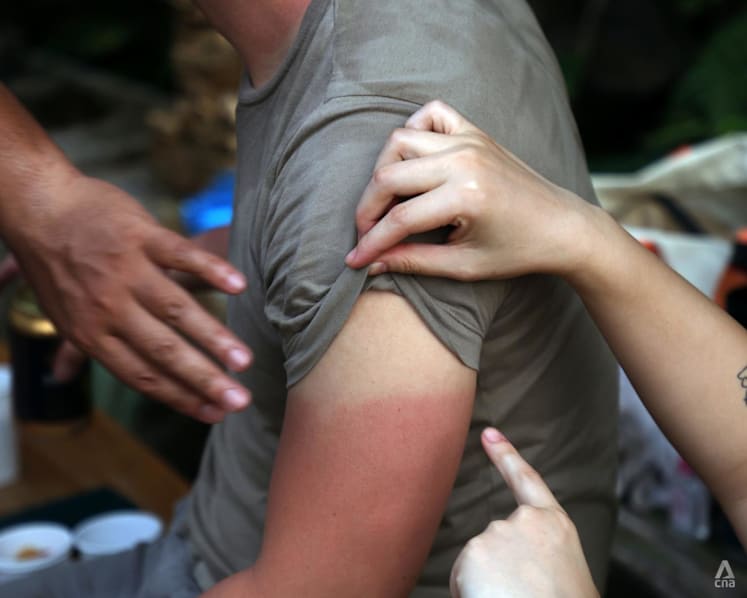
THE "KAMPUNG SPIRIT"

Advertising executive Vanessa Low and product manager Goh Wei Ting, both 31, have been practising pottery at another pottery studio for around five years and this was their first time taking part in the wood-firing process.

Compared to a regular firing in an electric or gas kiln, wood-firing is "tiring and physically demanding", Mr Goh said.

However, they were buoyed by the “kampung spirit” or the sense of camaraderie that came about as participants laboured together. 

 “You just don’t feel tired, you just do (the work),” Mr Goh added. 

OPENING OF THE KILN

Six days after the firing at the dragon kiln, the participants returned to open the kiln and check on their art pieces. 

“Shall we form a chain?” someone suggested to facilitate the removal of the brick walls. 

Without hesitation, a human chain quickly formed as the potters unsealed the kiln, one brick at a time. 

A collective “wow” sounded as the final bricks were removed, revealing the final outcome of the nine-day process that comprised three days of firing and six days of cooling.

The potters carefully removed the art pieces from the shelves, while admiring the effects that the fire had on their work. 

Ms Tia Boon Sim, 69, one of the founders of Thow Kwang Clay Artists, a community group, said: “In wood-firing, the ashes from the fire would fly around and drop on the pieces and these are the effects potters love.”

When asked if she would do this again, Ms Low said: “I would want to come back with my friends for this, have fun and learn new things together.”  

Participants moving the pottery pieces out of the kiln area by forming a human chain. (Photo: CNA/Ooi Boon Keong)
Ceramic items in different shapes, sizes and colours were placed on tables. (Photo: CNA/Ooi Boon Keong)
Mr Goh Wei Ting comparing his pottery work before and after the items were fired in the kiln. (Photo: CNA/Ooi Boon Keong)
A participant looking at a freshly fired pot, examining every detail. (Photo: CNA/Ooi Boon Keong)
Source: CNA/jl/sf

Recommended

Advertisement

In Pixels

Meet the 70-year-old lorry driver who is also a 'kite doctor'

Meet the 70-year-old lorry driver who is also a 'kite doctor'

Kite maker Tan Poh Wah flying his handmade dragon kite at the Marina Barrage. (Photo: CNA/Nuria Ling)

30 Nov 2024 09:30PM (Updated: 16 Oct 2025 12:08AM)

Rolling up to Marina Barrage with a trolley bag full of handmade kites and repair tools, Mr Tan Poh Wah had one clear mission for the day: To share his love of kite-flying with others. 

Known informally as the “kite doctor” among the regular visitors there, the 70-year-old spends most Sundays repairing kites or offering his handmade ones – mostly for free – to people at the open-air space that is the venue of Singapore's largest reservoir. 

“Watching people fly my kites makes me really happy,” Mr Tan said.  

This weekend, In Pixels speaks to four enthusiasts to find out what excites them about kite-flying. 

A FAMILIAR FIGURE

CNA Games
Show More
Show Less

Shortly after Mr Tan turned up at Marina Barrage in the Marina Bay area, a handful of people who wanted their kites repaired immediately made a beeline towards him. 

They offered him drinks and snacks to thank him for his service. 

When he was done with the repairs, Mr Tan pulled a kite from his bag and launched it to the sky. 

He flew it with ease, strolling around the field, eager to find someone who will take the kite as a gift. 

His masterpieces are made mostly from recycled materials including plastic bags, discarded blinds, banners and umbrellas. 

Mr Tan is part of a group known as Singapore Original Kites, an informal gathering of adults in their 60s and 70s who share the same interest in making and flying kites.  

A semi-retired Chinese physician ​​Ong Cheng Her, 75, is the founder of the group.

He said that the only prerequisite to join the group is one’s ability to make a kite from scratch.  

He proudly showed CNA TODAY one of his creations, a red and white "umbrella kite". 

“Umbrellas are used for shade and rain protection, so why hasn’t anyone flown an umbrella kite? I decided to take on the challenge,” Mr Ong added.

HIS WORKSPACE AT HOME

As for Mr Tan, he is not retired, so flying and making kites is what he does only on Sundays.

He works six days a week as a lorry driver.

“I work to live, to fill my stomach so I can make kites.”

Stepping into his flat, Mr Tan led us to his "studio", which is a room filled with a bountiful supply of kites and raw materials. 

He described his workspace as a “chaotic but organised mess”. 

“My wife sometimes asks why I collect so many umbrellas, but she doesn’t interfere much because she knows I enjoy making these things.”

Mr Tan has loved kite flying since he was a child, but it was not until he was in his 30s that he took to making kites himself.

A self-taught craftsman, he said that he learnt how to make kites by observing other kite-makers whenever an opportunity comes along. 

Recently, Mr Tan finished repairing a 70m-long "dragon kite" that he first constructed in 2000. It broke at a kite festival in Taiwan in 2019 and required extensive repairs. 

After CNA TODAY approached him for an interview, Mr Tan said that he found new inspiration to repair the kite, which took him four Sundays to complete.

It was obvious that he is most proud of this kite among the many in his collection.

“Anyone who hasn't made a dragon or a phoenix kite isn't truly considered a kite maker,” he said, adding that these long kites are made up of many different sections and each needed to be crafted with great precision before they are finally stitched together. 

"GIANTS" IN THE SKY

Over at East Coast Park, another group of kite enthusiasts have gathered and their presence could be spotted from afar. 

The kites they have taken out, called "inflatable show kites", are gigantic balloon-like kites that are typically several metres in length when inflated.

Traditional kites rely on rigid frames for support, but inflatable show kites have no hard structures. They inflate as they catch on the wind and have to be anchored to the ground.

Project coordinator Johnny Yap and his wife Maggie Mok, a homemaker, both 51, are the founders of Show Kites Singapore, a group of people who are into these inflatable show kites.

The duo's interest in this started nearly 20 years ago when they took their children kite-flying. 

In the end, it was the couple themselves who got hooked on the activity. 

“We started flying bigger and bigger kites and before long, we realised that stick kites have a limit,” Mr Yap said.

This led them to explore inflatable ones in 2009 and they came across these kites online before buying their first. The sky is the limit when it comes to the sizes of such kites.

As their interests grew, Mr Yap and Ms Mok started travelling overseas to take part in international kite festivals. 

In September, they were at the International Kite Festival in Melaka, Malaysia, where they flew an inflatable show kite in the form of Singapore's tourism icon, the Merlion.

In watching the kite-flyers, CNA TODAY observed that the age-old method of rolling out and pulling the kite lines or strings is still used for flying simple traditional kites regardless of their sizes.

For long, intricate traditional kites such as Mr Tan's dragon kite, as well as the inflatable show kites, they are anchored to the ground and usually fly without much supervision. They also tend to have a "pilot" kite attached to the main kite to provide a lift for the initial flight. 

Some kites need very little wind, whereas others may need strong wind conditions. 

Inflatable show kites at the International Kite Festival held in Melaka, Malaysia in September 2024. (Photo: Maggie Mok)
Most of the kites designed by Mr Johnny Yap are in red and white, which are colours representing Singapore’s flag. (Photo: CNA/Nuria Ling)

Most of the kites owned by Mr Yap and Ms Mok are designed by them. 

The bespoke kites can cost between a few hundred and a few thousand dollars and they are manufactured in China. 

“We know how to make the kite, but we just don't have time. It takes many, many hours of sewing,” Mr Yap explained.

“We stick to the principle that we must design our own kites.”

Mr Johnny Yap trying to anchor some inflatable show kites to the ground. (Photo: CNA/Mak Jia Kee)
Members of the public taking photos with several inflatable show kites at East Coast Park. (Photo: CNA/Nuria Ling)

Through the years, the couple have met people from all walks of life who have taken an interest in this activity. 

“We have doctors, taxi drivers, hawkers (in Show Kites Singapore). It’s the kites that bring us together,” Mr Yap said.

“There’s no application form (to join the group), so long as you are passionate, come join me every Sunday."

Members of Show Kites Singapore taking a break under the shade at East Coast Park. (Photo: CNA/Mak Jia Kee)
Inflatable show kites flying next to a construction site at East Coast Park. (Photo: CNA/Mak Jia Kee)
Advertisement

In Pixels

Snakes and marine life you don’t always see at Sentosa

Snakes and marine life you don’t always see at Sentosa

A 2-metre juvenile reticulated python slithering across a tree branch in front of filmmaker Jayaprakash Bojan. The snake was found near Palawan Green on Sentosa Island and was rehomed in a forested area nearby. (Photo: CNA/Raj Nadarajan)

04 Oct 2024 09:30PM (Updated: 16 Oct 2025 12:12AM)

There was palpable tension in the air as a black bag was taken to the forest. 

Inside was a 2-metre juvenile reticulated python. 

The snake with diamond-patterned skin was being relocated to a forested area on Sentosa Island by the wildlife management team of the Sentosa Development Corporation (SDC), after it was spotted in a high foot-traffic area.

Standing very still just a few metres away were two professional filmmakers and a photographer, patiently waiting for the snake to emerge. 

CNA Games
Show More
Show Less

They did not have to wait long.

In just a couple of minutes, the python slithered out of the bag and gradually made its way up a tree. 

The team then waited another four hours for the snake to make its way down from the tree as they observed its movements on camera.

In Pixels takes you this weekend on a visual trip with wildlife filmmakers Jayaprakash “JP” Bojan and Ian Mun, as they document Sentosa’s biodiversity and conservation efforts for Earth in Focus, a nature film festival set to take place in November on the resort island south of mainland Singapore. 

Reticulated pythons are native to Singapore and they are commonly found in secondary forests with a water supply. (Photo: CNA/Raj Nadarajan)
Photographer and filmmaker Jayaprakash Bojan, fondly known as JP, attaching a camera to a monopod to capture footage of a python from a safe distance. (Photo: CNA/Raj Nadarajan)
A spitting cobra found in a drain at Fort Siloso in Sentosa was relocated to a forested area on the island. A team of filmmakers had been shooting in Sentosa thrice a week for three months but this was the first time that they were coming face-to-face with a venomous snake on the island. (Photo: CNA/Nuria Ling)

Sentosa is a tourist destination known for its themed parks and sandy beaches. The island’s free-roaming peacocks are probably its most well-known wildlife. 

Off the beaten tracks, though, in the forested areas or along the rocky shores, there is a rich biodiversity of flora and fauna unknown to many visitors.

One rare species found in the coastal forests is the Xylocarpus rumphii, a critically endangered plant that has not been discovered elsewhere on mainland Singapore. 

There is also the elusive lesser bamboo bat, one of the smallest mammals on earth. 

This vulnerable bat species, which weighs just a few grams, has a flattened skull that allows it to squeeze in a hollow bamboo shoot to roost, through narrow slits created by beetles.

A bamboo bat captured on video after being awakened by the endoscope. (Photo: CNA/Nuria Ling)
An endoscope being used to check on lesser bamboo bats that live inside bamboo plants. (Photo: CNA/Nuria Ling)

Sentosa is home to 850 flora and fauna species. 

Setting up camera traps is one way that the conservation team is able to track and protect the wildlife on the island.  

Unlike what it sounds, camera traps do not trap animals. They are cameras with sensors put up in animal habitats for a duration to record images of wildlife and collect data on them.

The team has deployed eight such cameras in biodiversity-sensitive habitats around the island and the cameras are checked every alternate month. 

Advertisement

In Pixels

Inside a dragon kiln where temperatures go up to 1,300°C

Inside a dragon kiln where temperatures go up to 1,300°C

Wood-firing at a dragon kiln is a community effort that requires round-the-clock monitoring. (Photo: CNA/Ooi Boon Keong)

15 Nov 2024 09:30PM (Updated: 16 Oct 2025 12:09AM)

Nestled in an industrial estate in the western part of Singapore is an 84-year-old dragon kiln, the oldest and the only operational dragon kiln in the country. 

Built in 1940, the kiln at Thow Kwang Pottery Jungle was originally used for the mass production of household and industrial items such as cups and flower pots.

Over the decades, the place has evolved into a community space, now offering classes and events for potters to hone their craft. 

CNA TODAY joined the potter community for a wood-firing session that happens only two or three times a year.

CNA Games
Show More
Show Less

In Pixels takes you through the experience, as new and seasoned potters bond over fire and perspiration, creating unique works of art. 

PRAYERS TO THE "KILN GOD"  

At Thow Kwang Pottery Jungle, which is located a short distance from Nanyang Technological University, a group of around 30 people gathered on a Friday last month in front of the kiln.

This was at the request of the owners, Mr Tan Teck Yoke, 68, and his wife Yulianti Tan, 66. 

A prayer ceremony to the "kiln god" was about to begin. 

“We are praying to the ‘kiln god’ for a successful firing, for the pieces to achieve the desired effects,” Mr Tan explained to the enthusiastic participants. 

To this, the crowd responded by shouting, “Heng, ong, huat, ah,” a phrase in the Chinese dialect of Hokkien that collectively means wishing for good fortune.

After the prayers were done, the fire box, which is a small opening at the front of the kiln, was lit. 

The participants each picked up a piece of wood to throw into the fire, hoping to add more "luck" to the process. 

The dragon kiln was bought by Mr Tan’s father in 1965 and has been owned by the family since then.

It sits on a slope, is 27-metres long, 2-metres wide and curves around the side, resembling the body of a dragon in Chinese mythology. 

Its lengthy chambers are made out of bricks and there is a chimney at the end, located at the top of the slope.

The kiln can fit thousands of pieces of ceramic items, depending on the size of the pots. 

For this firing session, around 400 to 500 pieces were loaded in the kiln. 

NEW WAYS TO IMPROVE PROCESS

Temperatures in the dragon kiln can reach up to 1,300°C. 

They can fluctuate significantly due to the shape of the furnace and the use of wood as a fuel.

That is why one of the most crucial parts of the process is to monitor the temperature for all three days of the firing session.

Mr Chua Hee Lai, who is in his 50s and a hobbyist-turned-kiln master, helped to plan and lead each firing session. 

In 2019, Mr Chua, with the help of another potter, introduced a digital monitoring system that allowed them to track the temperatures remotely and give instructions to the potters doing shift work on site. 

Previously, they had to monitor the temperature by looking at the colour of the flame or record temperatures manually and then draw up prediction charts – a process that requires them to be on site for longer periods of time.
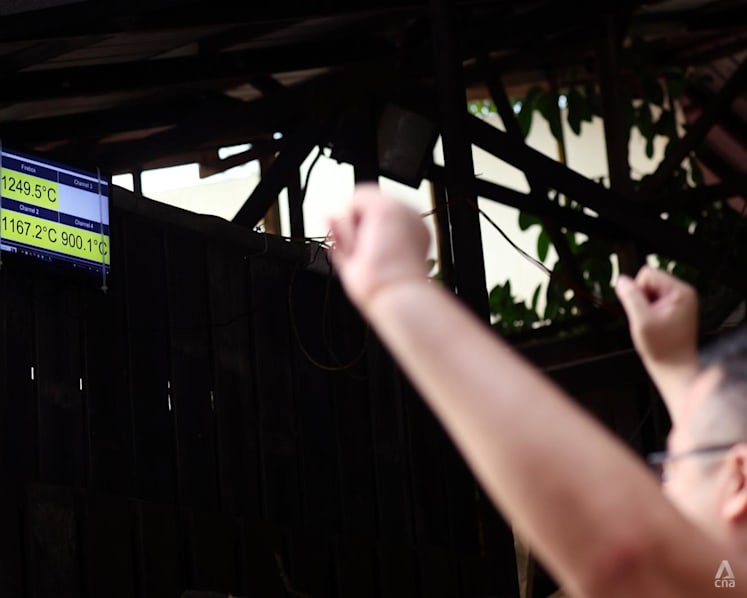
THE "KAMPUNG SPIRIT"

Advertising executive Vanessa Low and product manager Goh Wei Ting, both 31, have been practising pottery at another pottery studio for around five years and this was their first time taking part in the wood-firing process.

Compared to a regular firing in an electric or gas kiln, wood-firing is "tiring and physically demanding", Mr Goh said.

However, they were buoyed by the “kampung spirit” or the sense of camaraderie that came about as participants laboured together. 

 “You just don’t feel tired, you just do (the work),” Mr Goh added. 
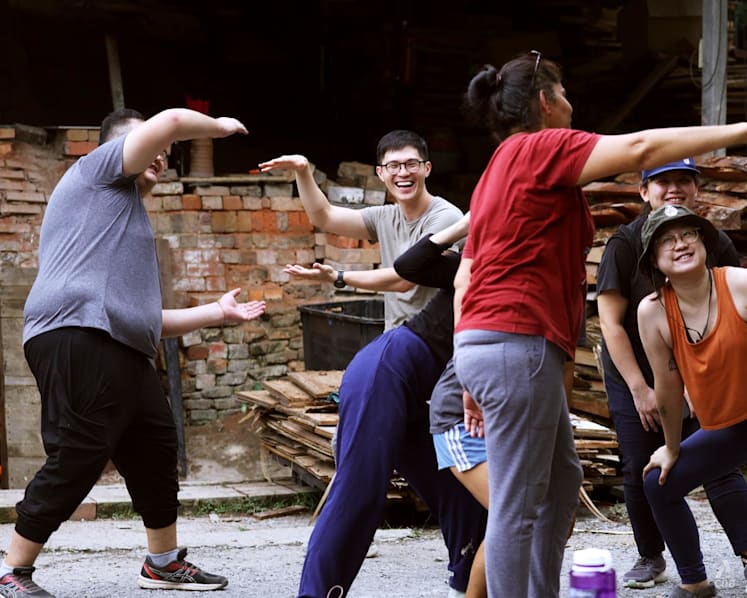
OPENING OF THE KILN

Six days after the firing at the dragon kiln, the participants returned to open the kiln and check on their art pieces. 

“Shall we form a chain?” someone suggested to facilitate the removal of the brick walls. 

Without hesitation, a human chain quickly formed as the potters unsealed the kiln, one brick at a time. 

A collective “wow” sounded as the final bricks were removed, revealing the final outcome of the nine-day process that comprised three days of firing and six days of cooling.

The potters carefully removed the art pieces from the shelves, while admiring the effects that the fire had on their work. 

Ms Tia Boon Sim, 69, one of the founders of Thow Kwang Clay Artists, a community group, said: “In wood-firing, the ashes from the fire would fly around and drop on the pieces and these are the effects potters love.”

When asked if she would do this again, Ms Low said: “I would want to come back with my friends for this, have fun and learn new things together.”  

Participants moving the pottery pieces out of the kiln area by forming a human chain. (Photo: CNA/Ooi Boon Keong)
Ceramic items in different shapes, sizes and colours were placed on tables. (Photo: CNA/Ooi Boon Keong)
Mr Goh Wei Ting comparing his pottery work before and after the items were fired in the kiln. (Photo: CNA/Ooi Boon Keong)
A participant looking at a freshly fired pot, examining every detail. (Photo: CNA/Ooi Boon Keong)
Source: CNA/jl/sf

Recommended

Advertisement

In Pixels

Meet the 70-year-old lorry driver who is also a 'kite doctor'

Meet the 70-year-old lorry driver who is also a 'kite doctor'

Kite maker Tan Poh Wah flying his handmade dragon kite at the Marina Barrage. (Photo: CNA/Nuria Ling)

30 Nov 2024 09:30PM (Updated: 16 Oct 2025 12:08AM)

Rolling up to Marina Barrage with a trolley bag full of handmade kites and repair tools, Mr Tan Poh Wah had one clear mission for the day: To share his love of kite-flying with others. 

Known informally as the “kite doctor” among the regular visitors there, the 70-year-old spends most Sundays repairing kites or offering his handmade ones – mostly for free – to people at the open-air space that is the venue of Singapore's largest reservoir. 

“Watching people fly my kites makes me really happy,” Mr Tan said.  

This weekend, In Pixels speaks to four enthusiasts to find out what excites them about kite-flying. 

A FAMILIAR FIGURE

CNA Games
Show More
Show Less

Shortly after Mr Tan turned up at Marina Barrage in the Marina Bay area, a handful of people who wanted their kites repaired immediately made a beeline towards him. 

They offered him drinks and snacks to thank him for his service. 

When he was done with the repairs, Mr Tan pulled a kite from his bag and launched it to the sky. 

He flew it with ease, strolling around the field, eager to find someone who will take the kite as a gift. 

His masterpieces are made mostly from recycled materials including plastic bags, discarded blinds, banners and umbrellas. 

Mr Tan is part of a group known as Singapore Original Kites, an informal gathering of adults in their 60s and 70s who share the same interest in making and flying kites.  

A semi-retired Chinese physician ​​Ong Cheng Her, 75, is the founder of the group.

He said that the only prerequisite to join the group is one’s ability to make a kite from scratch.  

He proudly showed CNA TODAY one of his creations, a red and white "umbrella kite". 

“Umbrellas are used for shade and rain protection, so why hasn’t anyone flown an umbrella kite? I decided to take on the challenge,” Mr Ong added.

HIS WORKSPACE AT HOME

As for Mr Tan, he is not retired, so flying and making kites is what he does only on Sundays.

He works six days a week as a lorry driver.

“I work to live, to fill my stomach so I can make kites.”

Stepping into his flat, Mr Tan led us to his "studio", which is a room filled with a bountiful supply of kites and raw materials. 

He described his workspace as a “chaotic but organised mess”. 

“My wife sometimes asks why I collect so many umbrellas, but she doesn’t interfere much because she knows I enjoy making these things.”

Mr Tan has loved kite flying since he was a child, but it was not until he was in his 30s that he took to making kites himself.

A self-taught craftsman, he said that he learnt how to make kites by observing other kite-makers whenever an opportunity comes along. 

Recently, Mr Tan finished repairing a 70m-long "dragon kite" that he first constructed in 2000. It broke at a kite festival in Taiwan in 2019 and required extensive repairs. 

After CNA TODAY approached him for an interview, Mr Tan said that he found new inspiration to repair the kite, which took him four Sundays to complete.

It was obvious that he is most proud of this kite among the many in his collection.

“Anyone who hasn't made a dragon or a phoenix kite isn't truly considered a kite maker,” he said, adding that these long kites are made up of many different sections and each needed to be crafted with great precision before they are finally stitched together. 

"GIANTS" IN THE SKY

Over at East Coast Park, another group of kite enthusiasts have gathered and their presence could be spotted from afar. 

The kites they have taken out, called "inflatable show kites", are gigantic balloon-like kites that are typically several metres in length when inflated.

Traditional kites rely on rigid frames for support, but inflatable show kites have no hard structures. They inflate as they catch on the wind and have to be anchored to the ground.

Project coordinator Johnny Yap and his wife Maggie Mok, a homemaker, both 51, are the founders of Show Kites Singapore, a group of people who are into these inflatable show kites.

The duo's interest in this started nearly 20 years ago when they took their children kite-flying. 

In the end, it was the couple themselves who got hooked on the activity. 

“We started flying bigger and bigger kites and before long, we realised that stick kites have a limit,” Mr Yap said.

This led them to explore inflatable ones in 2009 and they came across these kites online before buying their first. The sky is the limit when it comes to the sizes of such kites.

As their interests grew, Mr Yap and Ms Mok started travelling overseas to take part in international kite festivals. 

In September, they were at the International Kite Festival in Melaka, Malaysia, where they flew an inflatable show kite in the form of Singapore's tourism icon, the Merlion.

In watching the kite-flyers, CNA TODAY observed that the age-old method of rolling out and pulling the kite lines or strings is still used for flying simple traditional kites regardless of their sizes.

For long, intricate traditional kites such as Mr Tan's dragon kite, as well as the inflatable show kites, they are anchored to the ground and usually fly without much supervision. They also tend to have a "pilot" kite attached to the main kite to provide a lift for the initial flight. 

Some kites need very little wind, whereas others may need strong wind conditions. 

Inflatable show kites at the International Kite Festival held in Melaka, Malaysia in September 2024. (Photo: Maggie Mok)
Most of the kites designed by Mr Johnny Yap are in red and white, which are colours representing Singapore’s flag. (Photo: CNA/Nuria Ling)

Most of the kites owned by Mr Yap and Ms Mok are designed by them. 

The bespoke kites can cost between a few hundred and a few thousand dollars and they are manufactured in China. 

“We know how to make the kite, but we just don't have time. It takes many, many hours of sewing,” Mr Yap explained.

“We stick to the principle that we must design our own kites.”

Mr Johnny Yap trying to anchor some inflatable show kites to the ground. (Photo: CNA/Mak Jia Kee)
Members of the public taking photos with several inflatable show kites at East Coast Park. (Photo: CNA/Nuria Ling)

Through the years, the couple have met people from all walks of life who have taken an interest in this activity. 

“We have doctors, taxi drivers, hawkers (in Show Kites Singapore). It’s the kites that bring us together,” Mr Yap said.

“There’s no application form (to join the group), so long as you are passionate, come join me every Sunday."

Members of Show Kites Singapore taking a break under the shade at East Coast Park. (Photo: CNA/Mak Jia Kee)
Inflatable show kites flying next to a construction site at East Coast Park. (Photo: CNA/Mak Jia Kee)
Advertisement

In Pixels

Snakes and marine life you don’t always see at Sentosa

Snakes and marine life you don’t always see at Sentosa

A 2-metre juvenile reticulated python slithering across a tree branch in front of filmmaker Jayaprakash Bojan. The snake was found near Palawan Green on Sentosa Island and was rehomed in a forested area nearby. (Photo: CNA/Raj Nadarajan)

04 Oct 2024 09:30PM (Updated: 16 Oct 2025 12:12AM)

There was palpable tension in the air as a black bag was taken to the forest. 

Inside was a 2-metre juvenile reticulated python. 

The snake with diamond-patterned skin was being relocated to a forested area on Sentosa Island by the wildlife management team of the Sentosa Development Corporation (SDC), after it was spotted in a high foot-traffic area.

Standing very still just a few metres away were two professional filmmakers and a photographer, patiently waiting for the snake to emerge. 

CNA Games
Show More
Show Less

They did not have to wait long.

In just a couple of minutes, the python slithered out of the bag and gradually made its way up a tree. 

The team then waited another four hours for the snake to make its way down from the tree as they observed its movements on camera.

In Pixels takes you this weekend on a visual trip with wildlife filmmakers Jayaprakash “JP” Bojan and Ian Mun, as they document Sentosa’s biodiversity and conservation efforts for Earth in Focus, a nature film festival set to take place in November on the resort island south of mainland Singapore. 

Reticulated pythons are native to Singapore and they are commonly found in secondary forests with a water supply. (Photo: CNA/Raj Nadarajan)
Photographer and filmmaker Jayaprakash Bojan, fondly known as JP, attaching a camera to a monopod to capture footage of a python from a safe distance. (Photo: CNA/Raj Nadarajan)
A spitting cobra found in a drain at Fort Siloso in Sentosa was relocated to a forested area on the island. A team of filmmakers had been shooting in Sentosa thrice a week for three months but this was the first time that they were coming face-to-face with a venomous snake on the island. (Photo: CNA/Nuria Ling)

Sentosa is a tourist destination known for its themed parks and sandy beaches. The island’s free-roaming peacocks are probably its most well-known wildlife. 

Off the beaten tracks, though, in the forested areas or along the rocky shores, there is a rich biodiversity of flora and fauna unknown to many visitors.

One rare species found in the coastal forests is the Xylocarpus rumphii, a critically endangered plant that has not been discovered elsewhere on mainland Singapore. 

There is also the elusive lesser bamboo bat, one of the smallest mammals on earth. 

This vulnerable bat species, which weighs just a few grams, has a flattened skull that allows it to squeeze in a hollow bamboo shoot to roost, through narrow slits created by beetles.

A bamboo bat captured on video after being awakened by the endoscope. (Photo: CNA/Nuria Ling)
An endoscope being used to check on lesser bamboo bats that live inside bamboo plants. (Photo: CNA/Nuria Ling)

Sentosa is home to 850 flora and fauna species. 

Setting up camera traps is one way that the conservation team is able to track and protect the wildlife on the island.  

Unlike what it sounds, camera traps do not trap animals. They are cameras with sensors put up in animal habitats for a duration to record images of wildlife and collect data on them.

The team has deployed eight such cameras in biodiversity-sensitive habitats around the island and the cameras are checked every alternate month. 

Advertisement

In Pixels

Inside a dragon kiln where temperatures go up to 1,300°C

Inside a dragon kiln where temperatures go up to 1,300°C

Wood-firing at a dragon kiln is a community effort that requires round-the-clock monitoring. (Photo: CNA/Ooi Boon Keong)

15 Nov 2024 09:30PM (Updated: 16 Oct 2025 12:09AM)

Nestled in an industrial estate in the western part of Singapore is an 84-year-old dragon kiln, the oldest and the only operational dragon kiln in the country. 

Built in 1940, the kiln at Thow Kwang Pottery Jungle was originally used for the mass production of household and industrial items such as cups and flower pots.

Over the decades, the place has evolved into a community space, now offering classes and events for potters to hone their craft. 

CNA TODAY joined the potter community for a wood-firing session that happens only two or three times a year.

CNA Games
Show More
Show Less

In Pixels takes you through the experience, as new and seasoned potters bond over fire and perspiration, creating unique works of art. 

PRAYERS TO THE "KILN GOD"  

At Thow Kwang Pottery Jungle, which is located a short distance from Nanyang Technological University, a group of around 30 people gathered on a Friday last month in front of the kiln.

This was at the request of the owners, Mr Tan Teck Yoke, 68, and his wife Yulianti Tan, 66. 

A prayer ceremony to the "kiln god" was about to begin. 

“We are praying to the ‘kiln god’ for a successful firing, for the pieces to achieve the desired effects,” Mr Tan explained to the enthusiastic participants. 

To this, the crowd responded by shouting, “Heng, ong, huat, ah,” a phrase in the Chinese dialect of Hokkien that collectively means wishing for good fortune.

After the prayers were done, the fire box, which is a small opening at the front of the kiln, was lit. 

The participants each picked up a piece of wood to throw into the fire, hoping to add more "luck" to the process. 

The dragon kiln was bought by Mr Tan’s father in 1965 and has been owned by the family since then.

It sits on a slope, is 27-metres long, 2-metres wide and curves around the side, resembling the body of a dragon in Chinese mythology. 

Its lengthy chambers are made out of bricks and there is a chimney at the end, located at the top of the slope.

The kiln can fit thousands of pieces of ceramic items, depending on the size of the pots. 

For this firing session, around 400 to 500 pieces were loaded in the kiln. 

NEW WAYS TO IMPROVE PROCESS

Temperatures in the dragon kiln can reach up to 1,300°C. 

They can fluctuate significantly due to the shape of the furnace and the use of wood as a fuel.

That is why one of the most crucial parts of the process is to monitor the temperature for all three days of the firing session.

Mr Chua Hee Lai, who is in his 50s and a hobbyist-turned-kiln master, helped to plan and lead each firing session. 

In 2019, Mr Chua, with the help of another potter, introduced a digital monitoring system that allowed them to track the temperatures remotely and give instructions to the potters doing shift work on site. 

Previously, they had to monitor the temperature by looking at the colour of the flame or record temperatures manually and then draw up prediction charts – a process that requires them to be on site for longer periods of time.

THE "KAMPUNG SPIRIT"

Advertising executive Vanessa Low and product manager Goh Wei Ting, both 31, have been practising pottery at another pottery studio for around five years and this was their first time taking part in the wood-firing process.

Compared to a regular firing in an electric or gas kiln, wood-firing is "tiring and physically demanding", Mr Goh said.

However, they were buoyed by the “kampung spirit” or the sense of camaraderie that came about as participants laboured together. 

 “You just don’t feel tired, you just do (the work),” Mr Goh added. 
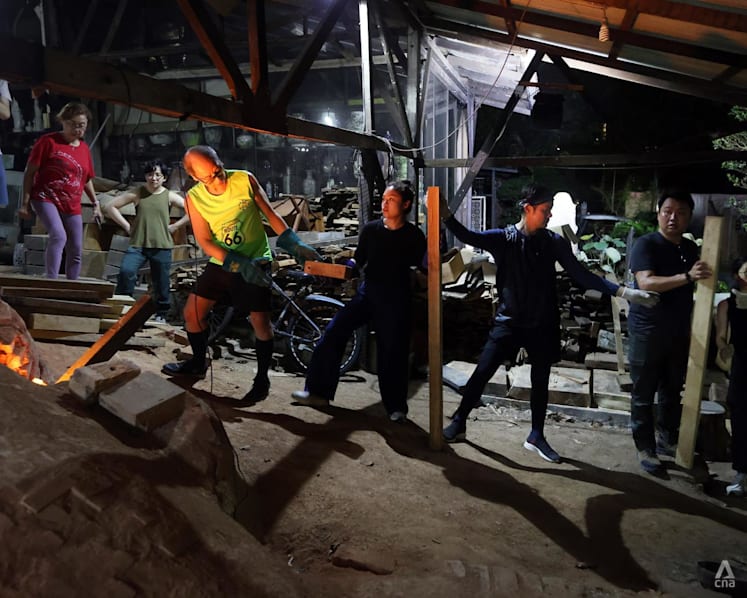
OPENING OF THE KILN

Six days after the firing at the dragon kiln, the participants returned to open the kiln and check on their art pieces. 

“Shall we form a chain?” someone suggested to facilitate the removal of the brick walls. 

Without hesitation, a human chain quickly formed as the potters unsealed the kiln, one brick at a time. 

A collective “wow” sounded as the final bricks were removed, revealing the final outcome of the nine-day process that comprised three days of firing and six days of cooling.

The potters carefully removed the art pieces from the shelves, while admiring the effects that the fire had on their work. 

Ms Tia Boon Sim, 69, one of the founders of Thow Kwang Clay Artists, a community group, said: “In wood-firing, the ashes from the fire would fly around and drop on the pieces and these are the effects potters love.”

When asked if she would do this again, Ms Low said: “I would want to come back with my friends for this, have fun and learn new things together.”  

Participants moving the pottery pieces out of the kiln area by forming a human chain. (Photo: CNA/Ooi Boon Keong)
Ceramic items in different shapes, sizes and colours were placed on tables. (Photo: CNA/Ooi Boon Keong)
Mr Goh Wei Ting comparing his pottery work before and after the items were fired in the kiln. (Photo: CNA/Ooi Boon Keong)
A participant looking at a freshly fired pot, examining every detail. (Photo: CNA/Ooi Boon Keong)
Source: CNA/jl/sf

Recommended

Advertisement

In Pixels

Meet the 70-year-old lorry driver who is also a 'kite doctor'

Meet the 70-year-old lorry driver who is also a 'kite doctor'

Kite maker Tan Poh Wah flying his handmade dragon kite at the Marina Barrage. (Photo: CNA/Nuria Ling)

30 Nov 2024 09:30PM (Updated: 16 Oct 2025 12:08AM)

Rolling up to Marina Barrage with a trolley bag full of handmade kites and repair tools, Mr Tan Poh Wah had one clear mission for the day: To share his love of kite-flying with others. 

Known informally as the “kite doctor” among the regular visitors there, the 70-year-old spends most Sundays repairing kites or offering his handmade ones – mostly for free – to people at the open-air space that is the venue of Singapore's largest reservoir. 

“Watching people fly my kites makes me really happy,” Mr Tan said.  

This weekend, In Pixels speaks to four enthusiasts to find out what excites them about kite-flying. 

A FAMILIAR FIGURE

CNA Games
Show More
Show Less

Shortly after Mr Tan turned up at Marina Barrage in the Marina Bay area, a handful of people who wanted their kites repaired immediately made a beeline towards him. 

They offered him drinks and snacks to thank him for his service. 

When he was done with the repairs, Mr Tan pulled a kite from his bag and launched it to the sky. 

He flew it with ease, strolling around the field, eager to find someone who will take the kite as a gift. 

His masterpieces are made mostly from recycled materials including plastic bags, discarded blinds, banners and umbrellas. 

Mr Tan is part of a group known as Singapore Original Kites, an informal gathering of adults in their 60s and 70s who share the same interest in making and flying kites.  

A semi-retired Chinese physician ​​Ong Cheng Her, 75, is the founder of the group.

He said that the only prerequisite to join the group is one’s ability to make a kite from scratch.  

He proudly showed CNA TODAY one of his creations, a red and white "umbrella kite". 

“Umbrellas are used for shade and rain protection, so why hasn’t anyone flown an umbrella kite? I decided to take on the challenge,” Mr Ong added.

HIS WORKSPACE AT HOME

As for Mr Tan, he is not retired, so flying and making kites is what he does only on Sundays.

He works six days a week as a lorry driver.

“I work to live, to fill my stomach so I can make kites.”

Stepping into his flat, Mr Tan led us to his "studio", which is a room filled with a bountiful supply of kites and raw materials. 

He described his workspace as a “chaotic but organised mess”. 

“My wife sometimes asks why I collect so many umbrellas, but she doesn’t interfere much because she knows I enjoy making these things.”

Mr Tan has loved kite flying since he was a child, but it was not until he was in his 30s that he took to making kites himself.

A self-taught craftsman, he said that he learnt how to make kites by observing other kite-makers whenever an opportunity comes along. 

Recently, Mr Tan finished repairing a 70m-long "dragon kite" that he first constructed in 2000. It broke at a kite festival in Taiwan in 2019 and required extensive repairs. 

After CNA TODAY approached him for an interview, Mr Tan said that he found new inspiration to repair the kite, which took him four Sundays to complete.

It was obvious that he is most proud of this kite among the many in his collection.

“Anyone who hasn't made a dragon or a phoenix kite isn't truly considered a kite maker,” he said, adding that these long kites are made up of many different sections and each needed to be crafted with great precision before they are finally stitched together. 

"GIANTS" IN THE SKY

Over at East Coast Park, another group of kite enthusiasts have gathered and their presence could be spotted from afar. 

The kites they have taken out, called "inflatable show kites", are gigantic balloon-like kites that are typically several metres in length when inflated.

Traditional kites rely on rigid frames for support, but inflatable show kites have no hard structures. They inflate as they catch on the wind and have to be anchored to the ground.

Project coordinator Johnny Yap and his wife Maggie Mok, a homemaker, both 51, are the founders of Show Kites Singapore, a group of people who are into these inflatable show kites.

The duo's interest in this started nearly 20 years ago when they took their children kite-flying. 

In the end, it was the couple themselves who got hooked on the activity. 

“We started flying bigger and bigger kites and before long, we realised that stick kites have a limit,” Mr Yap said.

This led them to explore inflatable ones in 2009 and they came across these kites online before buying their first. The sky is the limit when it comes to the sizes of such kites.

As their interests grew, Mr Yap and Ms Mok started travelling overseas to take part in international kite festivals. 

In September, they were at the International Kite Festival in Melaka, Malaysia, where they flew an inflatable show kite in the form of Singapore's tourism icon, the Merlion.

In watching the kite-flyers, CNA TODAY observed that the age-old method of rolling out and pulling the kite lines or strings is still used for flying simple traditional kites regardless of their sizes.

For long, intricate traditional kites such as Mr Tan's dragon kite, as well as the inflatable show kites, they are anchored to the ground and usually fly without much supervision. They also tend to have a "pilot" kite attached to the main kite to provide a lift for the initial flight. 

Some kites need very little wind, whereas others may need strong wind conditions. 

Inflatable show kites at the International Kite Festival held in Melaka, Malaysia in September 2024. (Photo: Maggie Mok)
Most of the kites designed by Mr Johnny Yap are in red and white, which are colours representing Singapore’s flag. (Photo: CNA/Nuria Ling)

Most of the kites owned by Mr Yap and Ms Mok are designed by them. 

The bespoke kites can cost between a few hundred and a few thousand dollars and they are manufactured in China. 

“We know how to make the kite, but we just don't have time. It takes many, many hours of sewing,” Mr Yap explained.

“We stick to the principle that we must design our own kites.”

Mr Johnny Yap trying to anchor some inflatable show kites to the ground. (Photo: CNA/Mak Jia Kee)
Members of the public taking photos with several inflatable show kites at East Coast Park. (Photo: CNA/Nuria Ling)

Through the years, the couple have met people from all walks of life who have taken an interest in this activity. 

“We have doctors, taxi drivers, hawkers (in Show Kites Singapore). It’s the kites that bring us together,” Mr Yap said.

“There’s no application form (to join the group), so long as you are passionate, come join me every Sunday."

Members of Show Kites Singapore taking a break under the shade at East Coast Park. (Photo: CNA/Mak Jia Kee)
Inflatable show kites flying next to a construction site at East Coast Park. (Photo: CNA/Mak Jia Kee)
Advertisement

In Pixels

Snakes and marine life you don’t always see at Sentosa

Snakes and marine life you don’t always see at Sentosa

A 2-metre juvenile reticulated python slithering across a tree branch in front of filmmaker Jayaprakash Bojan. The snake was found near Palawan Green on Sentosa Island and was rehomed in a forested area nearby. (Photo: CNA/Raj Nadarajan)

04 Oct 2024 09:30PM (Updated: 16 Oct 2025 12:12AM)

There was palpable tension in the air as a black bag was taken to the forest. 

Inside was a 2-metre juvenile reticulated python. 

The snake with diamond-patterned skin was being relocated to a forested area on Sentosa Island by the wildlife management team of the Sentosa Development Corporation (SDC), after it was spotted in a high foot-traffic area.

Standing very still just a few metres away were two professional filmmakers and a photographer, patiently waiting for the snake to emerge. 

CNA Games
Show More
Show Less

They did not have to wait long.

In just a couple of minutes, the python slithered out of the bag and gradually made its way up a tree. 

The team then waited another four hours for the snake to make its way down from the tree as they observed its movements on camera.

In Pixels takes you this weekend on a visual trip with wildlife filmmakers Jayaprakash “JP” Bojan and Ian Mun, as they document Sentosa’s biodiversity and conservation efforts for Earth in Focus, a nature film festival set to take place in November on the resort island south of mainland Singapore. 

Reticulated pythons are native to Singapore and they are commonly found in secondary forests with a water supply. (Photo: CNA/Raj Nadarajan)
Photographer and filmmaker Jayaprakash Bojan, fondly known as JP, attaching a camera to a monopod to capture footage of a python from a safe distance. (Photo: CNA/Raj Nadarajan)
A spitting cobra found in a drain at Fort Siloso in Sentosa was relocated to a forested area on the island. A team of filmmakers had been shooting in Sentosa thrice a week for three months but this was the first time that they were coming face-to-face with a venomous snake on the island. (Photo: CNA/Nuria Ling)

Sentosa is a tourist destination known for its themed parks and sandy beaches. The island’s free-roaming peacocks are probably its most well-known wildlife. 

Off the beaten tracks, though, in the forested areas or along the rocky shores, there is a rich biodiversity of flora and fauna unknown to many visitors.

One rare species found in the coastal forests is the Xylocarpus rumphii, a critically endangered plant that has not been discovered elsewhere on mainland Singapore. 

There is also the elusive lesser bamboo bat, one of the smallest mammals on earth. 

This vulnerable bat species, which weighs just a few grams, has a flattened skull that allows it to squeeze in a hollow bamboo shoot to roost, through narrow slits created by beetles.

A bamboo bat captured on video after being awakened by the endoscope. (Photo: CNA/Nuria Ling)
An endoscope being used to check on lesser bamboo bats that live inside bamboo plants. (Photo: CNA/Nuria Ling)

Sentosa is home to 850 flora and fauna species. 

Setting up camera traps is one way that the conservation team is able to track and protect the wildlife on the island.  

Unlike what it sounds, camera traps do not trap animals. They are cameras with sensors put up in animal habitats for a duration to record images of wildlife and collect data on them.

The team has deployed eight such cameras in biodiversity-sensitive habitats around the island and the cameras are checked every alternate month. 

Advertisement

In Pixels

Inside a dragon kiln where temperatures go up to 1,300°C

Inside a dragon kiln where temperatures go up to 1,300°C

Wood-firing at a dragon kiln is a community effort that requires round-the-clock monitoring. (Photo: CNA/Ooi Boon Keong)

15 Nov 2024 09:30PM (Updated: 16 Oct 2025 12:09AM)

Nestled in an industrial estate in the western part of Singapore is an 84-year-old dragon kiln, the oldest and the only operational dragon kiln in the country. 

Built in 1940, the kiln at Thow Kwang Pottery Jungle was originally used for the mass production of household and industrial items such as cups and flower pots.

Over the decades, the place has evolved into a community space, now offering classes and events for potters to hone their craft. 

CNA TODAY joined the potter community for a wood-firing session that happens only two or three times a year.

CNA Games
Show More
Show Less

In Pixels takes you through the experience, as new and seasoned potters bond over fire and perspiration, creating unique works of art. 

PRAYERS TO THE "KILN GOD"  

At Thow Kwang Pottery Jungle, which is located a short distance from Nanyang Technological University, a group of around 30 people gathered on a Friday last month in front of the kiln.

This was at the request of the owners, Mr Tan Teck Yoke, 68, and his wife Yulianti Tan, 66. 

A prayer ceremony to the "kiln god" was about to begin. 

“We are praying to the ‘kiln god’ for a successful firing, for the pieces to achieve the desired effects,” Mr Tan explained to the enthusiastic participants. 

To this, the crowd responded by shouting, “Heng, ong, huat, ah,” a phrase in the Chinese dialect of Hokkien that collectively means wishing for good fortune.

After the prayers were done, the fire box, which is a small opening at the front of the kiln, was lit. 

The participants each picked up a piece of wood to throw into the fire, hoping to add more "luck" to the process. 

The dragon kiln was bought by Mr Tan’s father in 1965 and has been owned by the family since then.

It sits on a slope, is 27-metres long, 2-metres wide and curves around the side, resembling the body of a dragon in Chinese mythology. 

Its lengthy chambers are made out of bricks and there is a chimney at the end, located at the top of the slope.

The kiln can fit thousands of pieces of ceramic items, depending on the size of the pots. 

For this firing session, around 400 to 500 pieces were loaded in the kiln. 

NEW WAYS TO IMPROVE PROCESS

Temperatures in the dragon kiln can reach up to 1,300°C. 

They can fluctuate significantly due to the shape of the furnace and the use of wood as a fuel.

That is why one of the most crucial parts of the process is to monitor the temperature for all three days of the firing session.

Mr Chua Hee Lai, who is in his 50s and a hobbyist-turned-kiln master, helped to plan and lead each firing session. 

In 2019, Mr Chua, with the help of another potter, introduced a digital monitoring system that allowed them to track the temperatures remotely and give instructions to the potters doing shift work on site. 

Previously, they had to monitor the temperature by looking at the colour of the flame or record temperatures manually and then draw up prediction charts – a process that requires them to be on site for longer periods of time.

THE "KAMPUNG SPIRIT"

Advertising executive Vanessa Low and product manager Goh Wei Ting, both 31, have been practising pottery at another pottery studio for around five years and this was their first time taking part in the wood-firing process.

Compared to a regular firing in an electric or gas kiln, wood-firing is "tiring and physically demanding", Mr Goh said.

However, they were buoyed by the “kampung spirit” or the sense of camaraderie that came about as participants laboured together. 

 “You just don’t feel tired, you just do (the work),” Mr Goh added. 
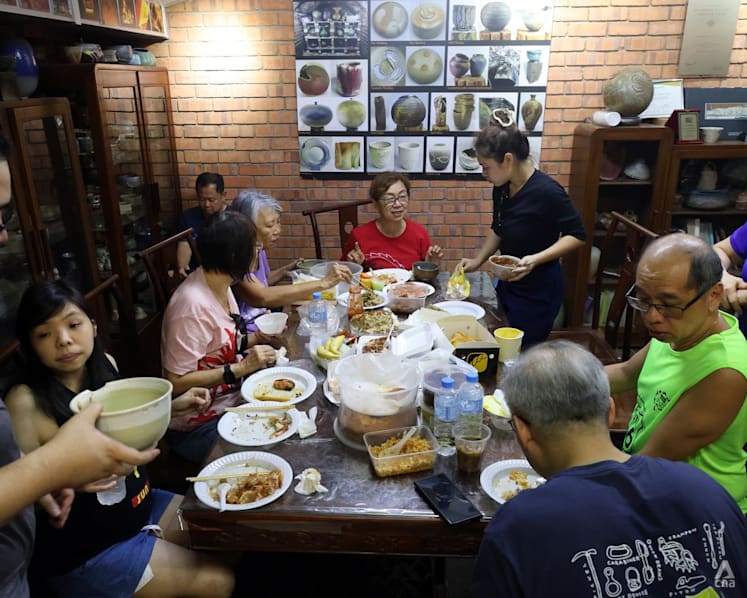
OPENING OF THE KILN

Six days after the firing at the dragon kiln, the participants returned to open the kiln and check on their art pieces. 

“Shall we form a chain?” someone suggested to facilitate the removal of the brick walls. 

Without hesitation, a human chain quickly formed as the potters unsealed the kiln, one brick at a time. 

A collective “wow” sounded as the final bricks were removed, revealing the final outcome of the nine-day process that comprised three days of firing and six days of cooling.

The potters carefully removed the art pieces from the shelves, while admiring the effects that the fire had on their work. 

Ms Tia Boon Sim, 69, one of the founders of Thow Kwang Clay Artists, a community group, said: “In wood-firing, the ashes from the fire would fly around and drop on the pieces and these are the effects potters love.”

When asked if she would do this again, Ms Low said: “I would want to come back with my friends for this, have fun and learn new things together.”  

Participants moving the pottery pieces out of the kiln area by forming a human chain. (Photo: CNA/Ooi Boon Keong)
Ceramic items in different shapes, sizes and colours were placed on tables. (Photo: CNA/Ooi Boon Keong)
Mr Goh Wei Ting comparing his pottery work before and after the items were fired in the kiln. (Photo: CNA/Ooi Boon Keong)
A participant looking at a freshly fired pot, examining every detail. (Photo: CNA/Ooi Boon Keong)
Source: CNA/jl/sf

Recommended

Advertisement

In Pixels

Meet the 70-year-old lorry driver who is also a 'kite doctor'

Meet the 70-year-old lorry driver who is also a 'kite doctor'

Kite maker Tan Poh Wah flying his handmade dragon kite at the Marina Barrage. (Photo: CNA/Nuria Ling)

30 Nov 2024 09:30PM (Updated: 16 Oct 2025 12:08AM)

Rolling up to Marina Barrage with a trolley bag full of handmade kites and repair tools, Mr Tan Poh Wah had one clear mission for the day: To share his love of kite-flying with others. 

Known informally as the “kite doctor” among the regular visitors there, the 70-year-old spends most Sundays repairing kites or offering his handmade ones – mostly for free – to people at the open-air space that is the venue of Singapore's largest reservoir. 

“Watching people fly my kites makes me really happy,” Mr Tan said.  

This weekend, In Pixels speaks to four enthusiasts to find out what excites them about kite-flying. 

A FAMILIAR FIGURE

CNA Games
Show More
Show Less

Shortly after Mr Tan turned up at Marina Barrage in the Marina Bay area, a handful of people who wanted their kites repaired immediately made a beeline towards him. 

They offered him drinks and snacks to thank him for his service. 

When he was done with the repairs, Mr Tan pulled a kite from his bag and launched it to the sky. 

He flew it with ease, strolling around the field, eager to find someone who will take the kite as a gift. 

His masterpieces are made mostly from recycled materials including plastic bags, discarded blinds, banners and umbrellas. 

Mr Tan is part of a group known as Singapore Original Kites, an informal gathering of adults in their 60s and 70s who share the same interest in making and flying kites.  

A semi-retired Chinese physician ​​Ong Cheng Her, 75, is the founder of the group.

He said that the only prerequisite to join the group is one’s ability to make a kite from scratch.  

He proudly showed CNA TODAY one of his creations, a red and white "umbrella kite". 

“Umbrellas are used for shade and rain protection, so why hasn’t anyone flown an umbrella kite? I decided to take on the challenge,” Mr Ong added.

HIS WORKSPACE AT HOME

As for Mr Tan, he is not retired, so flying and making kites is what he does only on Sundays.

He works six days a week as a lorry driver.

“I work to live, to fill my stomach so I can make kites.”

Stepping into his flat, Mr Tan led us to his "studio", which is a room filled with a bountiful supply of kites and raw materials. 

He described his workspace as a “chaotic but organised mess”. 

“My wife sometimes asks why I collect so many umbrellas, but she doesn’t interfere much because she knows I enjoy making these things.”

Mr Tan has loved kite flying since he was a child, but it was not until he was in his 30s that he took to making kites himself.

A self-taught craftsman, he said that he learnt how to make kites by observing other kite-makers whenever an opportunity comes along. 

Recently, Mr Tan finished repairing a 70m-long "dragon kite" that he first constructed in 2000. It broke at a kite festival in Taiwan in 2019 and required extensive repairs. 

After CNA TODAY approached him for an interview, Mr Tan said that he found new inspiration to repair the kite, which took him four Sundays to complete.

It was obvious that he is most proud of this kite among the many in his collection.

“Anyone who hasn't made a dragon or a phoenix kite isn't truly considered a kite maker,” he said, adding that these long kites are made up of many different sections and each needed to be crafted with great precision before they are finally stitched together. 

"GIANTS" IN THE SKY

Over at East Coast Park, another group of kite enthusiasts have gathered and their presence could be spotted from afar. 

The kites they have taken out, called "inflatable show kites", are gigantic balloon-like kites that are typically several metres in length when inflated.

Traditional kites rely on rigid frames for support, but inflatable show kites have no hard structures. They inflate as they catch on the wind and have to be anchored to the ground.

Project coordinator Johnny Yap and his wife Maggie Mok, a homemaker, both 51, are the founders of Show Kites Singapore, a group of people who are into these inflatable show kites.

The duo's interest in this started nearly 20 years ago when they took their children kite-flying. 

In the end, it was the couple themselves who got hooked on the activity. 

“We started flying bigger and bigger kites and before long, we realised that stick kites have a limit,” Mr Yap said.

This led them to explore inflatable ones in 2009 and they came across these kites online before buying their first. The sky is the limit when it comes to the sizes of such kites.

As their interests grew, Mr Yap and Ms Mok started travelling overseas to take part in international kite festivals. 

In September, they were at the International Kite Festival in Melaka, Malaysia, where they flew an inflatable show kite in the form of Singapore's tourism icon, the Merlion.

In watching the kite-flyers, CNA TODAY observed that the age-old method of rolling out and pulling the kite lines or strings is still used for flying simple traditional kites regardless of their sizes.

For long, intricate traditional kites such as Mr Tan's dragon kite, as well as the inflatable show kites, they are anchored to the ground and usually fly without much supervision. They also tend to have a "pilot" kite attached to the main kite to provide a lift for the initial flight. 

Some kites need very little wind, whereas others may need strong wind conditions. 

Inflatable show kites at the International Kite Festival held in Melaka, Malaysia in September 2024. (Photo: Maggie Mok)
Most of the kites designed by Mr Johnny Yap are in red and white, which are colours representing Singapore’s flag. (Photo: CNA/Nuria Ling)

Most of the kites owned by Mr Yap and Ms Mok are designed by them. 

The bespoke kites can cost between a few hundred and a few thousand dollars and they are manufactured in China. 

“We know how to make the kite, but we just don't have time. It takes many, many hours of sewing,” Mr Yap explained.

“We stick to the principle that we must design our own kites.”

Mr Johnny Yap trying to anchor some inflatable show kites to the ground. (Photo: CNA/Mak Jia Kee)
Members of the public taking photos with several inflatable show kites at East Coast Park. (Photo: CNA/Nuria Ling)

Through the years, the couple have met people from all walks of life who have taken an interest in this activity. 

“We have doctors, taxi drivers, hawkers (in Show Kites Singapore). It’s the kites that bring us together,” Mr Yap said.

“There’s no application form (to join the group), so long as you are passionate, come join me every Sunday."

Members of Show Kites Singapore taking a break under the shade at East Coast Park. (Photo: CNA/Mak Jia Kee)
Inflatable show kites flying next to a construction site at East Coast Park. (Photo: CNA/Mak Jia Kee)
Advertisement

In Pixels

Snakes and marine life you don’t always see at Sentosa

Snakes and marine life you don’t always see at Sentosa

A 2-metre juvenile reticulated python slithering across a tree branch in front of filmmaker Jayaprakash Bojan. The snake was found near Palawan Green on Sentosa Island and was rehomed in a forested area nearby. (Photo: CNA/Raj Nadarajan)

04 Oct 2024 09:30PM (Updated: 16 Oct 2025 12:12AM)

There was palpable tension in the air as a black bag was taken to the forest. 

Inside was a 2-metre juvenile reticulated python. 

The snake with diamond-patterned skin was being relocated to a forested area on Sentosa Island by the wildlife management team of the Sentosa Development Corporation (SDC), after it was spotted in a high foot-traffic area.

Standing very still just a few metres away were two professional filmmakers and a photographer, patiently waiting for the snake to emerge. 

CNA Games
Show More
Show Less

They did not have to wait long.

In just a couple of minutes, the python slithered out of the bag and gradually made its way up a tree. 

The team then waited another four hours for the snake to make its way down from the tree as they observed its movements on camera.

In Pixels takes you this weekend on a visual trip with wildlife filmmakers Jayaprakash “JP” Bojan and Ian Mun, as they document Sentosa’s biodiversity and conservation efforts for Earth in Focus, a nature film festival set to take place in November on the resort island south of mainland Singapore. 

Reticulated pythons are native to Singapore and they are commonly found in secondary forests with a water supply. (Photo: CNA/Raj Nadarajan)
Photographer and filmmaker Jayaprakash Bojan, fondly known as JP, attaching a camera to a monopod to capture footage of a python from a safe distance. (Photo: CNA/Raj Nadarajan)
A spitting cobra found in a drain at Fort Siloso in Sentosa was relocated to a forested area on the island. A team of filmmakers had been shooting in Sentosa thrice a week for three months but this was the first time that they were coming face-to-face with a venomous snake on the island. (Photo: CNA/Nuria Ling)

Sentosa is a tourist destination known for its themed parks and sandy beaches. The island’s free-roaming peacocks are probably its most well-known wildlife. 

Off the beaten tracks, though, in the forested areas or along the rocky shores, there is a rich biodiversity of flora and fauna unknown to many visitors.

One rare species found in the coastal forests is the Xylocarpus rumphii, a critically endangered plant that has not been discovered elsewhere on mainland Singapore. 

There is also the elusive lesser bamboo bat, one of the smallest mammals on earth. 

This vulnerable bat species, which weighs just a few grams, has a flattened skull that allows it to squeeze in a hollow bamboo shoot to roost, through narrow slits created by beetles.

A bamboo bat captured on video after being awakened by the endoscope. (Photo: CNA/Nuria Ling)
An endoscope being used to check on lesser bamboo bats that live inside bamboo plants. (Photo: CNA/Nuria Ling)

Sentosa is home to 850 flora and fauna species. 

Setting up camera traps is one way that the conservation team is able to track and protect the wildlife on the island.  

Unlike what it sounds, camera traps do not trap animals. They are cameras with sensors put up in animal habitats for a duration to record images of wildlife and collect data on them.

The team has deployed eight such cameras in biodiversity-sensitive habitats around the island and the cameras are checked every alternate month. 

Advertisement

In Pixels

Inside a dragon kiln where temperatures go up to 1,300°C

Inside a dragon kiln where temperatures go up to 1,300°C

Wood-firing at a dragon kiln is a community effort that requires round-the-clock monitoring. (Photo: CNA/Ooi Boon Keong)

15 Nov 2024 09:30PM (Updated: 16 Oct 2025 12:09AM)

Nestled in an industrial estate in the western part of Singapore is an 84-year-old dragon kiln, the oldest and the only operational dragon kiln in the country. 

Built in 1940, the kiln at Thow Kwang Pottery Jungle was originally used for the mass production of household and industrial items such as cups and flower pots.

Over the decades, the place has evolved into a community space, now offering classes and events for potters to hone their craft. 

CNA TODAY joined the potter community for a wood-firing session that happens only two or three times a year.

CNA Games
Show More
Show Less

In Pixels takes you through the experience, as new and seasoned potters bond over fire and perspiration, creating unique works of art. 

PRAYERS TO THE "KILN GOD"  

At Thow Kwang Pottery Jungle, which is located a short distance from Nanyang Technological University, a group of around 30 people gathered on a Friday last month in front of the kiln.

This was at the request of the owners, Mr Tan Teck Yoke, 68, and his wife Yulianti Tan, 66. 

A prayer ceremony to the "kiln god" was about to begin. 

“We are praying to the ‘kiln god’ for a successful firing, for the pieces to achieve the desired effects,” Mr Tan explained to the enthusiastic participants. 

To this, the crowd responded by shouting, “Heng, ong, huat, ah,” a phrase in the Chinese dialect of Hokkien that collectively means wishing for good fortune.

After the prayers were done, the fire box, which is a small opening at the front of the kiln, was lit. 

The participants each picked up a piece of wood to throw into the fire, hoping to add more "luck" to the process. 

The dragon kiln was bought by Mr Tan’s father in 1965 and has been owned by the family since then.

It sits on a slope, is 27-metres long, 2-metres wide and curves around the side, resembling the body of a dragon in Chinese mythology. 

Its lengthy chambers are made out of bricks and there is a chimney at the end, located at the top of the slope.

The kiln can fit thousands of pieces of ceramic items, depending on the size of the pots. 

For this firing session, around 400 to 500 pieces were loaded in the kiln. 

NEW WAYS TO IMPROVE PROCESS

Temperatures in the dragon kiln can reach up to 1,300°C. 

They can fluctuate significantly due to the shape of the furnace and the use of wood as a fuel.

That is why one of the most crucial parts of the process is to monitor the temperature for all three days of the firing session.

Mr Chua Hee Lai, who is in his 50s and a hobbyist-turned-kiln master, helped to plan and lead each firing session. 

In 2019, Mr Chua, with the help of another potter, introduced a digital monitoring system that allowed them to track the temperatures remotely and give instructions to the potters doing shift work on site. 

Previously, they had to monitor the temperature by looking at the colour of the flame or record temperatures manually and then draw up prediction charts – a process that requires them to be on site for longer periods of time.

THE "KAMPUNG SPIRIT"

Advertising executive Vanessa Low and product manager Goh Wei Ting, both 31, have been practising pottery at another pottery studio for around five years and this was their first time taking part in the wood-firing process.

Compared to a regular firing in an electric or gas kiln, wood-firing is "tiring and physically demanding", Mr Goh said.

However, they were buoyed by the “kampung spirit” or the sense of camaraderie that came about as participants laboured together. 

 “You just don’t feel tired, you just do (the work),” Mr Goh added. 
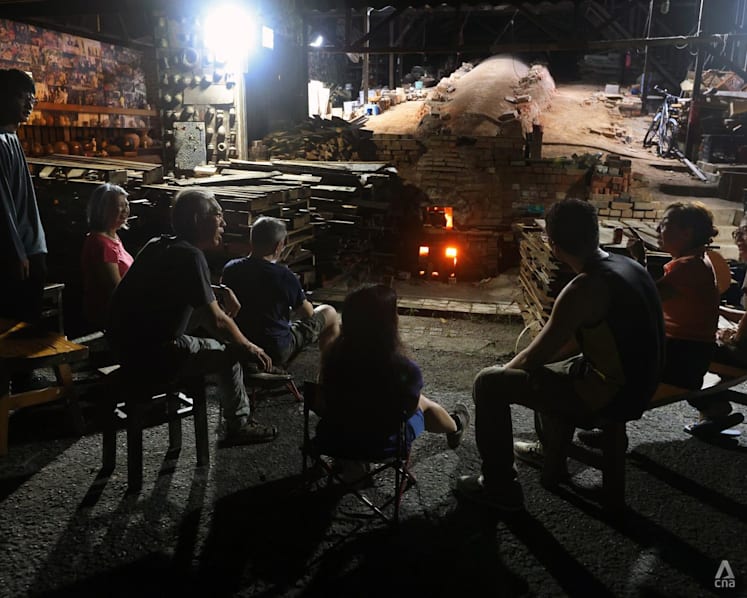
OPENING OF THE KILN

Six days after the firing at the dragon kiln, the participants returned to open the kiln and check on their art pieces. 

“Shall we form a chain?” someone suggested to facilitate the removal of the brick walls. 

Without hesitation, a human chain quickly formed as the potters unsealed the kiln, one brick at a time. 
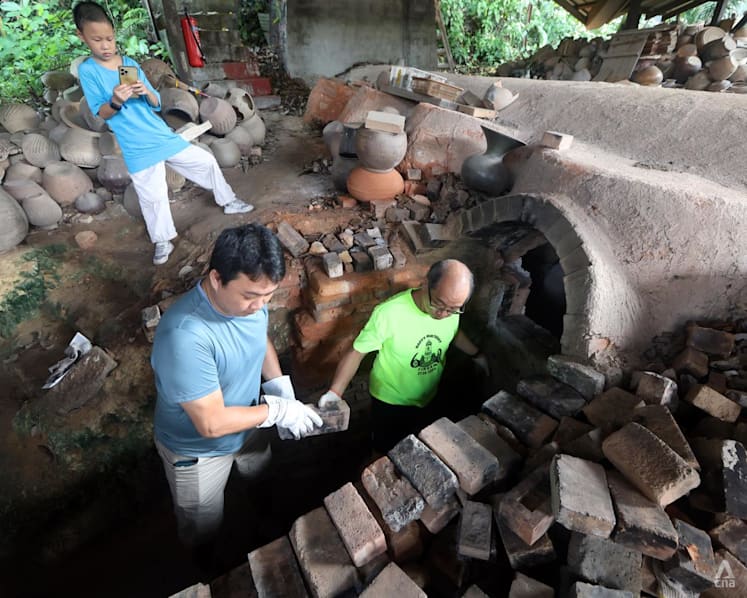
A collective “wow” sounded as the final bricks were removed, revealing the final outcome of the nine-day process that comprised three days of firing and six days of cooling.

The potters carefully removed the art pieces from the shelves, while admiring the effects that the fire had on their work. 

Ms Tia Boon Sim, 69, one of the founders of Thow Kwang Clay Artists, a community group, said: “In wood-firing, the ashes from the fire would fly around and drop on the pieces and these are the effects potters love.”

When asked if she would do this again, Ms Low said: “I would want to come back with my friends for this, have fun and learn new things together.”  

Participants moving the pottery pieces out of the kiln area by forming a human chain. (Photo: CNA/Ooi Boon Keong)
Ceramic items in different shapes, sizes and colours were placed on tables. (Photo: CNA/Ooi Boon Keong)
Mr Goh Wei Ting comparing his pottery work before and after the items were fired in the kiln. (Photo: CNA/Ooi Boon Keong)
A participant looking at a freshly fired pot, examining every detail. (Photo: CNA/Ooi Boon Keong)
Source: CNA/jl/sf

Recommended

Advertisement

In Pixels

Meet the 70-year-old lorry driver who is also a 'kite doctor'

Meet the 70-year-old lorry driver who is also a 'kite doctor'

Kite maker Tan Poh Wah flying his handmade dragon kite at the Marina Barrage. (Photo: CNA/Nuria Ling)

30 Nov 2024 09:30PM (Updated: 16 Oct 2025 12:08AM)

Rolling up to Marina Barrage with a trolley bag full of handmade kites and repair tools, Mr Tan Poh Wah had one clear mission for the day: To share his love of kite-flying with others. 

Known informally as the “kite doctor” among the regular visitors there, the 70-year-old spends most Sundays repairing kites or offering his handmade ones – mostly for free – to people at the open-air space that is the venue of Singapore's largest reservoir. 

“Watching people fly my kites makes me really happy,” Mr Tan said.  

This weekend, In Pixels speaks to four enthusiasts to find out what excites them about kite-flying. 

A FAMILIAR FIGURE

CNA Games
Show More
Show Less

Shortly after Mr Tan turned up at Marina Barrage in the Marina Bay area, a handful of people who wanted their kites repaired immediately made a beeline towards him. 

They offered him drinks and snacks to thank him for his service. 

When he was done with the repairs, Mr Tan pulled a kite from his bag and launched it to the sky. 

He flew it with ease, strolling around the field, eager to find someone who will take the kite as a gift. 

His masterpieces are made mostly from recycled materials including plastic bags, discarded blinds, banners and umbrellas. 

Mr Tan is part of a group known as Singapore Original Kites, an informal gathering of adults in their 60s and 70s who share the same interest in making and flying kites.  

A semi-retired Chinese physician ​​Ong Cheng Her, 75, is the founder of the group.

He said that the only prerequisite to join the group is one’s ability to make a kite from scratch.  

He proudly showed CNA TODAY one of his creations, a red and white "umbrella kite". 

“Umbrellas are used for shade and rain protection, so why hasn’t anyone flown an umbrella kite? I decided to take on the challenge,” Mr Ong added.

HIS WORKSPACE AT HOME

As for Mr Tan, he is not retired, so flying and making kites is what he does only on Sundays.

He works six days a week as a lorry driver.

“I work to live, to fill my stomach so I can make kites.”

Stepping into his flat, Mr Tan led us to his "studio", which is a room filled with a bountiful supply of kites and raw materials. 

He described his workspace as a “chaotic but organised mess”. 

“My wife sometimes asks why I collect so many umbrellas, but she doesn’t interfere much because she knows I enjoy making these things.”

Mr Tan has loved kite flying since he was a child, but it was not until he was in his 30s that he took to making kites himself.

A self-taught craftsman, he said that he learnt how to make kites by observing other kite-makers whenever an opportunity comes along. 

Recently, Mr Tan finished repairing a 70m-long "dragon kite" that he first constructed in 2000. It broke at a kite festival in Taiwan in 2019 and required extensive repairs. 

After CNA TODAY approached him for an interview, Mr Tan said that he found new inspiration to repair the kite, which took him four Sundays to complete.

It was obvious that he is most proud of this kite among the many in his collection.

“Anyone who hasn't made a dragon or a phoenix kite isn't truly considered a kite maker,” he said, adding that these long kites are made up of many different sections and each needed to be crafted with great precision before they are finally stitched together. 

"GIANTS" IN THE SKY

Over at East Coast Park, another group of kite enthusiasts have gathered and their presence could be spotted from afar. 

The kites they have taken out, called "inflatable show kites", are gigantic balloon-like kites that are typically several metres in length when inflated.

Traditional kites rely on rigid frames for support, but inflatable show kites have no hard structures. They inflate as they catch on the wind and have to be anchored to the ground.

Project coordinator Johnny Yap and his wife Maggie Mok, a homemaker, both 51, are the founders of Show Kites Singapore, a group of people who are into these inflatable show kites.

The duo's interest in this started nearly 20 years ago when they took their children kite-flying. 

In the end, it was the couple themselves who got hooked on the activity. 

“We started flying bigger and bigger kites and before long, we realised that stick kites have a limit,” Mr Yap said.

This led them to explore inflatable ones in 2009 and they came across these kites online before buying their first. The sky is the limit when it comes to the sizes of such kites.

As their interests grew, Mr Yap and Ms Mok started travelling overseas to take part in international kite festivals. 

In September, they were at the International Kite Festival in Melaka, Malaysia, where they flew an inflatable show kite in the form of Singapore's tourism icon, the Merlion.

In watching the kite-flyers, CNA TODAY observed that the age-old method of rolling out and pulling the kite lines or strings is still used for flying simple traditional kites regardless of their sizes.

For long, intricate traditional kites such as Mr Tan's dragon kite, as well as the inflatable show kites, they are anchored to the ground and usually fly without much supervision. They also tend to have a "pilot" kite attached to the main kite to provide a lift for the initial flight. 

Some kites need very little wind, whereas others may need strong wind conditions. 

Inflatable show kites at the International Kite Festival held in Melaka, Malaysia in September 2024. (Photo: Maggie Mok)
Most of the kites designed by Mr Johnny Yap are in red and white, which are colours representing Singapore’s flag. (Photo: CNA/Nuria Ling)

Most of the kites owned by Mr Yap and Ms Mok are designed by them. 

The bespoke kites can cost between a few hundred and a few thousand dollars and they are manufactured in China. 

“We know how to make the kite, but we just don't have time. It takes many, many hours of sewing,” Mr Yap explained.

“We stick to the principle that we must design our own kites.”

Mr Johnny Yap trying to anchor some inflatable show kites to the ground. (Photo: CNA/Mak Jia Kee)
Members of the public taking photos with several inflatable show kites at East Coast Park. (Photo: CNA/Nuria Ling)

Through the years, the couple have met people from all walks of life who have taken an interest in this activity. 

“We have doctors, taxi drivers, hawkers (in Show Kites Singapore). It’s the kites that bring us together,” Mr Yap said.

“There’s no application form (to join the group), so long as you are passionate, come join me every Sunday."

Members of Show Kites Singapore taking a break under the shade at East Coast Park. (Photo: CNA/Mak Jia Kee)
Inflatable show kites flying next to a construction site at East Coast Park. (Photo: CNA/Mak Jia Kee)
Advertisement

In Pixels

Snakes and marine life you don’t always see at Sentosa

Snakes and marine life you don’t always see at Sentosa

A 2-metre juvenile reticulated python slithering across a tree branch in front of filmmaker Jayaprakash Bojan. The snake was found near Palawan Green on Sentosa Island and was rehomed in a forested area nearby. (Photo: CNA/Raj Nadarajan)

04 Oct 2024 09:30PM (Updated: 16 Oct 2025 12:12AM)

There was palpable tension in the air as a black bag was taken to the forest. 

Inside was a 2-metre juvenile reticulated python. 

The snake with diamond-patterned skin was being relocated to a forested area on Sentosa Island by the wildlife management team of the Sentosa Development Corporation (SDC), after it was spotted in a high foot-traffic area.

Standing very still just a few metres away were two professional filmmakers and a photographer, patiently waiting for the snake to emerge. 

CNA Games
Show More
Show Less

They did not have to wait long.

In just a couple of minutes, the python slithered out of the bag and gradually made its way up a tree. 

The team then waited another four hours for the snake to make its way down from the tree as they observed its movements on camera.

In Pixels takes you this weekend on a visual trip with wildlife filmmakers Jayaprakash “JP” Bojan and Ian Mun, as they document Sentosa’s biodiversity and conservation efforts for Earth in Focus, a nature film festival set to take place in November on the resort island south of mainland Singapore. 

Reticulated pythons are native to Singapore and they are commonly found in secondary forests with a water supply. (Photo: CNA/Raj Nadarajan)
Photographer and filmmaker Jayaprakash Bojan, fondly known as JP, attaching a camera to a monopod to capture footage of a python from a safe distance. (Photo: CNA/Raj Nadarajan)
A spitting cobra found in a drain at Fort Siloso in Sentosa was relocated to a forested area on the island. A team of filmmakers had been shooting in Sentosa thrice a week for three months but this was the first time that they were coming face-to-face with a venomous snake on the island. (Photo: CNA/Nuria Ling)

Sentosa is a tourist destination known for its themed parks and sandy beaches. The island’s free-roaming peacocks are probably its most well-known wildlife. 

Off the beaten tracks, though, in the forested areas or along the rocky shores, there is a rich biodiversity of flora and fauna unknown to many visitors.

One rare species found in the coastal forests is the Xylocarpus rumphii, a critically endangered plant that has not been discovered elsewhere on mainland Singapore. 

There is also the elusive lesser bamboo bat, one of the smallest mammals on earth. 

This vulnerable bat species, which weighs just a few grams, has a flattened skull that allows it to squeeze in a hollow bamboo shoot to roost, through narrow slits created by beetles.

A bamboo bat captured on video after being awakened by the endoscope. (Photo: CNA/Nuria Ling)
An endoscope being used to check on lesser bamboo bats that live inside bamboo plants. (Photo: CNA/Nuria Ling)

Sentosa is home to 850 flora and fauna species. 

Setting up camera traps is one way that the conservation team is able to track and protect the wildlife on the island.  

Unlike what it sounds, camera traps do not trap animals. They are cameras with sensors put up in animal habitats for a duration to record images of wildlife and collect data on them.

The team has deployed eight such cameras in biodiversity-sensitive habitats around the island and the cameras are checked every alternate month. 

Advertisement

In Pixels

Inside a dragon kiln where temperatures go up to 1,300°C

Inside a dragon kiln where temperatures go up to 1,300°C

Wood-firing at a dragon kiln is a community effort that requires round-the-clock monitoring. (Photo: CNA/Ooi Boon Keong)

15 Nov 2024 09:30PM (Updated: 16 Oct 2025 12:09AM)

Nestled in an industrial estate in the western part of Singapore is an 84-year-old dragon kiln, the oldest and the only operational dragon kiln in the country. 

Built in 1940, the kiln at Thow Kwang Pottery Jungle was originally used for the mass production of household and industrial items such as cups and flower pots.

Over the decades, the place has evolved into a community space, now offering classes and events for potters to hone their craft. 

CNA TODAY joined the potter community for a wood-firing session that happens only two or three times a year.

CNA Games
Show More
Show Less

In Pixels takes you through the experience, as new and seasoned potters bond over fire and perspiration, creating unique works of art. 

PRAYERS TO THE "KILN GOD"  

At Thow Kwang Pottery Jungle, which is located a short distance from Nanyang Technological University, a group of around 30 people gathered on a Friday last month in front of the kiln.

This was at the request of the owners, Mr Tan Teck Yoke, 68, and his wife Yulianti Tan, 66. 

A prayer ceremony to the "kiln god" was about to begin. 

“We are praying to the ‘kiln god’ for a successful firing, for the pieces to achieve the desired effects,” Mr Tan explained to the enthusiastic participants. 

To this, the crowd responded by shouting, “Heng, ong, huat, ah,” a phrase in the Chinese dialect of Hokkien that collectively means wishing for good fortune.

After the prayers were done, the fire box, which is a small opening at the front of the kiln, was lit. 

The participants each picked up a piece of wood to throw into the fire, hoping to add more "luck" to the process. 

The dragon kiln was bought by Mr Tan’s father in 1965 and has been owned by the family since then.

It sits on a slope, is 27-metres long, 2-metres wide and curves around the side, resembling the body of a dragon in Chinese mythology. 

Its lengthy chambers are made out of bricks and there is a chimney at the end, located at the top of the slope.

The kiln can fit thousands of pieces of ceramic items, depending on the size of the pots. 

For this firing session, around 400 to 500 pieces were loaded in the kiln. 

NEW WAYS TO IMPROVE PROCESS

Temperatures in the dragon kiln can reach up to 1,300°C. 

They can fluctuate significantly due to the shape of the furnace and the use of wood as a fuel.

That is why one of the most crucial parts of the process is to monitor the temperature for all three days of the firing session.

Mr Chua Hee Lai, who is in his 50s and a hobbyist-turned-kiln master, helped to plan and lead each firing session. 

In 2019, Mr Chua, with the help of another potter, introduced a digital monitoring system that allowed them to track the temperatures remotely and give instructions to the potters doing shift work on site. 

Previously, they had to monitor the temperature by looking at the colour of the flame or record temperatures manually and then draw up prediction charts – a process that requires them to be on site for longer periods of time.

THE "KAMPUNG SPIRIT"

Advertising executive Vanessa Low and product manager Goh Wei Ting, both 31, have been practising pottery at another pottery studio for around five years and this was their first time taking part in the wood-firing process.

Compared to a regular firing in an electric or gas kiln, wood-firing is "tiring and physically demanding", Mr Goh said.

However, they were buoyed by the “kampung spirit” or the sense of camaraderie that came about as participants laboured together. 

 “You just don’t feel tired, you just do (the work),” Mr Goh added. 

OPENING OF THE KILN

Six days after the firing at the dragon kiln, the participants returned to open the kiln and check on their art pieces. 

“Shall we form a chain?” someone suggested to facilitate the removal of the brick walls. 

Without hesitation, a human chain quickly formed as the potters unsealed the kiln, one brick at a time. 
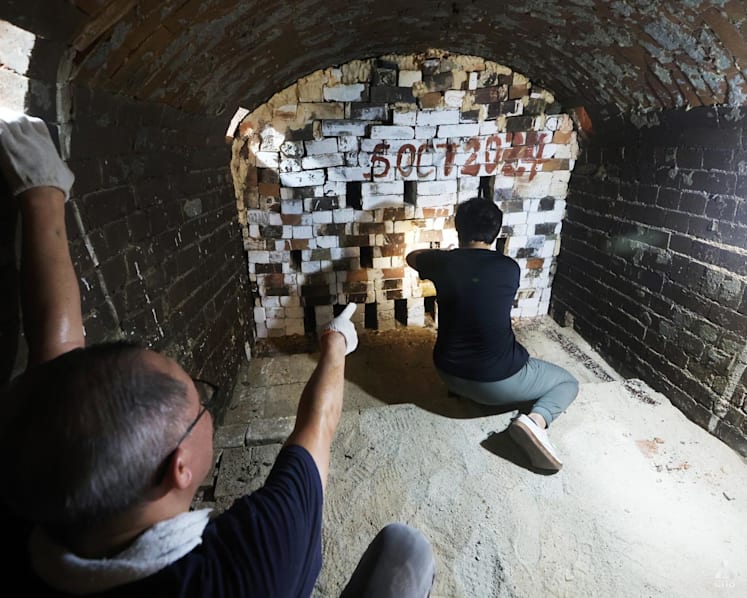
A collective “wow” sounded as the final bricks were removed, revealing the final outcome of the nine-day process that comprised three days of firing and six days of cooling.

The potters carefully removed the art pieces from the shelves, while admiring the effects that the fire had on their work. 

Ms Tia Boon Sim, 69, one of the founders of Thow Kwang Clay Artists, a community group, said: “In wood-firing, the ashes from the fire would fly around and drop on the pieces and these are the effects potters love.”

When asked if she would do this again, Ms Low said: “I would want to come back with my friends for this, have fun and learn new things together.”  

Participants moving the pottery pieces out of the kiln area by forming a human chain. (Photo: CNA/Ooi Boon Keong)
Ceramic items in different shapes, sizes and colours were placed on tables. (Photo: CNA/Ooi Boon Keong)
Mr Goh Wei Ting comparing his pottery work before and after the items were fired in the kiln. (Photo: CNA/Ooi Boon Keong)
A participant looking at a freshly fired pot, examining every detail. (Photo: CNA/Ooi Boon Keong)
Source: CNA/jl/sf

Recommended

Advertisement

In Pixels

Meet the 70-year-old lorry driver who is also a 'kite doctor'

Meet the 70-year-old lorry driver who is also a 'kite doctor'

Kite maker Tan Poh Wah flying his handmade dragon kite at the Marina Barrage. (Photo: CNA/Nuria Ling)

30 Nov 2024 09:30PM (Updated: 16 Oct 2025 12:08AM)

Rolling up to Marina Barrage with a trolley bag full of handmade kites and repair tools, Mr Tan Poh Wah had one clear mission for the day: To share his love of kite-flying with others. 

Known informally as the “kite doctor” among the regular visitors there, the 70-year-old spends most Sundays repairing kites or offering his handmade ones – mostly for free – to people at the open-air space that is the venue of Singapore's largest reservoir. 

“Watching people fly my kites makes me really happy,” Mr Tan said.  

This weekend, In Pixels speaks to four enthusiasts to find out what excites them about kite-flying. 

A FAMILIAR FIGURE

CNA Games
Show More
Show Less

Shortly after Mr Tan turned up at Marina Barrage in the Marina Bay area, a handful of people who wanted their kites repaired immediately made a beeline towards him. 

They offered him drinks and snacks to thank him for his service. 

When he was done with the repairs, Mr Tan pulled a kite from his bag and launched it to the sky. 

He flew it with ease, strolling around the field, eager to find someone who will take the kite as a gift. 

His masterpieces are made mostly from recycled materials including plastic bags, discarded blinds, banners and umbrellas. 

Mr Tan is part of a group known as Singapore Original Kites, an informal gathering of adults in their 60s and 70s who share the same interest in making and flying kites.  

A semi-retired Chinese physician ​​Ong Cheng Her, 75, is the founder of the group.

He said that the only prerequisite to join the group is one’s ability to make a kite from scratch.  

He proudly showed CNA TODAY one of his creations, a red and white "umbrella kite". 

“Umbrellas are used for shade and rain protection, so why hasn’t anyone flown an umbrella kite? I decided to take on the challenge,” Mr Ong added.

HIS WORKSPACE AT HOME

As for Mr Tan, he is not retired, so flying and making kites is what he does only on Sundays.

He works six days a week as a lorry driver.

“I work to live, to fill my stomach so I can make kites.”

Stepping into his flat, Mr Tan led us to his "studio", which is a room filled with a bountiful supply of kites and raw materials. 

He described his workspace as a “chaotic but organised mess”. 

“My wife sometimes asks why I collect so many umbrellas, but she doesn’t interfere much because she knows I enjoy making these things.”

Mr Tan has loved kite flying since he was a child, but it was not until he was in his 30s that he took to making kites himself.

A self-taught craftsman, he said that he learnt how to make kites by observing other kite-makers whenever an opportunity comes along. 

Recently, Mr Tan finished repairing a 70m-long "dragon kite" that he first constructed in 2000. It broke at a kite festival in Taiwan in 2019 and required extensive repairs. 

After CNA TODAY approached him for an interview, Mr Tan said that he found new inspiration to repair the kite, which took him four Sundays to complete.

It was obvious that he is most proud of this kite among the many in his collection.

“Anyone who hasn't made a dragon or a phoenix kite isn't truly considered a kite maker,” he said, adding that these long kites are made up of many different sections and each needed to be crafted with great precision before they are finally stitched together. 

"GIANTS" IN THE SKY

Over at East Coast Park, another group of kite enthusiasts have gathered and their presence could be spotted from afar. 

The kites they have taken out, called "inflatable show kites", are gigantic balloon-like kites that are typically several metres in length when inflated.

Traditional kites rely on rigid frames for support, but inflatable show kites have no hard structures. They inflate as they catch on the wind and have to be anchored to the ground.

Project coordinator Johnny Yap and his wife Maggie Mok, a homemaker, both 51, are the founders of Show Kites Singapore, a group of people who are into these inflatable show kites.

The duo's interest in this started nearly 20 years ago when they took their children kite-flying. 

In the end, it was the couple themselves who got hooked on the activity. 

“We started flying bigger and bigger kites and before long, we realised that stick kites have a limit,” Mr Yap said.

This led them to explore inflatable ones in 2009 and they came across these kites online before buying their first. The sky is the limit when it comes to the sizes of such kites.

As their interests grew, Mr Yap and Ms Mok started travelling overseas to take part in international kite festivals. 

In September, they were at the International Kite Festival in Melaka, Malaysia, where they flew an inflatable show kite in the form of Singapore's tourism icon, the Merlion.

In watching the kite-flyers, CNA TODAY observed that the age-old method of rolling out and pulling the kite lines or strings is still used for flying simple traditional kites regardless of their sizes.

For long, intricate traditional kites such as Mr Tan's dragon kite, as well as the inflatable show kites, they are anchored to the ground and usually fly without much supervision. They also tend to have a "pilot" kite attached to the main kite to provide a lift for the initial flight. 

Some kites need very little wind, whereas others may need strong wind conditions. 

Inflatable show kites at the International Kite Festival held in Melaka, Malaysia in September 2024. (Photo: Maggie Mok)
Most of the kites designed by Mr Johnny Yap are in red and white, which are colours representing Singapore’s flag. (Photo: CNA/Nuria Ling)

Most of the kites owned by Mr Yap and Ms Mok are designed by them. 

The bespoke kites can cost between a few hundred and a few thousand dollars and they are manufactured in China. 

“We know how to make the kite, but we just don't have time. It takes many, many hours of sewing,” Mr Yap explained.

“We stick to the principle that we must design our own kites.”

Mr Johnny Yap trying to anchor some inflatable show kites to the ground. (Photo: CNA/Mak Jia Kee)
Members of the public taking photos with several inflatable show kites at East Coast Park. (Photo: CNA/Nuria Ling)

Through the years, the couple have met people from all walks of life who have taken an interest in this activity. 

“We have doctors, taxi drivers, hawkers (in Show Kites Singapore). It’s the kites that bring us together,” Mr Yap said.

“There’s no application form (to join the group), so long as you are passionate, come join me every Sunday."

Members of Show Kites Singapore taking a break under the shade at East Coast Park. (Photo: CNA/Mak Jia Kee)
Inflatable show kites flying next to a construction site at East Coast Park. (Photo: CNA/Mak Jia Kee)
Advertisement

In Pixels

Snakes and marine life you don’t always see at Sentosa

Snakes and marine life you don’t always see at Sentosa

A 2-metre juvenile reticulated python slithering across a tree branch in front of filmmaker Jayaprakash Bojan. The snake was found near Palawan Green on Sentosa Island and was rehomed in a forested area nearby. (Photo: CNA/Raj Nadarajan)

04 Oct 2024 09:30PM (Updated: 16 Oct 2025 12:12AM)

There was palpable tension in the air as a black bag was taken to the forest. 

Inside was a 2-metre juvenile reticulated python. 

The snake with diamond-patterned skin was being relocated to a forested area on Sentosa Island by the wildlife management team of the Sentosa Development Corporation (SDC), after it was spotted in a high foot-traffic area.

Standing very still just a few metres away were two professional filmmakers and a photographer, patiently waiting for the snake to emerge. 

CNA Games
Show More
Show Less

They did not have to wait long.

In just a couple of minutes, the python slithered out of the bag and gradually made its way up a tree. 

The team then waited another four hours for the snake to make its way down from the tree as they observed its movements on camera.

In Pixels takes you this weekend on a visual trip with wildlife filmmakers Jayaprakash “JP” Bojan and Ian Mun, as they document Sentosa’s biodiversity and conservation efforts for Earth in Focus, a nature film festival set to take place in November on the resort island south of mainland Singapore. 

Reticulated pythons are native to Singapore and they are commonly found in secondary forests with a water supply. (Photo: CNA/Raj Nadarajan)
Photographer and filmmaker Jayaprakash Bojan, fondly known as JP, attaching a camera to a monopod to capture footage of a python from a safe distance. (Photo: CNA/Raj Nadarajan)
A spitting cobra found in a drain at Fort Siloso in Sentosa was relocated to a forested area on the island. A team of filmmakers had been shooting in Sentosa thrice a week for three months but this was the first time that they were coming face-to-face with a venomous snake on the island. (Photo: CNA/Nuria Ling)

Sentosa is a tourist destination known for its themed parks and sandy beaches. The island’s free-roaming peacocks are probably its most well-known wildlife. 

Off the beaten tracks, though, in the forested areas or along the rocky shores, there is a rich biodiversity of flora and fauna unknown to many visitors.

One rare species found in the coastal forests is the Xylocarpus rumphii, a critically endangered plant that has not been discovered elsewhere on mainland Singapore. 

There is also the elusive lesser bamboo bat, one of the smallest mammals on earth. 

This vulnerable bat species, which weighs just a few grams, has a flattened skull that allows it to squeeze in a hollow bamboo shoot to roost, through narrow slits created by beetles.

A bamboo bat captured on video after being awakened by the endoscope. (Photo: CNA/Nuria Ling)
An endoscope being used to check on lesser bamboo bats that live inside bamboo plants. (Photo: CNA/Nuria Ling)

Sentosa is home to 850 flora and fauna species. 

Setting up camera traps is one way that the conservation team is able to track and protect the wildlife on the island.  

Unlike what it sounds, camera traps do not trap animals. They are cameras with sensors put up in animal habitats for a duration to record images of wildlife and collect data on them.

The team has deployed eight such cameras in biodiversity-sensitive habitats around the island and the cameras are checked every alternate month. 

Advertisement

In Pixels

Inside a dragon kiln where temperatures go up to 1,300°C

Inside a dragon kiln where temperatures go up to 1,300°C

Wood-firing at a dragon kiln is a community effort that requires round-the-clock monitoring. (Photo: CNA/Ooi Boon Keong)

15 Nov 2024 09:30PM (Updated: 16 Oct 2025 12:09AM)

Nestled in an industrial estate in the western part of Singapore is an 84-year-old dragon kiln, the oldest and the only operational dragon kiln in the country. 

Built in 1940, the kiln at Thow Kwang Pottery Jungle was originally used for the mass production of household and industrial items such as cups and flower pots.

Over the decades, the place has evolved into a community space, now offering classes and events for potters to hone their craft. 

CNA TODAY joined the potter community for a wood-firing session that happens only two or three times a year.

CNA Games
Show More
Show Less

In Pixels takes you through the experience, as new and seasoned potters bond over fire and perspiration, creating unique works of art. 

PRAYERS TO THE "KILN GOD"  

At Thow Kwang Pottery Jungle, which is located a short distance from Nanyang Technological University, a group of around 30 people gathered on a Friday last month in front of the kiln.

This was at the request of the owners, Mr Tan Teck Yoke, 68, and his wife Yulianti Tan, 66. 

A prayer ceremony to the "kiln god" was about to begin. 

“We are praying to the ‘kiln god’ for a successful firing, for the pieces to achieve the desired effects,” Mr Tan explained to the enthusiastic participants. 

To this, the crowd responded by shouting, “Heng, ong, huat, ah,” a phrase in the Chinese dialect of Hokkien that collectively means wishing for good fortune.

After the prayers were done, the fire box, which is a small opening at the front of the kiln, was lit. 

The participants each picked up a piece of wood to throw into the fire, hoping to add more "luck" to the process. 

The dragon kiln was bought by Mr Tan’s father in 1965 and has been owned by the family since then.

It sits on a slope, is 27-metres long, 2-metres wide and curves around the side, resembling the body of a dragon in Chinese mythology. 

Its lengthy chambers are made out of bricks and there is a chimney at the end, located at the top of the slope.

The kiln can fit thousands of pieces of ceramic items, depending on the size of the pots. 

For this firing session, around 400 to 500 pieces were loaded in the kiln. 

NEW WAYS TO IMPROVE PROCESS

Temperatures in the dragon kiln can reach up to 1,300°C. 

They can fluctuate significantly due to the shape of the furnace and the use of wood as a fuel.

That is why one of the most crucial parts of the process is to monitor the temperature for all three days of the firing session.

Mr Chua Hee Lai, who is in his 50s and a hobbyist-turned-kiln master, helped to plan and lead each firing session. 

In 2019, Mr Chua, with the help of another potter, introduced a digital monitoring system that allowed them to track the temperatures remotely and give instructions to the potters doing shift work on site. 

Previously, they had to monitor the temperature by looking at the colour of the flame or record temperatures manually and then draw up prediction charts – a process that requires them to be on site for longer periods of time.

THE "KAMPUNG SPIRIT"

Advertising executive Vanessa Low and product manager Goh Wei Ting, both 31, have been practising pottery at another pottery studio for around five years and this was their first time taking part in the wood-firing process.

Compared to a regular firing in an electric or gas kiln, wood-firing is "tiring and physically demanding", Mr Goh said.

However, they were buoyed by the “kampung spirit” or the sense of camaraderie that came about as participants laboured together. 

 “You just don’t feel tired, you just do (the work),” Mr Goh added. 

OPENING OF THE KILN

Six days after the firing at the dragon kiln, the participants returned to open the kiln and check on their art pieces. 

“Shall we form a chain?” someone suggested to facilitate the removal of the brick walls. 

Without hesitation, a human chain quickly formed as the potters unsealed the kiln, one brick at a time. 
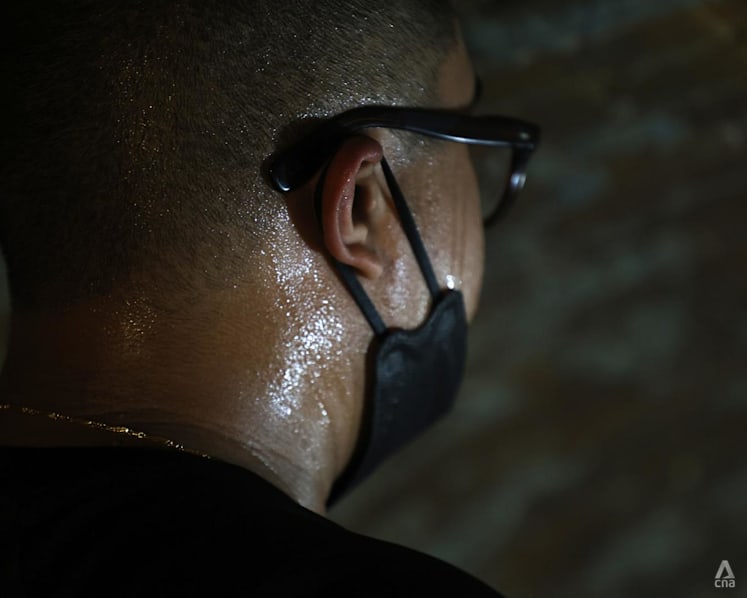
A collective “wow” sounded as the final bricks were removed, revealing the final outcome of the nine-day process that comprised three days of firing and six days of cooling.

The potters carefully removed the art pieces from the shelves, while admiring the effects that the fire had on their work. 

Ms Tia Boon Sim, 69, one of the founders of Thow Kwang Clay Artists, a community group, said: “In wood-firing, the ashes from the fire would fly around and drop on the pieces and these are the effects potters love.”

When asked if she would do this again, Ms Low said: “I would want to come back with my friends for this, have fun and learn new things together.”  

Participants moving the pottery pieces out of the kiln area by forming a human chain. (Photo: CNA/Ooi Boon Keong)
Ceramic items in different shapes, sizes and colours were placed on tables. (Photo: CNA/Ooi Boon Keong)
Mr Goh Wei Ting comparing his pottery work before and after the items were fired in the kiln. (Photo: CNA/Ooi Boon Keong)
A participant looking at a freshly fired pot, examining every detail. (Photo: CNA/Ooi Boon Keong)
Source: CNA/jl/sf

Recommended

Advertisement

In Pixels

Meet the 70-year-old lorry driver who is also a 'kite doctor'

Meet the 70-year-old lorry driver who is also a 'kite doctor'

Kite maker Tan Poh Wah flying his handmade dragon kite at the Marina Barrage. (Photo: CNA/Nuria Ling)

30 Nov 2024 09:30PM (Updated: 16 Oct 2025 12:08AM)

Rolling up to Marina Barrage with a trolley bag full of handmade kites and repair tools, Mr Tan Poh Wah had one clear mission for the day: To share his love of kite-flying with others. 

Known informally as the “kite doctor” among the regular visitors there, the 70-year-old spends most Sundays repairing kites or offering his handmade ones – mostly for free – to people at the open-air space that is the venue of Singapore's largest reservoir. 

“Watching people fly my kites makes me really happy,” Mr Tan said.  

This weekend, In Pixels speaks to four enthusiasts to find out what excites them about kite-flying. 

A FAMILIAR FIGURE

CNA Games
Show More
Show Less

Shortly after Mr Tan turned up at Marina Barrage in the Marina Bay area, a handful of people who wanted their kites repaired immediately made a beeline towards him. 

They offered him drinks and snacks to thank him for his service. 

When he was done with the repairs, Mr Tan pulled a kite from his bag and launched it to the sky. 

He flew it with ease, strolling around the field, eager to find someone who will take the kite as a gift. 

His masterpieces are made mostly from recycled materials including plastic bags, discarded blinds, banners and umbrellas. 

Mr Tan is part of a group known as Singapore Original Kites, an informal gathering of adults in their 60s and 70s who share the same interest in making and flying kites.  

A semi-retired Chinese physician ​​Ong Cheng Her, 75, is the founder of the group.

He said that the only prerequisite to join the group is one’s ability to make a kite from scratch.  

He proudly showed CNA TODAY one of his creations, a red and white "umbrella kite". 

“Umbrellas are used for shade and rain protection, so why hasn’t anyone flown an umbrella kite? I decided to take on the challenge,” Mr Ong added.

HIS WORKSPACE AT HOME

As for Mr Tan, he is not retired, so flying and making kites is what he does only on Sundays.

He works six days a week as a lorry driver.

“I work to live, to fill my stomach so I can make kites.”

Stepping into his flat, Mr Tan led us to his "studio", which is a room filled with a bountiful supply of kites and raw materials. 

He described his workspace as a “chaotic but organised mess”. 

“My wife sometimes asks why I collect so many umbrellas, but she doesn’t interfere much because she knows I enjoy making these things.”

Mr Tan has loved kite flying since he was a child, but it was not until he was in his 30s that he took to making kites himself.

A self-taught craftsman, he said that he learnt how to make kites by observing other kite-makers whenever an opportunity comes along. 

Recently, Mr Tan finished repairing a 70m-long "dragon kite" that he first constructed in 2000. It broke at a kite festival in Taiwan in 2019 and required extensive repairs. 

After CNA TODAY approached him for an interview, Mr Tan said that he found new inspiration to repair the kite, which took him four Sundays to complete.

It was obvious that he is most proud of this kite among the many in his collection.

“Anyone who hasn't made a dragon or a phoenix kite isn't truly considered a kite maker,” he said, adding that these long kites are made up of many different sections and each needed to be crafted with great precision before they are finally stitched together. 

"GIANTS" IN THE SKY

Over at East Coast Park, another group of kite enthusiasts have gathered and their presence could be spotted from afar. 

The kites they have taken out, called "inflatable show kites", are gigantic balloon-like kites that are typically several metres in length when inflated.

Traditional kites rely on rigid frames for support, but inflatable show kites have no hard structures. They inflate as they catch on the wind and have to be anchored to the ground.

Project coordinator Johnny Yap and his wife Maggie Mok, a homemaker, both 51, are the founders of Show Kites Singapore, a group of people who are into these inflatable show kites.

The duo's interest in this started nearly 20 years ago when they took their children kite-flying. 

In the end, it was the couple themselves who got hooked on the activity. 

“We started flying bigger and bigger kites and before long, we realised that stick kites have a limit,” Mr Yap said.

This led them to explore inflatable ones in 2009 and they came across these kites online before buying their first. The sky is the limit when it comes to the sizes of such kites.

As their interests grew, Mr Yap and Ms Mok started travelling overseas to take part in international kite festivals. 

In September, they were at the International Kite Festival in Melaka, Malaysia, where they flew an inflatable show kite in the form of Singapore's tourism icon, the Merlion.

In watching the kite-flyers, CNA TODAY observed that the age-old method of rolling out and pulling the kite lines or strings is still used for flying simple traditional kites regardless of their sizes.

For long, intricate traditional kites such as Mr Tan's dragon kite, as well as the inflatable show kites, they are anchored to the ground and usually fly without much supervision. They also tend to have a "pilot" kite attached to the main kite to provide a lift for the initial flight. 

Some kites need very little wind, whereas others may need strong wind conditions. 

Inflatable show kites at the International Kite Festival held in Melaka, Malaysia in September 2024. (Photo: Maggie Mok)
Most of the kites designed by Mr Johnny Yap are in red and white, which are colours representing Singapore’s flag. (Photo: CNA/Nuria Ling)

Most of the kites owned by Mr Yap and Ms Mok are designed by them. 

The bespoke kites can cost between a few hundred and a few thousand dollars and they are manufactured in China. 

“We know how to make the kite, but we just don't have time. It takes many, many hours of sewing,” Mr Yap explained.

“We stick to the principle that we must design our own kites.”

Mr Johnny Yap trying to anchor some inflatable show kites to the ground. (Photo: CNA/Mak Jia Kee)
Members of the public taking photos with several inflatable show kites at East Coast Park. (Photo: CNA/Nuria Ling)

Through the years, the couple have met people from all walks of life who have taken an interest in this activity. 

“We have doctors, taxi drivers, hawkers (in Show Kites Singapore). It’s the kites that bring us together,” Mr Yap said.

“There’s no application form (to join the group), so long as you are passionate, come join me every Sunday."

Members of Show Kites Singapore taking a break under the shade at East Coast Park. (Photo: CNA/Mak Jia Kee)
Inflatable show kites flying next to a construction site at East Coast Park. (Photo: CNA/Mak Jia Kee)
Advertisement

In Pixels

Snakes and marine life you don’t always see at Sentosa

Snakes and marine life you don’t always see at Sentosa

A 2-metre juvenile reticulated python slithering across a tree branch in front of filmmaker Jayaprakash Bojan. The snake was found near Palawan Green on Sentosa Island and was rehomed in a forested area nearby. (Photo: CNA/Raj Nadarajan)

04 Oct 2024 09:30PM (Updated: 16 Oct 2025 12:12AM)

There was palpable tension in the air as a black bag was taken to the forest. 

Inside was a 2-metre juvenile reticulated python. 

The snake with diamond-patterned skin was being relocated to a forested area on Sentosa Island by the wildlife management team of the Sentosa Development Corporation (SDC), after it was spotted in a high foot-traffic area.

Standing very still just a few metres away were two professional filmmakers and a photographer, patiently waiting for the snake to emerge. 

CNA Games
Show More
Show Less

They did not have to wait long.

In just a couple of minutes, the python slithered out of the bag and gradually made its way up a tree. 

The team then waited another four hours for the snake to make its way down from the tree as they observed its movements on camera.

In Pixels takes you this weekend on a visual trip with wildlife filmmakers Jayaprakash “JP” Bojan and Ian Mun, as they document Sentosa’s biodiversity and conservation efforts for Earth in Focus, a nature film festival set to take place in November on the resort island south of mainland Singapore. 

Reticulated pythons are native to Singapore and they are commonly found in secondary forests with a water supply. (Photo: CNA/Raj Nadarajan)
Photographer and filmmaker Jayaprakash Bojan, fondly known as JP, attaching a camera to a monopod to capture footage of a python from a safe distance. (Photo: CNA/Raj Nadarajan)
A spitting cobra found in a drain at Fort Siloso in Sentosa was relocated to a forested area on the island. A team of filmmakers had been shooting in Sentosa thrice a week for three months but this was the first time that they were coming face-to-face with a venomous snake on the island. (Photo: CNA/Nuria Ling)

Sentosa is a tourist destination known for its themed parks and sandy beaches. The island’s free-roaming peacocks are probably its most well-known wildlife. 

Off the beaten tracks, though, in the forested areas or along the rocky shores, there is a rich biodiversity of flora and fauna unknown to many visitors.

One rare species found in the coastal forests is the Xylocarpus rumphii, a critically endangered plant that has not been discovered elsewhere on mainland Singapore. 

There is also the elusive lesser bamboo bat, one of the smallest mammals on earth. 

This vulnerable bat species, which weighs just a few grams, has a flattened skull that allows it to squeeze in a hollow bamboo shoot to roost, through narrow slits created by beetles.

A bamboo bat captured on video after being awakened by the endoscope. (Photo: CNA/Nuria Ling)
An endoscope being used to check on lesser bamboo bats that live inside bamboo plants. (Photo: CNA/Nuria Ling)

Sentosa is home to 850 flora and fauna species. 

Setting up camera traps is one way that the conservation team is able to track and protect the wildlife on the island.  

Unlike what it sounds, camera traps do not trap animals. They are cameras with sensors put up in animal habitats for a duration to record images of wildlife and collect data on them.

The team has deployed eight such cameras in biodiversity-sensitive habitats around the island and the cameras are checked every alternate month. 

Advertisement

In Pixels

Inside a dragon kiln where temperatures go up to 1,300°C

Inside a dragon kiln where temperatures go up to 1,300°C

Wood-firing at a dragon kiln is a community effort that requires round-the-clock monitoring. (Photo: CNA/Ooi Boon Keong)

15 Nov 2024 09:30PM (Updated: 16 Oct 2025 12:09AM)

Nestled in an industrial estate in the western part of Singapore is an 84-year-old dragon kiln, the oldest and the only operational dragon kiln in the country. 

Built in 1940, the kiln at Thow Kwang Pottery Jungle was originally used for the mass production of household and industrial items such as cups and flower pots.

Over the decades, the place has evolved into a community space, now offering classes and events for potters to hone their craft. 

CNA TODAY joined the potter community for a wood-firing session that happens only two or three times a year.

CNA Games
Show More
Show Less

In Pixels takes you through the experience, as new and seasoned potters bond over fire and perspiration, creating unique works of art. 

PRAYERS TO THE "KILN GOD"  

At Thow Kwang Pottery Jungle, which is located a short distance from Nanyang Technological University, a group of around 30 people gathered on a Friday last month in front of the kiln.

This was at the request of the owners, Mr Tan Teck Yoke, 68, and his wife Yulianti Tan, 66. 

A prayer ceremony to the "kiln god" was about to begin. 

“We are praying to the ‘kiln god’ for a successful firing, for the pieces to achieve the desired effects,” Mr Tan explained to the enthusiastic participants. 

To this, the crowd responded by shouting, “Heng, ong, huat, ah,” a phrase in the Chinese dialect of Hokkien that collectively means wishing for good fortune.

After the prayers were done, the fire box, which is a small opening at the front of the kiln, was lit. 

The participants each picked up a piece of wood to throw into the fire, hoping to add more "luck" to the process. 

The dragon kiln was bought by Mr Tan’s father in 1965 and has been owned by the family since then.

It sits on a slope, is 27-metres long, 2-metres wide and curves around the side, resembling the body of a dragon in Chinese mythology. 

Its lengthy chambers are made out of bricks and there is a chimney at the end, located at the top of the slope.

The kiln can fit thousands of pieces of ceramic items, depending on the size of the pots. 

For this firing session, around 400 to 500 pieces were loaded in the kiln. 

NEW WAYS TO IMPROVE PROCESS

Temperatures in the dragon kiln can reach up to 1,300°C. 

They can fluctuate significantly due to the shape of the furnace and the use of wood as a fuel.

That is why one of the most crucial parts of the process is to monitor the temperature for all three days of the firing session.

Mr Chua Hee Lai, who is in his 50s and a hobbyist-turned-kiln master, helped to plan and lead each firing session. 

In 2019, Mr Chua, with the help of another potter, introduced a digital monitoring system that allowed them to track the temperatures remotely and give instructions to the potters doing shift work on site. 

Previously, they had to monitor the temperature by looking at the colour of the flame or record temperatures manually and then draw up prediction charts – a process that requires them to be on site for longer periods of time.

THE "KAMPUNG SPIRIT"

Advertising executive Vanessa Low and product manager Goh Wei Ting, both 31, have been practising pottery at another pottery studio for around five years and this was their first time taking part in the wood-firing process.

Compared to a regular firing in an electric or gas kiln, wood-firing is "tiring and physically demanding", Mr Goh said.

However, they were buoyed by the “kampung spirit” or the sense of camaraderie that came about as participants laboured together. 

 “You just don’t feel tired, you just do (the work),” Mr Goh added. 

OPENING OF THE KILN

Six days after the firing at the dragon kiln, the participants returned to open the kiln and check on their art pieces. 

“Shall we form a chain?” someone suggested to facilitate the removal of the brick walls. 

Without hesitation, a human chain quickly formed as the potters unsealed the kiln, one brick at a time. 
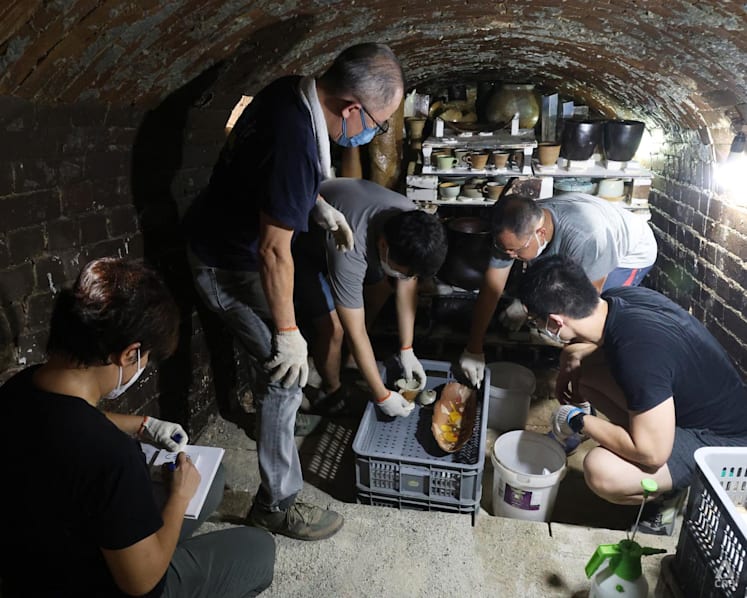
A collective “wow” sounded as the final bricks were removed, revealing the final outcome of the nine-day process that comprised three days of firing and six days of cooling.

The potters carefully removed the art pieces from the shelves, while admiring the effects that the fire had on their work. 

Ms Tia Boon Sim, 69, one of the founders of Thow Kwang Clay Artists, a community group, said: “In wood-firing, the ashes from the fire would fly around and drop on the pieces and these are the effects potters love.”

When asked if she would do this again, Ms Low said: “I would want to come back with my friends for this, have fun and learn new things together.”  

Participants moving the pottery pieces out of the kiln area by forming a human chain. (Photo: CNA/Ooi Boon Keong)
Ceramic items in different shapes, sizes and colours were placed on tables. (Photo: CNA/Ooi Boon Keong)
Mr Goh Wei Ting comparing his pottery work before and after the items were fired in the kiln. (Photo: CNA/Ooi Boon Keong)
A participant looking at a freshly fired pot, examining every detail. (Photo: CNA/Ooi Boon Keong)
Source: CNA/jl/sf

Recommended

Advertisement

In Pixels

Meet the 70-year-old lorry driver who is also a 'kite doctor'

Meet the 70-year-old lorry driver who is also a 'kite doctor'

Kite maker Tan Poh Wah flying his handmade dragon kite at the Marina Barrage. (Photo: CNA/Nuria Ling)

30 Nov 2024 09:30PM (Updated: 16 Oct 2025 12:08AM)

Rolling up to Marina Barrage with a trolley bag full of handmade kites and repair tools, Mr Tan Poh Wah had one clear mission for the day: To share his love of kite-flying with others. 

Known informally as the “kite doctor” among the regular visitors there, the 70-year-old spends most Sundays repairing kites or offering his handmade ones – mostly for free – to people at the open-air space that is the venue of Singapore's largest reservoir. 

“Watching people fly my kites makes me really happy,” Mr Tan said.  

This weekend, In Pixels speaks to four enthusiasts to find out what excites them about kite-flying. 

A FAMILIAR FIGURE

CNA Games
Show More
Show Less

Shortly after Mr Tan turned up at Marina Barrage in the Marina Bay area, a handful of people who wanted their kites repaired immediately made a beeline towards him. 

They offered him drinks and snacks to thank him for his service. 

When he was done with the repairs, Mr Tan pulled a kite from his bag and launched it to the sky. 

He flew it with ease, strolling around the field, eager to find someone who will take the kite as a gift. 

His masterpieces are made mostly from recycled materials including plastic bags, discarded blinds, banners and umbrellas. 

Mr Tan is part of a group known as Singapore Original Kites, an informal gathering of adults in their 60s and 70s who share the same interest in making and flying kites.  

A semi-retired Chinese physician ​​Ong Cheng Her, 75, is the founder of the group.

He said that the only prerequisite to join the group is one’s ability to make a kite from scratch.  

He proudly showed CNA TODAY one of his creations, a red and white "umbrella kite". 

“Umbrellas are used for shade and rain protection, so why hasn’t anyone flown an umbrella kite? I decided to take on the challenge,” Mr Ong added.

HIS WORKSPACE AT HOME

As for Mr Tan, he is not retired, so flying and making kites is what he does only on Sundays.

He works six days a week as a lorry driver.

“I work to live, to fill my stomach so I can make kites.”

Stepping into his flat, Mr Tan led us to his "studio", which is a room filled with a bountiful supply of kites and raw materials. 

He described his workspace as a “chaotic but organised mess”. 

“My wife sometimes asks why I collect so many umbrellas, but she doesn’t interfere much because she knows I enjoy making these things.”

Mr Tan has loved kite flying since he was a child, but it was not until he was in his 30s that he took to making kites himself.

A self-taught craftsman, he said that he learnt how to make kites by observing other kite-makers whenever an opportunity comes along. 

Recently, Mr Tan finished repairing a 70m-long "dragon kite" that he first constructed in 2000. It broke at a kite festival in Taiwan in 2019 and required extensive repairs. 

After CNA TODAY approached him for an interview, Mr Tan said that he found new inspiration to repair the kite, which took him four Sundays to complete.

It was obvious that he is most proud of this kite among the many in his collection.

“Anyone who hasn't made a dragon or a phoenix kite isn't truly considered a kite maker,” he said, adding that these long kites are made up of many different sections and each needed to be crafted with great precision before they are finally stitched together. 

"GIANTS" IN THE SKY

Over at East Coast Park, another group of kite enthusiasts have gathered and their presence could be spotted from afar. 

The kites they have taken out, called "inflatable show kites", are gigantic balloon-like kites that are typically several metres in length when inflated.

Traditional kites rely on rigid frames for support, but inflatable show kites have no hard structures. They inflate as they catch on the wind and have to be anchored to the ground.

Project coordinator Johnny Yap and his wife Maggie Mok, a homemaker, both 51, are the founders of Show Kites Singapore, a group of people who are into these inflatable show kites.

The duo's interest in this started nearly 20 years ago when they took their children kite-flying. 

In the end, it was the couple themselves who got hooked on the activity. 

“We started flying bigger and bigger kites and before long, we realised that stick kites have a limit,” Mr Yap said.

This led them to explore inflatable ones in 2009 and they came across these kites online before buying their first. The sky is the limit when it comes to the sizes of such kites.

As their interests grew, Mr Yap and Ms Mok started travelling overseas to take part in international kite festivals. 

In September, they were at the International Kite Festival in Melaka, Malaysia, where they flew an inflatable show kite in the form of Singapore's tourism icon, the Merlion.

In watching the kite-flyers, CNA TODAY observed that the age-old method of rolling out and pulling the kite lines or strings is still used for flying simple traditional kites regardless of their sizes.

For long, intricate traditional kites such as Mr Tan's dragon kite, as well as the inflatable show kites, they are anchored to the ground and usually fly without much supervision. They also tend to have a "pilot" kite attached to the main kite to provide a lift for the initial flight. 

Some kites need very little wind, whereas others may need strong wind conditions. 

Inflatable show kites at the International Kite Festival held in Melaka, Malaysia in September 2024. (Photo: Maggie Mok)
Most of the kites designed by Mr Johnny Yap are in red and white, which are colours representing Singapore’s flag. (Photo: CNA/Nuria Ling)

Most of the kites owned by Mr Yap and Ms Mok are designed by them. 

The bespoke kites can cost between a few hundred and a few thousand dollars and they are manufactured in China. 

“We know how to make the kite, but we just don't have time. It takes many, many hours of sewing,” Mr Yap explained.

“We stick to the principle that we must design our own kites.”

Mr Johnny Yap trying to anchor some inflatable show kites to the ground. (Photo: CNA/Mak Jia Kee)
Members of the public taking photos with several inflatable show kites at East Coast Park. (Photo: CNA/Nuria Ling)

Through the years, the couple have met people from all walks of life who have taken an interest in this activity. 

“We have doctors, taxi drivers, hawkers (in Show Kites Singapore). It’s the kites that bring us together,” Mr Yap said.

“There’s no application form (to join the group), so long as you are passionate, come join me every Sunday."

Members of Show Kites Singapore taking a break under the shade at East Coast Park. (Photo: CNA/Mak Jia Kee)
Inflatable show kites flying next to a construction site at East Coast Park. (Photo: CNA/Mak Jia Kee)
Advertisement

In Pixels

Snakes and marine life you don’t always see at Sentosa

Snakes and marine life you don’t always see at Sentosa

A 2-metre juvenile reticulated python slithering across a tree branch in front of filmmaker Jayaprakash Bojan. The snake was found near Palawan Green on Sentosa Island and was rehomed in a forested area nearby. (Photo: CNA/Raj Nadarajan)

04 Oct 2024 09:30PM (Updated: 16 Oct 2025 12:12AM)

There was palpable tension in the air as a black bag was taken to the forest. 

Inside was a 2-metre juvenile reticulated python. 

The snake with diamond-patterned skin was being relocated to a forested area on Sentosa Island by the wildlife management team of the Sentosa Development Corporation (SDC), after it was spotted in a high foot-traffic area.

Standing very still just a few metres away were two professional filmmakers and a photographer, patiently waiting for the snake to emerge. 

CNA Games
Show More
Show Less

They did not have to wait long.

In just a couple of minutes, the python slithered out of the bag and gradually made its way up a tree. 

The team then waited another four hours for the snake to make its way down from the tree as they observed its movements on camera.

In Pixels takes you this weekend on a visual trip with wildlife filmmakers Jayaprakash “JP” Bojan and Ian Mun, as they document Sentosa’s biodiversity and conservation efforts for Earth in Focus, a nature film festival set to take place in November on the resort island south of mainland Singapore. 

Reticulated pythons are native to Singapore and they are commonly found in secondary forests with a water supply. (Photo: CNA/Raj Nadarajan)
Photographer and filmmaker Jayaprakash Bojan, fondly known as JP, attaching a camera to a monopod to capture footage of a python from a safe distance. (Photo: CNA/Raj Nadarajan)
A spitting cobra found in a drain at Fort Siloso in Sentosa was relocated to a forested area on the island. A team of filmmakers had been shooting in Sentosa thrice a week for three months but this was the first time that they were coming face-to-face with a venomous snake on the island. (Photo: CNA/Nuria Ling)

Sentosa is a tourist destination known for its themed parks and sandy beaches. The island’s free-roaming peacocks are probably its most well-known wildlife. 

Off the beaten tracks, though, in the forested areas or along the rocky shores, there is a rich biodiversity of flora and fauna unknown to many visitors.

One rare species found in the coastal forests is the Xylocarpus rumphii, a critically endangered plant that has not been discovered elsewhere on mainland Singapore. 

There is also the elusive lesser bamboo bat, one of the smallest mammals on earth. 

This vulnerable bat species, which weighs just a few grams, has a flattened skull that allows it to squeeze in a hollow bamboo shoot to roost, through narrow slits created by beetles.

A bamboo bat captured on video after being awakened by the endoscope. (Photo: CNA/Nuria Ling)
An endoscope being used to check on lesser bamboo bats that live inside bamboo plants. (Photo: CNA/Nuria Ling)

Sentosa is home to 850 flora and fauna species. 

Setting up camera traps is one way that the conservation team is able to track and protect the wildlife on the island.  

Unlike what it sounds, camera traps do not trap animals. They are cameras with sensors put up in animal habitats for a duration to record images of wildlife and collect data on them.

The team has deployed eight such cameras in biodiversity-sensitive habitats around the island and the cameras are checked every alternate month. 

Advertisement

In Pixels

Inside a dragon kiln where temperatures go up to 1,300°C

Inside a dragon kiln where temperatures go up to 1,300°C

Wood-firing at a dragon kiln is a community effort that requires round-the-clock monitoring. (Photo: CNA/Ooi Boon Keong)

15 Nov 2024 09:30PM (Updated: 16 Oct 2025 12:09AM)

Nestled in an industrial estate in the western part of Singapore is an 84-year-old dragon kiln, the oldest and the only operational dragon kiln in the country. 

Built in 1940, the kiln at Thow Kwang Pottery Jungle was originally used for the mass production of household and industrial items such as cups and flower pots.

Over the decades, the place has evolved into a community space, now offering classes and events for potters to hone their craft. 

CNA TODAY joined the potter community for a wood-firing session that happens only two or three times a year.

CNA Games
Show More
Show Less

In Pixels takes you through the experience, as new and seasoned potters bond over fire and perspiration, creating unique works of art. 

PRAYERS TO THE "KILN GOD"  

At Thow Kwang Pottery Jungle, which is located a short distance from Nanyang Technological University, a group of around 30 people gathered on a Friday last month in front of the kiln.

This was at the request of the owners, Mr Tan Teck Yoke, 68, and his wife Yulianti Tan, 66. 

A prayer ceremony to the "kiln god" was about to begin. 

“We are praying to the ‘kiln god’ for a successful firing, for the pieces to achieve the desired effects,” Mr Tan explained to the enthusiastic participants. 

To this, the crowd responded by shouting, “Heng, ong, huat, ah,” a phrase in the Chinese dialect of Hokkien that collectively means wishing for good fortune.

After the prayers were done, the fire box, which is a small opening at the front of the kiln, was lit. 

The participants each picked up a piece of wood to throw into the fire, hoping to add more "luck" to the process. 

The dragon kiln was bought by Mr Tan’s father in 1965 and has been owned by the family since then.

It sits on a slope, is 27-metres long, 2-metres wide and curves around the side, resembling the body of a dragon in Chinese mythology. 

Its lengthy chambers are made out of bricks and there is a chimney at the end, located at the top of the slope.

The kiln can fit thousands of pieces of ceramic items, depending on the size of the pots. 

For this firing session, around 400 to 500 pieces were loaded in the kiln. 

NEW WAYS TO IMPROVE PROCESS

Temperatures in the dragon kiln can reach up to 1,300°C. 

They can fluctuate significantly due to the shape of the furnace and the use of wood as a fuel.

That is why one of the most crucial parts of the process is to monitor the temperature for all three days of the firing session.

Mr Chua Hee Lai, who is in his 50s and a hobbyist-turned-kiln master, helped to plan and lead each firing session. 

In 2019, Mr Chua, with the help of another potter, introduced a digital monitoring system that allowed them to track the temperatures remotely and give instructions to the potters doing shift work on site. 

Previously, they had to monitor the temperature by looking at the colour of the flame or record temperatures manually and then draw up prediction charts – a process that requires them to be on site for longer periods of time.

THE "KAMPUNG SPIRIT"

Advertising executive Vanessa Low and product manager Goh Wei Ting, both 31, have been practising pottery at another pottery studio for around five years and this was their first time taking part in the wood-firing process.

Compared to a regular firing in an electric or gas kiln, wood-firing is "tiring and physically demanding", Mr Goh said.

However, they were buoyed by the “kampung spirit” or the sense of camaraderie that came about as participants laboured together. 

 “You just don’t feel tired, you just do (the work),” Mr Goh added. 

OPENING OF THE KILN

Six days after the firing at the dragon kiln, the participants returned to open the kiln and check on their art pieces. 

“Shall we form a chain?” someone suggested to facilitate the removal of the brick walls. 

Without hesitation, a human chain quickly formed as the potters unsealed the kiln, one brick at a time. 
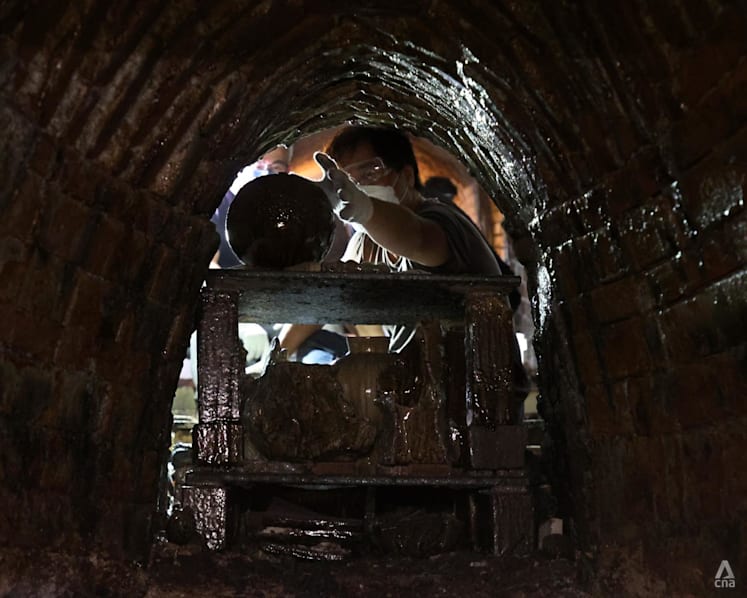
A collective “wow” sounded as the final bricks were removed, revealing the final outcome of the nine-day process that comprised three days of firing and six days of cooling.

The potters carefully removed the art pieces from the shelves, while admiring the effects that the fire had on their work. 

Ms Tia Boon Sim, 69, one of the founders of Thow Kwang Clay Artists, a community group, said: “In wood-firing, the ashes from the fire would fly around and drop on the pieces and these are the effects potters love.”

When asked if she would do this again, Ms Low said: “I would want to come back with my friends for this, have fun and learn new things together.”  

Participants moving the pottery pieces out of the kiln area by forming a human chain. (Photo: CNA/Ooi Boon Keong)
Ceramic items in different shapes, sizes and colours were placed on tables. (Photo: CNA/Ooi Boon Keong)
Mr Goh Wei Ting comparing his pottery work before and after the items were fired in the kiln. (Photo: CNA/Ooi Boon Keong)
A participant looking at a freshly fired pot, examining every detail. (Photo: CNA/Ooi Boon Keong)
Source: CNA/jl/sf

Recommended

Advertisement

In Pixels

Meet the 70-year-old lorry driver who is also a 'kite doctor'

Meet the 70-year-old lorry driver who is also a 'kite doctor'

Kite maker Tan Poh Wah flying his handmade dragon kite at the Marina Barrage. (Photo: CNA/Nuria Ling)

30 Nov 2024 09:30PM (Updated: 16 Oct 2025 12:08AM)

Rolling up to Marina Barrage with a trolley bag full of handmade kites and repair tools, Mr Tan Poh Wah had one clear mission for the day: To share his love of kite-flying with others. 

Known informally as the “kite doctor” among the regular visitors there, the 70-year-old spends most Sundays repairing kites or offering his handmade ones – mostly for free – to people at the open-air space that is the venue of Singapore's largest reservoir. 

“Watching people fly my kites makes me really happy,” Mr Tan said.  

This weekend, In Pixels speaks to four enthusiasts to find out what excites them about kite-flying. 

A FAMILIAR FIGURE

CNA Games
Show More
Show Less

Shortly after Mr Tan turned up at Marina Barrage in the Marina Bay area, a handful of people who wanted their kites repaired immediately made a beeline towards him. 

They offered him drinks and snacks to thank him for his service. 
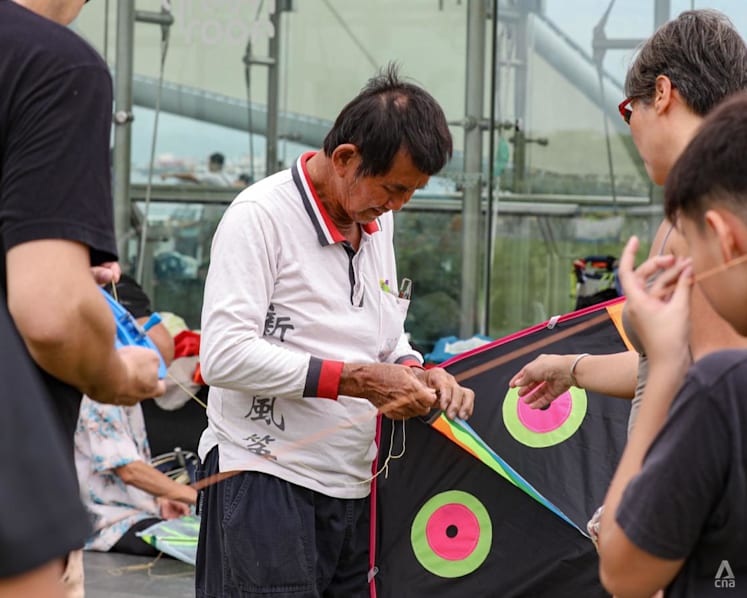
When he was done with the repairs, Mr Tan pulled a kite from his bag and launched it to the sky. 

He flew it with ease, strolling around the field, eager to find someone who will take the kite as a gift. 

His masterpieces are made mostly from recycled materials including plastic bags, discarded blinds, banners and umbrellas. 

Mr Tan is part of a group known as Singapore Original Kites, an informal gathering of adults in their 60s and 70s who share the same interest in making and flying kites.  

A semi-retired Chinese physician ​​Ong Cheng Her, 75, is the founder of the group.

He said that the only prerequisite to join the group is one’s ability to make a kite from scratch.  

He proudly showed CNA TODAY one of his creations, a red and white "umbrella kite". 

“Umbrellas are used for shade and rain protection, so why hasn’t anyone flown an umbrella kite? I decided to take on the challenge,” Mr Ong added.

HIS WORKSPACE AT HOME

As for Mr Tan, he is not retired, so flying and making kites is what he does only on Sundays.

He works six days a week as a lorry driver.

“I work to live, to fill my stomach so I can make kites.”

Stepping into his flat, Mr Tan led us to his "studio", which is a room filled with a bountiful supply of kites and raw materials. 

He described his workspace as a “chaotic but organised mess”. 

“My wife sometimes asks why I collect so many umbrellas, but she doesn’t interfere much because she knows I enjoy making these things.”

Mr Tan has loved kite flying since he was a child, but it was not until he was in his 30s that he took to making kites himself.

A self-taught craftsman, he said that he learnt how to make kites by observing other kite-makers whenever an opportunity comes along. 

Recently, Mr Tan finished repairing a 70m-long "dragon kite" that he first constructed in 2000. It broke at a kite festival in Taiwan in 2019 and required extensive repairs. 

After CNA TODAY approached him for an interview, Mr Tan said that he found new inspiration to repair the kite, which took him four Sundays to complete.

It was obvious that he is most proud of this kite among the many in his collection.

“Anyone who hasn't made a dragon or a phoenix kite isn't truly considered a kite maker,” he said, adding that these long kites are made up of many different sections and each needed to be crafted with great precision before they are finally stitched together. 

"GIANTS" IN THE SKY

Over at East Coast Park, another group of kite enthusiasts have gathered and their presence could be spotted from afar. 

The kites they have taken out, called "inflatable show kites", are gigantic balloon-like kites that are typically several metres in length when inflated.

Traditional kites rely on rigid frames for support, but inflatable show kites have no hard structures. They inflate as they catch on the wind and have to be anchored to the ground.

Project coordinator Johnny Yap and his wife Maggie Mok, a homemaker, both 51, are the founders of Show Kites Singapore, a group of people who are into these inflatable show kites.

The duo's interest in this started nearly 20 years ago when they took their children kite-flying. 

In the end, it was the couple themselves who got hooked on the activity. 

“We started flying bigger and bigger kites and before long, we realised that stick kites have a limit,” Mr Yap said.

This led them to explore inflatable ones in 2009 and they came across these kites online before buying their first. The sky is the limit when it comes to the sizes of such kites.

As their interests grew, Mr Yap and Ms Mok started travelling overseas to take part in international kite festivals. 

In September, they were at the International Kite Festival in Melaka, Malaysia, where they flew an inflatable show kite in the form of Singapore's tourism icon, the Merlion.

In watching the kite-flyers, CNA TODAY observed that the age-old method of rolling out and pulling the kite lines or strings is still used for flying simple traditional kites regardless of their sizes.

For long, intricate traditional kites such as Mr Tan's dragon kite, as well as the inflatable show kites, they are anchored to the ground and usually fly without much supervision. They also tend to have a "pilot" kite attached to the main kite to provide a lift for the initial flight. 

Some kites need very little wind, whereas others may need strong wind conditions. 

Inflatable show kites at the International Kite Festival held in Melaka, Malaysia in September 2024. (Photo: Maggie Mok)
Most of the kites designed by Mr Johnny Yap are in red and white, which are colours representing Singapore’s flag. (Photo: CNA/Nuria Ling)

Most of the kites owned by Mr Yap and Ms Mok are designed by them. 

The bespoke kites can cost between a few hundred and a few thousand dollars and they are manufactured in China. 

“We know how to make the kite, but we just don't have time. It takes many, many hours of sewing,” Mr Yap explained.

“We stick to the principle that we must design our own kites.”

Mr Johnny Yap trying to anchor some inflatable show kites to the ground. (Photo: CNA/Mak Jia Kee)
Members of the public taking photos with several inflatable show kites at East Coast Park. (Photo: CNA/Nuria Ling)

Through the years, the couple have met people from all walks of life who have taken an interest in this activity. 

“We have doctors, taxi drivers, hawkers (in Show Kites Singapore). It’s the kites that bring us together,” Mr Yap said.

“There’s no application form (to join the group), so long as you are passionate, come join me every Sunday."

Members of Show Kites Singapore taking a break under the shade at East Coast Park. (Photo: CNA/Mak Jia Kee)
Inflatable show kites flying next to a construction site at East Coast Park. (Photo: CNA/Mak Jia Kee)
Advertisement

In Pixels

Snakes and marine life you don’t always see at Sentosa

Snakes and marine life you don’t always see at Sentosa

A 2-metre juvenile reticulated python slithering across a tree branch in front of filmmaker Jayaprakash Bojan. The snake was found near Palawan Green on Sentosa Island and was rehomed in a forested area nearby. (Photo: CNA/Raj Nadarajan)

04 Oct 2024 09:30PM (Updated: 16 Oct 2025 12:12AM)

There was palpable tension in the air as a black bag was taken to the forest. 

Inside was a 2-metre juvenile reticulated python. 

The snake with diamond-patterned skin was being relocated to a forested area on Sentosa Island by the wildlife management team of the Sentosa Development Corporation (SDC), after it was spotted in a high foot-traffic area.

Standing very still just a few metres away were two professional filmmakers and a photographer, patiently waiting for the snake to emerge. 

CNA Games
Show More
Show Less

They did not have to wait long.

In just a couple of minutes, the python slithered out of the bag and gradually made its way up a tree. 

The team then waited another four hours for the snake to make its way down from the tree as they observed its movements on camera.

In Pixels takes you this weekend on a visual trip with wildlife filmmakers Jayaprakash “JP” Bojan and Ian Mun, as they document Sentosa’s biodiversity and conservation efforts for Earth in Focus, a nature film festival set to take place in November on the resort island south of mainland Singapore. 

Reticulated pythons are native to Singapore and they are commonly found in secondary forests with a water supply. (Photo: CNA/Raj Nadarajan)
Photographer and filmmaker Jayaprakash Bojan, fondly known as JP, attaching a camera to a monopod to capture footage of a python from a safe distance. (Photo: CNA/Raj Nadarajan)
A spitting cobra found in a drain at Fort Siloso in Sentosa was relocated to a forested area on the island. A team of filmmakers had been shooting in Sentosa thrice a week for three months but this was the first time that they were coming face-to-face with a venomous snake on the island. (Photo: CNA/Nuria Ling)

Sentosa is a tourist destination known for its themed parks and sandy beaches. The island’s free-roaming peacocks are probably its most well-known wildlife. 

Off the beaten tracks, though, in the forested areas or along the rocky shores, there is a rich biodiversity of flora and fauna unknown to many visitors.

One rare species found in the coastal forests is the Xylocarpus rumphii, a critically endangered plant that has not been discovered elsewhere on mainland Singapore. 

There is also the elusive lesser bamboo bat, one of the smallest mammals on earth. 

This vulnerable bat species, which weighs just a few grams, has a flattened skull that allows it to squeeze in a hollow bamboo shoot to roost, through narrow slits created by beetles.

A bamboo bat captured on video after being awakened by the endoscope. (Photo: CNA/Nuria Ling)
An endoscope being used to check on lesser bamboo bats that live inside bamboo plants. (Photo: CNA/Nuria Ling)

Sentosa is home to 850 flora and fauna species. 

Setting up camera traps is one way that the conservation team is able to track and protect the wildlife on the island.  

Unlike what it sounds, camera traps do not trap animals. They are cameras with sensors put up in animal habitats for a duration to record images of wildlife and collect data on them.

The team has deployed eight such cameras in biodiversity-sensitive habitats around the island and the cameras are checked every alternate month. 

Advertisement

In Pixels

Inside a dragon kiln where temperatures go up to 1,300°C

Inside a dragon kiln where temperatures go up to 1,300°C

Wood-firing at a dragon kiln is a community effort that requires round-the-clock monitoring. (Photo: CNA/Ooi Boon Keong)

15 Nov 2024 09:30PM (Updated: 16 Oct 2025 12:09AM)

Nestled in an industrial estate in the western part of Singapore is an 84-year-old dragon kiln, the oldest and the only operational dragon kiln in the country. 

Built in 1940, the kiln at Thow Kwang Pottery Jungle was originally used for the mass production of household and industrial items such as cups and flower pots.

Over the decades, the place has evolved into a community space, now offering classes and events for potters to hone their craft. 

CNA TODAY joined the potter community for a wood-firing session that happens only two or three times a year.

CNA Games
Show More
Show Less

In Pixels takes you through the experience, as new and seasoned potters bond over fire and perspiration, creating unique works of art. 

PRAYERS TO THE "KILN GOD"  

At Thow Kwang Pottery Jungle, which is located a short distance from Nanyang Technological University, a group of around 30 people gathered on a Friday last month in front of the kiln.

This was at the request of the owners, Mr Tan Teck Yoke, 68, and his wife Yulianti Tan, 66. 

A prayer ceremony to the "kiln god" was about to begin. 

“We are praying to the ‘kiln god’ for a successful firing, for the pieces to achieve the desired effects,” Mr Tan explained to the enthusiastic participants. 

To this, the crowd responded by shouting, “Heng, ong, huat, ah,” a phrase in the Chinese dialect of Hokkien that collectively means wishing for good fortune.

After the prayers were done, the fire box, which is a small opening at the front of the kiln, was lit. 

The participants each picked up a piece of wood to throw into the fire, hoping to add more "luck" to the process. 

The dragon kiln was bought by Mr Tan’s father in 1965 and has been owned by the family since then.

It sits on a slope, is 27-metres long, 2-metres wide and curves around the side, resembling the body of a dragon in Chinese mythology. 

Its lengthy chambers are made out of bricks and there is a chimney at the end, located at the top of the slope.

The kiln can fit thousands of pieces of ceramic items, depending on the size of the pots. 

For this firing session, around 400 to 500 pieces were loaded in the kiln. 

NEW WAYS TO IMPROVE PROCESS

Temperatures in the dragon kiln can reach up to 1,300°C. 

They can fluctuate significantly due to the shape of the furnace and the use of wood as a fuel.

That is why one of the most crucial parts of the process is to monitor the temperature for all three days of the firing session.

Mr Chua Hee Lai, who is in his 50s and a hobbyist-turned-kiln master, helped to plan and lead each firing session. 

In 2019, Mr Chua, with the help of another potter, introduced a digital monitoring system that allowed them to track the temperatures remotely and give instructions to the potters doing shift work on site. 

Previously, they had to monitor the temperature by looking at the colour of the flame or record temperatures manually and then draw up prediction charts – a process that requires them to be on site for longer periods of time.

THE "KAMPUNG SPIRIT"

Advertising executive Vanessa Low and product manager Goh Wei Ting, both 31, have been practising pottery at another pottery studio for around five years and this was their first time taking part in the wood-firing process.

Compared to a regular firing in an electric or gas kiln, wood-firing is "tiring and physically demanding", Mr Goh said.

However, they were buoyed by the “kampung spirit” or the sense of camaraderie that came about as participants laboured together. 

 “You just don’t feel tired, you just do (the work),” Mr Goh added. 

OPENING OF THE KILN

Six days after the firing at the dragon kiln, the participants returned to open the kiln and check on their art pieces. 

“Shall we form a chain?” someone suggested to facilitate the removal of the brick walls. 

Without hesitation, a human chain quickly formed as the potters unsealed the kiln, one brick at a time. 

A collective “wow” sounded as the final bricks were removed, revealing the final outcome of the nine-day process that comprised three days of firing and six days of cooling.

The potters carefully removed the art pieces from the shelves, while admiring the effects that the fire had on their work. 

Ms Tia Boon Sim, 69, one of the founders of Thow Kwang Clay Artists, a community group, said: “In wood-firing, the ashes from the fire would fly around and drop on the pieces and these are the effects potters love.”

When asked if she would do this again, Ms Low said: “I would want to come back with my friends for this, have fun and learn new things together.”  

Participants moving the pottery pieces out of the kiln area by forming a human chain. (Photo: CNA/Ooi Boon Keong)
Ceramic items in different shapes, sizes and colours were placed on tables. (Photo: CNA/Ooi Boon Keong)
Mr Goh Wei Ting comparing his pottery work before and after the items were fired in the kiln. (Photo: CNA/Ooi Boon Keong)
A participant looking at a freshly fired pot, examining every detail. (Photo: CNA/Ooi Boon Keong)
Source: CNA/jl/sf

Recommended

Advertisement

In Pixels

Meet the 70-year-old lorry driver who is also a 'kite doctor'

Meet the 70-year-old lorry driver who is also a 'kite doctor'

Kite maker Tan Poh Wah flying his handmade dragon kite at the Marina Barrage. (Photo: CNA/Nuria Ling)

30 Nov 2024 09:30PM (Updated: 16 Oct 2025 12:08AM)

Rolling up to Marina Barrage with a trolley bag full of handmade kites and repair tools, Mr Tan Poh Wah had one clear mission for the day: To share his love of kite-flying with others. 

Known informally as the “kite doctor” among the regular visitors there, the 70-year-old spends most Sundays repairing kites or offering his handmade ones – mostly for free – to people at the open-air space that is the venue of Singapore's largest reservoir. 

“Watching people fly my kites makes me really happy,” Mr Tan said.  

This weekend, In Pixels speaks to four enthusiasts to find out what excites them about kite-flying. 

A FAMILIAR FIGURE

CNA Games
Show More
Show Less

Shortly after Mr Tan turned up at Marina Barrage in the Marina Bay area, a handful of people who wanted their kites repaired immediately made a beeline towards him. 

They offered him drinks and snacks to thank him for his service. 
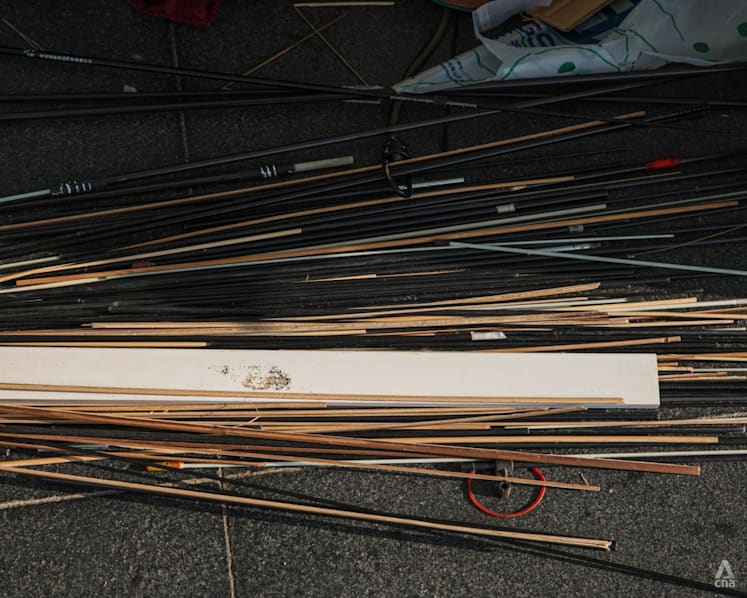
When he was done with the repairs, Mr Tan pulled a kite from his bag and launched it to the sky. 

He flew it with ease, strolling around the field, eager to find someone who will take the kite as a gift. 

His masterpieces are made mostly from recycled materials including plastic bags, discarded blinds, banners and umbrellas. 
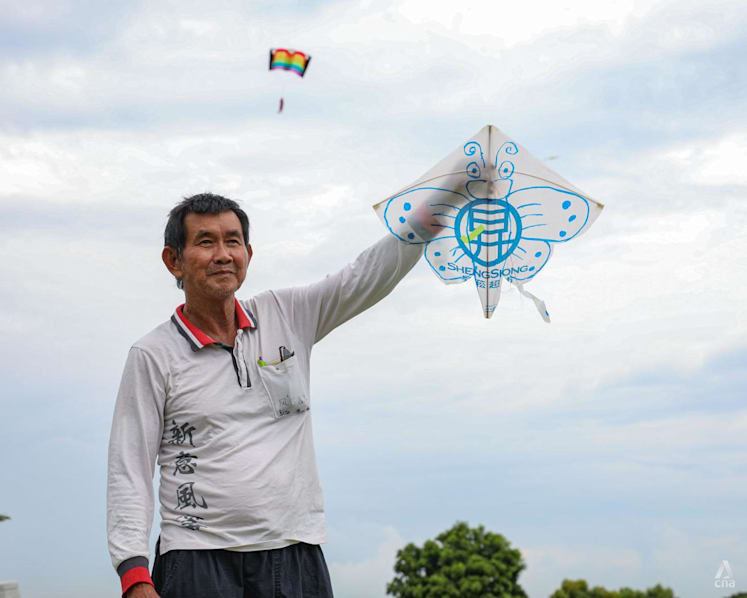
Mr Tan is part of a group known as Singapore Original Kites, an informal gathering of adults in their 60s and 70s who share the same interest in making and flying kites.  

A semi-retired Chinese physician ​​Ong Cheng Her, 75, is the founder of the group.

He said that the only prerequisite to join the group is one’s ability to make a kite from scratch.  

He proudly showed CNA TODAY one of his creations, a red and white "umbrella kite". 

“Umbrellas are used for shade and rain protection, so why hasn’t anyone flown an umbrella kite? I decided to take on the challenge,” Mr Ong added.

HIS WORKSPACE AT HOME

As for Mr Tan, he is not retired, so flying and making kites is what he does only on Sundays.

He works six days a week as a lorry driver.

“I work to live, to fill my stomach so I can make kites.”

Stepping into his flat, Mr Tan led us to his "studio", which is a room filled with a bountiful supply of kites and raw materials. 

He described his workspace as a “chaotic but organised mess”. 

“My wife sometimes asks why I collect so many umbrellas, but she doesn’t interfere much because she knows I enjoy making these things.”

Mr Tan has loved kite flying since he was a child, but it was not until he was in his 30s that he took to making kites himself.

A self-taught craftsman, he said that he learnt how to make kites by observing other kite-makers whenever an opportunity comes along. 

Recently, Mr Tan finished repairing a 70m-long "dragon kite" that he first constructed in 2000. It broke at a kite festival in Taiwan in 2019 and required extensive repairs. 

After CNA TODAY approached him for an interview, Mr Tan said that he found new inspiration to repair the kite, which took him four Sundays to complete.

It was obvious that he is most proud of this kite among the many in his collection.

“Anyone who hasn't made a dragon or a phoenix kite isn't truly considered a kite maker,” he said, adding that these long kites are made up of many different sections and each needed to be crafted with great precision before they are finally stitched together. 

"GIANTS" IN THE SKY

Over at East Coast Park, another group of kite enthusiasts have gathered and their presence could be spotted from afar. 

The kites they have taken out, called "inflatable show kites", are gigantic balloon-like kites that are typically several metres in length when inflated.

Traditional kites rely on rigid frames for support, but inflatable show kites have no hard structures. They inflate as they catch on the wind and have to be anchored to the ground.

Project coordinator Johnny Yap and his wife Maggie Mok, a homemaker, both 51, are the founders of Show Kites Singapore, a group of people who are into these inflatable show kites.

The duo's interest in this started nearly 20 years ago when they took their children kite-flying. 

In the end, it was the couple themselves who got hooked on the activity. 

“We started flying bigger and bigger kites and before long, we realised that stick kites have a limit,” Mr Yap said.

This led them to explore inflatable ones in 2009 and they came across these kites online before buying their first. The sky is the limit when it comes to the sizes of such kites.

As their interests grew, Mr Yap and Ms Mok started travelling overseas to take part in international kite festivals. 

In September, they were at the International Kite Festival in Melaka, Malaysia, where they flew an inflatable show kite in the form of Singapore's tourism icon, the Merlion.

In watching the kite-flyers, CNA TODAY observed that the age-old method of rolling out and pulling the kite lines or strings is still used for flying simple traditional kites regardless of their sizes.

For long, intricate traditional kites such as Mr Tan's dragon kite, as well as the inflatable show kites, they are anchored to the ground and usually fly without much supervision. They also tend to have a "pilot" kite attached to the main kite to provide a lift for the initial flight. 

Some kites need very little wind, whereas others may need strong wind conditions. 

Inflatable show kites at the International Kite Festival held in Melaka, Malaysia in September 2024. (Photo: Maggie Mok)
Most of the kites designed by Mr Johnny Yap are in red and white, which are colours representing Singapore’s flag. (Photo: CNA/Nuria Ling)

Most of the kites owned by Mr Yap and Ms Mok are designed by them. 

The bespoke kites can cost between a few hundred and a few thousand dollars and they are manufactured in China. 

“We know how to make the kite, but we just don't have time. It takes many, many hours of sewing,” Mr Yap explained.

“We stick to the principle that we must design our own kites.”

Mr Johnny Yap trying to anchor some inflatable show kites to the ground. (Photo: CNA/Mak Jia Kee)
Members of the public taking photos with several inflatable show kites at East Coast Park. (Photo: CNA/Nuria Ling)

Through the years, the couple have met people from all walks of life who have taken an interest in this activity. 

“We have doctors, taxi drivers, hawkers (in Show Kites Singapore). It’s the kites that bring us together,” Mr Yap said.

“There’s no application form (to join the group), so long as you are passionate, come join me every Sunday."

Members of Show Kites Singapore taking a break under the shade at East Coast Park. (Photo: CNA/Mak Jia Kee)
Inflatable show kites flying next to a construction site at East Coast Park. (Photo: CNA/Mak Jia Kee)
Advertisement

In Pixels

Snakes and marine life you don’t always see at Sentosa

Snakes and marine life you don’t always see at Sentosa

A 2-metre juvenile reticulated python slithering across a tree branch in front of filmmaker Jayaprakash Bojan. The snake was found near Palawan Green on Sentosa Island and was rehomed in a forested area nearby. (Photo: CNA/Raj Nadarajan)

04 Oct 2024 09:30PM (Updated: 16 Oct 2025 12:12AM)

There was palpable tension in the air as a black bag was taken to the forest. 

Inside was a 2-metre juvenile reticulated python. 

The snake with diamond-patterned skin was being relocated to a forested area on Sentosa Island by the wildlife management team of the Sentosa Development Corporation (SDC), after it was spotted in a high foot-traffic area.

Standing very still just a few metres away were two professional filmmakers and a photographer, patiently waiting for the snake to emerge. 

CNA Games
Show More
Show Less

They did not have to wait long.

In just a couple of minutes, the python slithered out of the bag and gradually made its way up a tree. 

The team then waited another four hours for the snake to make its way down from the tree as they observed its movements on camera.

In Pixels takes you this weekend on a visual trip with wildlife filmmakers Jayaprakash “JP” Bojan and Ian Mun, as they document Sentosa’s biodiversity and conservation efforts for Earth in Focus, a nature film festival set to take place in November on the resort island south of mainland Singapore. 

Reticulated pythons are native to Singapore and they are commonly found in secondary forests with a water supply. (Photo: CNA/Raj Nadarajan)
Photographer and filmmaker Jayaprakash Bojan, fondly known as JP, attaching a camera to a monopod to capture footage of a python from a safe distance. (Photo: CNA/Raj Nadarajan)
A spitting cobra found in a drain at Fort Siloso in Sentosa was relocated to a forested area on the island. A team of filmmakers had been shooting in Sentosa thrice a week for three months but this was the first time that they were coming face-to-face with a venomous snake on the island. (Photo: CNA/Nuria Ling)

Sentosa is a tourist destination known for its themed parks and sandy beaches. The island’s free-roaming peacocks are probably its most well-known wildlife. 

Off the beaten tracks, though, in the forested areas or along the rocky shores, there is a rich biodiversity of flora and fauna unknown to many visitors.

One rare species found in the coastal forests is the Xylocarpus rumphii, a critically endangered plant that has not been discovered elsewhere on mainland Singapore. 

There is also the elusive lesser bamboo bat, one of the smallest mammals on earth. 

This vulnerable bat species, which weighs just a few grams, has a flattened skull that allows it to squeeze in a hollow bamboo shoot to roost, through narrow slits created by beetles.

A bamboo bat captured on video after being awakened by the endoscope. (Photo: CNA/Nuria Ling)
An endoscope being used to check on lesser bamboo bats that live inside bamboo plants. (Photo: CNA/Nuria Ling)

Sentosa is home to 850 flora and fauna species. 

Setting up camera traps is one way that the conservation team is able to track and protect the wildlife on the island.  

Unlike what it sounds, camera traps do not trap animals. They are cameras with sensors put up in animal habitats for a duration to record images of wildlife and collect data on them.

The team has deployed eight such cameras in biodiversity-sensitive habitats around the island and the cameras are checked every alternate month. 

Advertisement

In Pixels

Inside a dragon kiln where temperatures go up to 1,300°C

Inside a dragon kiln where temperatures go up to 1,300°C

Wood-firing at a dragon kiln is a community effort that requires round-the-clock monitoring. (Photo: CNA/Ooi Boon Keong)

15 Nov 2024 09:30PM (Updated: 16 Oct 2025 12:09AM)

Nestled in an industrial estate in the western part of Singapore is an 84-year-old dragon kiln, the oldest and the only operational dragon kiln in the country. 

Built in 1940, the kiln at Thow Kwang Pottery Jungle was originally used for the mass production of household and industrial items such as cups and flower pots.

Over the decades, the place has evolved into a community space, now offering classes and events for potters to hone their craft. 

CNA TODAY joined the potter community for a wood-firing session that happens only two or three times a year.

CNA Games
Show More
Show Less

In Pixels takes you through the experience, as new and seasoned potters bond over fire and perspiration, creating unique works of art. 

PRAYERS TO THE "KILN GOD"  

At Thow Kwang Pottery Jungle, which is located a short distance from Nanyang Technological University, a group of around 30 people gathered on a Friday last month in front of the kiln.

This was at the request of the owners, Mr Tan Teck Yoke, 68, and his wife Yulianti Tan, 66. 

A prayer ceremony to the "kiln god" was about to begin. 

“We are praying to the ‘kiln god’ for a successful firing, for the pieces to achieve the desired effects,” Mr Tan explained to the enthusiastic participants. 

To this, the crowd responded by shouting, “Heng, ong, huat, ah,” a phrase in the Chinese dialect of Hokkien that collectively means wishing for good fortune.

After the prayers were done, the fire box, which is a small opening at the front of the kiln, was lit. 

The participants each picked up a piece of wood to throw into the fire, hoping to add more "luck" to the process. 

The dragon kiln was bought by Mr Tan’s father in 1965 and has been owned by the family since then.

It sits on a slope, is 27-metres long, 2-metres wide and curves around the side, resembling the body of a dragon in Chinese mythology. 

Its lengthy chambers are made out of bricks and there is a chimney at the end, located at the top of the slope.

The kiln can fit thousands of pieces of ceramic items, depending on the size of the pots. 

For this firing session, around 400 to 500 pieces were loaded in the kiln. 

NEW WAYS TO IMPROVE PROCESS

Temperatures in the dragon kiln can reach up to 1,300°C. 

They can fluctuate significantly due to the shape of the furnace and the use of wood as a fuel.

That is why one of the most crucial parts of the process is to monitor the temperature for all three days of the firing session.

Mr Chua Hee Lai, who is in his 50s and a hobbyist-turned-kiln master, helped to plan and lead each firing session. 

In 2019, Mr Chua, with the help of another potter, introduced a digital monitoring system that allowed them to track the temperatures remotely and give instructions to the potters doing shift work on site. 

Previously, they had to monitor the temperature by looking at the colour of the flame or record temperatures manually and then draw up prediction charts – a process that requires them to be on site for longer periods of time.

THE "KAMPUNG SPIRIT"

Advertising executive Vanessa Low and product manager Goh Wei Ting, both 31, have been practising pottery at another pottery studio for around five years and this was their first time taking part in the wood-firing process.

Compared to a regular firing in an electric or gas kiln, wood-firing is "tiring and physically demanding", Mr Goh said.

However, they were buoyed by the “kampung spirit” or the sense of camaraderie that came about as participants laboured together. 

 “You just don’t feel tired, you just do (the work),” Mr Goh added. 

OPENING OF THE KILN

Six days after the firing at the dragon kiln, the participants returned to open the kiln and check on their art pieces. 

“Shall we form a chain?” someone suggested to facilitate the removal of the brick walls. 

Without hesitation, a human chain quickly formed as the potters unsealed the kiln, one brick at a time. 

A collective “wow” sounded as the final bricks were removed, revealing the final outcome of the nine-day process that comprised three days of firing and six days of cooling.

The potters carefully removed the art pieces from the shelves, while admiring the effects that the fire had on their work. 

Ms Tia Boon Sim, 69, one of the founders of Thow Kwang Clay Artists, a community group, said: “In wood-firing, the ashes from the fire would fly around and drop on the pieces and these are the effects potters love.”

When asked if she would do this again, Ms Low said: “I would want to come back with my friends for this, have fun and learn new things together.”  

Participants moving the pottery pieces out of the kiln area by forming a human chain. (Photo: CNA/Ooi Boon Keong)
Ceramic items in different shapes, sizes and colours were placed on tables. (Photo: CNA/Ooi Boon Keong)
Mr Goh Wei Ting comparing his pottery work before and after the items were fired in the kiln. (Photo: CNA/Ooi Boon Keong)
A participant looking at a freshly fired pot, examining every detail. (Photo: CNA/Ooi Boon Keong)
Source: CNA/jl/sf

Recommended

Advertisement

In Pixels

Meet the 70-year-old lorry driver who is also a 'kite doctor'

Meet the 70-year-old lorry driver who is also a 'kite doctor'

Kite maker Tan Poh Wah flying his handmade dragon kite at the Marina Barrage. (Photo: CNA/Nuria Ling)

30 Nov 2024 09:30PM (Updated: 16 Oct 2025 12:08AM)

Rolling up to Marina Barrage with a trolley bag full of handmade kites and repair tools, Mr Tan Poh Wah had one clear mission for the day: To share his love of kite-flying with others. 

Known informally as the “kite doctor” among the regular visitors there, the 70-year-old spends most Sundays repairing kites or offering his handmade ones – mostly for free – to people at the open-air space that is the venue of Singapore's largest reservoir. 

“Watching people fly my kites makes me really happy,” Mr Tan said.  

This weekend, In Pixels speaks to four enthusiasts to find out what excites them about kite-flying. 

A FAMILIAR FIGURE

CNA Games
Show More
Show Less

Shortly after Mr Tan turned up at Marina Barrage in the Marina Bay area, a handful of people who wanted their kites repaired immediately made a beeline towards him. 

They offered him drinks and snacks to thank him for his service. 

When he was done with the repairs, Mr Tan pulled a kite from his bag and launched it to the sky. 

He flew it with ease, strolling around the field, eager to find someone who will take the kite as a gift. 

His masterpieces are made mostly from recycled materials including plastic bags, discarded blinds, banners and umbrellas. 
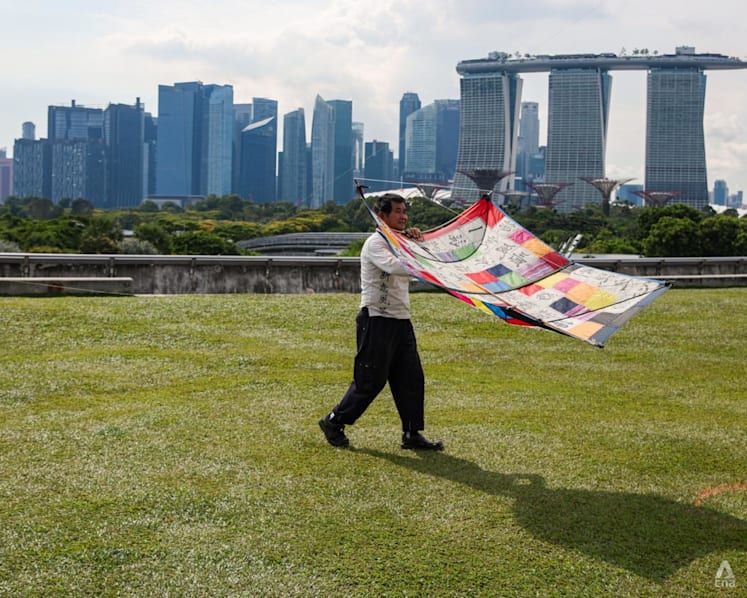
Mr Tan is part of a group known as Singapore Original Kites, an informal gathering of adults in their 60s and 70s who share the same interest in making and flying kites.  

A semi-retired Chinese physician ​​Ong Cheng Her, 75, is the founder of the group.

He said that the only prerequisite to join the group is one’s ability to make a kite from scratch.  

He proudly showed CNA TODAY one of his creations, a red and white "umbrella kite". 

“Umbrellas are used for shade and rain protection, so why hasn’t anyone flown an umbrella kite? I decided to take on the challenge,” Mr Ong added.
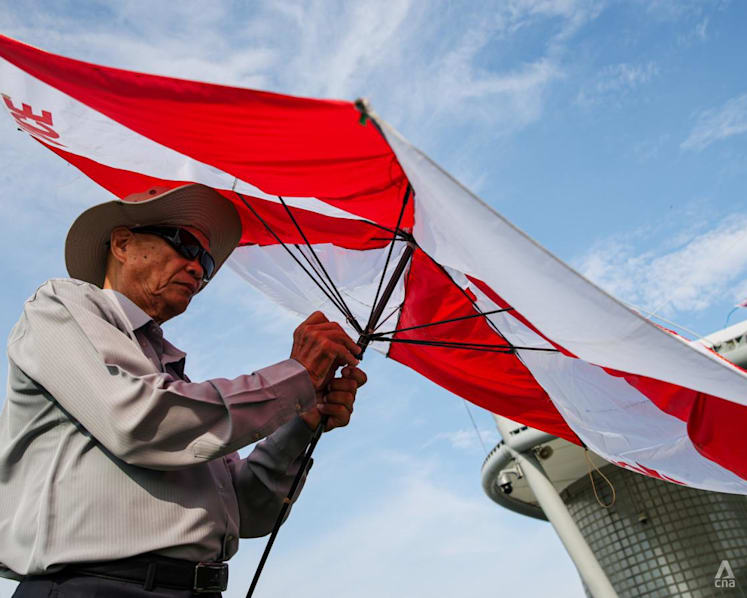
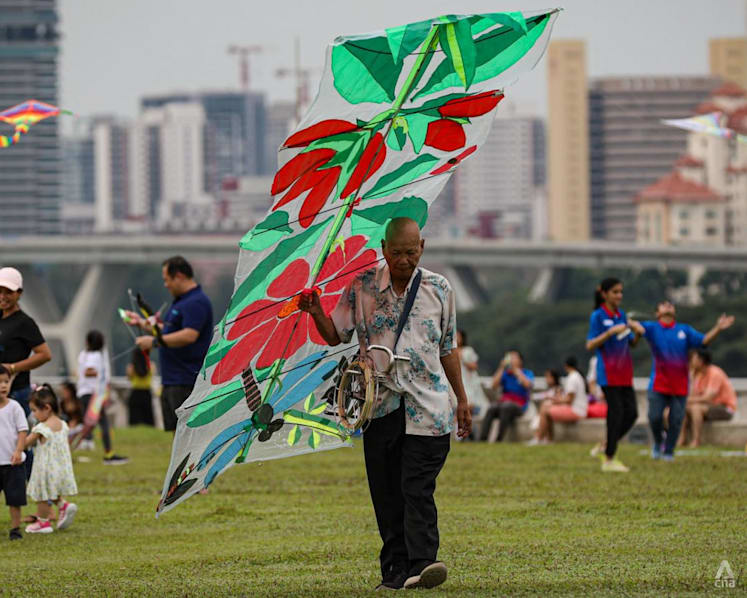
HIS WORKSPACE AT HOME

As for Mr Tan, he is not retired, so flying and making kites is what he does only on Sundays.

He works six days a week as a lorry driver.

“I work to live, to fill my stomach so I can make kites.”

Stepping into his flat, Mr Tan led us to his "studio", which is a room filled with a bountiful supply of kites and raw materials. 

He described his workspace as a “chaotic but organised mess”. 

“My wife sometimes asks why I collect so many umbrellas, but she doesn’t interfere much because she knows I enjoy making these things.”
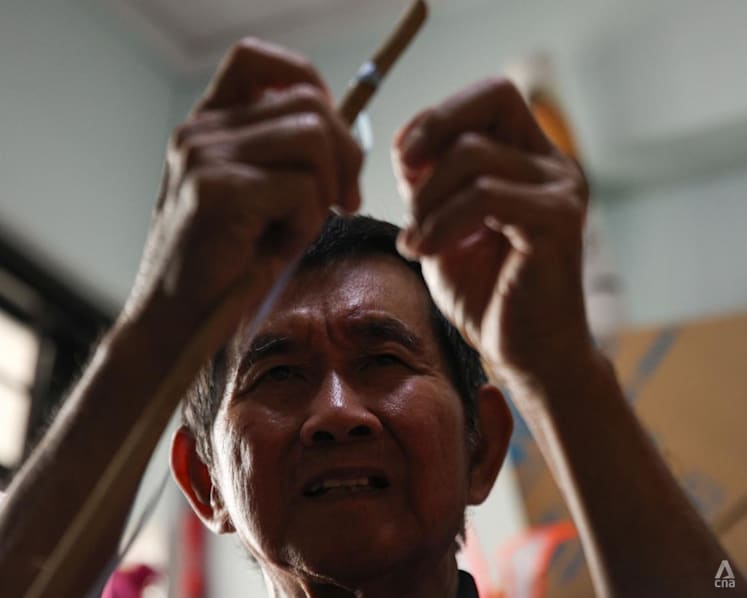
Mr Tan has loved kite flying since he was a child, but it was not until he was in his 30s that he took to making kites himself.

A self-taught craftsman, he said that he learnt how to make kites by observing other kite-makers whenever an opportunity comes along. 
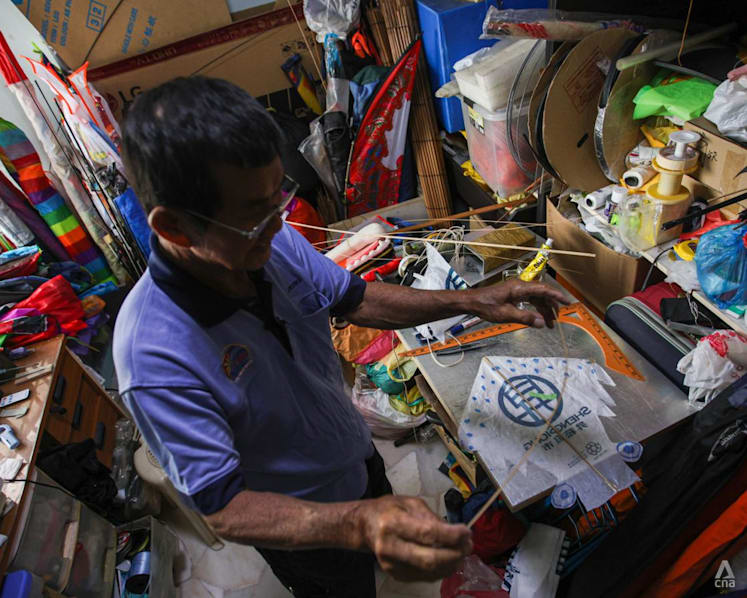
Recently, Mr Tan finished repairing a 70m-long "dragon kite" that he first constructed in 2000. It broke at a kite festival in Taiwan in 2019 and required extensive repairs. 

After CNA TODAY approached him for an interview, Mr Tan said that he found new inspiration to repair the kite, which took him four Sundays to complete.

It was obvious that he is most proud of this kite among the many in his collection.

“Anyone who hasn't made a dragon or a phoenix kite isn't truly considered a kite maker,” he said, adding that these long kites are made up of many different sections and each needed to be crafted with great precision before they are finally stitched together. 

"GIANTS" IN THE SKY

Over at East Coast Park, another group of kite enthusiasts have gathered and their presence could be spotted from afar. 

The kites they have taken out, called "inflatable show kites", are gigantic balloon-like kites that are typically several metres in length when inflated.

Traditional kites rely on rigid frames for support, but inflatable show kites have no hard structures. They inflate as they catch on the wind and have to be anchored to the ground.

Project coordinator Johnny Yap and his wife Maggie Mok, a homemaker, both 51, are the founders of Show Kites Singapore, a group of people who are into these inflatable show kites.

The duo's interest in this started nearly 20 years ago when they took their children kite-flying. 

In the end, it was the couple themselves who got hooked on the activity. 

“We started flying bigger and bigger kites and before long, we realised that stick kites have a limit,” Mr Yap said.

This led them to explore inflatable ones in 2009 and they came across these kites online before buying their first. The sky is the limit when it comes to the sizes of such kites.

As their interests grew, Mr Yap and Ms Mok started travelling overseas to take part in international kite festivals. 

In September, they were at the International Kite Festival in Melaka, Malaysia, where they flew an inflatable show kite in the form of Singapore's tourism icon, the Merlion.

In watching the kite-flyers, CNA TODAY observed that the age-old method of rolling out and pulling the kite lines or strings is still used for flying simple traditional kites regardless of their sizes.

For long, intricate traditional kites such as Mr Tan's dragon kite, as well as the inflatable show kites, they are anchored to the ground and usually fly without much supervision. They also tend to have a "pilot" kite attached to the main kite to provide a lift for the initial flight. 

Some kites need very little wind, whereas others may need strong wind conditions. 

Inflatable show kites at the International Kite Festival held in Melaka, Malaysia in September 2024. (Photo: Maggie Mok)
Most of the kites designed by Mr Johnny Yap are in red and white, which are colours representing Singapore’s flag. (Photo: CNA/Nuria Ling)

Most of the kites owned by Mr Yap and Ms Mok are designed by them. 

The bespoke kites can cost between a few hundred and a few thousand dollars and they are manufactured in China. 

“We know how to make the kite, but we just don't have time. It takes many, many hours of sewing,” Mr Yap explained.

“We stick to the principle that we must design our own kites.”

Mr Johnny Yap trying to anchor some inflatable show kites to the ground. (Photo: CNA/Mak Jia Kee)
Members of the public taking photos with several inflatable show kites at East Coast Park. (Photo: CNA/Nuria Ling)

Through the years, the couple have met people from all walks of life who have taken an interest in this activity. 

“We have doctors, taxi drivers, hawkers (in Show Kites Singapore). It’s the kites that bring us together,” Mr Yap said.

“There’s no application form (to join the group), so long as you are passionate, come join me every Sunday."

Members of Show Kites Singapore taking a break under the shade at East Coast Park. (Photo: CNA/Mak Jia Kee)
Inflatable show kites flying next to a construction site at East Coast Park. (Photo: CNA/Mak Jia Kee)
Advertisement

In Pixels

Snakes and marine life you don’t always see at Sentosa

Snakes and marine life you don’t always see at Sentosa

A 2-metre juvenile reticulated python slithering across a tree branch in front of filmmaker Jayaprakash Bojan. The snake was found near Palawan Green on Sentosa Island and was rehomed in a forested area nearby. (Photo: CNA/Raj Nadarajan)

04 Oct 2024 09:30PM (Updated: 16 Oct 2025 12:12AM)

There was palpable tension in the air as a black bag was taken to the forest. 

Inside was a 2-metre juvenile reticulated python. 

The snake with diamond-patterned skin was being relocated to a forested area on Sentosa Island by the wildlife management team of the Sentosa Development Corporation (SDC), after it was spotted in a high foot-traffic area.

Standing very still just a few metres away were two professional filmmakers and a photographer, patiently waiting for the snake to emerge. 

CNA Games
Show More
Show Less

They did not have to wait long.

In just a couple of minutes, the python slithered out of the bag and gradually made its way up a tree. 

The team then waited another four hours for the snake to make its way down from the tree as they observed its movements on camera.

In Pixels takes you this weekend on a visual trip with wildlife filmmakers Jayaprakash “JP” Bojan and Ian Mun, as they document Sentosa’s biodiversity and conservation efforts for Earth in Focus, a nature film festival set to take place in November on the resort island south of mainland Singapore. 

Reticulated pythons are native to Singapore and they are commonly found in secondary forests with a water supply. (Photo: CNA/Raj Nadarajan)
Photographer and filmmaker Jayaprakash Bojan, fondly known as JP, attaching a camera to a monopod to capture footage of a python from a safe distance. (Photo: CNA/Raj Nadarajan)
A spitting cobra found in a drain at Fort Siloso in Sentosa was relocated to a forested area on the island. A team of filmmakers had been shooting in Sentosa thrice a week for three months but this was the first time that they were coming face-to-face with a venomous snake on the island. (Photo: CNA/Nuria Ling)

Sentosa is a tourist destination known for its themed parks and sandy beaches. The island’s free-roaming peacocks are probably its most well-known wildlife. 

Off the beaten tracks, though, in the forested areas or along the rocky shores, there is a rich biodiversity of flora and fauna unknown to many visitors.

One rare species found in the coastal forests is the Xylocarpus rumphii, a critically endangered plant that has not been discovered elsewhere on mainland Singapore. 

There is also the elusive lesser bamboo bat, one of the smallest mammals on earth. 

This vulnerable bat species, which weighs just a few grams, has a flattened skull that allows it to squeeze in a hollow bamboo shoot to roost, through narrow slits created by beetles.

A bamboo bat captured on video after being awakened by the endoscope. (Photo: CNA/Nuria Ling)
An endoscope being used to check on lesser bamboo bats that live inside bamboo plants. (Photo: CNA/Nuria Ling)

Sentosa is home to 850 flora and fauna species. 

Setting up camera traps is one way that the conservation team is able to track and protect the wildlife on the island.  

Unlike what it sounds, camera traps do not trap animals. They are cameras with sensors put up in animal habitats for a duration to record images of wildlife and collect data on them.

The team has deployed eight such cameras in biodiversity-sensitive habitats around the island and the cameras are checked every alternate month. 

Advertisement

In Pixels

Inside a dragon kiln where temperatures go up to 1,300°C

Inside a dragon kiln where temperatures go up to 1,300°C

Wood-firing at a dragon kiln is a community effort that requires round-the-clock monitoring. (Photo: CNA/Ooi Boon Keong)

15 Nov 2024 09:30PM (Updated: 16 Oct 2025 12:09AM)

Nestled in an industrial estate in the western part of Singapore is an 84-year-old dragon kiln, the oldest and the only operational dragon kiln in the country. 

Built in 1940, the kiln at Thow Kwang Pottery Jungle was originally used for the mass production of household and industrial items such as cups and flower pots.

Over the decades, the place has evolved into a community space, now offering classes and events for potters to hone their craft. 

CNA TODAY joined the potter community for a wood-firing session that happens only two or three times a year.

CNA Games
Show More
Show Less

In Pixels takes you through the experience, as new and seasoned potters bond over fire and perspiration, creating unique works of art. 

PRAYERS TO THE "KILN GOD"  

At Thow Kwang Pottery Jungle, which is located a short distance from Nanyang Technological University, a group of around 30 people gathered on a Friday last month in front of the kiln.

This was at the request of the owners, Mr Tan Teck Yoke, 68, and his wife Yulianti Tan, 66. 

A prayer ceremony to the "kiln god" was about to begin. 

“We are praying to the ‘kiln god’ for a successful firing, for the pieces to achieve the desired effects,” Mr Tan explained to the enthusiastic participants. 

To this, the crowd responded by shouting, “Heng, ong, huat, ah,” a phrase in the Chinese dialect of Hokkien that collectively means wishing for good fortune.

After the prayers were done, the fire box, which is a small opening at the front of the kiln, was lit. 

The participants each picked up a piece of wood to throw into the fire, hoping to add more "luck" to the process. 

The dragon kiln was bought by Mr Tan’s father in 1965 and has been owned by the family since then.

It sits on a slope, is 27-metres long, 2-metres wide and curves around the side, resembling the body of a dragon in Chinese mythology. 

Its lengthy chambers are made out of bricks and there is a chimney at the end, located at the top of the slope.

The kiln can fit thousands of pieces of ceramic items, depending on the size of the pots. 

For this firing session, around 400 to 500 pieces were loaded in the kiln. 

NEW WAYS TO IMPROVE PROCESS

Temperatures in the dragon kiln can reach up to 1,300°C. 

They can fluctuate significantly due to the shape of the furnace and the use of wood as a fuel.

That is why one of the most crucial parts of the process is to monitor the temperature for all three days of the firing session.

Mr Chua Hee Lai, who is in his 50s and a hobbyist-turned-kiln master, helped to plan and lead each firing session. 

In 2019, Mr Chua, with the help of another potter, introduced a digital monitoring system that allowed them to track the temperatures remotely and give instructions to the potters doing shift work on site. 

Previously, they had to monitor the temperature by looking at the colour of the flame or record temperatures manually and then draw up prediction charts – a process that requires them to be on site for longer periods of time.

THE "KAMPUNG SPIRIT"

Advertising executive Vanessa Low and product manager Goh Wei Ting, both 31, have been practising pottery at another pottery studio for around five years and this was their first time taking part in the wood-firing process.

Compared to a regular firing in an electric or gas kiln, wood-firing is "tiring and physically demanding", Mr Goh said.

However, they were buoyed by the “kampung spirit” or the sense of camaraderie that came about as participants laboured together. 

 “You just don’t feel tired, you just do (the work),” Mr Goh added. 

OPENING OF THE KILN

Six days after the firing at the dragon kiln, the participants returned to open the kiln and check on their art pieces. 

“Shall we form a chain?” someone suggested to facilitate the removal of the brick walls. 

Without hesitation, a human chain quickly formed as the potters unsealed the kiln, one brick at a time. 

A collective “wow” sounded as the final bricks were removed, revealing the final outcome of the nine-day process that comprised three days of firing and six days of cooling.

The potters carefully removed the art pieces from the shelves, while admiring the effects that the fire had on their work. 

Ms Tia Boon Sim, 69, one of the founders of Thow Kwang Clay Artists, a community group, said: “In wood-firing, the ashes from the fire would fly around and drop on the pieces and these are the effects potters love.”

When asked if she would do this again, Ms Low said: “I would want to come back with my friends for this, have fun and learn new things together.”  

Participants moving the pottery pieces out of the kiln area by forming a human chain. (Photo: CNA/Ooi Boon Keong)
Ceramic items in different shapes, sizes and colours were placed on tables. (Photo: CNA/Ooi Boon Keong)
Mr Goh Wei Ting comparing his pottery work before and after the items were fired in the kiln. (Photo: CNA/Ooi Boon Keong)
A participant looking at a freshly fired pot, examining every detail. (Photo: CNA/Ooi Boon Keong)
Source: CNA/jl/sf

Recommended

Advertisement

In Pixels

Meet the 70-year-old lorry driver who is also a 'kite doctor'

Meet the 70-year-old lorry driver who is also a 'kite doctor'

Kite maker Tan Poh Wah flying his handmade dragon kite at the Marina Barrage. (Photo: CNA/Nuria Ling)

30 Nov 2024 09:30PM (Updated: 16 Oct 2025 12:08AM)

Rolling up to Marina Barrage with a trolley bag full of handmade kites and repair tools, Mr Tan Poh Wah had one clear mission for the day: To share his love of kite-flying with others. 

Known informally as the “kite doctor” among the regular visitors there, the 70-year-old spends most Sundays repairing kites or offering his handmade ones – mostly for free – to people at the open-air space that is the venue of Singapore's largest reservoir. 

“Watching people fly my kites makes me really happy,” Mr Tan said.  

This weekend, In Pixels speaks to four enthusiasts to find out what excites them about kite-flying. 

A FAMILIAR FIGURE

CNA Games
Show More
Show Less

Shortly after Mr Tan turned up at Marina Barrage in the Marina Bay area, a handful of people who wanted their kites repaired immediately made a beeline towards him. 

They offered him drinks and snacks to thank him for his service. 

When he was done with the repairs, Mr Tan pulled a kite from his bag and launched it to the sky. 

He flew it with ease, strolling around the field, eager to find someone who will take the kite as a gift. 

His masterpieces are made mostly from recycled materials including plastic bags, discarded blinds, banners and umbrellas. 

Mr Tan is part of a group known as Singapore Original Kites, an informal gathering of adults in their 60s and 70s who share the same interest in making and flying kites.  

A semi-retired Chinese physician ​​Ong Cheng Her, 75, is the founder of the group.

He said that the only prerequisite to join the group is one’s ability to make a kite from scratch.  

He proudly showed CNA TODAY one of his creations, a red and white "umbrella kite". 

“Umbrellas are used for shade and rain protection, so why hasn’t anyone flown an umbrella kite? I decided to take on the challenge,” Mr Ong added.

HIS WORKSPACE AT HOME

As for Mr Tan, he is not retired, so flying and making kites is what he does only on Sundays.

He works six days a week as a lorry driver.

“I work to live, to fill my stomach so I can make kites.”

Stepping into his flat, Mr Tan led us to his "studio", which is a room filled with a bountiful supply of kites and raw materials. 

He described his workspace as a “chaotic but organised mess”. 

“My wife sometimes asks why I collect so many umbrellas, but she doesn’t interfere much because she knows I enjoy making these things.”

Mr Tan has loved kite flying since he was a child, but it was not until he was in his 30s that he took to making kites himself.

A self-taught craftsman, he said that he learnt how to make kites by observing other kite-makers whenever an opportunity comes along. 
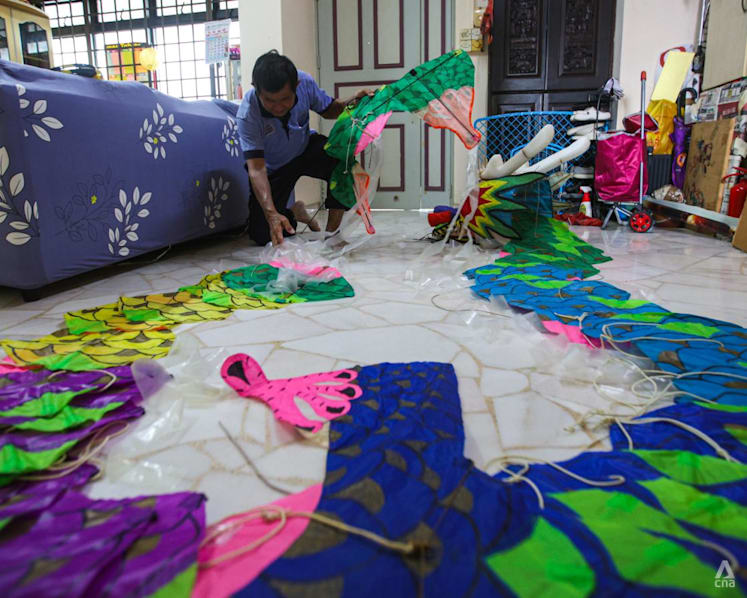
Recently, Mr Tan finished repairing a 70m-long "dragon kite" that he first constructed in 2000. It broke at a kite festival in Taiwan in 2019 and required extensive repairs. 

After CNA TODAY approached him for an interview, Mr Tan said that he found new inspiration to repair the kite, which took him four Sundays to complete.

It was obvious that he is most proud of this kite among the many in his collection.

“Anyone who hasn't made a dragon or a phoenix kite isn't truly considered a kite maker,” he said, adding that these long kites are made up of many different sections and each needed to be crafted with great precision before they are finally stitched together. 
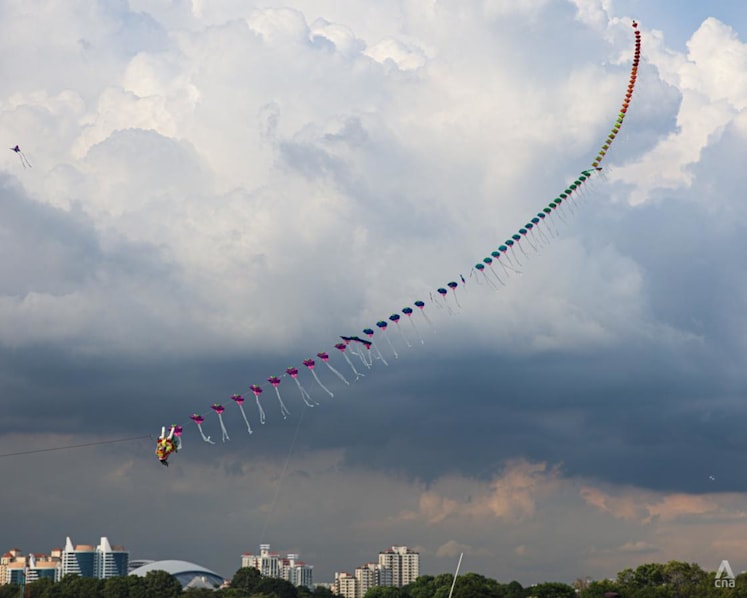
"GIANTS" IN THE SKY

Over at East Coast Park, another group of kite enthusiasts have gathered and their presence could be spotted from afar. 

The kites they have taken out, called "inflatable show kites", are gigantic balloon-like kites that are typically several metres in length when inflated.

Traditional kites rely on rigid frames for support, but inflatable show kites have no hard structures. They inflate as they catch on the wind and have to be anchored to the ground.
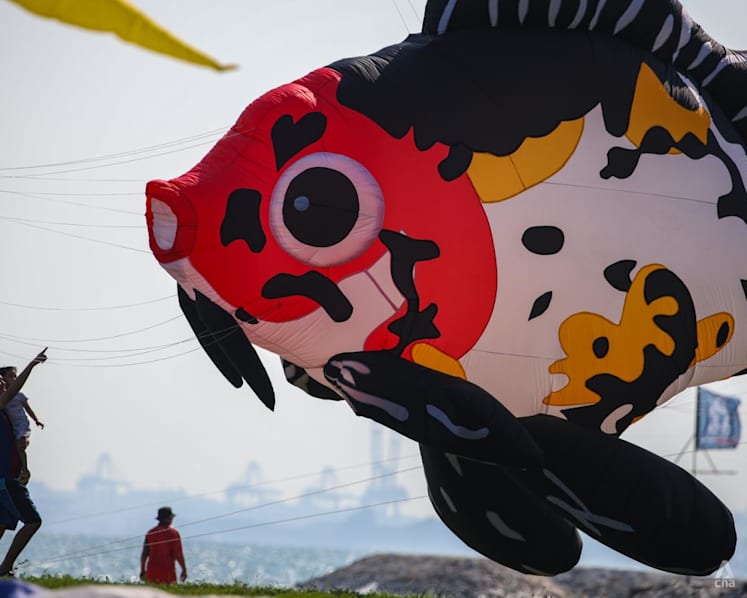
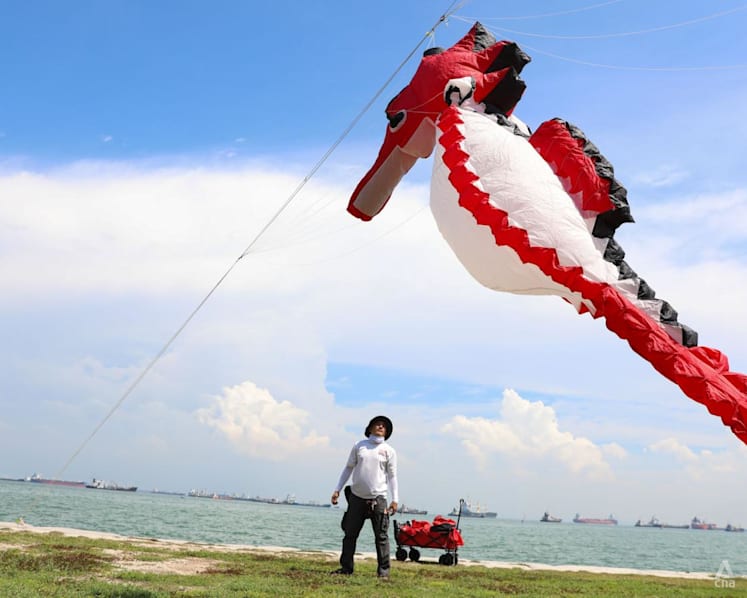
Project coordinator Johnny Yap and his wife Maggie Mok, a homemaker, both 51, are the founders of Show Kites Singapore, a group of people who are into these inflatable show kites.

The duo's interest in this started nearly 20 years ago when they took their children kite-flying. 

In the end, it was the couple themselves who got hooked on the activity. 

“We started flying bigger and bigger kites and before long, we realised that stick kites have a limit,” Mr Yap said.

This led them to explore inflatable ones in 2009 and they came across these kites online before buying their first. The sky is the limit when it comes to the sizes of such kites.
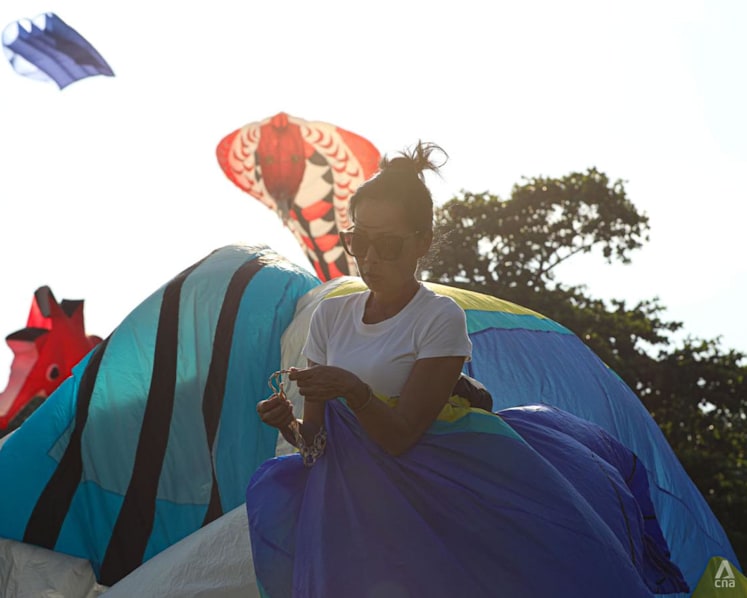
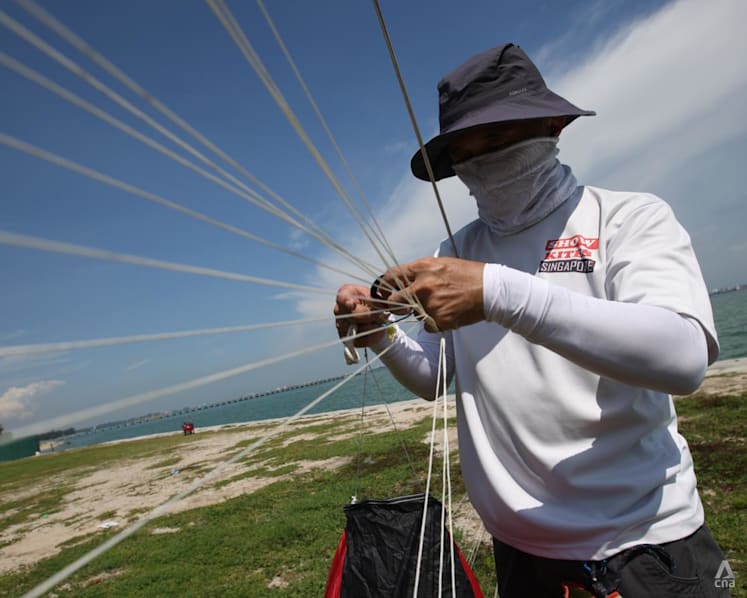
As their interests grew, Mr Yap and Ms Mok started travelling overseas to take part in international kite festivals. 

In September, they were at the International Kite Festival in Melaka, Malaysia, where they flew an inflatable show kite in the form of Singapore's tourism icon, the Merlion.

In watching the kite-flyers, CNA TODAY observed that the age-old method of rolling out and pulling the kite lines or strings is still used for flying simple traditional kites regardless of their sizes.

For long, intricate traditional kites such as Mr Tan's dragon kite, as well as the inflatable show kites, they are anchored to the ground and usually fly without much supervision. They also tend to have a "pilot" kite attached to the main kite to provide a lift for the initial flight. 

Some kites need very little wind, whereas others may need strong wind conditions. 

Inflatable show kites at the International Kite Festival held in Melaka, Malaysia in September 2024. (Photo: Maggie Mok)
Most of the kites designed by Mr Johnny Yap are in red and white, which are colours representing Singapore’s flag. (Photo: CNA/Nuria Ling)

Most of the kites owned by Mr Yap and Ms Mok are designed by them. 

The bespoke kites can cost between a few hundred and a few thousand dollars and they are manufactured in China. 

“We know how to make the kite, but we just don't have time. It takes many, many hours of sewing,” Mr Yap explained.

“We stick to the principle that we must design our own kites.”

Mr Johnny Yap trying to anchor some inflatable show kites to the ground. (Photo: CNA/Mak Jia Kee)
Members of the public taking photos with several inflatable show kites at East Coast Park. (Photo: CNA/Nuria Ling)

Through the years, the couple have met people from all walks of life who have taken an interest in this activity. 

“We have doctors, taxi drivers, hawkers (in Show Kites Singapore). It’s the kites that bring us together,” Mr Yap said.

“There’s no application form (to join the group), so long as you are passionate, come join me every Sunday."

Members of Show Kites Singapore taking a break under the shade at East Coast Park. (Photo: CNA/Mak Jia Kee)
Inflatable show kites flying next to a construction site at East Coast Park. (Photo: CNA/Mak Jia Kee)
Advertisement

In Pixels

Snakes and marine life you don’t always see at Sentosa

Snakes and marine life you don’t always see at Sentosa

A 2-metre juvenile reticulated python slithering across a tree branch in front of filmmaker Jayaprakash Bojan. The snake was found near Palawan Green on Sentosa Island and was rehomed in a forested area nearby. (Photo: CNA/Raj Nadarajan)

04 Oct 2024 09:30PM (Updated: 16 Oct 2025 12:12AM)

There was palpable tension in the air as a black bag was taken to the forest. 

Inside was a 2-metre juvenile reticulated python. 

The snake with diamond-patterned skin was being relocated to a forested area on Sentosa Island by the wildlife management team of the Sentosa Development Corporation (SDC), after it was spotted in a high foot-traffic area.

Standing very still just a few metres away were two professional filmmakers and a photographer, patiently waiting for the snake to emerge. 

CNA Games
Show More
Show Less

They did not have to wait long.

In just a couple of minutes, the python slithered out of the bag and gradually made its way up a tree. 

The team then waited another four hours for the snake to make its way down from the tree as they observed its movements on camera.

In Pixels takes you this weekend on a visual trip with wildlife filmmakers Jayaprakash “JP” Bojan and Ian Mun, as they document Sentosa’s biodiversity and conservation efforts for Earth in Focus, a nature film festival set to take place in November on the resort island south of mainland Singapore. 

Reticulated pythons are native to Singapore and they are commonly found in secondary forests with a water supply. (Photo: CNA/Raj Nadarajan)
Photographer and filmmaker Jayaprakash Bojan, fondly known as JP, attaching a camera to a monopod to capture footage of a python from a safe distance. (Photo: CNA/Raj Nadarajan)
A spitting cobra found in a drain at Fort Siloso in Sentosa was relocated to a forested area on the island. A team of filmmakers had been shooting in Sentosa thrice a week for three months but this was the first time that they were coming face-to-face with a venomous snake on the island. (Photo: CNA/Nuria Ling)

Sentosa is a tourist destination known for its themed parks and sandy beaches. The island’s free-roaming peacocks are probably its most well-known wildlife. 

Off the beaten tracks, though, in the forested areas or along the rocky shores, there is a rich biodiversity of flora and fauna unknown to many visitors.

One rare species found in the coastal forests is the Xylocarpus rumphii, a critically endangered plant that has not been discovered elsewhere on mainland Singapore. 

There is also the elusive lesser bamboo bat, one of the smallest mammals on earth. 

This vulnerable bat species, which weighs just a few grams, has a flattened skull that allows it to squeeze in a hollow bamboo shoot to roost, through narrow slits created by beetles.

A bamboo bat captured on video after being awakened by the endoscope. (Photo: CNA/Nuria Ling)
An endoscope being used to check on lesser bamboo bats that live inside bamboo plants. (Photo: CNA/Nuria Ling)

Sentosa is home to 850 flora and fauna species. 

Setting up camera traps is one way that the conservation team is able to track and protect the wildlife on the island.  

Unlike what it sounds, camera traps do not trap animals. They are cameras with sensors put up in animal habitats for a duration to record images of wildlife and collect data on them.

The team has deployed eight such cameras in biodiversity-sensitive habitats around the island and the cameras are checked every alternate month. 

Advertisement

In Pixels

Inside a dragon kiln where temperatures go up to 1,300°C

Inside a dragon kiln where temperatures go up to 1,300°C

Wood-firing at a dragon kiln is a community effort that requires round-the-clock monitoring. (Photo: CNA/Ooi Boon Keong)

15 Nov 2024 09:30PM (Updated: 16 Oct 2025 12:09AM)

Nestled in an industrial estate in the western part of Singapore is an 84-year-old dragon kiln, the oldest and the only operational dragon kiln in the country. 

Built in 1940, the kiln at Thow Kwang Pottery Jungle was originally used for the mass production of household and industrial items such as cups and flower pots.

Over the decades, the place has evolved into a community space, now offering classes and events for potters to hone their craft. 

CNA TODAY joined the potter community for a wood-firing session that happens only two or three times a year.

CNA Games
Show More
Show Less

In Pixels takes you through the experience, as new and seasoned potters bond over fire and perspiration, creating unique works of art. 

PRAYERS TO THE "KILN GOD"  

At Thow Kwang Pottery Jungle, which is located a short distance from Nanyang Technological University, a group of around 30 people gathered on a Friday last month in front of the kiln.

This was at the request of the owners, Mr Tan Teck Yoke, 68, and his wife Yulianti Tan, 66. 

A prayer ceremony to the "kiln god" was about to begin. 

“We are praying to the ‘kiln god’ for a successful firing, for the pieces to achieve the desired effects,” Mr Tan explained to the enthusiastic participants. 

To this, the crowd responded by shouting, “Heng, ong, huat, ah,” a phrase in the Chinese dialect of Hokkien that collectively means wishing for good fortune.

After the prayers were done, the fire box, which is a small opening at the front of the kiln, was lit. 

The participants each picked up a piece of wood to throw into the fire, hoping to add more "luck" to the process. 

The dragon kiln was bought by Mr Tan’s father in 1965 and has been owned by the family since then.

It sits on a slope, is 27-metres long, 2-metres wide and curves around the side, resembling the body of a dragon in Chinese mythology. 

Its lengthy chambers are made out of bricks and there is a chimney at the end, located at the top of the slope.

The kiln can fit thousands of pieces of ceramic items, depending on the size of the pots. 

For this firing session, around 400 to 500 pieces were loaded in the kiln. 

NEW WAYS TO IMPROVE PROCESS

Temperatures in the dragon kiln can reach up to 1,300°C. 

They can fluctuate significantly due to the shape of the furnace and the use of wood as a fuel.

That is why one of the most crucial parts of the process is to monitor the temperature for all three days of the firing session.

Mr Chua Hee Lai, who is in his 50s and a hobbyist-turned-kiln master, helped to plan and lead each firing session. 

In 2019, Mr Chua, with the help of another potter, introduced a digital monitoring system that allowed them to track the temperatures remotely and give instructions to the potters doing shift work on site. 

Previously, they had to monitor the temperature by looking at the colour of the flame or record temperatures manually and then draw up prediction charts – a process that requires them to be on site for longer periods of time.

THE "KAMPUNG SPIRIT"

Advertising executive Vanessa Low and product manager Goh Wei Ting, both 31, have been practising pottery at another pottery studio for around five years and this was their first time taking part in the wood-firing process.

Compared to a regular firing in an electric or gas kiln, wood-firing is "tiring and physically demanding", Mr Goh said.

However, they were buoyed by the “kampung spirit” or the sense of camaraderie that came about as participants laboured together. 

 “You just don’t feel tired, you just do (the work),” Mr Goh added. 

OPENING OF THE KILN

Six days after the firing at the dragon kiln, the participants returned to open the kiln and check on their art pieces. 

“Shall we form a chain?” someone suggested to facilitate the removal of the brick walls. 

Without hesitation, a human chain quickly formed as the potters unsealed the kiln, one brick at a time. 

A collective “wow” sounded as the final bricks were removed, revealing the final outcome of the nine-day process that comprised three days of firing and six days of cooling.

The potters carefully removed the art pieces from the shelves, while admiring the effects that the fire had on their work. 

Ms Tia Boon Sim, 69, one of the founders of Thow Kwang Clay Artists, a community group, said: “In wood-firing, the ashes from the fire would fly around and drop on the pieces and these are the effects potters love.”

When asked if she would do this again, Ms Low said: “I would want to come back with my friends for this, have fun and learn new things together.”  

Participants moving the pottery pieces out of the kiln area by forming a human chain. (Photo: CNA/Ooi Boon Keong)
Ceramic items in different shapes, sizes and colours were placed on tables. (Photo: CNA/Ooi Boon Keong)
Mr Goh Wei Ting comparing his pottery work before and after the items were fired in the kiln. (Photo: CNA/Ooi Boon Keong)
A participant looking at a freshly fired pot, examining every detail. (Photo: CNA/Ooi Boon Keong)
Source: CNA/jl/sf

Recommended

Advertisement

In Pixels

Meet the 70-year-old lorry driver who is also a 'kite doctor'

Meet the 70-year-old lorry driver who is also a 'kite doctor'

Kite maker Tan Poh Wah flying his handmade dragon kite at the Marina Barrage. (Photo: CNA/Nuria Ling)

30 Nov 2024 09:30PM (Updated: 16 Oct 2025 12:08AM)

Rolling up to Marina Barrage with a trolley bag full of handmade kites and repair tools, Mr Tan Poh Wah had one clear mission for the day: To share his love of kite-flying with others. 

Known informally as the “kite doctor” among the regular visitors there, the 70-year-old spends most Sundays repairing kites or offering his handmade ones – mostly for free – to people at the open-air space that is the venue of Singapore's largest reservoir. 

“Watching people fly my kites makes me really happy,” Mr Tan said.  

This weekend, In Pixels speaks to four enthusiasts to find out what excites them about kite-flying. 

A FAMILIAR FIGURE

CNA Games
Show More
Show Less

Shortly after Mr Tan turned up at Marina Barrage in the Marina Bay area, a handful of people who wanted their kites repaired immediately made a beeline towards him. 

They offered him drinks and snacks to thank him for his service. 

When he was done with the repairs, Mr Tan pulled a kite from his bag and launched it to the sky. 

He flew it with ease, strolling around the field, eager to find someone who will take the kite as a gift. 

His masterpieces are made mostly from recycled materials including plastic bags, discarded blinds, banners and umbrellas. 

Mr Tan is part of a group known as Singapore Original Kites, an informal gathering of adults in their 60s and 70s who share the same interest in making and flying kites.  

A semi-retired Chinese physician ​​Ong Cheng Her, 75, is the founder of the group.

He said that the only prerequisite to join the group is one’s ability to make a kite from scratch.  

He proudly showed CNA TODAY one of his creations, a red and white "umbrella kite". 

“Umbrellas are used for shade and rain protection, so why hasn’t anyone flown an umbrella kite? I decided to take on the challenge,” Mr Ong added.

HIS WORKSPACE AT HOME

As for Mr Tan, he is not retired, so flying and making kites is what he does only on Sundays.

He works six days a week as a lorry driver.

“I work to live, to fill my stomach so I can make kites.”

Stepping into his flat, Mr Tan led us to his "studio", which is a room filled with a bountiful supply of kites and raw materials. 

He described his workspace as a “chaotic but organised mess”. 

“My wife sometimes asks why I collect so many umbrellas, but she doesn’t interfere much because she knows I enjoy making these things.”

Mr Tan has loved kite flying since he was a child, but it was not until he was in his 30s that he took to making kites himself.

A self-taught craftsman, he said that he learnt how to make kites by observing other kite-makers whenever an opportunity comes along. 

Recently, Mr Tan finished repairing a 70m-long "dragon kite" that he first constructed in 2000. It broke at a kite festival in Taiwan in 2019 and required extensive repairs. 

After CNA TODAY approached him for an interview, Mr Tan said that he found new inspiration to repair the kite, which took him four Sundays to complete.

It was obvious that he is most proud of this kite among the many in his collection.

“Anyone who hasn't made a dragon or a phoenix kite isn't truly considered a kite maker,” he said, adding that these long kites are made up of many different sections and each needed to be crafted with great precision before they are finally stitched together. 

"GIANTS" IN THE SKY

Over at East Coast Park, another group of kite enthusiasts have gathered and their presence could be spotted from afar. 

The kites they have taken out, called "inflatable show kites", are gigantic balloon-like kites that are typically several metres in length when inflated.

Traditional kites rely on rigid frames for support, but inflatable show kites have no hard structures. They inflate as they catch on the wind and have to be anchored to the ground.

Project coordinator Johnny Yap and his wife Maggie Mok, a homemaker, both 51, are the founders of Show Kites Singapore, a group of people who are into these inflatable show kites.

The duo's interest in this started nearly 20 years ago when they took their children kite-flying. 

In the end, it was the couple themselves who got hooked on the activity. 

“We started flying bigger and bigger kites and before long, we realised that stick kites have a limit,” Mr Yap said.

This led them to explore inflatable ones in 2009 and they came across these kites online before buying their first. The sky is the limit when it comes to the sizes of such kites.
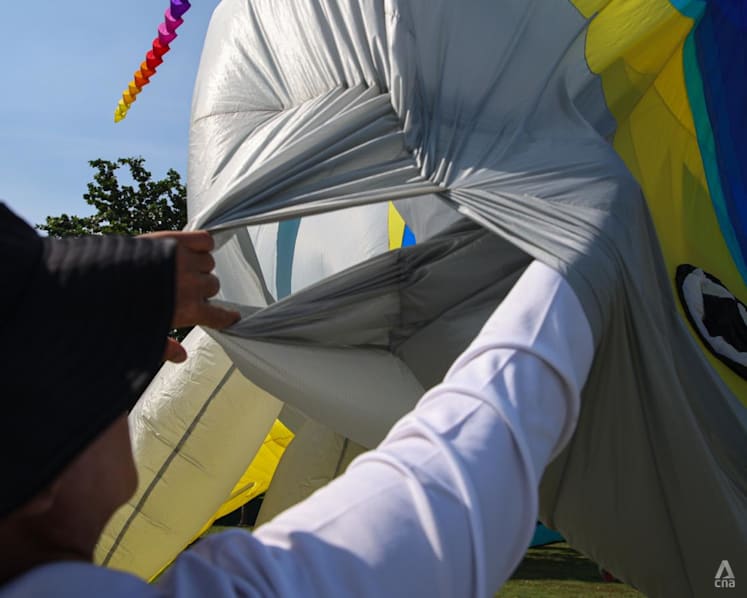
As their interests grew, Mr Yap and Ms Mok started travelling overseas to take part in international kite festivals. 

In September, they were at the International Kite Festival in Melaka, Malaysia, where they flew an inflatable show kite in the form of Singapore's tourism icon, the Merlion.

In watching the kite-flyers, CNA TODAY observed that the age-old method of rolling out and pulling the kite lines or strings is still used for flying simple traditional kites regardless of their sizes.

For long, intricate traditional kites such as Mr Tan's dragon kite, as well as the inflatable show kites, they are anchored to the ground and usually fly without much supervision. They also tend to have a "pilot" kite attached to the main kite to provide a lift for the initial flight. 

Some kites need very little wind, whereas others may need strong wind conditions. 

Inflatable show kites at the International Kite Festival held in Melaka, Malaysia in September 2024. (Photo: Maggie Mok)
Most of the kites designed by Mr Johnny Yap are in red and white, which are colours representing Singapore’s flag. (Photo: CNA/Nuria Ling)

Most of the kites owned by Mr Yap and Ms Mok are designed by them. 

The bespoke kites can cost between a few hundred and a few thousand dollars and they are manufactured in China. 

“We know how to make the kite, but we just don't have time. It takes many, many hours of sewing,” Mr Yap explained.

“We stick to the principle that we must design our own kites.”

Mr Johnny Yap trying to anchor some inflatable show kites to the ground. (Photo: CNA/Mak Jia Kee)
Members of the public taking photos with several inflatable show kites at East Coast Park. (Photo: CNA/Nuria Ling)

Through the years, the couple have met people from all walks of life who have taken an interest in this activity. 

“We have doctors, taxi drivers, hawkers (in Show Kites Singapore). It’s the kites that bring us together,” Mr Yap said.

“There’s no application form (to join the group), so long as you are passionate, come join me every Sunday."

Members of Show Kites Singapore taking a break under the shade at East Coast Park. (Photo: CNA/Mak Jia Kee)
Inflatable show kites flying next to a construction site at East Coast Park. (Photo: CNA/Mak Jia Kee)
Advertisement

In Pixels

Snakes and marine life you don’t always see at Sentosa

Snakes and marine life you don’t always see at Sentosa

A 2-metre juvenile reticulated python slithering across a tree branch in front of filmmaker Jayaprakash Bojan. The snake was found near Palawan Green on Sentosa Island and was rehomed in a forested area nearby. (Photo: CNA/Raj Nadarajan)

04 Oct 2024 09:30PM (Updated: 16 Oct 2025 12:12AM)

There was palpable tension in the air as a black bag was taken to the forest. 

Inside was a 2-metre juvenile reticulated python. 

The snake with diamond-patterned skin was being relocated to a forested area on Sentosa Island by the wildlife management team of the Sentosa Development Corporation (SDC), after it was spotted in a high foot-traffic area.

Standing very still just a few metres away were two professional filmmakers and a photographer, patiently waiting for the snake to emerge. 

CNA Games
Show More
Show Less

They did not have to wait long.

In just a couple of minutes, the python slithered out of the bag and gradually made its way up a tree. 

The team then waited another four hours for the snake to make its way down from the tree as they observed its movements on camera.

In Pixels takes you this weekend on a visual trip with wildlife filmmakers Jayaprakash “JP” Bojan and Ian Mun, as they document Sentosa’s biodiversity and conservation efforts for Earth in Focus, a nature film festival set to take place in November on the resort island south of mainland Singapore. 

Reticulated pythons are native to Singapore and they are commonly found in secondary forests with a water supply. (Photo: CNA/Raj Nadarajan)
Photographer and filmmaker Jayaprakash Bojan, fondly known as JP, attaching a camera to a monopod to capture footage of a python from a safe distance. (Photo: CNA/Raj Nadarajan)
A spitting cobra found in a drain at Fort Siloso in Sentosa was relocated to a forested area on the island. A team of filmmakers had been shooting in Sentosa thrice a week for three months but this was the first time that they were coming face-to-face with a venomous snake on the island. (Photo: CNA/Nuria Ling)

Sentosa is a tourist destination known for its themed parks and sandy beaches. The island’s free-roaming peacocks are probably its most well-known wildlife. 

Off the beaten tracks, though, in the forested areas or along the rocky shores, there is a rich biodiversity of flora and fauna unknown to many visitors.

One rare species found in the coastal forests is the Xylocarpus rumphii, a critically endangered plant that has not been discovered elsewhere on mainland Singapore. 

There is also the elusive lesser bamboo bat, one of the smallest mammals on earth. 

This vulnerable bat species, which weighs just a few grams, has a flattened skull that allows it to squeeze in a hollow bamboo shoot to roost, through narrow slits created by beetles.

A bamboo bat captured on video after being awakened by the endoscope. (Photo: CNA/Nuria Ling)
An endoscope being used to check on lesser bamboo bats that live inside bamboo plants. (Photo: CNA/Nuria Ling)

Sentosa is home to 850 flora and fauna species. 

Setting up camera traps is one way that the conservation team is able to track and protect the wildlife on the island.  

Unlike what it sounds, camera traps do not trap animals. They are cameras with sensors put up in animal habitats for a duration to record images of wildlife and collect data on them.

The team has deployed eight such cameras in biodiversity-sensitive habitats around the island and the cameras are checked every alternate month. 

Advertisement

In Pixels

Inside a dragon kiln where temperatures go up to 1,300°C

Inside a dragon kiln where temperatures go up to 1,300°C

Wood-firing at a dragon kiln is a community effort that requires round-the-clock monitoring. (Photo: CNA/Ooi Boon Keong)

15 Nov 2024 09:30PM (Updated: 16 Oct 2025 12:09AM)

Nestled in an industrial estate in the western part of Singapore is an 84-year-old dragon kiln, the oldest and the only operational dragon kiln in the country. 

Built in 1940, the kiln at Thow Kwang Pottery Jungle was originally used for the mass production of household and industrial items such as cups and flower pots.

Over the decades, the place has evolved into a community space, now offering classes and events for potters to hone their craft. 

CNA TODAY joined the potter community for a wood-firing session that happens only two or three times a year.

CNA Games
Show More
Show Less

In Pixels takes you through the experience, as new and seasoned potters bond over fire and perspiration, creating unique works of art. 

PRAYERS TO THE "KILN GOD"  

At Thow Kwang Pottery Jungle, which is located a short distance from Nanyang Technological University, a group of around 30 people gathered on a Friday last month in front of the kiln.

This was at the request of the owners, Mr Tan Teck Yoke, 68, and his wife Yulianti Tan, 66. 

A prayer ceremony to the "kiln god" was about to begin. 

“We are praying to the ‘kiln god’ for a successful firing, for the pieces to achieve the desired effects,” Mr Tan explained to the enthusiastic participants. 

To this, the crowd responded by shouting, “Heng, ong, huat, ah,” a phrase in the Chinese dialect of Hokkien that collectively means wishing for good fortune.

After the prayers were done, the fire box, which is a small opening at the front of the kiln, was lit. 

The participants each picked up a piece of wood to throw into the fire, hoping to add more "luck" to the process. 

The dragon kiln was bought by Mr Tan’s father in 1965 and has been owned by the family since then.

It sits on a slope, is 27-metres long, 2-metres wide and curves around the side, resembling the body of a dragon in Chinese mythology. 

Its lengthy chambers are made out of bricks and there is a chimney at the end, located at the top of the slope.

The kiln can fit thousands of pieces of ceramic items, depending on the size of the pots. 

For this firing session, around 400 to 500 pieces were loaded in the kiln. 

NEW WAYS TO IMPROVE PROCESS

Temperatures in the dragon kiln can reach up to 1,300°C. 

They can fluctuate significantly due to the shape of the furnace and the use of wood as a fuel.

That is why one of the most crucial parts of the process is to monitor the temperature for all three days of the firing session.

Mr Chua Hee Lai, who is in his 50s and a hobbyist-turned-kiln master, helped to plan and lead each firing session. 

In 2019, Mr Chua, with the help of another potter, introduced a digital monitoring system that allowed them to track the temperatures remotely and give instructions to the potters doing shift work on site. 

Previously, they had to monitor the temperature by looking at the colour of the flame or record temperatures manually and then draw up prediction charts – a process that requires them to be on site for longer periods of time.

THE "KAMPUNG SPIRIT"

Advertising executive Vanessa Low and product manager Goh Wei Ting, both 31, have been practising pottery at another pottery studio for around five years and this was their first time taking part in the wood-firing process.

Compared to a regular firing in an electric or gas kiln, wood-firing is "tiring and physically demanding", Mr Goh said.

However, they were buoyed by the “kampung spirit” or the sense of camaraderie that came about as participants laboured together. 

 “You just don’t feel tired, you just do (the work),” Mr Goh added. 

OPENING OF THE KILN

Six days after the firing at the dragon kiln, the participants returned to open the kiln and check on their art pieces. 

“Shall we form a chain?” someone suggested to facilitate the removal of the brick walls. 

Without hesitation, a human chain quickly formed as the potters unsealed the kiln, one brick at a time. 

A collective “wow” sounded as the final bricks were removed, revealing the final outcome of the nine-day process that comprised three days of firing and six days of cooling.

The potters carefully removed the art pieces from the shelves, while admiring the effects that the fire had on their work. 

Ms Tia Boon Sim, 69, one of the founders of Thow Kwang Clay Artists, a community group, said: “In wood-firing, the ashes from the fire would fly around and drop on the pieces and these are the effects potters love.”

When asked if she would do this again, Ms Low said: “I would want to come back with my friends for this, have fun and learn new things together.”  

Participants moving the pottery pieces out of the kiln area by forming a human chain. (Photo: CNA/Ooi Boon Keong)
Ceramic items in different shapes, sizes and colours were placed on tables. (Photo: CNA/Ooi Boon Keong)
Mr Goh Wei Ting comparing his pottery work before and after the items were fired in the kiln. (Photo: CNA/Ooi Boon Keong)
A participant looking at a freshly fired pot, examining every detail. (Photo: CNA/Ooi Boon Keong)
Source: CNA/jl/sf

Recommended

Advertisement

In Pixels

Meet the 70-year-old lorry driver who is also a 'kite doctor'
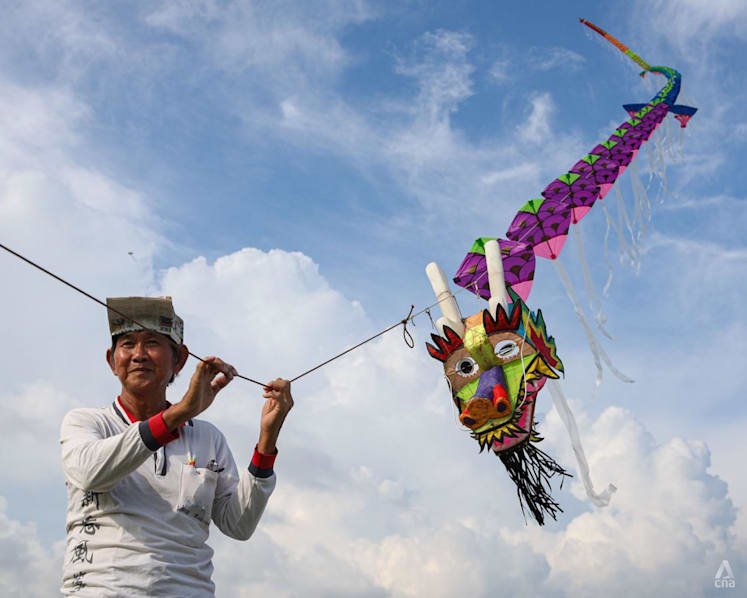
Meet the 70-year-old lorry driver who is also a 'kite doctor'

Kite maker Tan Poh Wah flying his handmade dragon kite at the Marina Barrage. (Photo: CNA/Nuria Ling)

30 Nov 2024 09:30PM (Updated: 16 Oct 2025 12:08AM)

Rolling up to Marina Barrage with a trolley bag full of handmade kites and repair tools, Mr Tan Poh Wah had one clear mission for the day: To share his love of kite-flying with others. 

Known informally as the “kite doctor” among the regular visitors there, the 70-year-old spends most Sundays repairing kites or offering his handmade ones – mostly for free – to people at the open-air space that is the venue of Singapore's largest reservoir. 

“Watching people fly my kites makes me really happy,” Mr Tan said.  

This weekend, In Pixels speaks to four enthusiasts to find out what excites them about kite-flying. 

A FAMILIAR FIGURE

CNA Games
Show More
Show Less

Shortly after Mr Tan turned up at Marina Barrage in the Marina Bay area, a handful of people who wanted their kites repaired immediately made a beeline towards him. 

They offered him drinks and snacks to thank him for his service. 

When he was done with the repairs, Mr Tan pulled a kite from his bag and launched it to the sky. 

He flew it with ease, strolling around the field, eager to find someone who will take the kite as a gift. 

His masterpieces are made mostly from recycled materials including plastic bags, discarded blinds, banners and umbrellas. 

Mr Tan is part of a group known as Singapore Original Kites, an informal gathering of adults in their 60s and 70s who share the same interest in making and flying kites.  

A semi-retired Chinese physician ​​Ong Cheng Her, 75, is the founder of the group.

He said that the only prerequisite to join the group is one’s ability to make a kite from scratch.  

He proudly showed CNA TODAY one of his creations, a red and white "umbrella kite". 

“Umbrellas are used for shade and rain protection, so why hasn’t anyone flown an umbrella kite? I decided to take on the challenge,” Mr Ong added.

HIS WORKSPACE AT HOME

As for Mr Tan, he is not retired, so flying and making kites is what he does only on Sundays.

He works six days a week as a lorry driver.

“I work to live, to fill my stomach so I can make kites.”

Stepping into his flat, Mr Tan led us to his "studio", which is a room filled with a bountiful supply of kites and raw materials. 

He described his workspace as a “chaotic but organised mess”. 

“My wife sometimes asks why I collect so many umbrellas, but she doesn’t interfere much because she knows I enjoy making these things.”

Mr Tan has loved kite flying since he was a child, but it was not until he was in his 30s that he took to making kites himself.

A self-taught craftsman, he said that he learnt how to make kites by observing other kite-makers whenever an opportunity comes along. 

Recently, Mr Tan finished repairing a 70m-long "dragon kite" that he first constructed in 2000. It broke at a kite festival in Taiwan in 2019 and required extensive repairs. 

After CNA TODAY approached him for an interview, Mr Tan said that he found new inspiration to repair the kite, which took him four Sundays to complete.

It was obvious that he is most proud of this kite among the many in his collection.

“Anyone who hasn't made a dragon or a phoenix kite isn't truly considered a kite maker,” he said, adding that these long kites are made up of many different sections and each needed to be crafted with great precision before they are finally stitched together. 

"GIANTS" IN THE SKY

Over at East Coast Park, another group of kite enthusiasts have gathered and their presence could be spotted from afar. 

The kites they have taken out, called "inflatable show kites", are gigantic balloon-like kites that are typically several metres in length when inflated.

Traditional kites rely on rigid frames for support, but inflatable show kites have no hard structures. They inflate as they catch on the wind and have to be anchored to the ground.

Project coordinator Johnny Yap and his wife Maggie Mok, a homemaker, both 51, are the founders of Show Kites Singapore, a group of people who are into these inflatable show kites.

The duo's interest in this started nearly 20 years ago when they took their children kite-flying. 

In the end, it was the couple themselves who got hooked on the activity. 

“We started flying bigger and bigger kites and before long, we realised that stick kites have a limit,” Mr Yap said.

This led them to explore inflatable ones in 2009 and they came across these kites online before buying their first. The sky is the limit when it comes to the sizes of such kites.

As their interests grew, Mr Yap and Ms Mok started travelling overseas to take part in international kite festivals. 

In September, they were at the International Kite Festival in Melaka, Malaysia, where they flew an inflatable show kite in the form of Singapore's tourism icon, the Merlion.

In watching the kite-flyers, CNA TODAY observed that the age-old method of rolling out and pulling the kite lines or strings is still used for flying simple traditional kites regardless of their sizes.

For long, intricate traditional kites such as Mr Tan's dragon kite, as well as the inflatable show kites, they are anchored to the ground and usually fly without much supervision. They also tend to have a "pilot" kite attached to the main kite to provide a lift for the initial flight. 

Some kites need very little wind, whereas others may need strong wind conditions. 

Inflatable show kites at the International Kite Festival held in Melaka, Malaysia in September 2024. (Photo: Maggie Mok)
Most of the kites designed by Mr Johnny Yap are in red and white, which are colours representing Singapore’s flag. (Photo: CNA/Nuria Ling)

Most of the kites owned by Mr Yap and Ms Mok are designed by them. 

The bespoke kites can cost between a few hundred and a few thousand dollars and they are manufactured in China. 

“We know how to make the kite, but we just don't have time. It takes many, many hours of sewing,” Mr Yap explained.

“We stick to the principle that we must design our own kites.”

Mr Johnny Yap trying to anchor some inflatable show kites to the ground. (Photo: CNA/Mak Jia Kee)
Members of the public taking photos with several inflatable show kites at East Coast Park. (Photo: CNA/Nuria Ling)

Through the years, the couple have met people from all walks of life who have taken an interest in this activity. 

“We have doctors, taxi drivers, hawkers (in Show Kites Singapore). It’s the kites that bring us together,” Mr Yap said.

“There’s no application form (to join the group), so long as you are passionate, come join me every Sunday."

Members of Show Kites Singapore taking a break under the shade at East Coast Park. (Photo: CNA/Mak Jia Kee)
Inflatable show kites flying next to a construction site at East Coast Park. (Photo: CNA/Mak Jia Kee)
Advertisement

In Pixels

Snakes and marine life you don’t always see at Sentosa

Snakes and marine life you don’t always see at Sentosa

A 2-metre juvenile reticulated python slithering across a tree branch in front of filmmaker Jayaprakash Bojan. The snake was found near Palawan Green on Sentosa Island and was rehomed in a forested area nearby. (Photo: CNA/Raj Nadarajan)

04 Oct 2024 09:30PM (Updated: 16 Oct 2025 12:12AM)

There was palpable tension in the air as a black bag was taken to the forest. 

Inside was a 2-metre juvenile reticulated python. 

The snake with diamond-patterned skin was being relocated to a forested area on Sentosa Island by the wildlife management team of the Sentosa Development Corporation (SDC), after it was spotted in a high foot-traffic area.

Standing very still just a few metres away were two professional filmmakers and a photographer, patiently waiting for the snake to emerge. 

CNA Games
Show More
Show Less

They did not have to wait long.

In just a couple of minutes, the python slithered out of the bag and gradually made its way up a tree. 

The team then waited another four hours for the snake to make its way down from the tree as they observed its movements on camera.

In Pixels takes you this weekend on a visual trip with wildlife filmmakers Jayaprakash “JP” Bojan and Ian Mun, as they document Sentosa’s biodiversity and conservation efforts for Earth in Focus, a nature film festival set to take place in November on the resort island south of mainland Singapore. 

Reticulated pythons are native to Singapore and they are commonly found in secondary forests with a water supply. (Photo: CNA/Raj Nadarajan)
Photographer and filmmaker Jayaprakash Bojan, fondly known as JP, attaching a camera to a monopod to capture footage of a python from a safe distance. (Photo: CNA/Raj Nadarajan)
A spitting cobra found in a drain at Fort Siloso in Sentosa was relocated to a forested area on the island. A team of filmmakers had been shooting in Sentosa thrice a week for three months but this was the first time that they were coming face-to-face with a venomous snake on the island. (Photo: CNA/Nuria Ling)

Sentosa is a tourist destination known for its themed parks and sandy beaches. The island’s free-roaming peacocks are probably its most well-known wildlife. 

Off the beaten tracks, though, in the forested areas or along the rocky shores, there is a rich biodiversity of flora and fauna unknown to many visitors.

One rare species found in the coastal forests is the Xylocarpus rumphii, a critically endangered plant that has not been discovered elsewhere on mainland Singapore. 

There is also the elusive lesser bamboo bat, one of the smallest mammals on earth. 

This vulnerable bat species, which weighs just a few grams, has a flattened skull that allows it to squeeze in a hollow bamboo shoot to roost, through narrow slits created by beetles.

A bamboo bat captured on video after being awakened by the endoscope. (Photo: CNA/Nuria Ling)
An endoscope being used to check on lesser bamboo bats that live inside bamboo plants. (Photo: CNA/Nuria Ling)

Sentosa is home to 850 flora and fauna species. 

Setting up camera traps is one way that the conservation team is able to track and protect the wildlife on the island.  

Unlike what it sounds, camera traps do not trap animals. They are cameras with sensors put up in animal habitats for a duration to record images of wildlife and collect data on them.

The team has deployed eight such cameras in biodiversity-sensitive habitats around the island and the cameras are checked every alternate month. 

Advertisement

In Pixels

Inside a dragon kiln where temperatures go up to 1,300°C

Inside a dragon kiln where temperatures go up to 1,300°C

Wood-firing at a dragon kiln is a community effort that requires round-the-clock monitoring. (Photo: CNA/Ooi Boon Keong)

15 Nov 2024 09:30PM (Updated: 16 Oct 2025 12:09AM)

Nestled in an industrial estate in the western part of Singapore is an 84-year-old dragon kiln, the oldest and the only operational dragon kiln in the country. 

Built in 1940, the kiln at Thow Kwang Pottery Jungle was originally used for the mass production of household and industrial items such as cups and flower pots.

Over the decades, the place has evolved into a community space, now offering classes and events for potters to hone their craft. 

CNA TODAY joined the potter community for a wood-firing session that happens only two or three times a year.

CNA Games
Show More
Show Less

In Pixels takes you through the experience, as new and seasoned potters bond over fire and perspiration, creating unique works of art. 

PRAYERS TO THE "KILN GOD"  

At Thow Kwang Pottery Jungle, which is located a short distance from Nanyang Technological University, a group of around 30 people gathered on a Friday last month in front of the kiln.

This was at the request of the owners, Mr Tan Teck Yoke, 68, and his wife Yulianti Tan, 66. 

A prayer ceremony to the "kiln god" was about to begin. 

“We are praying to the ‘kiln god’ for a successful firing, for the pieces to achieve the desired effects,” Mr Tan explained to the enthusiastic participants. 

To this, the crowd responded by shouting, “Heng, ong, huat, ah,” a phrase in the Chinese dialect of Hokkien that collectively means wishing for good fortune.

After the prayers were done, the fire box, which is a small opening at the front of the kiln, was lit. 

The participants each picked up a piece of wood to throw into the fire, hoping to add more "luck" to the process. 

The dragon kiln was bought by Mr Tan’s father in 1965 and has been owned by the family since then.

It sits on a slope, is 27-metres long, 2-metres wide and curves around the side, resembling the body of a dragon in Chinese mythology. 

Its lengthy chambers are made out of bricks and there is a chimney at the end, located at the top of the slope.

The kiln can fit thousands of pieces of ceramic items, depending on the size of the pots. 

For this firing session, around 400 to 500 pieces were loaded in the kiln. 

NEW WAYS TO IMPROVE PROCESS

Temperatures in the dragon kiln can reach up to 1,300°C. 

They can fluctuate significantly due to the shape of the furnace and the use of wood as a fuel.

That is why one of the most crucial parts of the process is to monitor the temperature for all three days of the firing session.

Mr Chua Hee Lai, who is in his 50s and a hobbyist-turned-kiln master, helped to plan and lead each firing session. 

In 2019, Mr Chua, with the help of another potter, introduced a digital monitoring system that allowed them to track the temperatures remotely and give instructions to the potters doing shift work on site. 

Previously, they had to monitor the temperature by looking at the colour of the flame or record temperatures manually and then draw up prediction charts – a process that requires them to be on site for longer periods of time.

THE "KAMPUNG SPIRIT"

Advertising executive Vanessa Low and product manager Goh Wei Ting, both 31, have been practising pottery at another pottery studio for around five years and this was their first time taking part in the wood-firing process.

Compared to a regular firing in an electric or gas kiln, wood-firing is "tiring and physically demanding", Mr Goh said.

However, they were buoyed by the “kampung spirit” or the sense of camaraderie that came about as participants laboured together. 

 “You just don’t feel tired, you just do (the work),” Mr Goh added. 

OPENING OF THE KILN

Six days after the firing at the dragon kiln, the participants returned to open the kiln and check on their art pieces. 

“Shall we form a chain?” someone suggested to facilitate the removal of the brick walls. 

Without hesitation, a human chain quickly formed as the potters unsealed the kiln, one brick at a time. 

A collective “wow” sounded as the final bricks were removed, revealing the final outcome of the nine-day process that comprised three days of firing and six days of cooling.

The potters carefully removed the art pieces from the shelves, while admiring the effects that the fire had on their work. 

Ms Tia Boon Sim, 69, one of the founders of Thow Kwang Clay Artists, a community group, said: “In wood-firing, the ashes from the fire would fly around and drop on the pieces and these are the effects potters love.”

When asked if she would do this again, Ms Low said: “I would want to come back with my friends for this, have fun and learn new things together.”  

Participants moving the pottery pieces out of the kiln area by forming a human chain. (Photo: CNA/Ooi Boon Keong)
Ceramic items in different shapes, sizes and colours were placed on tables. (Photo: CNA/Ooi Boon Keong)
Mr Goh Wei Ting comparing his pottery work before and after the items were fired in the kiln. (Photo: CNA/Ooi Boon Keong)
A participant looking at a freshly fired pot, examining every detail. (Photo: CNA/Ooi Boon Keong)
Source: CNA/jl/sf

Recommended

Advertisement

In Pixels

Meet the 70-year-old lorry driver who is also a 'kite doctor'

Meet the 70-year-old lorry driver who is also a 'kite doctor'

Kite maker Tan Poh Wah flying his handmade dragon kite at the Marina Barrage. (Photo: CNA/Nuria Ling)

30 Nov 2024 09:30PM (Updated: 16 Oct 2025 12:08AM)

Rolling up to Marina Barrage with a trolley bag full of handmade kites and repair tools, Mr Tan Poh Wah had one clear mission for the day: To share his love of kite-flying with others. 

Known informally as the “kite doctor” among the regular visitors there, the 70-year-old spends most Sundays repairing kites or offering his handmade ones – mostly for free – to people at the open-air space that is the venue of Singapore's largest reservoir. 

“Watching people fly my kites makes me really happy,” Mr Tan said.  

This weekend, In Pixels speaks to four enthusiasts to find out what excites them about kite-flying. 

A FAMILIAR FIGURE

CNA Games
Show More
Show Less

Shortly after Mr Tan turned up at Marina Barrage in the Marina Bay area, a handful of people who wanted their kites repaired immediately made a beeline towards him. 

They offered him drinks and snacks to thank him for his service. 

When he was done with the repairs, Mr Tan pulled a kite from his bag and launched it to the sky. 

He flew it with ease, strolling around the field, eager to find someone who will take the kite as a gift. 

His masterpieces are made mostly from recycled materials including plastic bags, discarded blinds, banners and umbrellas. 

Mr Tan is part of a group known as Singapore Original Kites, an informal gathering of adults in their 60s and 70s who share the same interest in making and flying kites.  

A semi-retired Chinese physician ​​Ong Cheng Her, 75, is the founder of the group.

He said that the only prerequisite to join the group is one’s ability to make a kite from scratch.  

He proudly showed CNA TODAY one of his creations, a red and white "umbrella kite". 

“Umbrellas are used for shade and rain protection, so why hasn’t anyone flown an umbrella kite? I decided to take on the challenge,” Mr Ong added.

HIS WORKSPACE AT HOME

As for Mr Tan, he is not retired, so flying and making kites is what he does only on Sundays.

He works six days a week as a lorry driver.

“I work to live, to fill my stomach so I can make kites.”

Stepping into his flat, Mr Tan led us to his "studio", which is a room filled with a bountiful supply of kites and raw materials. 

He described his workspace as a “chaotic but organised mess”. 

“My wife sometimes asks why I collect so many umbrellas, but she doesn’t interfere much because she knows I enjoy making these things.”

Mr Tan has loved kite flying since he was a child, but it was not until he was in his 30s that he took to making kites himself.

A self-taught craftsman, he said that he learnt how to make kites by observing other kite-makers whenever an opportunity comes along. 

Recently, Mr Tan finished repairing a 70m-long "dragon kite" that he first constructed in 2000. It broke at a kite festival in Taiwan in 2019 and required extensive repairs. 

After CNA TODAY approached him for an interview, Mr Tan said that he found new inspiration to repair the kite, which took him four Sundays to complete.

It was obvious that he is most proud of this kite among the many in his collection.

“Anyone who hasn't made a dragon or a phoenix kite isn't truly considered a kite maker,” he said, adding that these long kites are made up of many different sections and each needed to be crafted with great precision before they are finally stitched together. 

"GIANTS" IN THE SKY

Over at East Coast Park, another group of kite enthusiasts have gathered and their presence could be spotted from afar. 

The kites they have taken out, called "inflatable show kites", are gigantic balloon-like kites that are typically several metres in length when inflated.

Traditional kites rely on rigid frames for support, but inflatable show kites have no hard structures. They inflate as they catch on the wind and have to be anchored to the ground.

Project coordinator Johnny Yap and his wife Maggie Mok, a homemaker, both 51, are the founders of Show Kites Singapore, a group of people who are into these inflatable show kites.

The duo's interest in this started nearly 20 years ago when they took their children kite-flying. 

In the end, it was the couple themselves who got hooked on the activity. 

“We started flying bigger and bigger kites and before long, we realised that stick kites have a limit,” Mr Yap said.

This led them to explore inflatable ones in 2009 and they came across these kites online before buying their first. The sky is the limit when it comes to the sizes of such kites.

As their interests grew, Mr Yap and Ms Mok started travelling overseas to take part in international kite festivals. 

In September, they were at the International Kite Festival in Melaka, Malaysia, where they flew an inflatable show kite in the form of Singapore's tourism icon, the Merlion.

In watching the kite-flyers, CNA TODAY observed that the age-old method of rolling out and pulling the kite lines or strings is still used for flying simple traditional kites regardless of their sizes.

For long, intricate traditional kites such as Mr Tan's dragon kite, as well as the inflatable show kites, they are anchored to the ground and usually fly without much supervision. They also tend to have a "pilot" kite attached to the main kite to provide a lift for the initial flight. 

Some kites need very little wind, whereas others may need strong wind conditions. 

Inflatable show kites at the International Kite Festival held in Melaka, Malaysia in September 2024. (Photo: Maggie Mok)
Most of the kites designed by Mr Johnny Yap are in red and white, which are colours representing Singapore’s flag. (Photo: CNA/Nuria Ling)

Most of the kites owned by Mr Yap and Ms Mok are designed by them. 

The bespoke kites can cost between a few hundred and a few thousand dollars and they are manufactured in China. 

“We know how to make the kite, but we just don't have time. It takes many, many hours of sewing,” Mr Yap explained.

“We stick to the principle that we must design our own kites.”

Mr Johnny Yap trying to anchor some inflatable show kites to the ground. (Photo: CNA/Mak Jia Kee)
Members of the public taking photos with several inflatable show kites at East Coast Park. (Photo: CNA/Nuria Ling)

Through the years, the couple have met people from all walks of life who have taken an interest in this activity. 

“We have doctors, taxi drivers, hawkers (in Show Kites Singapore). It’s the kites that bring us together,” Mr Yap said.

“There’s no application form (to join the group), so long as you are passionate, come join me every Sunday."

Members of Show Kites Singapore taking a break under the shade at East Coast Park. (Photo: CNA/Mak Jia Kee)
Inflatable show kites flying next to a construction site at East Coast Park. (Photo: CNA/Mak Jia Kee)
Advertisement

In Pixels

Snakes and marine life you don’t always see at Sentosa

Snakes and marine life you don’t always see at Sentosa

A 2-metre juvenile reticulated python slithering across a tree branch in front of filmmaker Jayaprakash Bojan. The snake was found near Palawan Green on Sentosa Island and was rehomed in a forested area nearby. (Photo: CNA/Raj Nadarajan)

04 Oct 2024 09:30PM (Updated: 16 Oct 2025 12:12AM)

There was palpable tension in the air as a black bag was taken to the forest. 

Inside was a 2-metre juvenile reticulated python. 

The snake with diamond-patterned skin was being relocated to a forested area on Sentosa Island by the wildlife management team of the Sentosa Development Corporation (SDC), after it was spotted in a high foot-traffic area.

Standing very still just a few metres away were two professional filmmakers and a photographer, patiently waiting for the snake to emerge. 

CNA Games
Show More
Show Less

They did not have to wait long.

In just a couple of minutes, the python slithered out of the bag and gradually made its way up a tree. 

The team then waited another four hours for the snake to make its way down from the tree as they observed its movements on camera.

In Pixels takes you this weekend on a visual trip with wildlife filmmakers Jayaprakash “JP” Bojan and Ian Mun, as they document Sentosa’s biodiversity and conservation efforts for Earth in Focus, a nature film festival set to take place in November on the resort island south of mainland Singapore. 

Sentosa is a tourist destination known for its themed parks and sandy beaches. The island’s free-roaming peacocks are probably its most well-known wildlife. 

Off the beaten tracks, though, in the forested areas or along the rocky shores, there is a rich biodiversity of flora and fauna unknown to many visitors.

One rare species found in the coastal forests is the Xylocarpus rumphii, a critically endangered plant that has not been discovered elsewhere on mainland Singapore. 

There is also the elusive lesser bamboo bat, one of the smallest mammals on earth. 

This vulnerable bat species, which weighs just a few grams, has a flattened skull that allows it to squeeze in a hollow bamboo shoot to roost, through narrow slits created by beetles.

Sentosa is home to 850 flora and fauna species. 

Setting up camera traps is one way that the conservation team is able to track and protect the wildlife on the island.  

Unlike what it sounds, camera traps do not trap animals. They are cameras with sensors put up in animal habitats for a duration to record images of wildlife and collect data on them.

The team has deployed eight such cameras in biodiversity-sensitive habitats around the island and the cameras are checked every alternate month. 

SDC said: “We urge guests to be mindful as they explore Sentosa and to treat our fragile ecosystems with care.”

Visits to some areas such as Tanjong Rimau and Mount Serapong are available only through guided tours by SDC or SDC-approved tours. 

Tanjong Rimau, also known as Siloso Headland, is located at the western-most tip of Sentosa and is one of Singapore's last remaining coastal cliffs and rocky shores that are habitats for marine life.

Mount Serapong, located around the north-eastern part of the island, has a mature tropical rainforest and also a coastal forest nearer the shore.

“Guests should also observe our nature areas guidelines so that everyone can enjoy the greenery and wildlife that Sentosa has to offer,” SDC said.

Senior supervisor Justin David (left) and senior animal handler Joshua Sathasivam Shanmugam (right) from the Sentosa wildlife management team setting up a camera trap. (Photo: CNA/Nuria Ling)
A Goffin's cockatoo captured on a camera trap set up along Sentosa’s coastal trail. (Photo: CNA/Nuria Ling)
Photographers and filmmakers JP (right) and Ian Mun (left) looking for hornbills that have previously been spotted in the area. (Photo: CNA/Nuria Ling)
A family of up to 11 hornbills were spotted by filmmaker and photographer JP near a plant nursery. JP and fellow team mate Ian Mun were also able to capture footage of other bird species including hawk eagles, parakeets and blue-throated bee-eaters. (Photo: CNA/Nuria Ling)

JP, who is the 2017 National Geographic Nature Photographer of the Year, said: “The excitement of not knowing what you’re going to get is amazing. I know I’m going to get something but I don’t know what.”

The seasoned nature photographer of 20 years said that there is “nothing in your control” when it comes to capturing wildlife. 

For instance, an extra low tide on the north-western tip of Sentosa accompanied a supermoon in August, making it a rare occasion and perfect opportunity to capture intertidal marine life.

A filmmaking team set out before sunrise to capture the wild marine life at Sentosa’s intertidal zone along the north-western tip of the island, an area of fragile habitats closed to the public except for approved guided tours. (Photo: CNA/Nuria Ling)
Filmmakers found small fish in tide pools along the rocky shores of north-western Sentosa. (Photo: CNA/Nuria Ling)
A live coral found in a tide pool, which was exposed during low tide. (Photo: CNA/Nuria Ling)
Chitons seen here during low tide. They are a type of mollusc such as snails and clams that resemble fossils. They typically have eight overlapping plates along the centre and a powerful suction that clings on to rocks. (Photo: CNA/ Nuria Ling)
A highlight for photographer Ian Mun while shooting in the intertidal zone was spotting a red egg crab chasing a reef octopus. “Inter-species interaction is always interesting to observe,” he said. (Photo: CNA/Nuria Ling)
A red egg crab chasing a reef octopus spotted at Sentosa’s intertidal zone at Tanjong Rimau. (Photo: Ian Mun)
Source: CNA/jl/sf

Recommended

Source: CNA/jl/sf

Recommended

Ms Tia Boon Sim, 69, one of the founders of Thow Kwang Clay Artists, a community group, said: “In wood-firing, the ashes from the fire would fly around and drop on the pieces and these are the effects potters love.”

When asked if she would do this again, Ms Low said: “I would want to come back with my friends for this, have fun and learn new things together.”  

Participants moving the pottery pieces out of the kiln area by forming a human chain. (Photo: CNA/Ooi Boon Keong)
Ceramic items in different shapes, sizes and colours were placed on tables. (Photo: CNA/Ooi Boon Keong)
Mr Goh Wei Ting comparing his pottery work before and after the items were fired in the kiln. (Photo: CNA/Ooi Boon Keong)
A participant looking at a freshly fired pot, examining every detail. (Photo: CNA/Ooi Boon Keong)
Source: CNA/jl/sf

Recommended

In watching the kite-flyers, CNA TODAY observed that the age-old method of rolling out and pulling the kite lines or strings is still used for flying simple traditional kites regardless of their sizes.

For long, intricate traditional kites such as Mr Tan's dragon kite, as well as the inflatable show kites, they are anchored to the ground and usually fly without much supervision. They also tend to have a "pilot" kite attached to the main kite to provide a lift for the initial flight. 

Some kites need very little wind, whereas others may need strong wind conditions. 

Most of the kites owned by Mr Yap and Ms Mok are designed by them. 

The bespoke kites can cost between a few hundred and a few thousand dollars and they are manufactured in China. 

“We know how to make the kite, but we just don't have time. It takes many, many hours of sewing,” Mr Yap explained.

“We stick to the principle that we must design our own kites.”

Through the years, the couple have met people from all walks of life who have taken an interest in this activity. 

“We have doctors, taxi drivers, hawkers (in Show Kites Singapore). It’s the kites that bring us together,” Mr Yap said.

“There’s no application form (to join the group), so long as you are passionate, come join me every Sunday."

Source: CNA/jl/sf

Recommended

Ms Tia Boon Sim, 69, one of the founders of Thow Kwang Clay Artists, a community group, said: “In wood-firing, the ashes from the fire would fly around and drop on the pieces and these are the effects potters love.”

When asked if she would do this again, Ms Low said: “I would want to come back with my friends for this, have fun and learn new things together.”  

Source: CNA/jl/sf

Recommended

Advertisement

In Pixels

Meet the 70-year-old lorry driver who is also a 'kite doctor'

Meet the 70-year-old lorry driver who is also a 'kite doctor'

Kite maker Tan Poh Wah flying his handmade dragon kite at the Marina Barrage. (Photo: CNA/Nuria Ling)

30 Nov 2024 09:30PM (Updated: 16 Oct 2025 12:08AM)

Rolling up to Marina Barrage with a trolley bag full of handmade kites and repair tools, Mr Tan Poh Wah had one clear mission for the day: To share his love of kite-flying with others. 

Known informally as the “kite doctor” among the regular visitors there, the 70-year-old spends most Sundays repairing kites or offering his handmade ones – mostly for free – to people at the open-air space that is the venue of Singapore's largest reservoir. 

“Watching people fly my kites makes me really happy,” Mr Tan said.  

This weekend, In Pixels speaks to four enthusiasts to find out what excites them about kite-flying. 

A FAMILIAR FIGURE

CNA Games
Show More
Show Less

Shortly after Mr Tan turned up at Marina Barrage in the Marina Bay area, a handful of people who wanted their kites repaired immediately made a beeline towards him. 

They offered him drinks and snacks to thank him for his service. 

Mr Tan Poh Wah fixing a kite for a member of the public at the Marina Barrage. (Photo: CNA/Mak Jia Kee)
A variety of sticks and other kite parts are some of the things in Mr Tan Poh Wah’s kit that he takes to the Marina Barrage. (Photo: CNA/Nuria Ling)

When he was done with the repairs, Mr Tan pulled a kite from his bag and launched it to the sky. 

He flew it with ease, strolling around the field, eager to find someone who will take the kite as a gift. 

His masterpieces are made mostly from recycled materials including plastic bags, discarded blinds, banners and umbrellas. 

Mr Tan Poh Wah holding up a kite he made using a supermarket plastic bag. (Photo: CNA/Mak Jia Kee)
Mr Tan Poh Wah with a handmade kite made out of recycled materials. (Photo: CNA/Nuria Ling)

Mr Tan is part of a group known as Singapore Original Kites, an informal gathering of adults in their 60s and 70s who share the same interest in making and flying kites.  

A semi-retired Chinese physician ​​Ong Cheng Her, 75, is the founder of the group.

He said that the only prerequisite to join the group is one’s ability to make a kite from scratch.  

He proudly showed CNA TODAY one of his creations, a red and white "umbrella kite". 

“Umbrellas are used for shade and rain protection, so why hasn’t anyone flown an umbrella kite? I decided to take on the challenge,” Mr Ong added.

Mr Ong Cheng Her, founder of the Singapore Original Kites group, holding an "umbrella kite" that he made in 2023. (Photo: CNA/Nuria Ling )
Mr Ong Cheng Her holding a kite he made, featuring flower and leaf patterns inspired by traditional Chinese paintings. (Photo: CNA/Mak Jia Kee)

HIS WORKSPACE AT HOME

As for Mr Tan, he is not retired, so flying and making kites is what he does only on Sundays.

He works six days a week as a lorry driver.

“I work to live, to fill my stomach so I can make kites.”

Stepping into his flat, Mr Tan led us to his "studio", which is a room filled with a bountiful supply of kites and raw materials. 

He described his workspace as a “chaotic but organised mess”. 

“My wife sometimes asks why I collect so many umbrellas, but she doesn’t interfere much because she knows I enjoy making these things.”

Mr Tan Poh Wah tying a ribbon to a bamboo stick to form part of a kite. (Photo: CNA/Nuria Ling)

Mr Tan has loved kite flying since he was a child, but it was not until he was in his 30s that he took to making kites himself.

A self-taught craftsman, he said that he learnt how to make kites by observing other kite-makers whenever an opportunity comes along. 

Mr Tan Poh Wah crafting a squid kite in his workshop that he set up in his flat. (Photo: CNA/Nuria Ling)
Mr Tan Poh Wah laying out pieces of a 70m-long "dragon kite" in his living room. (Photo: CNA/Nuria Ling)

Recently, Mr Tan finished repairing a 70m-long "dragon kite" that he first constructed in 2000. It broke at a kite festival in Taiwan in 2019 and required extensive repairs. 

After CNA TODAY approached him for an interview, Mr Tan said that he found new inspiration to repair the kite, which took him four Sundays to complete.

It was obvious that he is most proud of this kite among the many in his collection.

“Anyone who hasn't made a dragon or a phoenix kite isn't truly considered a kite maker,” he said, adding that these long kites are made up of many different sections and each needed to be crafted with great precision before they are finally stitched together. 

A 70m-long "dragon kite" made by Mr Tan Poh Wah flying at Marina Barrage. (Photo: CNA/Nuria Ling)

"GIANTS" IN THE SKY

Over at East Coast Park, another group of kite enthusiasts have gathered and their presence could be spotted from afar. 

The kites they have taken out, called "inflatable show kites", are gigantic balloon-like kites that are typically several metres in length when inflated.

Traditional kites rely on rigid frames for support, but inflatable show kites have no hard structures. They inflate as they catch on the wind and have to be anchored to the ground.

An inflatable show kite flying at East Coast Park. (Photo: CNA/Nuria Ling)
Mr Johnny Yap checking on a 10m-tall seahorse-shaped inflatable show kite. (Photo: CNA/Mak Jia Kee)

Project coordinator Johnny Yap and his wife Maggie Mok, a homemaker, both 51, are the founders of Show Kites Singapore, a group of people who are into these inflatable show kites.

The duo's interest in this started nearly 20 years ago when they took their children kite-flying. 

In the end, it was the couple themselves who got hooked on the activity. 

“We started flying bigger and bigger kites and before long, we realised that stick kites have a limit,” Mr Yap said.

This led them to explore inflatable ones in 2009 and they came across these kites online before buying their first. The sky is the limit when it comes to the sizes of such kites.

Ms Maggie Mok examining the flying cord of an inflatable show kite. (Photo: CNA/Mak Jia Kee)
Mr Johnny Yap fixing the attached strings on his show kite. (Photo: CNA/Nuria Ling)
Mr Johnny Yap holding open an inflation vent for air to fill up the kite. (Photo: CNA/Nuria Ling)

As their interests grew, Mr Yap and Ms Mok started travelling overseas to take part in international kite festivals. 

In September, they were at the International Kite Festival in Melaka, Malaysia, where they flew an inflatable show kite in the form of Singapore's tourism icon, the Merlion.

Advertisement

In Pixels

Inside a dragon kiln where temperatures go up to 1,300°C

Inside a dragon kiln where temperatures go up to 1,300°C

Wood-firing at a dragon kiln is a community effort that requires round-the-clock monitoring. (Photo: CNA/Ooi Boon Keong)

15 Nov 2024 09:30PM (Updated: 16 Oct 2025 12:09AM)

Nestled in an industrial estate in the western part of Singapore is an 84-year-old dragon kiln, the oldest and the only operational dragon kiln in the country. 

Built in 1940, the kiln at Thow Kwang Pottery Jungle was originally used for the mass production of household and industrial items such as cups and flower pots.

Over the decades, the place has evolved into a community space, now offering classes and events for potters to hone their craft. 

CNA TODAY joined the potter community for a wood-firing session that happens only two or three times a year.

CNA Games
Show More
Show Less

In Pixels takes you through the experience, as new and seasoned potters bond over fire and perspiration, creating unique works of art. 

PRAYERS TO THE "KILN GOD"  

At Thow Kwang Pottery Jungle, which is located a short distance from Nanyang Technological University, a group of around 30 people gathered on a Friday last month in front of the kiln.

This was at the request of the owners, Mr Tan Teck Yoke, 68, and his wife Yulianti Tan, 66. 

A prayer ceremony to the "kiln god" was about to begin. 

“We are praying to the ‘kiln god’ for a successful firing, for the pieces to achieve the desired effects,” Mr Tan explained to the enthusiastic participants. 

To this, the crowd responded by shouting, “Heng, ong, huat, ah,” a phrase in the Chinese dialect of Hokkien that collectively means wishing for good fortune.

Mrs Yulianti Tan and Mr Tan Teck Yoke, owners of Thow Kwang Pottery Jungle, praying for a successful wood-firing session. (Photo: CNA/Ooi Boon Keong)

After the prayers were done, the fire box, which is a small opening at the front of the kiln, was lit. 

The participants each picked up a piece of wood to throw into the fire, hoping to add more "luck" to the process. 

During wood-firing in a kiln, the fire and the ashes from the wood react with the glaze on the ceramic items to produce a unique and rustic look. (Photo: CNA/Ooi Boon Keong)

The dragon kiln was bought by Mr Tan’s father in 1965 and has been owned by the family since then.

It sits on a slope, is 27-metres long, 2-metres wide and curves around the side, resembling the body of a dragon in Chinese mythology. 

Its lengthy chambers are made out of bricks and there is a chimney at the end, located at the top of the slope.

The kiln can fit thousands of pieces of ceramic items, depending on the size of the pots. 

For this firing session, around 400 to 500 pieces were loaded in the kiln. 

NEW WAYS TO IMPROVE PROCESS

Temperatures in the dragon kiln can reach up to 1,300°C. 

They can fluctuate significantly due to the shape of the furnace and the use of wood as a fuel.

That is why one of the most crucial parts of the process is to monitor the temperature for all three days of the firing session.

Mr Chua Hee Lai, who is in his 50s and a hobbyist-turned-kiln master, helped to plan and lead each firing session. 

Mr Chua Hee Lai (right) installing thermocouples on the slopes of an 84-year-old kiln to monitor the temperatures. (Photo: CNA/Ooi Boon Keong)

In 2019, Mr Chua, with the help of another potter, introduced a digital monitoring system that allowed them to track the temperatures remotely and give instructions to the potters doing shift work on site. 

Previously, they had to monitor the temperature by looking at the colour of the flame or record temperatures manually and then draw up prediction charts – a process that requires them to be on site for longer periods of time.

When the temperatures start to dip, potters will add more wood into the fire. (Photo: CNA/Ooi Boon Keong)
Potters handling large pieces of wood to be fed into a fire box. (Photo: CNA/Ooi Boon Keong)
The effect of burning heat can be seen in the different skin colours of a potter’s arms, after he stood near the kiln's fire box for some time to keep the flame going. (Photo: CNA/Ooi Boon Keong)
Cheers breaking out as the target wood-firing temperature of 1,260°C was about to be reached. (Photo: CNA/Ooi Boon Keong)

THE "KAMPUNG SPIRIT"

Advertising executive Vanessa Low and product manager Goh Wei Ting, both 31, have been practising pottery at another pottery studio for around five years and this was their first time taking part in the wood-firing process.

Compared to a regular firing in an electric or gas kiln, wood-firing is "tiring and physically demanding", Mr Goh said.

However, they were buoyed by the “kampung spirit” or the sense of camaraderie that came about as participants laboured together. 

 “You just don’t feel tired, you just do (the work),” Mr Goh added. 

A group of young potters who are new to wood-firing taking photos near the kiln. (Photo: CNA/Ooi Boon Keong)
Experienced and new potters forming a human chain to carry pieces of wood to be used for the firing. (Photo: CNA/Ooi Boon Keong)
Participants having a lively potluck dinner, a brief respite from the day’s hard work. (Photo: CNA/Ooi Boon Keong)
After dinner, potters sitting around and chatting in front of the fire while monitoring the kiln. (Photo: CNA/Ooi Boon Keong)

OPENING OF THE KILN

Six days after the firing at the dragon kiln, the participants returned to open the kiln and check on their art pieces. 

“Shall we form a chain?” someone suggested to facilitate the removal of the brick walls. 

Without hesitation, a human chain quickly formed as the potters unsealed the kiln, one brick at a time. 

Potters in the process of dismantling the brick walls, in order to get into the kiln's chambers. (Photo: CNA/Ooi Boon Keong)
Breaking down the final wall to reach the last shelves holding pottery items. (Photo: CNA/Ooi Boon Keong)
The residual heat from the firing was keenly felt by the potters inside the kiln. (Photo: CNA/Ooi Boon Keong)
Each piece of pottery was removed carefully from the shelves and moved out in batches. (Photo: CNA/Ooi Boon Keong)
Finally, potters reached the chamber closest to the fire box. Only one person is able to reach the items in the narrow chamber. (Photo: CNA/Ooi Boon Keong)

A collective “wow” sounded as the final bricks were removed, revealing the final outcome of the nine-day process that comprised three days of firing and six days of cooling.

The potters carefully removed the art pieces from the shelves, while admiring the effects that the fire had on their work. 

Advertisement

In Pixels

Meet the 70-year-old lorry driver who is also a 'kite doctor'

Meet the 70-year-old lorry driver who is also a 'kite doctor'

Kite maker Tan Poh Wah flying his handmade dragon kite at the Marina Barrage. (Photo: CNA/Nuria Ling)

30 Nov 2024 09:30PM (Updated: 16 Oct 2025 12:08AM)

Rolling up to Marina Barrage with a trolley bag full of handmade kites and repair tools, Mr Tan Poh Wah had one clear mission for the day: To share his love of kite-flying with others. 

Known informally as the “kite doctor” among the regular visitors there, the 70-year-old spends most Sundays repairing kites or offering his handmade ones – mostly for free – to people at the open-air space that is the venue of Singapore's largest reservoir. 

“Watching people fly my kites makes me really happy,” Mr Tan said.  

This weekend, In Pixels speaks to four enthusiasts to find out what excites them about kite-flying. 

A FAMILIAR FIGURE

CNA Games
Show More
Show Less

Shortly after Mr Tan turned up at Marina Barrage in the Marina Bay area, a handful of people who wanted their kites repaired immediately made a beeline towards him. 

They offered him drinks and snacks to thank him for his service. 

Mr Tan Poh Wah fixing a kite for a member of the public at the Marina Barrage. (Photo: CNA/Mak Jia Kee)
A variety of sticks and other kite parts are some of the things in Mr Tan Poh Wah’s kit that he takes to the Marina Barrage. (Photo: CNA/Nuria Ling)

When he was done with the repairs, Mr Tan pulled a kite from his bag and launched it to the sky. 

He flew it with ease, strolling around the field, eager to find someone who will take the kite as a gift. 

His masterpieces are made mostly from recycled materials including plastic bags, discarded blinds, banners and umbrellas. 

Mr Tan Poh Wah holding up a kite he made using a supermarket plastic bag. (Photo: CNA/Mak Jia Kee)
Mr Tan Poh Wah with a handmade kite made out of recycled materials. (Photo: CNA/Nuria Ling)

Mr Tan is part of a group known as Singapore Original Kites, an informal gathering of adults in their 60s and 70s who share the same interest in making and flying kites.  

A semi-retired Chinese physician ​​Ong Cheng Her, 75, is the founder of the group.

He said that the only prerequisite to join the group is one’s ability to make a kite from scratch.  

He proudly showed CNA TODAY one of his creations, a red and white "umbrella kite". 

“Umbrellas are used for shade and rain protection, so why hasn’t anyone flown an umbrella kite? I decided to take on the challenge,” Mr Ong added.

Mr Ong Cheng Her, founder of the Singapore Original Kites group, holding an "umbrella kite" that he made in 2023. (Photo: CNA/Nuria Ling )
Mr Ong Cheng Her holding a kite he made, featuring flower and leaf patterns inspired by traditional Chinese paintings. (Photo: CNA/Mak Jia Kee)

HIS WORKSPACE AT HOME

As for Mr Tan, he is not retired, so flying and making kites is what he does only on Sundays.

He works six days a week as a lorry driver.

“I work to live, to fill my stomach so I can make kites.”

Stepping into his flat, Mr Tan led us to his "studio", which is a room filled with a bountiful supply of kites and raw materials. 

He described his workspace as a “chaotic but organised mess”. 

“My wife sometimes asks why I collect so many umbrellas, but she doesn’t interfere much because she knows I enjoy making these things.”

Mr Tan Poh Wah tying a ribbon to a bamboo stick to form part of a kite. (Photo: CNA/Nuria Ling)

Mr Tan has loved kite flying since he was a child, but it was not until he was in his 30s that he took to making kites himself.

A self-taught craftsman, he said that he learnt how to make kites by observing other kite-makers whenever an opportunity comes along. 

Mr Tan Poh Wah crafting a squid kite in his workshop that he set up in his flat. (Photo: CNA/Nuria Ling)
Mr Tan Poh Wah laying out pieces of a 70m-long "dragon kite" in his living room. (Photo: CNA/Nuria Ling)

Recently, Mr Tan finished repairing a 70m-long "dragon kite" that he first constructed in 2000. It broke at a kite festival in Taiwan in 2019 and required extensive repairs. 

After CNA TODAY approached him for an interview, Mr Tan said that he found new inspiration to repair the kite, which took him four Sundays to complete.

It was obvious that he is most proud of this kite among the many in his collection.

“Anyone who hasn't made a dragon or a phoenix kite isn't truly considered a kite maker,” he said, adding that these long kites are made up of many different sections and each needed to be crafted with great precision before they are finally stitched together. 

A 70m-long "dragon kite" made by Mr Tan Poh Wah flying at Marina Barrage. (Photo: CNA/Nuria Ling)

"GIANTS" IN THE SKY

Over at East Coast Park, another group of kite enthusiasts have gathered and their presence could be spotted from afar. 

The kites they have taken out, called "inflatable show kites", are gigantic balloon-like kites that are typically several metres in length when inflated.

Traditional kites rely on rigid frames for support, but inflatable show kites have no hard structures. They inflate as they catch on the wind and have to be anchored to the ground.

An inflatable show kite flying at East Coast Park. (Photo: CNA/Nuria Ling)
Mr Johnny Yap checking on a 10m-tall seahorse-shaped inflatable show kite. (Photo: CNA/Mak Jia Kee)

Project coordinator Johnny Yap and his wife Maggie Mok, a homemaker, both 51, are the founders of Show Kites Singapore, a group of people who are into these inflatable show kites.

The duo's interest in this started nearly 20 years ago when they took their children kite-flying. 

In the end, it was the couple themselves who got hooked on the activity. 

“We started flying bigger and bigger kites and before long, we realised that stick kites have a limit,” Mr Yap said.

This led them to explore inflatable ones in 2009 and they came across these kites online before buying their first. The sky is the limit when it comes to the sizes of such kites.

Ms Maggie Mok examining the flying cord of an inflatable show kite. (Photo: CNA/Mak Jia Kee)
Mr Johnny Yap fixing the attached strings on his show kite. (Photo: CNA/Nuria Ling)
Mr Johnny Yap holding open an inflation vent for air to fill up the kite. (Photo: CNA/Nuria Ling)

As their interests grew, Mr Yap and Ms Mok started travelling overseas to take part in international kite festivals. 

In September, they were at the International Kite Festival in Melaka, Malaysia, where they flew an inflatable show kite in the form of Singapore's tourism icon, the Merlion.

Advertisement

In Pixels

Inside a dragon kiln where temperatures go up to 1,300°C

Inside a dragon kiln where temperatures go up to 1,300°C

Wood-firing at a dragon kiln is a community effort that requires round-the-clock monitoring. (Photo: CNA/Ooi Boon Keong)

15 Nov 2024 09:30PM (Updated: 16 Oct 2025 12:09AM)

Nestled in an industrial estate in the western part of Singapore is an 84-year-old dragon kiln, the oldest and the only operational dragon kiln in the country. 

Built in 1940, the kiln at Thow Kwang Pottery Jungle was originally used for the mass production of household and industrial items such as cups and flower pots.

Over the decades, the place has evolved into a community space, now offering classes and events for potters to hone their craft. 

CNA TODAY joined the potter community for a wood-firing session that happens only two or three times a year.

CNA Games
Show More
Show Less

In Pixels takes you through the experience, as new and seasoned potters bond over fire and perspiration, creating unique works of art. 

PRAYERS TO THE "KILN GOD"  

At Thow Kwang Pottery Jungle, which is located a short distance from Nanyang Technological University, a group of around 30 people gathered on a Friday last month in front of the kiln.

This was at the request of the owners, Mr Tan Teck Yoke, 68, and his wife Yulianti Tan, 66. 

A prayer ceremony to the "kiln god" was about to begin. 

“We are praying to the ‘kiln god’ for a successful firing, for the pieces to achieve the desired effects,” Mr Tan explained to the enthusiastic participants. 

To this, the crowd responded by shouting, “Heng, ong, huat, ah,” a phrase in the Chinese dialect of Hokkien that collectively means wishing for good fortune.

Mrs Yulianti Tan and Mr Tan Teck Yoke, owners of Thow Kwang Pottery Jungle, praying for a successful wood-firing session. (Photo: CNA/Ooi Boon Keong)

After the prayers were done, the fire box, which is a small opening at the front of the kiln, was lit. 

The participants each picked up a piece of wood to throw into the fire, hoping to add more "luck" to the process. 

During wood-firing in a kiln, the fire and the ashes from the wood react with the glaze on the ceramic items to produce a unique and rustic look. (Photo: CNA/Ooi Boon Keong)

The dragon kiln was bought by Mr Tan’s father in 19