







Speeding driver in accident that killed NUS undergrad, injured 3 others has court appeal dismissed
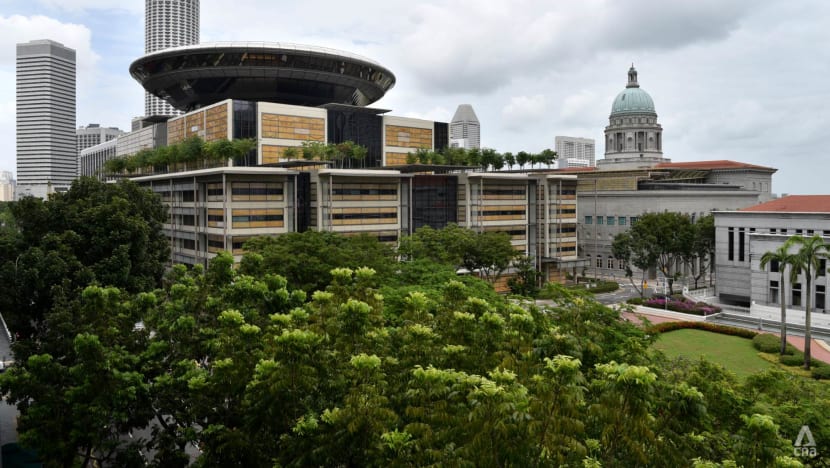
The Supreme Court in Singapore. (File photo: CNA/Jeremy Long)


SINGAPORE: A speeding driver who was involved in an accident that killed National University of Singapore (NUS) student Kathy Ong had his appeal for lower liability dismissed in court on Thursday (Sep 30).
Ng Li Ning, 25, was driving a car that collided with a taxi at the cross junction of Clementi Road and Commonwealth Avenue West on Apr 19, 2018. The cab driver was making a discretionary right turn, while Ng was travelling straight in the opposition direction.
All four taxi passengers were injured, including undergraduate Ms Ong who was in the back seat. The 19-year-old was taken to hospital where she died on the same day.
Mr Ting Jun Heng, who was seated at the back of the taxi, was flung out of the vehicle.





He suffered a traumatic brain injury and was initially in a vegetative state. He also sustained fractured ribs, a kidney laceration and multiple pelvic bone fractures. He had his studies deferred and walked with a slight limp.
Mr Ting sued taxi driver Yap Kok Hua and Ng, with the High Court judge ruling earlier that Yap was 65 per cent liable for the crash, while Ng was 35 per cent liable.
Ng appealed to be accorded a lower liability of 25 per cent, but the Court of Appeal dismissed this on Thursday. The judges said Ng was speeding at the time of the incident and had kept his foot on the accelerator as he approached the junction.
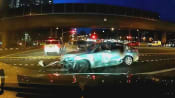

WHAT HAPPENED
On the night of the accident, there was another vehicle on the taxi’s left, also waiting to make the discretionary right turn into Clementi Road.
The vehicle on the left started to move and the taxi followed. The court heard that Yap had “merely followed” that vehicle without ensuring that it was safe for him to do so.
Ng’s car “charged into the junction” and missed colliding with the rear end of that car, but smashed into the taxi.
The impact was so great that Ng’s car tyres were lifted off the road “for a moment or two”, the grounds of decision stated, with the taxi sent spinning across the junction.
The entire incident was captured by in-vehicle video cameras of the vehicle waiting immediately behind the taxi. It also clearly captured the loud sound of the impact.
Ng was fined S$5,000 and banned from driving for two years, while Yap was given eight weeks’ jail and banned from driving for five years.
As part of the civil suit, Ng and Yap also had to pay Mr Ting costs fixed at S$95,000, excluding disbursements.
NG CLAIMS LOWER LIABILITY
The court heard there was no dispute that Ng had the right of way and that Yap should bear the greater liability. The junction was a large one and traffic was moderately heavy at about 7.30pm that weekday.
Although the traffic lights were in Ng's favour, he was travelling between 74kmh and 87kmh, which was above the road’s speed limit of 70kmh.
Ng appealed against the apportionment of liability and referred to similar previous cases. He submitted that these cases show that liability against the straight-moving vehicle in discretionary right-turn crashes was assessed consistently at between 0 and 20 per cent in almost 90 per cent of the cases.
“The appellant also referred to the Motor Accident Guide issued by the State Courts and pointed out that it recommends 15 per cent liability against the straight-moving vehicle, consistent with more than 70 per cent of the cases that he had referred to,” court documents stated.
Ng said the trial judge’s decision was “inconsistent with the existing body of case law”, the Motor Accident Guide and an outcome predictor on the Motor Accident Claims Online website.
Yap said Ng had “maintained his excessive speed throughout”, and that he should have been careful.

The court dismissed Ng’s appeal, saying that the case “certainly does not establish a precedent that the relative liability of straight-moving vehicles with the right of way against turning vehicles has now been raised to 35 per cent without qualification”.
“The appellant’s liability was assessed to be higher than most of the cases he cited simply because that degree of contributory negligence was justified on the facts,” wrote the judges.
They said it was obvious from the video footage that Ng was “charging down” Commonwealth Avenue West at a “recklessly high speed”.
He was “seemingly oblivious to the presence of the turning vehicles” from the opposite direction.
Ng had claimed he saw the vehicle to the left of the taxi making a move, and that his car would not have hit that vehicle if it continued at the same speed.
“He therefore did not think of slowing down when he approached the junction,” said the judges.
Watching the video footage, it was “truly heartbreaking and horrific” to watch the impact and how the victims were injured, they noted.
Ng was “speeding dangerously”, the judges said, adding that the road sloping slightly downwards would have aided his view of the junction.
As it was about 7.30pm, vehicles on the road would have had their lights turned on and this would have been “fairly obvious to a driver who is careful and conscious of his surroundings”, said the judges.
Ng agreed under cross-examination that he “kept his foot” on the accelerator as he approached the junction and did not slow down as his assessment was that the traffic lights were in his favour and the way ahead was clear.
The judges said this was not “merely a misjudgment of the situation”, and that it was “highly blameworthy” as it resulted in a close shave between Ng’s car and the car to the left of the taxi.
“Any reasonable driver in (Ng’s) situation would have anticipated that there would be other turning vehicles as well, even if he could not see them directly,” said the judges.
Ng was ordered to pay Yap costs fixed at S$22,000 inclusive of disbursements, and to pay Mr Ting S$750 as attendance costs, as requested by Mr Ting’s lawyer.
“The appellant should not have brought (Mr Ting) into this appeal as the issues did not involve (Mr Ting),” said the judges.
Editor’s note: An earlier version of this story said that Kathy Ong was in the front seat of the taxi. This is incorrect. Ms Ong was seated in the back of the taxi. We apologise for the error.




