

The Big Read in short: Fixing the foreign workers conundrum together
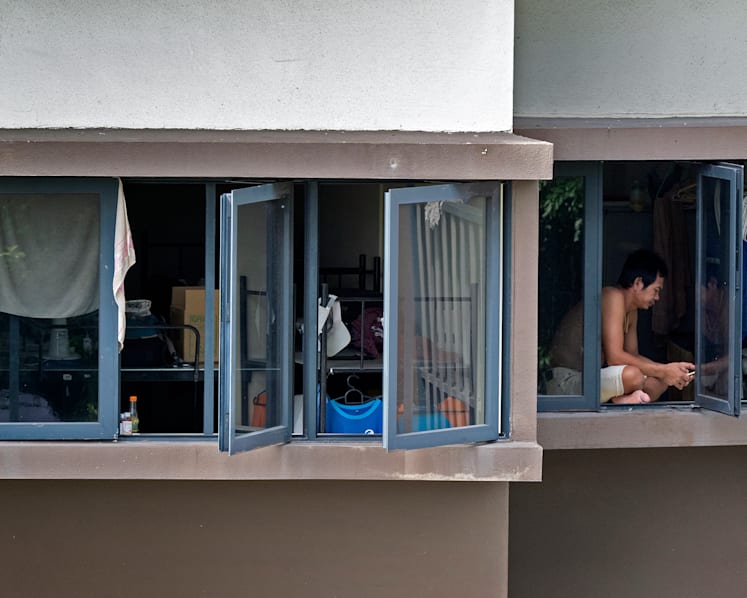
A migrant worker looks into a mobile device at Westlite Dormitory in Toh Guan, April 28, 2020.




Each week, TODAY’s long-running Big Read series delves into the trends and issues that matter. This week, we look at the way forward for Singapore’s migrant workers problem, which has come under scrutiny amid the Covid-19 pandemic. This is a shortened version of the full feature, which can be found here.
SINGAPORE — The number of Covid-19 cases has risen sharply from the first four infections detected at foreign worker dormitory (S11 Dormitory at Seletar North Link) on March 30 which were part of 879 cases in total at that point in time, to more than 21,700 as of Friday (May 8).
But for the 400,000 migrant workers living in Singapore, their livelihoods here will hang in the balance even after Covid-19 has been eradicated in the Republic, experts told TODAY.
As these workers ponder over the future, their host country — Singapore — will also have to reassess its whole relationship with migrant workers, especially its “addiction” to cheap migrant labour, and examine whether the lessons learnt from the explosion of Covid-19 cases in the workers’ dormitories could be used to implement meaningful changes.





But beyond the dormitories, there are also wider questions to consider, said the experts.
Should society start questioning its reliance on low-cost foreign workers? Will the economy be able to cope with increased costs of raised standards? Can people accept migrant workers living in their midst?
OPERATORS: DORMS NOT BUILT FOR A PANDEMIC
While purpose-built dormitories have met the needs of the workers during “normal times”, dorm operators said these large facilities were not built nor regulated to cater for a pandemic of such a scale.
In Singapore, there are some 200,000 migrant workers housed in 43 purpose-built dormitories — licensed dormitories housing more than 1,000 workers each. PBDs are required to comply with the requirements under the Foreign Employee Dormitory Act (Feda), such as providing facilities that include sick bays and isolation rooms.
Managing Director of S11 Dormitories Johnathan Cheah said that the purpose-built dormitories under his charge — S11 Dormitory @ Punggol and Changi Lodge II — are organised to accommodate residents who fall ill with infectious diseases such as chicken pox, measles and mumps.
“(The dormitories) were not designed to accommodate the large number (of infected cases) expected during a pandemic,” he said.
As of Friday (May 8), S11 Dormitory @ Punggol is Singapore’s biggest infection cluster, with 2,535 cases.
When asked how the living space each worker has is allotted, the operators said this is largely up to the specifications of the authorities.
As infections in dorm clusters began to rise early last month, an inter-agency task force was set up on April 7 to provide support to foreign workers and dormitory employers.
With help from the authorities, Mr Kong Chee Min, the chief executive officer of Centurion Corporation — who is in charge of ASPRI- Westlite Papan, Westlite Juniper, Westlite Mandai, Westlite Toh Guan and Westlite Woodlands — has been able to lower occupancy rates within the dormitories.
“On average, there are now about five or six persons living in an eight-bed apartment, and eight to nine persons in a 12-bed apartment,” said Mr Kong.
The operators hope that the next couple of years will bring improvements to the conditions and living standards within the dorms.
The issues which they would like to address include the long-standing conundrum of safe distancing.
“If we are to prepare for future pandemic situations, the density of the dorm population needs to be addressed and employers need to set aside higher budgets for rentals, for instance,” said Mr Cheah of S11 dormitories.
EMPLOYERS: ‘OUR HANDS ARE TIED’
While migrant workers are covered by Singapore’s main labour law, the Employment Act, employers of migrant workers also generally assume a greater responsibility for their welfare, including food accommodation and healthcare, than if they had hired a local resident to do the same job.
However, employers claimed that is is not up to them to dictate the density or the living conditions within the dormitories, but for the dorm operators to decide and the authorities to regulate.
Mr Chew Char Choon, senior project manager of a real estate construction firm, said: “As a contractor or dorm operator, we just take instructions from (the authorities) ... It is up to the Government, how they would like to control.”
Should new safe distancing guidelines cause housing to be more costly, not all contractors may be able to stomach this, the employers said. This is especially if they have long-term projects underway, some of which can last for four to five years.
At the end of the day, some employers think it boils down to who would be willing to shoulder and split the extra costs.
Mr Akbar Kader, managing director of Nan Guan Construction, said that he would like to see a “symbiotic arrangement” between the employer, dormitory operators, and the authorities, such that the extra costs are fairly distributed among them.
Some employers think that consumers should shoulder some of the costs, and take into account the workers’ efforts that go behind the end product.
Mr Kenneth Loo, executive director of Straits Construction Singapore, said that most Singaporeans are not aware of the workers’ hard work, and the tough living conditions they have to put up with.
“How much people are willing to pay depends on the economy (rather than the workers’ living conditions),” he said. “For example, when you buy a piece of clothing, do you think of where it comes from? No, right?”
GOVT: ROLE AS REGULATOR
Raising the Feda bar
As the authorities hunker down to mitigate the viral spread, the Government is also looking into new housing arrangements for migrant workers who have recovered from Covid-19 through a pipeline of short, medium and long-term plans, said National Development Minister Lawrence Wong.
Mr Wong co-chairs the multi-ministry task force leading Singapore’s response to the Covid-19 outbreak.
While details of these plans are not yet known, several suggestions have been raised:
- The Government should ensure “socially-conscious minimum standards”, said Mr Alex Au, vice-president of migrant worker rights group Transient Workers Count Too (TWC2). This is because employers and dorm operators do not function as welfare services and have to watch their bottom lines. “They would be foolish as profit-making enterprises to over-provide and drive up their own costs,” he said.
- Assoc Prof Walter Theseira, a Nominated Member of Parliament (NMP), said a proper study is needed to determine what construes a reasonable standard for living space. “If we come up with one set of standards for living for Singaporeans in a similar situation, for example, a long-term hostel, dormitory, or army camp residents, it would be quite unjust to apply a lower standard to migrant workers just because they are migrant workers,” he said.
- The Migrant Workers’ Centre (MWC) also urged for changes to Feda to include all migrant worker housing facilities regardless of their size or type, stripping away the 1,000-bed threshold which allows the law to kick in. Other suggestions from MWC include a minimum dorm staff to residents ratio, so as to ensure that dorm operators have sufficient manpower to carry out crucial work such as cleaning, operations support and security.
- Labour economist Kelvin Seah from the National University of Singapore’s (NUS) Faculty of Arts and Social Sciences said that these plans should include strategies to raise the hygiene standard in dorms — cleaning plans for shared spaces and sanctions for non-compliance, for instance. These suggestions would, however, likely lead to substantially higher costs of housing migrant workers, he added.
A more direct role for the Govt
Aside from regulations, could the Government also play a more active role in dorm management? Several observers had mixed feelings about this proposition.
Such services are best provided by the private market, said Dr Seah.
However, the Government could also take a leaf from the book for public transport operators which do not own the buses and trains, or from how the management of state-owned buildings are tendered out to commercial service providers, others said.
Assoc Prof Theseira said: “Having dormitories owned by the Government, and then managed on a competitive basis by private companies accountable both to workers and the Government, may be an interesting model to consider.”
Tweaking Singapore’s economic model
A more fundamental question would be whether Singapore should continue to rely heavily on low-cost migrant workers, said experts.
With Singapore now facing what has been touted as “a crisis of a generation”, some, like Assoc Prof Theseira and fellow NMP Anthea Ong, have called for a committee of inquiry into the foreign worker dormitory outbreak to work out the structural changes that Singapore sorely needs.
In his reply to the NMPs’ call, Minister Wong told Parliament on Monday that the Government will review its overall response to the pandemic comprehensively in order to learn and improve.
Deputy Prime Minister Heng Swee Keat has also set up the new Emerging Stronger Task Force, which is tasked with making recommendations on how to reimagine Singapore’s economic strategies.
Associate Professor Kenneth Paul Tan, from the Lee Kuan Yew School of Public Policy, said he hopes the review on dormitories, when it comes, will take in diverse voices from civil society in policy discussions.
PEOPLE: SOCIETY’S APPETITE FOR CHANGE
Mr Christopher Gee, senior research fellow at the Institute of Policy Studies, said that this traditional mindset of relying on lower-skilled and low-wage labour has created a “category of residents who have limited rights as a non-permanent resident foreigner and are treated differently”.
If Singapore decides that in a post-pandemic world, it needs to elevate their living standards to a decent level that Singaporeans can accept for themselves, then another question will be what level would Singaporeans be comfortable with, said Mr Gee.
“The same level as the lowest-paid Singaporean household? Or lesser? We have to negotiate and discuss this,” he said.
And then, there is also the matter of cost that society needs to bear.
Last month, amid the outbreak in the dormitories, Manpower Minister Josephine Teo said that each time MOM attempts to raise the standard of living in the dorms, it would face objections from employers due to the added costs that come with the move.
Assoc Prof Theseira said: “Fundamentally, the current structure is low-cost, and as a result, generally Singaporeans benefit in the narrow sense that we pay lower prices for anything produced by foreign workers.”
“Either our costs would go up, meaning more taxation, or standards would fall, meaning more potholes, uncleared fallen trees, et cetera, without so many low-cost workers.
With the pandemic forcing Singapore — as a collective — to pay the price for years of apparent neglect, commentators said that after Covid-19 is eliminated, Singapore needs to openly embark on some serious soul-searching.
For a start, the society’s mindset and attitude towards migrant workers need to “undergo a sea change”, said Associate Professor Eugene Tan from the Singapore Management University.
“SG United must include migrant workers from the get-go… We cannot, as a society, seek to harness the benefits of their being here and yet not prepare to bear the costs of their being in our midst. We cannot continue to have the gains privatised but the costs socialised in our migrant worker policy,” the law don said.
CORRECTION: In an earlier version of this article, we stated that migrant workers are not protected by the Employment Act. This is incorrect. The Act covers work permit holders, with some exceptions. We are sorry for the error.




