Singapore Polytechnic team wins top accolades at Huawei’s global ICT competition
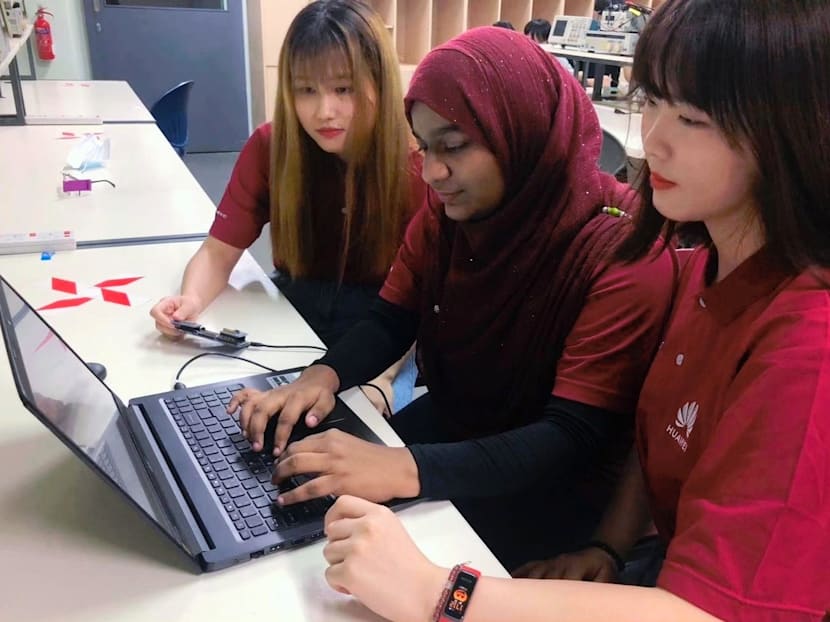
Ms Chen Zihan, Ms Nashita Fatima and Ms Fang Qian (left to right) were inspired by a reality TV show called Forget Me Not Cafe in which five elderly waiters with mild cognitive impairment run a restaurant. Photo: Huawei


Brought to you by

The all-girl trio garnered first prize for its innovative eldercare solutions.
Combining two innovative solutions aimed at helping the elderly has won an all-girl team from Singapore Polytechnic the grand prize in the Huawei ICT Competition 2020. Their proposal of smart recognition glasses and a global positioning system (GPS) tracking app also won the girls – Ms Nashita Fatima, Ms Chen Zihan and Ms Fang Qian – a TECH4ALL Social Contribution award for their inclusive spirit.
Their win marks the first time Singapore has garnered first prize in the annual worldwide event. Two other teams from Singapore Polytechnic and Temasek Polytechnic were awarded second prize for their innovative submissions.
ALWAYS A WIN-WIN





The Huawei Global ICT Competition aims to drive technological breakthroughs and innovation from the younger generation.
Said Mr Nicholas Ma, chief executive officer of Huawei International: “The competition showcases our continuous efforts to upskill and groom the local talent ecosystem to become more digitally inclusive.”
This year’s edition saw 109 teams from 39 countries entering the finals, with Singapore Polytechnic teams claiming the top two spots. The event attracted nearly 150,000 students from more than 2,000 colleges and universities in over 82 countries.
INSPIRED SOCIALLY, GLOBALLY
Speaking on their winning design, team leader Ms Fang said: “During our research, we discovered that there are many wonderful AIoT (Artificial Intelligence of Things) products designed to improve people’s quality of life. However, these products are not targeted at the elderly.”
The team also observed that a lot of existing tech equipment focused on easing functions for the seniors, but not so much on the emotional aspects of life.
Their project, Forever-Smart Glasses, helps dementia patients improve their relationships with caregivers and family by allowing them to recognise them using Huawei’s Cloud’s AI solutions.
“We were inspired by a reality TV show called Forget Me Not Cafe in which five elderly waiters with mild cognitive impairment run a restaurant,” Ms Chen shared. “The show, along with smart glasses technology, motivated us to create a wearable AIoT device for people with dementia, so that they won’t forget their loved ones so easily.”
The team also developed a Your Helper app to help family members locate their elderly member when he or she is lost.
Second prize went to fellow polytechnic team, comprising Mr Cheong Wai Khin, Mr Khor Kah Seng and Mr Tan Xin Ying. Their Intelligent Wildfire Mitigation System taps into a cloud-based, server-less system for adaptability and scalability, and helps to maximise mitigation measures to reduce the environmental, health and economic impact from forest and bush fires due to climate change.
A team from Temasek Polytechnic – comprising Mr Andrew Tan Yong Jun, Mr Wong Yao Hui and Mr Caleb Lee – also came in second in the competition. Their Fall Detection system features a combination of technologies and services on Huawei’s Cloud, including object storage service, data ingestion service and AI development platform ModelArts, to detect when an elderly person falls.
The team found that falls were the second leading cause of unintentional deaths for the elderly, so “shortening response times to falls is critical as it can save lives and minimise serious injury to the elderly”, said Mr Wong.
“The essence of our system is the predictive model powered by Huawei. It can be trained and deployed to reach a broader audience. This system can also be integrated into existing CCTVs using only software, which saves resources.”
CULTIVATING A SPIRIT OF DIGITAL INNOVATION
“We are thrilled with the creativity and the inclusive heart of young Singapore talents and proud to help these seeds of future ascend to the top of the world,” said Mr Ma. “As we accelerate into a digitalised post-pandemic world, it has never been so important to nurture our young talents who have a sustainable, inclusive mindset.”
Huawei’s efforts in Singapore have paved the way for another ongoing global project, Seeds for the Future. In collaboration with the Infocomm Media Development Authority in Singapore, it sends young people from around the world for ICT-related training in China – developing talent and bridging communication between countries and cultures. Since its inception in 2008, the training programme has seen participation from 5,770 selected people from 126 countries and regions.
The company aims to certify one million ICT professionals across the globe by 2024 as part of its efforts to drive intelligent and digital transformations across industries for a fully connected, intelligent world.