

Who are we, really?

Human beings are not that dissimilar from fish or apes, says Dr Adam Rutherford. Photos: Royal Institution


Brought to you by


"Exceptional, but part of nature. Special, but also animals. Unique, but part of one family."
That’s Dr Adam Rutherford’s take on human beings, which he calls “nature’s most paradoxical creature”. The British science writer and geneticist will be in Singapore to present the STAR Lecture 2019 – Presenting the Royal Institution Christmas Lectures from Great Britain: Who am I?
While the Christmas Lectures is a time-honoured science programme that has taken place since 1826 at the Royal Institution in London, STAR Lecture – which follows a similar format of a popular science figure delivering a televised lecture to an audience of young people – is part of the 2019 Singapore Science Festival, organised by the Agency for Science, Technology and Research (A*STAR) and Science Centre Singapore. The STAR Lecture incorporates live demonstrations, experiments and audience participation, and will be available on Mediacorp’s Channel 5, as well as on Toggle and Toggle’s Catch-Up TV.
Last year’s STAR Lecture, given by cognitive neuroscientist Professor Sophie Scott, was titled The Language of Life and had over 110,000 viewers when broadcast.





INVESTIGATING HUMAN EVOLUTION
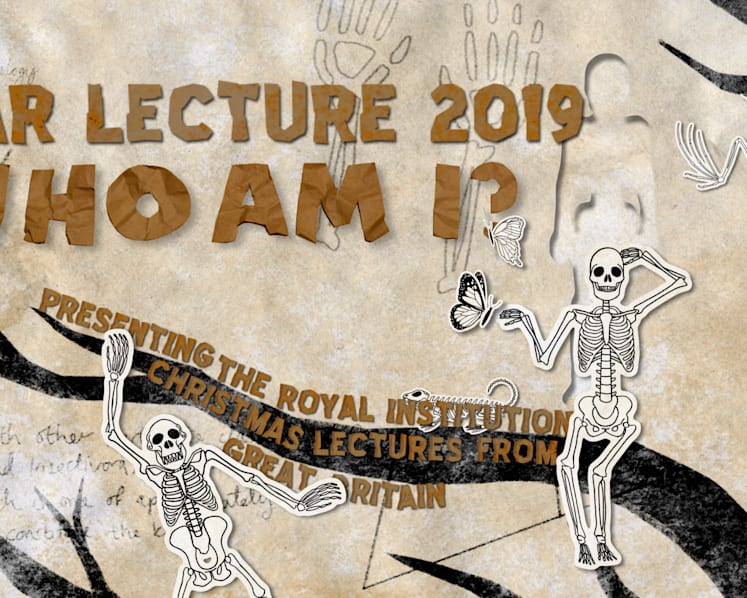
This year’s STAR Lecture is titled “Who am I?” and will be presented live by Dr Rutherford to 250 students over two days. In his lecture, Dr Rutherford will explore the topic of human evolution, and show how human beings – despite all our surface differences – are not that dissimilar from fish, or apes.
“We humans tend to view ourselves as separate from the natural world, a special creation even, but we’re far more closely related to the rest of the animal kingdom than you might imagine,” said Dr Rutherford.
“At the same time, we are all unique – a product of the interplay of our genetics and the environment we live in. The complex story of where humans came from and where we are going is a topic that should make for a fascinating lecture!”
THE SCIENCE OF BEING HUMAN
Dr Rutherford has long been interested in human evolution, in addition to a variety of scientific topics including astronomy, the inheritance of intelligence, science and cinema, scientific fraud, and the evolution of sex.
The honorary research fellow at UCL currently presents BBC Radio 4’s Inside Science, and has presented many documentaries, including the award-winning Horizon: Playing God, The Cell, and The Gene Code. He has also acted as a scientific advisor to movies like World War Z, The Secret Service, and Ex Machina.
Dr Rutherford, who holds a PhD in genetics of the eye and a degree in evolutionary biology, is also a former editor at Nature and an author. His first book, Creation, which explored the origin and future of life, was nominated for the Wellcome Trust Book Prize when published in 2013.
In his opinion, the youth of today need to take an interest in science and particularly in human evolution, because much work remains to be accomplished with the human genome.
He said: “The genome holds secrets that are waiting to be discovered, not only about our past, but about how we behave today, diseases, and how we are evolving. These are questions that the next generation of scientists will answer because so far, we’ve just scratched the surface.”
FROM CELLS TO WATER BALLOONS
During STAR Lecture, Dr Rutherford will take the audience on a journey starting from single-celled organisms and ending with the high prevalence of myopia among Singaporeans. In between, he plans to get audience members to walk a tightrope, burst water balloons to compare sweat amounts, and compare human and chimpanzee DNA.
The aim is to show how close we are to our animal counterparts, and how some of the features we take for granted – such as our ability to sweat and cool down – were adaptations that occurred over time, as we evolved to become more efficient long-distance runners who were able to outlast and exhaust our prey.
“We’ve got tightropes, whales, bones, genes, chimps, skulls and four billion years of evolution, crammed into an hour and a half,” said Dr Rutherford. “It’s the greatest story ever told because it’s our story! But the more we look, the more complicated and fascinating it becomes. With genetics as part of human evolution, we have access to a log book that records some aspects of the lives of everyone who ever lived. We’ve only just begun exploring the story of humans.”
Catch the 2019 STAR Lecture: ‘Who am I?’ on Channel 5 on Oct 1, 2019, 7pm to 8:30pm.




