

All eyes will be on how Heng and his 4G team lead Singapore
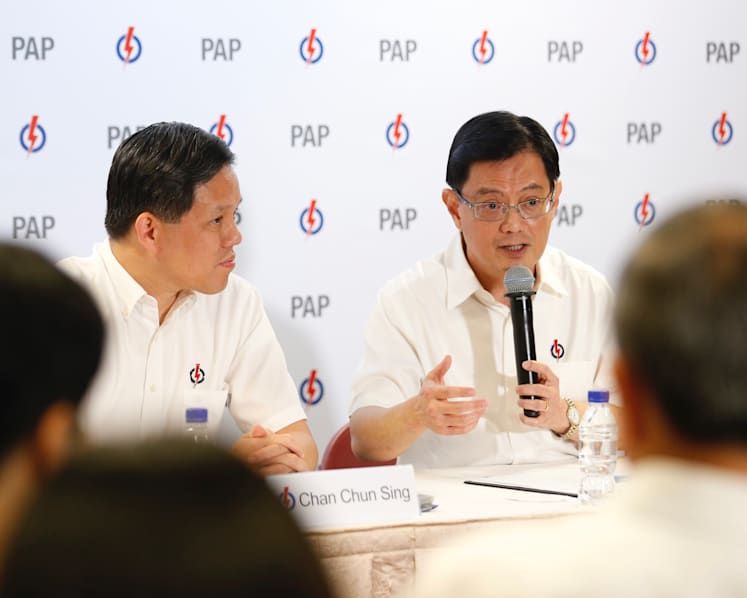
Mr Heng’s 4G team will have to stamp their distinctive collective identity and leadership ethos as governance becomes increasingly complex, says the author.
Singapore’s current political leadership renewal and succession took a significant and decisive step forward with the ruling People’s Action Party's (PAP) announcement on Friday (Nov 23) of its new Central Executive Committee (CEC) line-up.
Finance Minister Heng Swee Keat became the party’s first assistant secretary-general, making him the clear successor to Mr Lee Hsien Loong as PAP secretary-general and as Prime Minister in a few years’ time.
Mr Chan Chun Sing, the Trade and Industry Minister, was appointed second assistant secretary-general. In the Cabinet reshuffle next year, Mr Heng and Mr Chan are likely to be promoted to deputy prime ministers.
2018 had begun with some uncertainty on the progress of the meticulously planned leadership renewal, long regarded as a star attribute of the Singapore governance system.





The 4G leaders have now by consensus resolved that Mr Heng is the first among equals. The ruling party cadres have also given their imprimatur to Mr Heng and Mr Chan by electing them into the CEC.
The choice of Mr Heng should not come as a surprise. He was the only 4G leader to be made a full Minister upon winning his maiden election in 2011, helming the Education Ministry between 2011 and 2015.
Mr Heng’s political ascent can be attributed to his distinguished public sector career and to his public persona.
At 57, Mr Heng is the oldest 4G leader. But this gave him about eight years more experience in top government positions than the two other frontrunners, Mr Chan, and current Education Minister Ong Ye Kung.
Given the hot seat that the Prime Minister occupies, the importance of having someone who has been rigorously tested, possesses a broad-based policy experience, and demonstrating leadership, judgment, purpose, and integrity cannot be underestimated.
Immediately prior to entering politics, Mr Heng was Managing Director of the Monetary Authority of Singapore, where he played a key role in guiding Singapore to emerge from the global financial crisis relatively unscathed.
Before that, he was Permanent Secretary at the Ministry of Trade and Industry and headed the then Trade Development Board. He was also Principal Private Secretary to then-Senior Minister Lee Kuan Yew from 1997 to 2000.
Mr Heng therefore brings to bear a nuanced understanding of how the government works and years of experience of working with foreign leaders and officials.
His economics background stands him in good stead as the restructuring of the Singapore economy enters a critical phase, amid escalating global trade tensions.
His work in this area has been defined by his heading the high-level Committee on the Future Economy and now the Future Economy Council to implement and oversee the committee’s recommendations.
In his 2013 book, One Man’s View of the World, Mr Lee Kuan Yew had described Mr Heng as “the best Principal Private Secretary I ever had” and having “one of the finest minds among the civil servants I have worked with”.
WORKING WITH SINGAPOREANS
Mr Heng’s public persona is someone sincere and approachable.
This was evident when he led the organisation of the SG50 celebrations in 2015 and chaired the Our Singapore Conversation in 2012-13, the largest public consultation.
Both were about mobilising and engaging large swathes of the population across all strata of society for a common cause.
This will be important amid growing expectations among Singaporeans to be involved in charting the country’s future.
Mr Heng’s technocratic nous and personal touch is combined with a strong sense of duty and a resilience which was amply demonstrated by his full recovery from a brain aneurysm in May 2016.
In a press conference on Friday after the announcement of the new CEC, he said the well wishes of Singaporeans when he was ill has strengthened his commitment to serve Singapore.
And in an interview in May, asked if he would support whoever will be the next PM if it is not him, he said yes, adding that "this is really a matter about our young nation, not a matter about our personal ambitions... We must see it as much larger than ourselves."
As Singapore matures, this ideal should ameliorate the fixation on economic value and the “what’s in it for me” mentality.
Our energies must also be directed towards nurturing post-material values that provide a stronger foundation of belonging.
In the months ahead, Mr Heng will have to build the team around himself and Mr Chan and put in place the 4G leadership that will take over after the next General Election due by April 2021.
Mr Heng would be Singapore’s oldest Prime Minister to begin his tenure around 2022.
The ongoing transition from the 3G to 4G leadership has been denominated by the emphasis on team rather than any standout individual.
This was underlined in Mr Heng and Mr Chan co-hosting Friday’s press conference.
Both men also repeatedly stressed the importance of having complementary strengths as well as teamwork being more than the sum of good individual leaders, buttressing the theme of the collective.
One can expect Mr Heng’s tenure as Prime Minister to be defined by change amid continuity.
As the ruling party gears up for a pivotal general election in the next two years, time is of the essence for the 4G leadership to assert more visibility and to win the hearts and minds of Singaporeans.
Trust, confidence and respect will have to be earned. There is no guarantee that Singaporeans will identify with the 4G leaders.
Mr Heng’s 4G team will have to stamp their distinctive collective identity and leadership ethos as governance becomes increasingly complex.
On Friday, asked about his leadership style, he said that those who have worked with him would likely agree that he is “very open” but can be “fast and decisive”, as was the case during the financial crisis.
Beyond a more consultative style of leadership, the accent will be on action and harnessing the grassroots energy by engaging people and leadership at all levels of society.
A greater emphasis on a fairer and egalitarian society will be a shared mission.
In this vein, a stronger narrative of the shared purpose and shared values that define Singapore will come to the fore. The fundamental challenge is to ensure Singapore continues to be relevant not just to the world but to Singaporeans.
Only when Singapore is relevant to her people will the quest for geopolitical and economic relevance succeed.
Only then will the Singapore way of life continue to thrive and inspire Singaporeans.
ABOUT THE AUTHOR:
Eugene K B Tan is an associate professor at the School of Law, Singapore Management University, and a former Nominated Member of Parliament.




