Amateur terrorism: Drops in the ocean creating waves
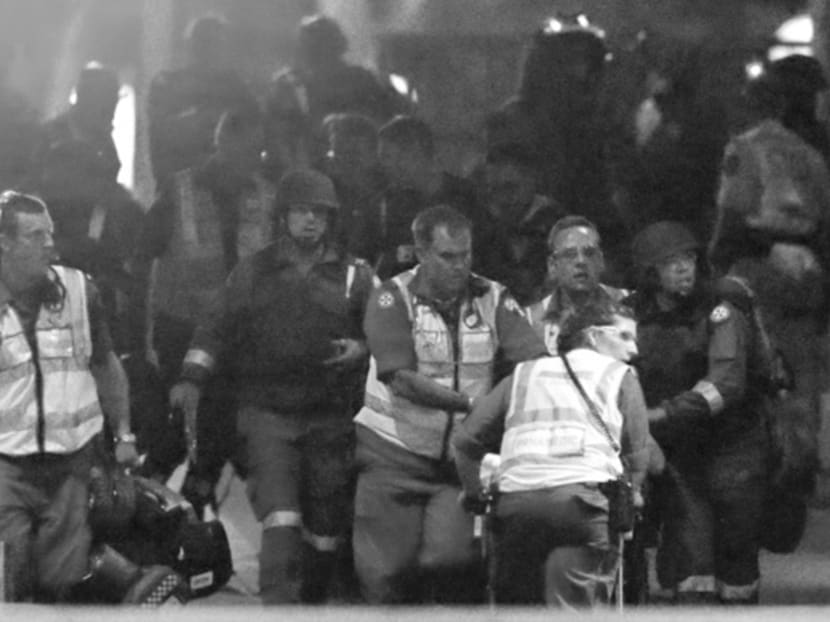
Policemen and paramedics during the Sydney hostage crisis. Both Al Qaeda and the Islamic State ‘adopted’ amateur attacker Monis after the Lindt Cafe incident. Photo: Reuters
Australia was shocked by the Sydney hostage crisis in December, in which a single shotgun-wielding attacker, Man Haron Monis, took 18 people hostage for 18 hours in the Lindt Chocolate Cafe at Sydney’s Martin Place, shutting down the central business district and, ultimately, resulting in the deaths of two hostages and the attacker. During the stand-off, Monis displayed a flag with the shahada — the Muslim article of faith — and demanded an Islamic State flag.
As is inevitable in such attacks, the news media immediately looked for connections to known terrorist groups and, when nothing substantive was found, claimed that Monis was an example of a “lone wolf” attacker, arguably a troubled individual rather than a terrorist.
But this is a flawed way of thinking about the Sydney attack and others similar to it. In fact, such attacks may represent a new trend in terrorism, one for which the term “lone wolf” is a misnomer.





DISAPPOINTMENT OF GLOBALISED TERRORISM
After the Sept 11 attacks, many commentators proclaimed that a new era of terrorism had arrived, one in which the technologies of globalisation, such as the Internet, mobile phones, 24-hour news stations, containerised shipping, and cheap and fast commercial jet travel, would bring transnational terrorism to the doorsteps of citizens in developed countries.
However, while there have indeed been transnational attacks and plots in developed countries, they have not occurred at the tempo that one might expect if terrorists have truly been liberated by globalisation.
Transnational terrorist groups maintain logistical support networks and communications across international borders necessary for planning and operational decisions by relying on the technologies associated with globalisation. However, the infrastructure supporting these terrorism-enabling technologies is also controlled by states; states can monitor mobile phones and emails, and they can exercise extra scrutiny at airports and seaports.
With greater hostility and focus from governments, terrorist groups have found it difficult to use these technologies without detection, thus making it difficult for them to stage transnational attacks, or even to get into some countries at all.
The Islamic State, and Al Qaeda before it, thus face a problem of being frozen out of many developed countries. They have responded by giving up on attempting to move weapons or people across international boundaries, and instead encouraging a new type of terrorism — one that does not need to use the technologies of globalisation to be successful.
In each of the incidents in this new wave of terrorism, one or sometimes two attackers staged a relatively unsophisticated attack with some but not dozens of casualties. They were usually resident in the country where they were attacking, or at least had easy access to the country, and used simple weapons — cars, knives and shotguns.
A number of attacks in recent years fit this pattern: In addition to the Sydney hostage crisis, there were also the May 2014 shooting by a French national at a Jewish museum in Belgium; the attempted beheading of soldier Lee Rigby in the United Kingdom in May 2013, the shooting attack at Parliament Hill in Ottawa in Canada in October last year, the bombing at the Boston Marathon in 2013 and last December’s attacks in France that used cars to run into crowds.
WHY AMATEUR TERRORISM WORKS
Since the groups themselves may only encourage rather than control the attacks, and may have never heard of the attackers before, they sacrifice command and control, as well as the ability to control logistics or training for attacks. Since the attackers often have no formal training, the attacks themselves are often amateurish, poorly planned and rarely kill large numbers of people. However, both these sacrifices redound to the benefit of the amateur terrorists and the organisations that encourage and claim credit for their actions, in four ways.
First, lack of command and control means that several ways for governments to gain information about attacks — intercepting communications, following links and relationships, and surveilling associates of known terrorists — are relatively ineffective in stopping the plots. A poorly planned attack is also often one that lacks any traceable communications with others.
Second, a lack of logistical sophistication make it easier to carry out the attack itself and harder to stop before the fact. The attackers often use everyday items that are readily available in the country and not amenable to being controlled even by well-functioning governments, and draw little or no suspicion when they obtain them. Increasingly harsh laws are unable to stop attackers; this is partially why China has been unable to stop Uighur separatist attacks, which have used knives, cars and homemade explosives, despite having a police state.
Third, the groups can rhetorically benefit from attacks that are congruent with their objectives and occur in developed countries, far from their logistical chains or command and control networks. By “adopting” amateur attackers, as both Al Qaeda and the Islamic State did after the Sydney hostage crisis, praising Monis’ actions in their magazines, terrorist groups are able to make it appear as if the tentacles of radical Islam are everywhere.
The existence of pinprick attacks around the world may also serve to encourage even more such plots, as amateur attackers use the attacks to reach out to the terrorist groups and demonstrate their solidarity (as Monis did), rather than the other way around.
Finally, the groups (and arguably the amateur attackers) have realised that they do not actually need to do much to damage their enemies. The effectiveness of the attack is not dependent on the size of the attack itself (or even whether the attacks kill anyone directly), but on the auto-immune response from the target state and its society.
With a shotgun and a black flag, Monis occupied Australia’s media space for nearly two days, and was able to shut down downtown Sydney, while the state library, Parliament and Supreme Court were closed, and the train station and nearby roads were shut down. Simply taking hostages and identifying himself as sympathetic to radical Islam was enough to achieve economic and psychological effects Islamic State never would have been able to achieve on its own, using its own resources, in Australia.
ABOUT THE AUTHOR:
Justin Hastings is a senior lecturer in international relations and comparative politics at the University of Sydney. He is a past visiting scholar at the Centre of Excellence for National Security at the S Rajaratnam School of International Studies (RSIS), Nanyang Technological University. This commentary first appeared in RSIS Commentaries.