Belt and Road Initiative underlines China's pursuit of global cooperation
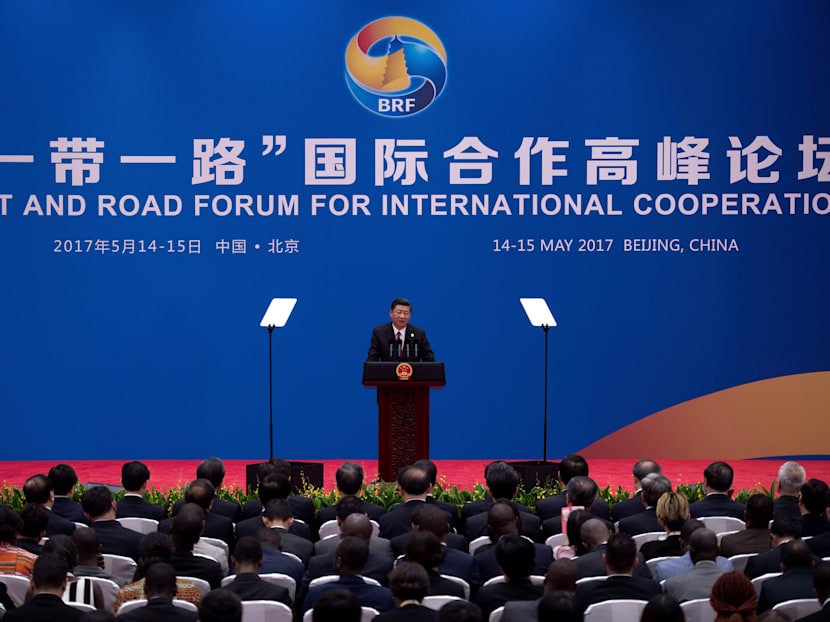
Chinese President Xi Jinping speaks during a briefing at the Belt and Road Forum in Beijing in May 2017. China’s massive build programme to recreate trade routes stretching from Asia to Africa and Europe is gaining momentum.
Recently, a hot topic in international media is the evolving global landscape and China’s role in it.
As a Chinese diplomat posted in Singapore, I find my country and the region I am living in are at the heart of the discussion. Therefore, I would like to offer my perspective.
Today we find ourselves in a world with unprecedented change. However, the trend of peace and development, economic globalization and regional economic integration remains unchanged. At the same time, development drivers and growth models are changing, leading to profound evolution in regional and international political and economic landscape.
The collective rise of developing countries and emerging markets is an established trend.





The group covers, among others, China, Association of South-east Asian Nations (Asean) and the BRICS countries (Brazil, Russia, India, China and South Africa), which all play an increasingly important role in global development and evolution towards a multi-polar world.
China stands out as a major representative and a notable force.
The year 2018 marks the 40th anniversary of China’s reform and opening-up.
The four-decade-long journey since 1978 bears witness to the progress of China embracing and integrating into the world.
China has benefited a great deal from the overall stable neighbouring and international environment, the mutually-beneficial global cooperation and the free and open world economy, which will remain crucial conditions underlying China’s development in the future.
As China adheres to the policy of reform and opening-up, there is no reason not to continue upholding these favourable conditions.
In the past, China’s contribution to the world is limited due to its weak foundation at home. Today, with its new-found strength, China is able to play a bigger role in and make greater contributions to the world. China can only do well when the world is doing well. When China is doing well, the world will also be better off.
It should be noted that however strong China becomes, it always commits to its independent foreign policy of peace, its neighbourhood diplomacy featuring friendship and partnership, and its objectives of external relations for mutually-beneficial cooperation and common development.
China’s growing strength does not constitute a threat to other countries. Nor does its growing confidence translate into ambition for regional hegemony or sphere of influence.
China stands ready to share its solutions with the world, but it will not export ideology or development model.
In November this year, China will host the inaugural China International Import Expo, the world’s first import-oriented expo.
It will be a significant gathering to showcase China’s determination to further trade and investment liberalisation and facilitation, and to share opportunities provided by its huge market to the world.
Exhibitors from Singapore and other countries are most welcome to join this event.
This year marks the fifth anniversary of the Belt and Road Initiative. China has turned from a beneficiary to a provider of international public goods.
As an important step in China’s foreign policy and an important item of public goods to the world, the Belt and Road Initiative has stayed true to its commitment, featured practical measures and yielded fruitful results.
The principle underpinning the Belt and Road Initiative, namely, to achieve shared growth through discussion and collaboration, has gained recognition with more and more countries.
Accumulated investment by Chinese companies in countries along the routes amounts to over US$50 billion (S$65.5 billion), creating 200,000 jobs and generating US$1.1 billion in tax revenues.
In 2017, the import and export volume between China and countries along the routes stood at RMB 7.3745 trillion (S$1.53 trillion), of which import was 3.07 trillion yuan, representing a year-on-year growth of 26.8 per cent.
The figures stand as testament to the strong momentum and significant benefits of the initiative.
The initiative has also promoted social progress and people’s welfare. Singapore, China’s 6th largest investment destination, is a case in point.
Chinese enterprises have been generating tax revenues, creating jobs, offering training opportunities and contributing to technological advances in Singapore with its more than 7,500 companies employing over 80 per cent of their staff locally.
Huawei has cooperated with Nanyang Polytechnic and other institutions to set up training centres for local telecommunication talents.
Just recently, Alibaba and Nanyang Technological University jointly launched a research institute for AI application, which I am sure will be conducive to Singapore’s smart nation building.
The Belt and Road Initiative is not merely a lofty political slogan or a solo by China.
Instead, it features practical actions and is more like a chorus by all countries along the routes. As distance tests a horse’s strength, so time reveals a person’s heart.
It is my firm belief that with strong faith and concerted efforts, cooperation under Belt and Road Initiative will bring more bumper rewards and broader prospects to the world.
ABOUT THE AUTHOR:
Mr Fang Xinwen is Chargé d’Affaires ad interim at the Chinese Embassy in Singapore.