I thought I was burnt out. I was just learning to level up
When does feeling overwhelmed signal burnout, and when is it part of learning something difficult? Business founder Joanne Chia says it matters for employers to be able to tell the difference.

Feeling overwhelmed at work can be a sign of burnout, but it can also be part of learning and growth, writes business founder Joanna Chia. (Photo: CNA/Raydza Rahman)

This audio is generated by an AI tool.


It started with sleep.
I began having dreams about Excel sheets. Numbers, unfinished financial reports and problems that needed fixing followed me into my slumber.
I could sleep for seven or eight hours and still wake up feeling like I had never stopped working in the hair care business I had founded.
That's when I started to wonder: Is this burnout?





I'd had the same thought just a few years earlier, when I first became a manager in my previous roles. I was dealing with heightened stress and exhaustion, and soon became convinced I was burnt out.
Looking back, though, I think I was wrong. I was just depleted from navigating a steeper learning curve – tired from doing things I hadn't yet learnt to do well.
Both experiences have made me realise how easily we can use "burnout" to describe very different kinds of exhaustion.
Now that I’m an employer, knowing the difference matters even more. When someone tells me they are overwhelmed, I have to ask myself: Are we asking too much of them? Or are they going through the discomfort that sometimes comes with learning to do something difficult?
And, perhaps, the most uncomfortable question: How do I know the difference between an employee who is simply struggling with a problem, and when I play a part in contributing to that struggle?
WHEN I WAS WRONG ABOUT BURNOUT
Before becoming a manager, my idea of doing a good job was fairly simple: Work hard, solve problems, be useful. If I put in enough effort, most things felt within my control.
Then suddenly, after a promotion, I was responsible for other people.
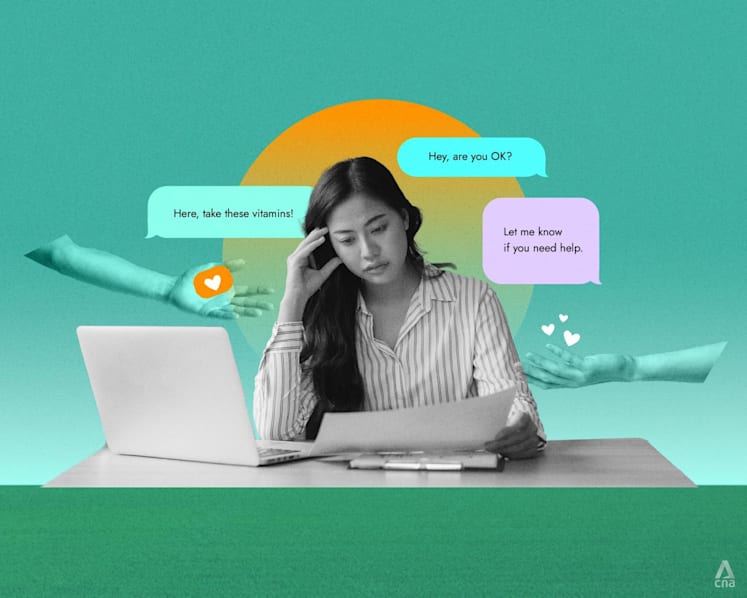

I found myself stressing more and more, not just about managing difficult conversations with my subordinates, but also about managing my own reaction to their reactions afterwards.
I would give a person feedback with the best intentions and spend the next three days replaying the 15-minute conversation in my head, wondering whether I had destroyed their confidence.
"Was I too harsh?" I'd wonder. "Did she understand what I meant? Is she upset with me now?"
At the time, I blamed some of this on the younger employees.
Almost a decade ago, I started my own career with a pretty typical old-school attitude towards work: If your boss tells you to do something, you do it. If you don't know how, you figure it out. Any discomfort or uncertainty is yours to deal with, not something you immediately raise with your manager.
So when young employees – both in my previous and current roles – wanted to discuss so many things with me, question my decisions, or understand the "why" behind an instruction, I found it exhausting.
Not long after becoming my own boss, I remember telling my co-founder: "I think I'm burnt out from dealing with Gen Zs."
But after some time, I realised that as my younger employees were adjusting to the working world, I was adjusting too, to the responsibility of managing people.
And, honestly, I was quite bad at it. I didn't know how to tell the difference between being a good manager and simply being well-liked.
On top of my workload, my mind was constantly in overdrive, wondering if there was anything I could have said or done better.
No wonder I was tired.

But over time, something changed. The difficult conversations were still difficult, but they stopped consuming me for days.
I learnt that someone could disagree with me without my decision necessarily being wrong. Someone could be unhappy with me, but that didn't automatically mean I had failed as a manager.
Most importantly, no matter how difficult my work week had been, I could always rest on the weekend and come back on Monday ready to try again.
I wasn't actually burnt out then. I was just inexperienced.
THIS TIME I REALLY WAS BURNT OUT
When I eventually faced actual burnout, it was actually much harder to recognise than those earlier false alarms.
There was no big breakdown – I didn't burst into tears in the middle of a meeting, nor did I pass out dramatically. As a business founder, there is always an "after".
After this product launch, things will calm down. After we hire this person, I’ll have more time. After this client is won, after this campaign is over – always "after".
I stopped focusing on the here and now and eventually even wins stopped feeling like wins. Something I had been worried about for weeks could finally go right, and within minutes I would already be thinking about whatever was wrong somewhere else.
And then the biggest shift: "rest" stopped being restful.
Physically, I would be in bed or out for a meal with my family. Mentally, I was still running the entire business in my head.
I was always "working", even when I wasn't.
Something I had been worried about for weeks could finally go right, and within minutes I would already be thinking about whatever was wrong somewhere else.
Everything started to feel heavy. Small problems irritated me much more than they should have. Even easy tasks exhausted me.
Sometimes I felt breathless even when nothing particularly urgent was happening. My body constantly felt like something was about to go wrong.
Eventually, even the things I loved best about my work started to feel flat too, like they were just another task I had to clear.
That's when I knew something was wrong.
WHEN IS IT TOO MUCH?
Becoming an employer adds a different dimension to identifying and dealing with burnout.
Now when someone tells me: "Boss, I'm overwhelmed", I have to figure out what that actually means.
Are they genuinely overloaded? Have we given them too much, or failed to set clear priorities? Did we give them responsibility without enough training?
Or are they still in adjustment mode, learning to do something difficult for the first time and experiencing the same stretched-ness and discomfort I once mistook in myself for burnout?
Sometimes, of course, it is both.
That is why I try not to jump straight to either "toughen up" or "okay, let’s take this off your plate". Both can be lazy answers.
Instead, I ask myself: Is this a capacity issue, a capability issue, or both? And then I ask them specific questions:
- What is actually taking up most of your energy?
- How was your weekend? Did you manage to rest? What did you do?
- Is this one crazy week, or has every week started feeling crazy?
If I keep hearing that everything feels urgent, priorities keep changing, or people no longer know what "good" looks like, I have to be honest: the problem is probably not the employee's lack of resilience. It's on me as the employer.
You cannot build a chaotic system and then tell people they need to become more resilient inside it. Human beings have limits.
But I also don't think removing every uncomfortable responsibility is the answer.
If someone had taken every difficult conversation or problem away from me when I first became a manager, I would have been extremely relieved at the time. But I probably would never have learnt how to be a good manager.
KNOWING WHEN TO STEP IN
There have been times when I realised too late that someone was carrying too much. Sometimes I almost stepped in too early when what that person needed was more confidence and experience.
I still get that judgment wrong sometimes.
What has changed now is how I think about resilience.
I used to think it was about how much pressure you can take. But feeling drained or exhausted doesn't necessarily mean you lack resilience.
Now, I think the more important question is whether you can go through something difficult and eventually feel like yourself again.
Not every difficult period is burnout. But not every difficulty can simply be powered through, either.
As an employer, I think the goal shouldn't be to remove discomfort entirely, but to make sure people aren't struggling alone in a bad system.
I can give someone a difficult responsibility, but I also need to give them clarity about what doing a good job handling that responsibility looks like, equip them with the right context and training, and keep a close watch on how they're progressing.
If they're coming to me only when they reach breaking point, I need to ask myself: Am I doing enough?
I hope more employers understand that resilience isn't something you can keep drawing on endlessly. Even your strongest employee has a limit.
Support does not always mean taking the work away. Sometimes it is simply saying: "I know this is hard, but I think you can do it. I'm here if you get stuck."
Joanne Chia is the founder of hair care brand Rehues.