A cancer treatment offers much hope for patients, until coronavirus comes along
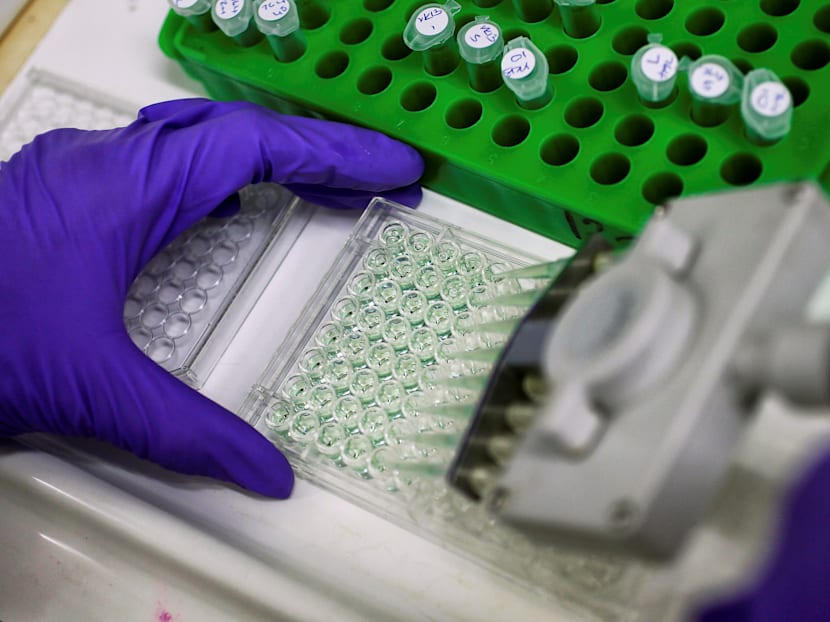
A scientist prepares protein samples for analysis in a lab at the Institute of Cancer Research in Sutton, Britain.
As a tide can lift a boat, so it can capsize a boat. These are words of wisdom from Xunzi(荀子) the Confucian scholar.
A coin, as has been often said, has two sides. The good and bad in life are often intertwined.
For many cancer patients, the arrival of cancer immunotherapy in the last couple of years has brought new hope.
Cancer immunotherapy involves a new technique of mobilising a patient’s own immune system to attack and destroy the cancer that has developed in the body.
Oncologists have successfully used immunotherapy to control various types of cancers in the advanced stage, from lung cancer to stomach cancer, uterus (womb) cancer and kidney cancer.
Cancer immunotherapy represents an unmitigated good to patients who have benefited from it.
The arrival of Covid-19, however, represents a new threat for cancer patients.
Cancer patients are more prone to infections by the novel coronavirus that causes Covid-19 and are a lot more likely to develop severe complications as a sequela.
A study supported by the National Natural Science Foundation of China and the Singapore Ministry of Health’s National Medical Research Council that looked at the threat of Covid-19 in cancer patients in 14 hospitals in Wuhan has rung alarm bells around the globe.
Cancer patients with Covid-19 are twice or thrice more likely to die from the infection than the general population not similarly afflicted with cancer.
Patients with metastatic cancer — cancer that has spread — face an even grimmer outlook. The risk of dying is elevated five to six times relative to that of the general population.
The one finding from this study that really caused me to sit up was the ability of Covid-19 to turn cancer immunotherapy from a tide that lifts boats to one that capsizes boats.
Amongst cancer patients infected by the coronavirus, those receiving cancer immunotherapy had the highest mortality rate of nine to 10 times that of the general population.
What is it about Covid-19 that turns the good effect of cancer immunotherapy on its head? What is the link between the two?
The common thread that ties cancer immunotherapy with dying from Covid-19 is the behaviour of the immune system.
Patients with Covid-19 may suffer complications as the infection progresses, leading to damage of multiple vital organs of the body.
The lungs often get the hardest knock, resulting in respiratory failure and the need for supplemental oxygen or even for the use of a ventilator to prevent suffocation.
The damage to the body’s organs is however not due entirely, as would be intuitive, to the direct destructive effect of the coronavirus.
Much of the organ injury arises from the collateral damage from the activation of the body’s immune system to fight the virus.
To mobilise the immune system, the body needs to produce substances that circulate in the blood known as cytokines to prime the white blood cells.
If the body releases too much cytokines, the immune cells will overreact. This damages the normal cells of the body that are not the intended targets — an off-target effect. This leads to organ failure since normal cells are essentially the building blocks of all body organs.
This excessive secretion of cytokines is often termed a “cytokine storm”. Just as gentle rain is good for the blooming of trees and flowers, a tropical storm is not.
Cancer immunotherapy, by positioning the body’s immune system in a more aggressive stance to destroy cancer cells, may unwittingly cause the immune system to overreact when faced with an invasion by the novel coronavirus.
Curiously, a patient of mine with advanced lung cancer who achieved complete remission after a period of treatment with cancer immunotherapy asked me, not too long ago, whether his ongoing cancer immunotherapy will also protect him from Covid-19.
He deduced, fairly logically, that he is less at risk of Covid-19 than other cancer patients on conventional chemotherapy since those patients will have a weakened immune system from the effects of chemotherapy.
He, on the other hand, has a “boosted” immune system from cancer immunotherapy.
Unfortunately, things in life are often paradoxical. Cancer immunotherapy may put cancer patients at greater risk of an adverse outcome when struck by Covid-19.
Singapore has been fortunate that the local mortality rate from Covid-19 has been low and only two patients with a history of cancer had lost their lives.
The impact of Covid-19 on cancer patients is still an evolving story.
Following the study in Wuhan, a United Kingdom study was published in the prestigious medical journal Lancet, confirming the relatively high mortality rate amongst cancer patients afflicted with Covid-19.
The death rate stood at 28 per cent. In this study, however, no particular anti-cancer therapy stood out as being especially problematic.
Nonetheless, the early worrying indicators are there.
The Ministry of Health has instructed doctors in Singapore, as a rule, to subject all patients on active cancer treatment to nucleic acid swab testing for the coronavirus should these patients display symptoms or signs of respiratory tract infection, as a precaution.
On balance, the threat to life from the delay or interruption of cancer treatment is higher than the risk of death from Covid-19.
Hence, necessary cancer treatment must still go ahead with the needed precautions in place.
Cancer patients must take all necessary precautions against Covid-19.
Patients riding high on the tide of cancer immunotherapy especially should heed this advice. Or the tide might turn.
ABOUT THE AUTHOR:
Dr Wong Seng Weng is Medical Director and Consultant Medical Oncologist at The Cancer Centre (Singapore Medical Group) at Paragon Medical and Mt Elizabeth Novena Specialist Centre.