

Changi Airport must develop into a destination in itself
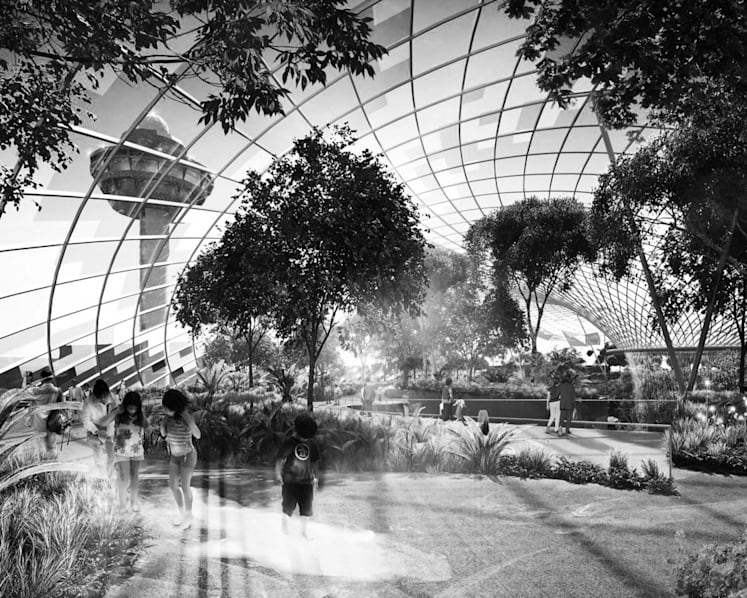
Why spend S$1.7 billion on the Project Jewel expansion, which will feature a bio-dome complex housing an indoor waterfall, a lush garden and many more shops? Obviously, it is more than to only create additional space to cater for the growing traffic. Artist’s Impression: Changi Airport group, CapitaMalls Asia
Any true champion will admit that staying No 1 is more challenging than climbing to the top. Thus, Changi Airport, which has been voted many times the world’s best airport in several surveys, is not resting on its laurels; it continues to raise the bar with its upgrading plans for Project Jewel.
But why spend S$1.7 billion on an expansion that will feature a bio-dome complex housing an indoor waterfall, a lush garden and many more shops? Obviously, it is more than to only create additional space to cater for the growing traffic. To quote Transport Minister Lui Tuck Yew: “We are operating in a dynamic and increasingly-competitive environment. Passengers today are spoilt for choice as air hubs around the world actively pursue new ways to boost their appeal as destinations and transit points.”
While Project Jewel will make Changi Airport a world showcase, the nub of the issue is competition. The rivalry goes beyond regional airports such as Hong Kong International Airport (HKIA), Kuala Lumpur International Airport and Bangkok’s Suvarnabhumi. In recent times, Dubai International has emerged as Changi’s closest hub rival for international traffic. Last year, Qantas moved its hub for European traffic on the Kangaroo Route, which connects Australia to Europe, from Changi to Dubai. While some analysts considered that to be reducing the competition for Singapore Airlines (SIA), it was not good news for the Republic’s airport.
Dubai’s success demonstrates how geographical advantage that has favoured Changi cannot be taken for granted. In the early jet era, Middle East airports such as those in Bahrain and Abu Dhabi were important transit stops for traffic between the Asia-Pacific and Europe. But with improved technology for the long range, these airports could be bypassed, while Changi with its cutting-edge technology, impressive facilities and excellent customer service continued to grow. However, Dubai today has managed to reverse the misfortune that befell Middle East airports, emulating Changi in becoming a hub airport.





Clearly, geographical advantage can shift. Any of a number of neighbouring airports could be an alternative to Changi. Qantas had considered Bangkok as a hub. HKIA is positioning itself as a gateway to not only the huge China market, but also the rest of Asia.
With more airlines mounting direct services between destinations, it is imperative that Changi continues to push the boundaries of the “airport city” concept to enhance its hub status. The concept takes the design of the airport beyond its traditional role to include non-aeronautical facilities and services.
DESTINATION ON ITS OWN?
If imitation is the sincerest form of flattery, Changi and Dubai can give each other a pat on the back. Besides a vast variety of shops and restaurants, they boast facilities that are not commonly found at other airports, such as a swimming pool and cinema. Dubai has its Zen Gardens, and Changi lush tropical foliage. Both aim to make their airport not only the preferred choice for transfer and transit traffic, but also a destination in itself. As Project Jewel architect Moshe Safdie said: “You must fly to Singapore because you’ve got to see that Jewel.”
But more than just a pretty physical landscape is needed to build an outstanding airport. Changi has been consistently ranked in the top three of the annual Skytrax’s World Best Airport survey. Dubai did not even make it to the top 10 in the past five surveys, but came in eighth last year in the category of airports serving at least 50 million passengers. However, Dubai has been growing in importance as a hub airport, surpassing the traffic carried by Changi to become the world’s busiest airport today for international passenger traffic. Dubai handled 68.9 million passengers last year compared with London Heathrow’s 67.8 million. Changi’s throughput was 53.2 million.
More airlines are flying through Dubai not only because of its strategic location, but also advanced infrastructure, a wide choice of connections and lower costs. Dubai allows free parking for up to three hours for a widebody aircraft. Other charges, such as for landing and aerobridge use, are also lower than Changi’s. Passengers pay a lower fee, too.
Like Changi, Dubai adopts an Open Skies policy. The paradox of competition is that it propagates rather than hampers growth. That, in turn, compels the airport to continually upgrade and expand to meet the growing demand. Home airlines play a key role — Emirates for Dubai, SIA for Changi, Cathay Pacific for HKIA and Asiana Airlines for Incheon. Qantas’ choice of Dubai over Changi has to do with a strategic alliance between the Australian carrier and Emirates that gives Qantas customers a wider choice of connections to Europe, the Middle East and Africa. As Emirates grows, so does Dubai.
Architect Safdie’s wish to make Changi a “must-see icon” raises the question as to whether the airport as a destination in itself is sufficient to draw transit and transfer passengers to purposefully pass through it. That may be a secondary consideration in a traveller’s choice of itinerary.
However, Changi’s edge over Dubai is boosted by Singapore as a stopover destination and convenient hop off point to neighbouring attractions in Malaysia, Indonesia and Thailand. Dubai has realised the importance of developing interest beyond the airport by promoting the city as a lavish tourist playground. In this regard, Changi has made a good decision in including a dedicated lounge for fly-cruise and fly-coach passengers in its Project Jewel plans.
The competition has gone beyond the basic functions of the airport as a transport exchange. HKIA, latching on to the potential of an extended marketplace, has set up a trading and logistics hub for precious metals as well as constructed an Airport World Trade Centre office tower next to one of its terminals.
Perhaps the next frontier is growing the airport into a modern agora, where people meet for business or other purposes instead of merely passing through it, fully realising the concept of the airport as a destination in itself. In this race, it is all about creating needs and influencing preferences where previously there were none.
ABOUT THE AUTHOR:
David Leo is an aviation veteran and published author.




