A China-US trade deal is likely to be only a truce
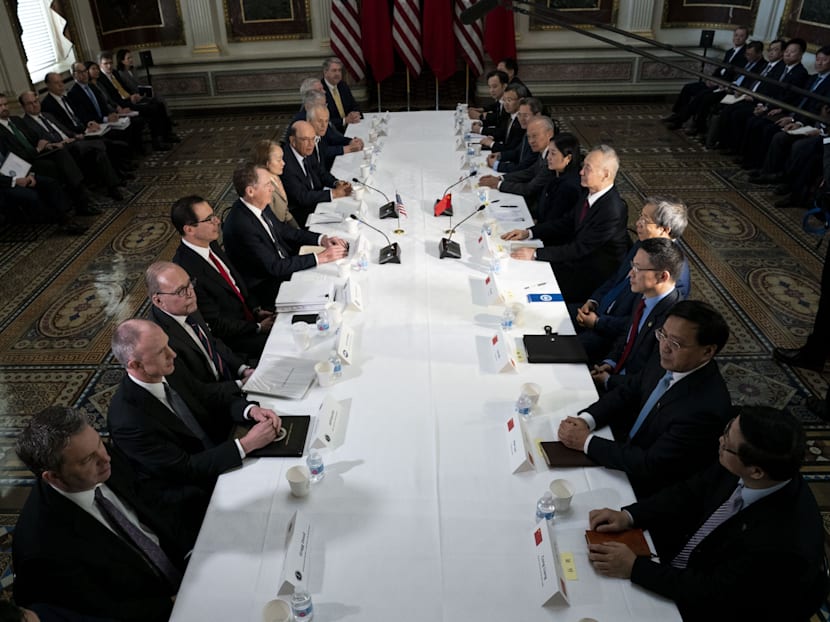
A US delegation led by Robert Lighthizer, the US trade representative (5th from left), during trade talks with a Chinese delegation, led by Liu He, China’s vice premier (5th from right) at the White House in Washington, Feb 21, 2019.
No one’s tweets move markets like Donald Trump’s. After the United States president confirmed he was postponing lifting punitive tariffs on US$200 billion of Chinese imports to 25 per cent thanks to “productive” trade talks, everything from global equities to oil prices and the Australian dollar rose.
Progress towards a deal is welcome. But this is far from the end of the story. Any agreement to end the seven-month trade skirmishing between the two sides over US accusations that China forces companies to hand over trade secrets and steals foreign technology would be a positive step.
Even a bad deal, if it prevents an all-out trade war, is better than no deal. With signs of growth slowing on both sides, it is in the interests of Mr Trump and China’s Xi Jinping to rein in the tensions.
But there are reasons for markets to contain their exuberance. One is that, beyond the fact that memorandums of understanding are being discussed covering key areas — though Mr Trump publicly instructed his trade representative, Robert Lighthizer, that he wants a “contract” — the details of a deal remain unknown.





READ ALSO:
European Parliament approves EU-Singapore free trade, partnership agreements
From haze to trade, Asean must no longer be weak in responding to challenges
The extent to which it can defuse longer-term tensions between Washington and Beijing will depend on the detail, and whether it can be implemented and monitored.
In reality, any deal is likely to be a little more than a brief truce in a longer war.
What markets, investors and many companies underestimate is the extent to which the US and China have entered a new epoch of strategic competition that will engulf all aspects of the relationship.
That will have significant implications for supply chains throughout Asia, and will bring economic and market volatility to a region that has been the main driver of the global economy for the past decade.
Mr Trump’s obsession with the trade balance is a short-term distraction.
The real friction comes from China’s stated goal of technological and regional dominance and America’s insistence on remaining the pre-eminent technological superpower.
China can easily address the former with purchases of soy beans — of which it reportedly committed to buy an additional 10 million tonnes — Boeing airliners and microchips.
It is politically, and perhaps physically, impossible for Mr Xi to compromise on Beijing’s wider aims. Having promised nothing less than the “great rejuvenation of the Chinese nation”, any willingness to delay or downgrade his ambitions in the face of American threats would be dangerous for the Chinese president.
Attitudes on both sides have hardened beyond the point where relations can return to the status quo ante.
In Beijing, the increasingly authoritarian administration is championing its unique brand of state capitalism as an alternative to the Washington Consensus.
It seeks to reshape global rules and institutions more in its own image. In Washington, meanwhile, Mr Trump’s reflexive isolationism is opposed by almost everyone, except when it comes to his efforts to level the playing field with China.
Nothing unites US political elites across partisan lines like fear of the threat China poses to the US-built global order.
Even US businesses, which have benefited for decades from outsourcing manufacturing to China, are now quietly egging on Mr Trump in the hope he will address the difficulties they face in doing business there.
In coming years, the focus for both the incumbent superpower and its nascent challenger should be on containing conflict and maintaining, as best as possible, free and open global trade and markets. A deal now might help build confidence. But the biggest challenges still lie ahead. FINANCIAL TIMES