

An economic fix won’t be enough to ease tensions in Hong Kong
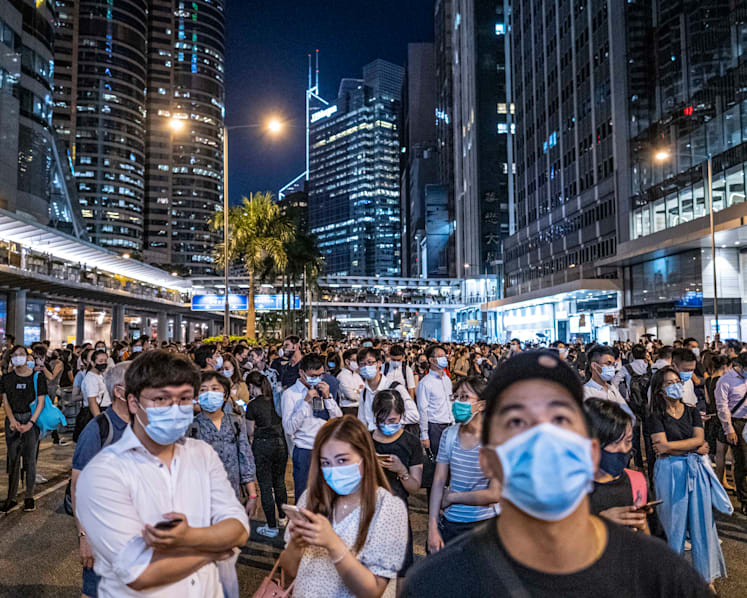
Protesters rally in Hong Kong on Oct 4, 2019. The authors' study finds that more Hong Kongers now do not believe they are able to achieve success based on their own efforts because the odds in the system are stacked against them.
On Wednesday (Oct 16), Hong Kong Chief Executive Carrie Lam had to deliver her annual policy address via video after pro-democracy legislators heckled her. This was the latest example of the deep divisions in a city that has been dogged by protests for four months, with no signs of easing.
Some commentators noted that the protests are motivated partly by youth disillusionment factors over economic issues such as unaffordable housing, which Ms Lam sought to address on Wednesday with several initiatives.
But any measure taken by Beijing to end the turbulence is unlikely to be effective if it is driven purely by economic considerations, without due consideration for political and ideological factors.
This is because there is increasing evidence to suggest that Hong Kongers deeply embrace post-materialist values such as human rights, freedom of speech and the rule of law.





Latest surveys by the Centre for Communication and Public Opinion Survey of the Chinese University of Hong Kong found that over 94 per cent of the protesters want “democracy” and “genuine universal suffrage”.
Our longitudinal research — random and rigorous phone surveys involving more than 1,000 adult respondents in 2007, 2013 and 2017 — also found that the younger generation in Hong Kong are driven more by their social values than their own economic interests.
It may be a surprise to those who assume that public attitudes in a capitalist society like Hong Kong would be mainly driven by self interests and individuality where people believe that they can determine their own success through their personal efforts.
But let’s take a look at how the answers to some of our questions have changed over 10 years.
To the question: “Do you think economic inequality is due to the manipulation by a small group of people in power?”, some 54 per cent of adult respondents agreed with the statement in 2007. In 2017, this increased to about 70 per cent.
When we delved deeper into the age differences, some interesting patterns emerged.
In the 2017 survey, among those who were 26 years old and younger, 78 per cent of respondents agreed with the statement. Notably, the figure for those between 17 and 26 years old was 83 per cent.
Now let’s consider the response to this statement: “Social inequality is due to different natural personal abilities and talents.”
In 2007, about 30 per cent of respondents disagreed with the statement. In 2017, it increased sharply to about 55 per cent.
This means that more people now do not believe they are able to achieve success based on their own efforts because the odds in the system are stacked against them. Correspondingly, their concerns about economic inequality and social injustice have been heightened.
Such concerns have inevitably raised questions over the legitimacy of the current government and are a main factor behind the months-long protests.
Focusing on economic growth, without politically and structurally addressing the issue of economic inequality and a cartel-dominated economy in Hong Kong, would therefore not ease the tensions.
The fact is that Hong Kongers treasure social values such as good governance and social justice in addition to reducing economic inequality and political manipulation by the establishment.
Many observers were surprised by the sudden rise of the mass movement against the government.
However, tensions fuelled by post-materialist values have been simmering for some time and the extradition bill introduced in February 2019 merely blew the lid off.
Hong Kongers are taught from young to foster values such as respecting the rule of law, the right to freedom of speech and association, zero tolerance for corruption, gender equality and protecting the environment.
These post-materialist values, in the words of political scientist Ronald Inglehart, emphasise the need to “give people more say in the decisions of the government” and “move toward a society where ideas count more than money”.
They are significantly different from the social values which the central government of China would like to promote in Hong Kong, one where the primary focus should be on economic development under the watchful leadership of the Chinese Communist Party with little room to challenge official decisions.
With an increasing emphasis on “one country” instead of “two systems”, the incompatibility of “two systems” (particularly value systems) has made the resolution of the unrest in Hong Kong particularly challenging.
One only needs to look at the five demands of the protesters: Full withdrawal of the extradition bill, an independent commission of inquiry into the extradition bill saga, retracting the classification of protesters as “rioters”, amnesty for arrested protesters and genuine universal suffrage in Hong Kong.
Only the first two can be handled under the purview of the Hong Kong government because some of the others are mainly driven by social values that are inimical to Beijing’s expectation.
To be sure, the protestors are also aware of the limitations of the Hong Kong public administrative system, which needs to be accountable to the central government in Beijing.
Recently, an increasing number of the heavyweights in the business community and the pro-democracy camp called for an independent inquiry into the police’s conduct in handling the protests, which is actually one of the demands raised by the protesters.
Such a call reflects the belief of general Hong Kongers in the rule of law and an independent judicial system.
Understanding the social values held by the public, particularly peaceful, rational and non-violent protesters, is the key to managing the social order and improving the well-being of the society.
A materialistic economic calculation oversimplifies what has unfolded in Hong Kong and will not address the fundamental problems. If the government does not restore confidence in the rule of law, uphold freedom of speech and citizen participation, it would be an irreversible disaster to the foundation of Hong Kong.
The broader and bigger issue is the predicament associated with the two starkly different set of social values in Hong Kong and mainland China.
ABOUT THE AUTHORS:
Alfred M Wu is Associate Professor and Assistant Dean in Lee Kuan Yew School of Public Policy (LKYSPP) at the National University of Singapore. He was a senior journalist in China who later spent a decade studying and teaching in Hong Kong. David Ng is a Master’s in Public Policy student at LKYSPP from Hong Kong. He was previously a community engagement manager of an internet company serving the Asia Pacific community.




