Economics will determine Taiwan presidential election
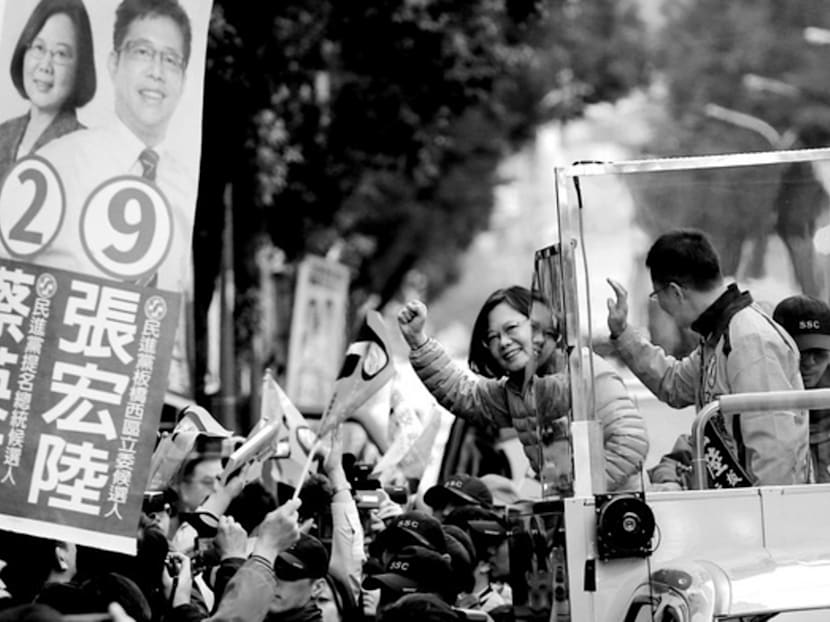
Beijing’s mistrust of the DPP’s Tsai Ing-wen stems from the fact that her vision for Taiwan does not match China’s expectations for future reunification. Photo: Reuters
The campaign for Taiwan’s presidential election on Saturday is one of the most surprising in the island’s political history.
In past presidential elections, candidates mainly campaigned on divisive ideological issues such as Taiwanese self-identification and whether Taiwan should become independent or unify with mainland China. Yet, this time, candidates have not framed their campaigns according to those traditional cleavages.
Instead, they are all trying to persuade voters that they can maintain — to use Democratic Progressive Party (DPP) presidential candidate Tsai Ing-wen’s phrasing — a “consistent, predictable and sustainable” relationship with China. The focus now is on policies to boost Taiwan’s economy, rather than the question of independence. This means that the ability to maintain cross-strait economic and trade relations is likely to be essential to Taiwan’s next president.
Economic voting theory predicts that voters will elect the ruling party when the economy is prosperous but vote for the opposition when the economy is in recession. In line with this theory, the key to winning the election seems to be to persuade voters that candidates are capable and experienced in handling economic issues.





From this perspective, the Kuomintang (KMT) losing this election is likely, if not inevitable. Current President Ma Ying-jeou won two elections in 2008 and 2012 because voters put faith in his economic performance. His manifesto claimed that in order to improve Taiwan’s economy, Taiwan must improve its relationship with mainland China.
But Mr Ma’s economic policies have failed over the past eight years and he has broken many campaign promises. Ordinary people in Taiwan have not seen significant economic benefits from improved cross-strait relations. The so-called “cross-strait peace dividends” have not spilled over to the general public but have primarily benefited the upper-socio-economic class.
The general public has consequently become increasingly sceptical about the value of deeper integration with mainland China. Debates over integration have become dominated by concerns about Taiwan’s national security, with little attention given to the potential boost greater economic ties could give Taiwan’s troubled economy.
These accumulated concerns were reflected in the Sunflower Movement in March 2014, which saw students occupy Taiwan’s legislative assembly to protest, among other things, the KMT’s handling of a new trade deal with China.
Polls suggest that disappointed economic voters are likely to replace the KMT with the opposition DPP. The DPP is considered a driving force of Taiwanese independence.
The biggest challenge for a DPP government in the future would therefore be to gain Beijing’s trust — without it, instability associated with poor cross-strait relations may lead to an economic downturn.
QUESTION OF CHINA
Beijing’s mistrust of the DPP’s Dr Tsai stems from the fact that her vision for Taiwan does not match China’s expectations for future reunification.
Dr Tsai participated in creating the “two state” theory in the Lee Teng-hui era. She also publicly rejected both the “one China” principle and the so-called “1992 Consensus” in her last presidential campaign in 2012.
While Dr Tsai has pledged that she will maintain the status quo, she has failed to clearly define how she would do so. Nor did she explain how she would keep cross-strait relations peaceful and progressive while denying the 1992 Consensus. These factors fuel Chinese suspicion of her as a prospective president.
Chinese President Xi Jinping has explicitly warned that any major deviations from current Taiwanese policy towards mainland China may jeopardise peaceful relations.
Without the “magic compass that calms the sea”, Mr Xi stated that “the ship of peaceful development would meet with great waves and even suffer total loss”.
He claims that if common ground, and particularly the 1992 Consensus, is rejected, any trust between the two sides will vanish and cross-strait relations will embark on a path to “disaster”.
Dr Tsai will need to develop an acceptable position for both Beijing and the United States regarding Taiwan–China policy. But she has not provided any clear answers. When questioned recently about her attitude towards the 1992 Consensus by the Taiwanese Industry Union, Dr Tsai only mentioned that “we will not challenge (the 1992 Consensus) aggressively” and will continue to pursue “peaceful, stable” cross-strait relations.
Post-election, the institutional mechanisms across the Strait could remain the same, but the frequency of political exchange between the two sides may decrease should Dr Tsai and the DPP win and form the government. China does seem eager to maintain relations as they are.
China has paid heavy attention to maintaining the main institutional mechanism for cross-strait communication, with the head of China’s Association for Relations Across the Taiwan Straits, Mr Chen Deming, paying an official visit to Taiwan 40 days ahead of the election.
Regardless of the outcome of the election, the institutional platforms between the two governments as well as non-governmental exchange across the Strait are likely to continue.
Yet, given the uncertainty that would accompany a likely DPP victory, Taiwan must be prepared in case diplomatic tensions lead to a decrease in cross-strait economic activity. One key way all local governments can prepare for a potential downturn is by rethinking their existing tourism policies.
For example, re-orientating tourism policies to target individual Chinese tourists, who are less influenced by Chinese official tourism policy than groups, could allow local governments to keep their current tourism advantage, even if the economic exchange across the Strait slows down.
Amid all the talk about cross-Strait policy the DPP would do well to remember that Taiwan’s economic fortunes are still closely tied to mainland China — and its economic woes are a key reason behind the declining popularity of the KMT. EAST ASIA FORUM
ABOUT THE AUTHOR:
Jean Yu-Chen Tseng is a Postdoctoral Fellow at the Department of Public Policy and Management at I-Shou University, Kaohsiung.