Focus on academic excellence should go hand-in-hand with character development
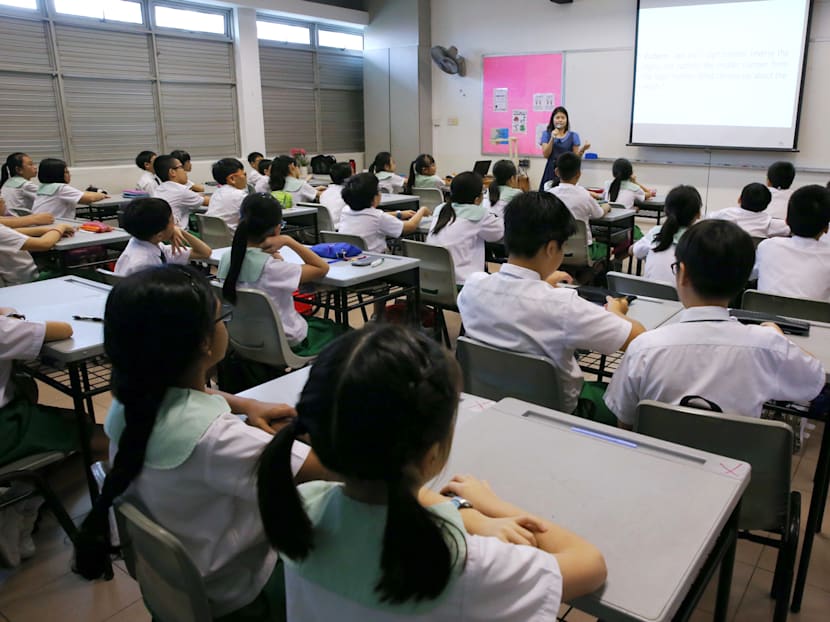
A Mathematics class with students from Woodgrove Primary School.
I followed TODAY's reports on the Primary School Leaving Examination (PSLE) with interest and would like to share my views pertaining to the reports, "Meritocracy right approach, but could become 'dirty' word: Education Minister Ong" and "MOE 'cautious' on issue of smaller class sizes: Ong Ye Kung" (July 11).
Speaking as a parent, I would say the struggle to ensure our children's academic success in Singapore is real. Now, the push is for higher-performance and high-potential students to excel above their previous achievements when heading towards the PSLE.
It is not about raising the baseline for all students in general, but pushing stronger students to be high achievers.
It can be suffocating in the last two years of the students' primary school education, and I can see the stress built-up in children, parents, teachers and schools.





Meritocracy has brought Singapore far in our achievements, but keeping up with these achievements is not easy when children are not resilient enough to take failures well. I have seen some bright students who condemned themselves as losers when they did not exceed their targets for academic results.
Such a grades-driven system exists because, typically, grades are all that employers have to assess a potential employee's abilities. They will usually not hire a fresh school-leaver without any robust indication of his or her skills. They, especially those in the public sector, depend on academic results and place lesser emphasis on the candidate's character and resilience.
It takes time to see how a person reacts to challenges, and I understand parents' fear that PSLE is one-dimensional.
It would benefit our society overall if secondary schools take into consideration the students' personal development, on top of their PSLE results and their track record in Co-Curricular Activities. The same applies to employers and organisations offering scholarships, as the individuals' potential is not limited to paper qualifications alone but how far this person can go, given the appropriate guidance and support.
Rather than focusing on how much parents and families can improve our children's academic performance quickly, how about focusing more on their character development?
This may relieve the pressure that students face when they have to attend enrichment classes or tuition.
While the PSLE is not ideal, I cannot find another assessment approach that would materially address the needs of our population at large. In comparison with other Asian education systems, I see that our Government has dedicated resources to support needy students, and this is commendable.
There are indeed smaller class sizes in our mainstream schools, for students with lesser academic abilities. I also realise that some of these classes have a higher team spirit compared with the better-performing classes. Perhaps the students are more empathetic of their peers and do not regard the PSLE as a form of "Hunger Games", where someone clinching a spot in a secondary school of choice means that someone else has to be sacrificed - a chilling analogy that my Primary 6 child used.
It is good that we have an ongoing debate on how to improve Singapore's education system.
It is more critical that we take personal ownership to change our ways today, because it will take at least two generations to shift deeply rooted perceptions.