Freedom from fear in the City of Light
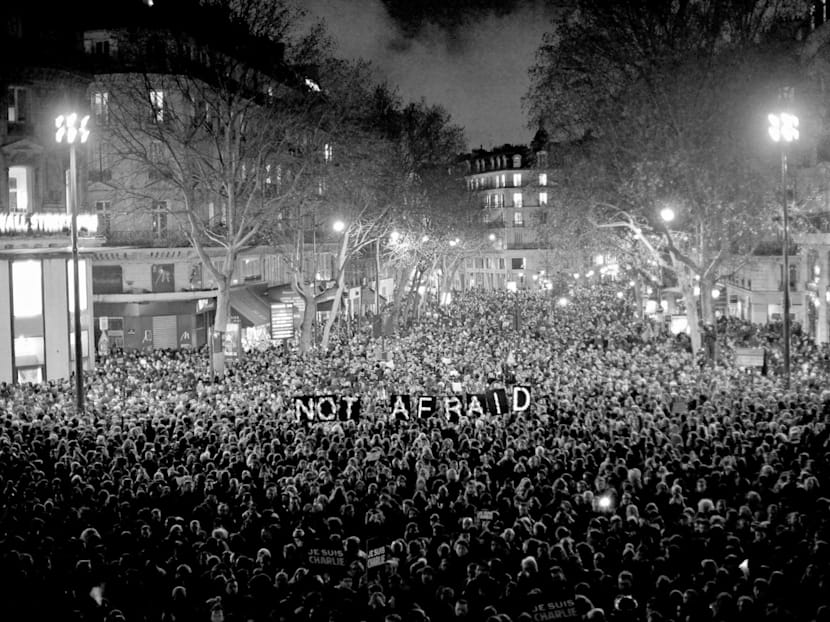
People paying respects to the victims of a terror attack against satirical newspaper Charlie Hebdo in Paris on Jan 7. Still reeling from the incident, the ramifications of the latest Paris attacks in November remain to be fully worked through. Photo: AP
I was in Paris last week, arriving a month to the day of the coordinated Paris terrorist attacks that killed 130 people. With my fellow researchers from France and Singapore, we were there as part of our research project on a comparative study of secularism in Singapore and France in the context of the integration of Muslims in both countries.
To anyone who has visited Paris, it is easy to understand why the City of Light was a well-chosen soft target for the terrorists on Nov 13.
Hugely symbolic for its way of life, Paris is a charming, chic, diverse, and iconic metropolis, the birthplace of the European Enlightenment and the 1789 Declaration of the Rights of Man and of the Citizen, an early and influential charter of human liberties, which also inspired the French Revolution. Today, France is under a state of emergency; Paris, the epicentre of the struggle between freedom and fear. The presence of soldiers at various locations along the Seine, at places of worship such as the Grand Mosque and Notre Dame Cathedral, and in the narrow Parisian sidewalks, remind Parisians and visitors alike of the aftermath of the terrorist attacks that has left France grappling with trying to make sense of the nihilistic hatred unleashed and what the ruthless killings mean.
French President Francois Hollande had declared the terrorist attacks as “an act of war” and ordered reprisal air strikes in Syria. He sought sweeping new powers, including a state of emergency for three months, and for the French state to be empowered to strip French citizenship from its nationals involved in terrorism.





But the necessary tension between security and freedom has taken on greater intensity in a land that made the rallying cry of “liberte, egalite, fraternite” famous and inspiring.
In fighting terrorism, it is absolutely essential that the operational imperative of order and security be balanced against the critical need to ensure that the values a society holds dear are not compromised or undermined. France is no different in this regard. Still reeling from the Charlie Hebdo attacks in January, the ramifications of the latest Paris attacks remain to be fully worked through.
But it is clear that France, which is home to Europe’s largest Muslim community, cannot harbour the near expectation that French Muslims, many of whom trace family origins to the Maghreb (encompassing former French colonies Algeria, Morocco and Tunisia in northern Africa), collectively apologise for the violence.
To expect the majority of Muslims to take responsibility for the acts of a few is unfair and would fundamentally undermine social cohesion and succumb to fear, precisely what the terrorists want. Any clampdown on French Muslims will provide propaganda fodder to Daesh (or IS) that Europe has no room for Muslims and that Europe is at war with Islam.
TOSSED, BUT NOT SUNK
Marine Le Pen, leader of far-right Front National (FN) had said after the Paris attacks that “Islamist fundamentalism must be annihilated, France must ban Islamist organisations, close radical mosques and expel foreigners who preach hatred in our country, as well as illegal migrants who have nothing to do here”.
But French voters, in the Dec 13 regional elections, denied FN in its bid to win in any of the country’s 13 regions. It had hoped to clinch at least three regions. A week earlier, in the first round of voting, FN made significant gains. It came out top in six regions and garnered some six million votes, the largest share of the national ballot. In the second round of voting, however, a more-than-50 per cent voter turnout — higher than expected — and tactical voting by Socialist sympathisers ensured that FN’s xenophobia did not gain ground.
After the second round of voting results, French premier Manuel Valls, who had warned of future “civil war” should the FN take power, said: “Tonight there is no relief, no triumphalism. The extreme-right threat has not been averted. I have not forgotten the first-round results.”
Clearly, France is not out of the woods yet even as she fared relatively well in the first major electoral test of unity after the attacks.
At critical junctures in a nation’s rise from tragedy, leadership at all levels of society matters greatly.
The choices France makes at this critical juncture will significantly impact how the French manage the collective-action challenge in the years ahead.
The French often speak self-deprecatingly of a crise des elites, a polite way of saying that their leaders are no longer considered relevant or representative or creative in their thinking.
The choices France, her leaders and people make at this transformational point will also determine the integrity of the French nation-state, which has long emphasised the overarching French national identity above sectarian ones, regardless of one’s origins.
The violence that terrorism unleashes has a far more ambitious aim beyond causing mayhem. Terrorism seeks to sow discord, engender a persistent debilitating divide on a society along racial and religious lines. To do so, it endeavours to recruit its strongest possible ally — ourselves.
Fundamentally, what is at stake is the inclusiveness of the French national identity, heritage and values — its figurative soul. In his memoirs, Ernest Hemingway, the great American novelist who lived in Paris as a struggling young writer in the 1920s, had described Paris as “a moveable feast”.
But the Parisian “joie de vivre” (joy of living) is deeply shattered. Whether this is temporary or more long-drawn remains to be seen.
Thus far, the determination of Parisians to continue with life and be resilient and inclusive in the wake of fear, anxiety, anger and uncertainty has been pivotal. All this is much in keeping with the Parisian Latin motto of “fluctuat nec mergitur” (“tossed but not sunk”). We, too, would want to share in that gallant spirit as part of our common humanity.
ABOUT THE AUTHOR:
Eugene KB Tan is associate professor of law at the School of Law, Singapore Management University. The research project is supported by the Université Sorbonne Paris Cité and National University of Singapore Alliance.