

Gen Y Speaks: The countries we thought we knew
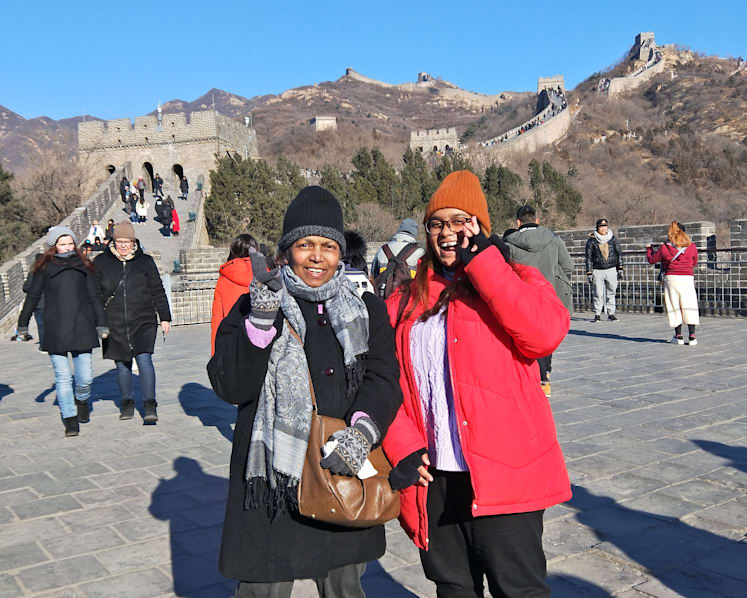
The writer, seen here on the right at the Great Wall of China with her mother on Dec 30 2018, says that being open-minded and looking beyond stereotypes allowed her to truly experience China.


When I told my friends I was going to China for a holiday last year, they warned me that as a Singaporean Indian who cannot speak Mandarin, I might be treated with disrespect or yelled at by locals whenever communication broke down.
The travel reviews I read on websites such as Tripadvisor were also concerning.
Western travellers warned about being “scammed by locals while shopping” because they did not understand Mandarin.
These led me to think that I too would be at the receiving end of some nasty experiences in China.





I was wrong. During my trip, I actually experienced many acts of kindness.
This made me realise that some countries are misunderstood because people form perceptions on them based on what they hear and read, without recognising that these perceptions might be outdated.
READ ALSO:
Travelling solo? You may want to think again
Gen Y Speaks: Travelling solo? You may just want to do it again
Nothing beats experiencing a country for oneself.
When I was in Chengdu, the capital of China’s Sichuan province, my mother and I could not find the correct bus stop to return to our hotel.
Google Maps showed that we were standing at the right bus stop.
But when the bus arrived, I showed the driver our destination and he shook his head. He tried explaining to me in Mandarin.
Seeing that we were confused, he gestured us up the bus and drove us to a bus terminal, without charge.
He directed us to his colleague, who would be driving past our hotel along his route. He was kind enough to insist that we ride for free, but we paid the fare when we alighted.
We encountered a similar situation in Beijing, where a middle-aged couple went out of their way to walk us to our hotel.
In a separate incident, I was on a sleeper train to Harbin and a group of four boys offered to swap one of their allocated bunk beds with mine, so that my mom and I could sleep closer to each other.
READ ALSO:
Book flights on Sunday, hotels on Friday to save money: Report
Colombia is another country that may often be misunderstood. Its second largest city, Medellin, which was dubbed as "the most dangerous city on Earth" by the Time Magazine in 1993, was where Pablo Escobar, history’s most powerful drug trafficker, ran his notorious drug cartel.
From 1990 to 1993, there were more 6,000 murders annually.
Following his death in 1993, the government worked towards curbing the cultivation of coca and banning people from carrying marijuana and cocaine in public.
Today, according to travel guide book The Lonely Planet, Medellin is one of the safest cities in Latin America, thanks to its public transport system, the MetroCable. This is an elevated metro system with a bird’s eye view of the city.
In 2004, the city’s mayors reduced the crime and violence rate by more than 80 per cent, by connecting the poorest and most violent neighbourhoods with the city centre using the metro system.
The residents could find more reputable jobs in places further away instead of succumbing to dealing with drugs as they used to.
The metro instilled confidence in the residents that change was possible.
Travellers who have been to Medellin now describes the place as “beautiful and safe unlike how it is portrayed in the news”, and lauds it for “combating crimes such as kidnapping”.
The Medellin example of a violent turned peaceful city shows how we should not hold a country’s notorious history against it without finding out how it has developed.
Closer to home, Japan is known for its resistance towards immigration.
On GajinPot Blog, a travel blog specifically catered to foreigners going to Japan, many described it as a “strict, conservative country that is difficult to live in”.
Japan was listed as the least preferred Asian country that foreigners wanted to work in, according to Bloomberg in 2017.
Reasons cited include the lack of English-language schools for children and a workplace culture steeped in tradition and inflexibility.
Nevertheless, Japan has opened up more to foreigners in recent years.
In 2018, the country introduced a bill to allow foreign workers with specialised skills to live and work in it for up to five years.
Expats on GaijinPot Blog shared that Japan is one of those places where “one’s race and skin colour do not determine how people perceive you”, a far cry from the perception that the country is xenophobic and culturally closed off.
We should not blindly believe what we hear about countries before researching about them for ourselves.
As much as the history of countries can give us a profound understanding of them, we should be open to forming new perspectives as new policies are put in place and mindsets change.
From the decades past, we have seen how Colombia and Japan have more to offer as destinations to travel, live and work, and I learned that firsthand from my experience in China.
Being open-minded and looking beyond stereotypes will allow us to experience the history and culture of more countries around the world.
ABOUT THE AUTHOR:
Natasha Ganesan is a second-year student at Wee Kim Wee School of Communication and Information at Nanyang Technological University. This is adapted from a piece which first appeared in Nanyang Chronicle, the university newspaper.




