Global economy still in good shape, but beware the tail risks
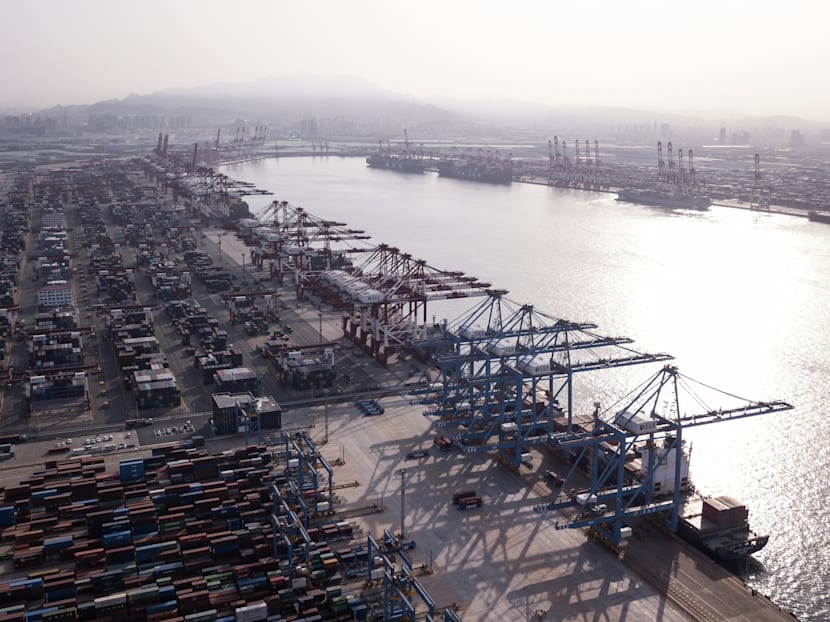
Cargo ships are moored under cranes as shipping containers stand at the Qingdao Qianwan Container Terminal. Mr Menon says if tariffs are applied to a much broader range of goods, trade flows would be severely impaired and the impact on growth would be greater.
While global economy will likely grow healthily this year, the growth cycle could have peaked and risks have jumped significantly in the last half a year, said Monetary Authority of Singapore (MAS) managing director Ravi Menon in a speech at the central bank’s annual report media briefing on Wednesday (July 4). Below is an excerpt of his speech, in which he also explained why Asian economies are well placed in deal with financial shocks.
Let me begin with three broad statements about the global economy. One, the current expansion in the global economy is likely to be sustained this year.
Two, the global growth cycle has matured and is probably past its peak. Three, tail risks to growth have grown significantly over the last six months.





The current expansion in the global economy is likely to be sustained through this year.
Last year, global GDP growth was at its strongest since 2011, at 3.8 per cent.
This momentum has carried into this year and is expected to persist.
The strength of the global economy is anchored on three mutually reinforcing upturns – in manufacturing, in trade, and in investment.
Global manufacturing is still expanding.
Industrial production rose by 3.4 per cent in 2017 and leading indicators like new orders for capital goods remain healthy.
World trade has kept pace with GDP growth.
Emerging Asia in particular is experiencing healthy expansion in trade, on the back of stronger demand in the G3 (United States, Japan and European Union) economies.
Investment growth has picked up.
Business capital expenditure in the G3 and Asia increased by 3.6 per cent in 2017.
Capex spending in the US is expected to be sustained, on the back of corporate tax cuts, deregulation, and positive business sentiment.
The global economy is also being supported by accommodative macroeconomic policies.
Monetary policy remains highly accommodative in the Eurozone and Japan.
Fiscal stimulus in the US will more than offset the gradual unwinding of monetary accommodation.
Across the major economies, labour markets are strengthening and wages are rising, underpinning consumer demand.
The global growth cycle has matured and is probably past its peak.
While growth remains healthy, it has ceased to accelerate, particularly in the Eurozone and Japan.
In the Eurozone, the initial spurt in domestic spending last year has stepped down to a more sustainable pace.
In Japan, the fiscal boost is over.
The US economy, albeit still growing strongly, is already at full employment.
At least part of the fiscal stimulus is likely to be dissipated through higher inflation.
In China, investment growth has slowed, with the shift in policy focus to addressing the country’s vulnerabilities, such as high levels of indebtedness and excess capacity.
From a sectoral perspective, the global tech cycle has moved into a consolidation stage, with inventory build-up fading.
The Global Manufacturing PMI has eased in recent months to 53.1 in May, although it remains in the expansionary zone.
Tail risks to global growth have grown significantly over the last six months.
Earlier this year, I described the “Goldilocks” state of the global economy—healthy growth, low inflation, and easy financial conditions.
I had then also warned that the “three bears”—inflation, protectionism, and financial instability—could make an appearance any time to spoil the party.
Six months later, we can say that at least two of the three bears have been sighted—inflation and protectionism.
First, the risk of more rapid inflation has heightened.
Inflation is on an upward path globally, and in the US has reached the Fed’s 2 per cent target amidst a tightening labour market.
Accordingly, last month, the Fed indicated a faster pace of monetary policy normalisation.
The expectation now is for two more rate hikes this year.
But if inflation surprises on the upside, the Fed could be compelled to hike more.
This would tighten global financial conditions by more than currently anticipated.
Tighter global financial conditions could trigger market volatility and dampen corporate spending.
As interest rates rise, some firms could face debt-servicing problems, especially in emerging market economies with relatively high levels of leverage.
And besides the risk of faster rate hikes, two things are happening that threaten to tighten global financial conditions even more:
First, the unwinding of the Fed’s balance sheet which withdraws US dollar liquidity from global markets; and second, the increased issuance of US Treasury bills to fund fiscal expansion, which accentuates tightness in US dollar funding.
We are already seeing some capital outflows from emerging market economies, alongside some tightness in US dollar liquidity and funding markets.
This is to be expected. But if the withdrawal of US dollar liquidity becomes more acute, some emerging market economies could face serious bouts of financial volatility.
But Asian economies are in a relatively stronger position to absorb these financial shocks.
Economic fundamentals in Emerging Asian economies are stronger since the taper tantrum in 2013.
Foreign reserves and bank capital buffers are larger while financial regulatory frameworks are more robust.
And policymakers in Asia are more prepared to make macro-policy adjustments as needed, including pre-emptive interest rate hikes to support exchange rate stability.
The second risk to the global economy is rising protectionism.
Protectionism is rearing its ugly head on three trade fronts: US-China; US-EU; and US-Mexico-Canada.
Thus far, the US has imposed tariffs on solar panels, washing machines, steel and aluminum imports from all major trading partners.
It has announced tariffs of 25 per cent on US$50 billion of imports from China, and has threatened tariffs of 10 per cent on another US$200 billion of imports from China.
Both China and Europe have announced retaliatory tariffs.
The immediate effect of these trade restrictions is limited and does not threaten global growth … yet.
The announced tariffs are estimated to shave around 0.1 per cent point off China’s growth, with the US economy similarly impacted by China’s retaliatory measures.
The real risks from the tariffs are spillover effects, escalation, and economic uncertainty—all of which could severely undermine global growth.
First, spillover effects.
The impact of the tariffs will be felt not only in the countries involved but across the value chains that span several countries.
Second, escalation.
If tariffs are applied to a much broader range of goods, trade flows would be severely impaired and the impact on growth would be greater.
Third, uncertainty.
The threat of further escalation is beginning to dampen business confidence and unsettle financial markets.
If businesses around the world take a wait-and-see approach, the global recovery in investment could be curtailed.
The world has clearly moved from trade tension to trade conflict.
If this escalates into a trade war, all three engines of global growth—manufacturing, trade, and investment—will stall.
Bottomline: the global economy is still in good shape but the momentum has started to flag and tail risks have grown.
So while global growth should be good this year, it may not be quite as good as last year.