Goodbye Malaysian cronyism, hello Anwarnomics
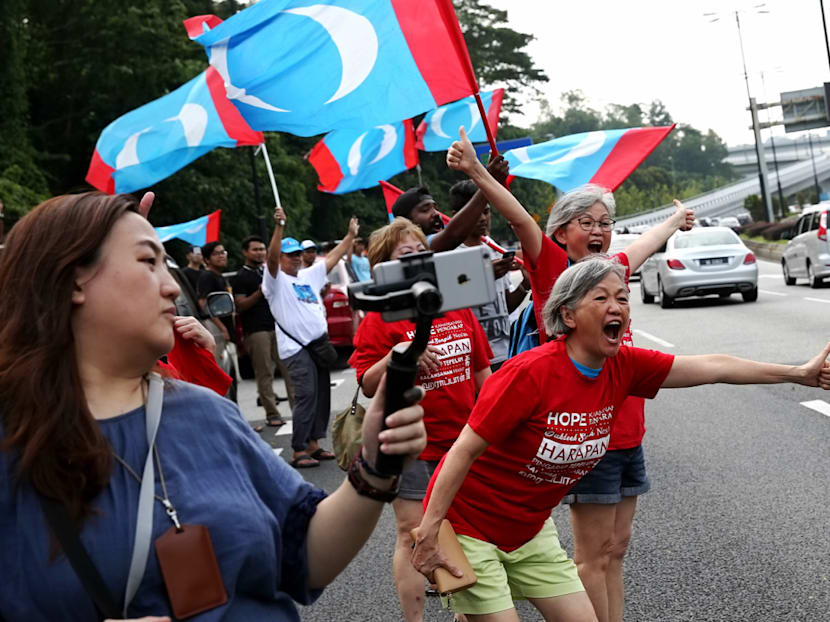
Pakatan Harapan supporters celebrating on the streets after unseating Prime Minister Najib Razak, and handing his Barisan Nasional coalition its first loss of power in six decades.
Only 24 hours ago I was lamenting the Malaysian political system’s incapability to self-correct after a plunder as brazen as the alleged US$4.5 billion (S$6.03 billion) looting of 1MDB, a state investment firm. The voters proved me wrong.
By unseating Prime Minister Najib Razak, and handing his Barisan Nasional coalition its first loss of power in six decades, Malaysians have sent a clear and optimistic message: Corruption matters.
But what now? Tun Dr Mahathir Mohamad, the 92-year-old former leader who staged the upset, was undoubtedly the vehicle for channeling anger against Mr Najib, his protege-turned-foe. However, he can’t be an instrument to address the disquiet.
For one thing, Tun Dr Mahathir played a large role in creating Malaysia’s patronage-based economy, sustained by oil riches. The country’s human resources chafed under state-sponsored racial discrimination. It was ostensibly aimed at improving the lot of underprivileged Malays.





But in reality, the sons-of-the-soil, or Bumiputera, policies only fattened rent-seekers while prompting a young, educated and disillusioned Chinese minority to leave the country in droves.
Mr Abdullah Badawi, who became prime minister after Tun Dr Mahathir retired in 2003, wasn't wrong when he said Malaysia’s ratio of civil contractors to population was perhaps the highest in the world.
BN was a gravy train; its ubiquity of attached vested interests made it difficult to derail. Mr Najib managed to crash the locomotive because the 1MDB scandal went a little too far too fast. Can a 92-year-old break and remake a system he helped create? I doubt it.
Besides, that’s not even Tun Dr Mahathir’s mandate. The politician who has been trying to fashion an alternative vision of a free and competitive Malaysian economy and a harmonious, multiracial society is Mr Anwar Ibrahim.
The 70-year-old couldn't pull it off from inside a prison cell, where he is serving a second sentence for sodomy. So he cut a deal with Tun Dr Mahathir, who had jailed him the first time. The victorious Pakatan Harapan, or Alliance of Hope, coalition is Mr Anwar’s child – a successor to a previous grouping that imploded once the ethnic Chinese and pro-Islamic parties fell out over imposition of Sharia law.
Once Tun Dr Mahathir obtains for him a promised royal pardon – and after he gets himself elected as a lawmaker – Mr Anwar will be able to become prime minister.
Who is Mr Anwar, and what is Anwarnomics? As a deputy prime minister under Tun Dr Mahathir during the Asian crisis, Mr Anwar came very close to dismantling the Malaysian version of crony capitalism when he decided to implement an austerity program, suspend big-bulge infrastructure investment and force big businessmen to take care of their own debt.
But Tun Dr Mahathir, having seen long-time Indonesian strongman Mr Suharto swept aside by the popular “reformasi” movement, fired Mr Anwar and imposed capital controls. Mr Anwar has since talked a pro-Western game, though his legal troubles and Barisan’s ability to somehow cling to federal power meant he never had a chance to do a big reset.
Anwarnomics promises to do away with state-backed racism. It promises to be inclusive, rules-based and competition-oriented with a large, well-funded social safety net. Well, I may have just described today’s Singapore, but that’s where Mr Anwar wants to take Malaysia.
How sincere he is, and how much of a free hand he will get in a coalition setup are the big questions. A shaken-but-not-smashed Barisan will be waiting for an early opportunity to reclaim power.
With Tun Dr Mahathir keeping the top job for two years and looking over his shoulder subsequently, the quality of Mr Anwar’s stewardship will have a larger significance than the stuff bothering credit-rating agencies on the morning after the election.
Moody’s Investors Service analyst Anushka Shah is right when she says that scrapping the three-year-old goods and services tax and resuming wasteful fuel subsidies – without offsetting policies – could be negative for Malaysia’s A3 sovereign rating.
However, those promises were made to win the election. Cost-of-living concerns are an easier sell to voters living on rubber and palm plantations than arcane details of 1MDB. Some of the fund’s money went into a yacht, luxury homes, expensive artwork, and even financing of the movie “The Wolf of Wall Street,” according to a US Department of Justice investigation.
As for the US$681 million that popped up in Najib’s bank account, he has insisted it was a political donation from Saudi royals that was mostly returned.
The time to worry about Malaysia’s credit rating may come. Thursday’s big news, though, is the end of kleptocracy. It should assure investors that the political framework is capable of self-correction.
Malaysia boleh – or Malaysia can do it – is the battle cry whenever the national team scores in a football game. Well, the people have certainly done it. With leadership, the country will, too. BLOOMBERG
ABOUT THE AUTHOR:
Andy Mukherjee is a Bloomberg Gadfly columnist covering industrial companies and financial services. He previously was a columnist for Reuters Breakingviews. He has also worked for the Straits Times, ET NOW and Bloomberg News.