

Hard truths for S’pore’s service culture
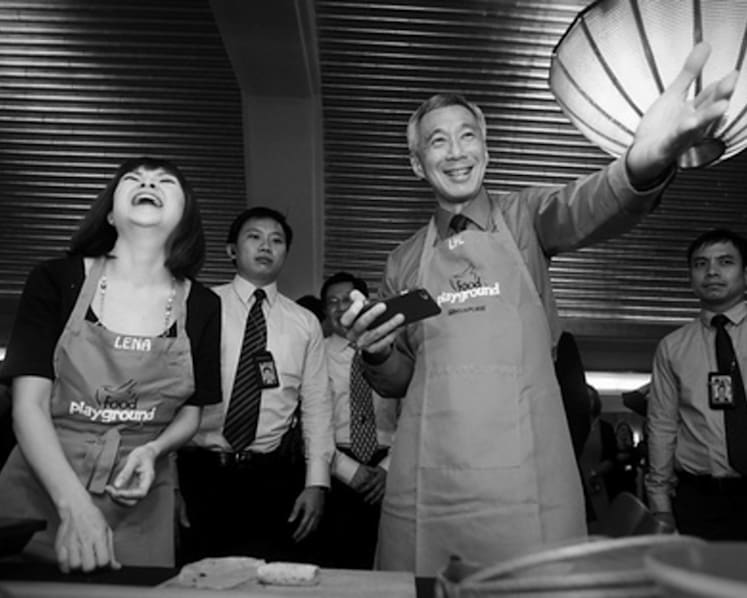
PM Lee Hsien Loong gestures after making kueh dardar crepes at the Food Playground booth at the Singapore Service Excellence Medallion Awards Ceremony on May 18, 2015. Photo: Jason Quah
At the Singapore Service Excellence Medallion Award ceremony on Monday last week, Prime Minister Lee Hsien Loong said that Singapore has made progress building a service culture in the past 10 years, but the Republic has some way to go from where it should be.
“Ask any tourist, or even a Singaporean, which country has good service and I don’t think Singapore will come immediately to mind,” he said, adding that most people would cite the Philippines, Japan, South Korea and Hong Kong in Asia.
But some of these countries did not start off that way. Rather, they had made major national efforts to transform their service industry and succeeded, as Hong Kong did after the Asian Financial Crisis in 1997, he added.
This reminded me of comments made five years ago by Mr Amadeo Zarzosa, then the general manager of St Regis Hotel. He was full of praise for Singapore’s beauty but politely hinted at the absence of “a culture of service” here.





He compared Singapore with Hong Kong, which had not only shown visible improvement but also surpassed Singapore’s service standards.
What was sad was that Mr Zarzosa recalled how impressed he was by “the service excellence, the care, the warmth you received when you went into a hotel” when he first visited Singapore in 1978. Back then, Singapore’s service levels were much better than Hong Kong’s. Why is it that Hong Kong has managed to transform its service industry, but Singapore has lagged behind?
Mr Arthur Kiong, chief executive of Far East Hospitality, made an interesting observation last week when expressing dismay that service standards in Singapore have fallen sharply. He asked: “Is it that we don’t get it, or are business owners not really convinced that service is related to keeping customers and (to) profitability? The disproportionate response to this major issue from business owners is shocking. Many are so financially driven that they refuse to look at the larger picture.”
He added that fresh graduates shun the hospitality and service industry, as they think the work is beneath them. This echoed the story a few years ago of a school principal here who rejected industrial attachments for her students, saying she believed they were destined for a higher calling. It seems that such prejudices continue to hold sway today.
Clearly, there are some hard truths that we must accept in order to transform the service culture in Singapore.
The honesty in accepting that service levels are not good enough marks the first step towards building a strong service culture. With it must come the commitment to improve and the belief that it is not an impossible task. There is a difference between understanding what goes wrong so we can correct our mistakes, and finding excuses for our shortcomings. Too often, service staff turn defensive when they are found wanting in customer service, even putting the blame on rising expectations of customers today, who are more sophisticated, demanding and outspoken.
To be sure, as Mr Lee pointed out, Singaporeans must strive to be good customers. It is a reciprocal relationship between service personnel and customer. Courtesy begets courtesy. Pleasant and helpful service personnel can be disarming, and respectful customers usually receive excellent service.
We must also dispel the myth that the propensity to provide good customer service is cultural, a gift that comes naturally to Indonesians, Filipinos, Thais and Japanese. Singaporeans, it has even been suggested, are not naturally inclined to smile.
But we can, if you recall the Four Million Smiles campaign launched in July 2006 when Singapore hosted the International Monetary Fund and World Bank meetings. Hong Kong debunks the cultural-bias myth completely, rising from being one of the worst to one of the best.
What was remarkable about Hong Kong’s turnaround was the concerted effort among major companies in various sectors to promote service excellence so as to remain competitive in the region, as well as their readiness to invest in enhancing customer experience.
A major mover is the Hong Kong Association for Customer Service Excellence, whose founding members include Cathay Pacific Airways, Hewlett-Packard, Hong Kong Jockey Club, Hongkong Post, Kowloon Motor Bus Co, Shell Hong Kong and Standard Chartered Bank. Besides offering opportunities to share experiences among members and conducting surveys and free seminars, the association acts as a catalyst of change and improvement, and advises and interfaces with the government on customer service issues. It is an ongoing effort involving both private and public sectors that, in the same way, Singapore will have to continually invigorate the national drive for service excellence.
Last but not least, the challenge of creating a service culture begins with the CEO. Too many firms make the mistake of thinking customer service is purely the responsibility of the staff on the shop floor. How many CEOs have personally experienced the service provided by the companies they are leading, to not only assess the competence of their staff, but also understand the problems faced by both staff and customers?
For a start, they could try calling their company’s customer service line.
ABOUT THE AUTHOR:
David Leo worked in the aviation industry, where his responsibilities included operations and customer service.




