

How to build the perfect power desk
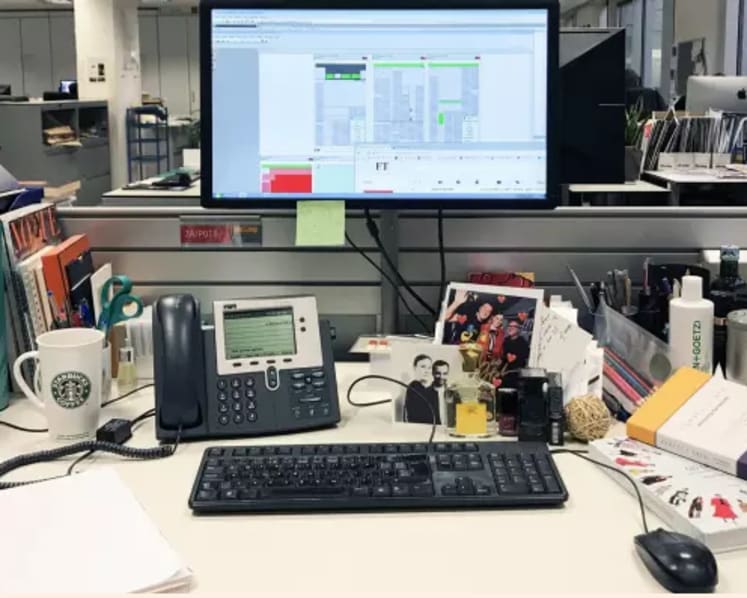
The steady spread of hot-desking in a pandemic that threatens to turn the personal, assigned desk into an ever rarer commodity. Photo: Financial Times
You know how it goes.
There you are, flipping through the pages of the office stationery catalogue wondering whether the administrative budget will stretch to a six-pack of Pilot V5 Hi-Tecpoint Rollerball (extra fine), when your mind is violently distracted by a strange and curious temptation towards the back of the book: the Habisphere Lifestyle Desktop Terrarium.
Never mind the feint-ruled yellow notebooks and lever-arch files. You require a more potent symbol to accessorise your office.
Something that reflects your appetite for the battle — your fearsomeness in the face of adversity, your quiet stealth.





What you need, is this very terrarium and a lethally poisonous arachnid to house within it . . . Or something like that.
One can only imagine the internal dialogue that persuaded the former British chief whip — now defence minister — Gavin Williamson to raise a tarantula while tending to the ministries of government.
Presumably he thought it would act as an appropriate and possibly humorous metaphor. Or at least keep people away. After all, few things say “I’m a colossal weirdo” like a colleague who keeps a pet spider named after the Greek god Cronos, the all-devouring King of the Titans, next to his computer mouse.
Mr Williamson’s decision to share his workspace with a creature poised to asphyxiate its enemies with a lethal venom might act as a handy shorthand for a don’t-mess-with-me attitude.
But his acquisition of such a bald accoutrement of power seems a bit Dr No in its ambition, far too flamboyant to be genuinely representative of real authority.
While possession of an office pet does usually signify an elevated status, there are subtler ways in which to signal one’s superiority.
To convey power with one’s desk space is a fine and nuanced art — especially in the modern office, where open-plan desk spaces are the norm, and the spectre of hot-desking is becoming a daily reality.
My desk, for example, may currently showcase a bottle of dog shampoo, petrifying ball of rubber bands, expired orchid plant and 25 plastic Pret A Manger spoons, but look behind the perfume bottles and you’ll see a tasty black and white postcard print of myself and the Louis Vuitton designer Nicolas Ghesquière, a customised thank-you note from Dolce & Gabbana and a card from Tom Ford. (Who sent the orchid.)
Communicating one’s impressiveness should be whittled down to a few talismanic details. Obviously, any self-respecting leader must first acquire an ergonomically designed lumbar-supporting chair. The chair should be larger and wider than anyone else’s, cost several thousand pounds, and be positioned in such a way that anyone else who sits in it will find it unbearably uncomfortable.
Desktop accessories, meanwhile, should be displayed as artlessly as possible. To make a lasting impact, one’s authority should be slowly insinuated rather than thrust in others’ faces.
Save the silver-plated snapshots of yourself negotiating world peace with the leaders of the free world for your bathroom, and litter the desk instead with cryptic souvenirs: A loveworn softball signed by a much admired statesman should roll aimlessly about the table top.
That note reminding you to return David Attenborough’s phone call should be casually tacked to the phone. A stack of handwritten notes from the leaders of your industry thanking you for your “kind words” and shared wisdoms should be collecting in a clearly visible yet insouciant pile. Obviously, a few copies of your latest book should be loitering about the place. Only a few, though. You mustn’t give the impression of having written a book that no one wants to buy.
You should also make sure to furnish yourself with a copy of whatever is currently stimulating an entirely different field of industry than your own — to demonstrate your breadth of interest and towering intellect.
Fleeting insights into your former glories should also be conspicuous. A yellowing press cutting detailing an early-life triumph, like your success as a rowing blue or world Sudoku champion, are all excellent materials for display.
Ideally this information should be accompanied by an image of you looking excruciatingly geeky. You may have achieved the highest placing in the world’s 400m hurdles championship, but you’re not vain.
Women, especially, will do much to convince others of their unassailable magnificence with a crude illustration or birthday message from a small dependent.
Screensavers of your family safari holiday to Botswana are unacceptable — too showy.
Ideally the note should be small and say something like “Mummy, you work an 80-hour week and we’re so proud of you”.
If this is not forthcoming, then you should at least be rendered in a superhero’s cape.
But the absolute masters and mistresses of the workplace are those who reveal much by revealing almost nothing at all.
By far the most impressive and influential colleague I worked with was also one of the most stubbornly inscrutable. As such, he acquired an intriguing mythology among us. Who was he really? Where did he go each night? Was he actually a foreign spy?
Tucked away in the corner of his desk he kept a blurry snapshot in a tiny frame.
One day, when he went on one of his daily wanders to who knows where, we snuck over for closer inspection only to discover it was a picture of him — wrestling a bear. Take that, incey wincey. THE FINANCIAL TIMES
ABOUT THE AUTHOR:
Jo Ellison is the Financial Times’ fashion editor.




